




Middle East Supply Risks Raise Oil Prices as Chinese Refinery Delays Tighten Fuel Supply


Middle East supply risks pushed Brent crude near $100 as China delayed 500,000 bpd of refining capacity, tightening fuel supply and supporting upstream energy.
- Brent crude rose $4.42, or 4.47%, to $97.15 per barrel on June 8 after Israeli strikes on Iran and renewed attacks in Lebanon renewed concerns over Middle East oil supplies, reversing the previous session's price decline.
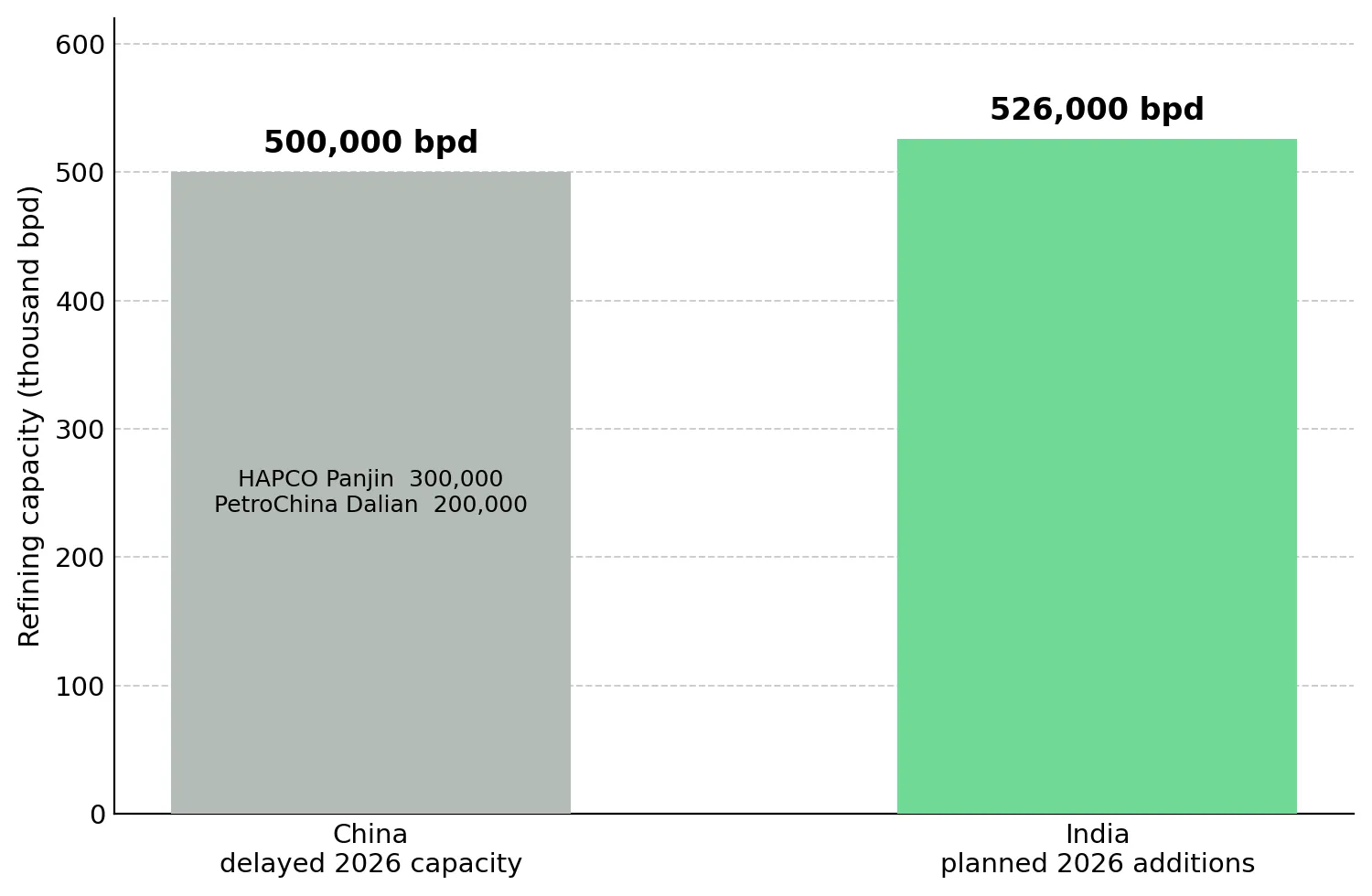
- Chinese refiners have delayed 500,000 bpd of planned refining capacity, including HAPCO's 300,000 bpd refinery project and PetroChina's 200,000 bpd Dalian refinery restart, reducing the pace of China's near-term refining capacity growth.
- China's refinery throughput fell to 13.3 million bpd in April, equivalent to 69% utilization and the lowest level since August 2022, signaling weaker refining activity and fuel demand.
- India is targeting the addition of 526,000 bpd of refining capacity in 2026 through projects led by Hindustan Petroleum Corp and Indian Oil Corp, increasing the country's refining capacity as Chinese refinery expansions slow.
- The case for higher oil prices weakens if delayed Chinese refining capacity enters service in Q3 and Brent crude falls below $95 per barrel, as additional refining capacity would increase fuel supply while lower crude prices would indicate weaker market support.
Chinese Refinery Delays Shift Focus From Oil Prices to Fuel Supply
Crude oil prices rose on June 8 after Israeli strikes on Iran and renewed attacks in Lebanon increased concerns over Middle East oil supplies. Brent crude climbed to $97.15 per barrel and US crude to $94.61 per barrel. Although oil prices have risen nearly 60% since late February, they remain below the March peak of about $120 per barrel.
The key question is how higher crude prices affect refining capacity growth. Rising feedstock costs and supply uncertainty have contributed to refinery project delays and lower utilization rates in China, shifting attention from oil prices to future refining capacity additions and fuel supply.
Higher Crude Costs Slow Chinese Refinery Expansion
China has already delayed two major refining projects, providing an early indication of how higher crude costs and market uncertainty are affecting capacity expansion plans. Huajin Aramco Petrochemical Co. delayed the startup of its 300,000 bpd Panjin refinery from mid-2026 to September or October, according to sources cited by Reuters on June 8. The project includes a 1.65 million tonne-per-year ethylene cracker and a 2 million tonne-per-year paraxylene unit. PetroChina also indefinitely postponed plans to restart a 200,000 bpd crude unit in Dalian. Together, the delays remove 500,000 bpd of planned refining capacity from China's near-term expansion pipeline.
Higher crude prices increase feedstock costs for refiners. Chinese refiners also face regulated fuel prices and weaker gasoline demand as electric vehicle adoption increases. Lower refining margins reduce the economic incentive to commission new facilities or restart idle units. Reuters reported that discounts on Russian crude, which previously lowered feedstock costs for Chinese refiners, have largely disappeared as global competition for barrels increased.
Refinery Startup Delays Extend Supply Constraints
The timing of refinery startups will determine when new product supply reaches the market. Consultancy Energy Aspects said HAPCO is targeting a startup in the latter part of the third quarter due to uncertainty over crude feedstock supplies. Even if geopolitical tensions ease, new refineries require commissioning, crude procurement, and logistics preparation before increasing fuel supply.
Refinery commissioning schedules at HAPCO, PetroChina, Hindustan Petroleum Corp, and Indian Oil Corp will determine when new refining capacity enters the market. These milestones may provide earlier indications of future fuel supply growth than short-term oil price movements. Reuters reported that Indian Oil Corp is targeting completion of refinery expansions at Barauni, Gujarat, and Panipat in August, November, and December, respectively.
Rising Feedstock Costs Reshape Energy Sector Returns
Higher oil prices benefit upstream producers because revenues typically rise faster than operating costs. Refiners face higher feedstock costs, although those with secure crude supply and flexible logistics are better positioned to protect margins.
Operational execution is becoming more important than short-term oil price forecasts. Hindustan Petroleum is targeting the startup of its Barmer refinery at 60% capacity this month, while feedstock access, logistics, and commissioning schedules will influence refining margins.
Shipping costs remain difficult to assess because proposed regional transit measures have not been finalized. While Iranian officials have discussed new shipping conditions, the impact on transport costs and trade flows remains uncertain, limiting the value of geopolitical forecasts relative to operational data.
The Data Points That Could Ease Supply Constraints
Delayed refinery projects and Brent crude near $95-$100 per barrel continue to support upstream producers by limiting fuel supply growth, while refiners face higher feedstock costs.
The key signal for changing market conditions is the startup of delayed refining capacity. If HAPCO's 300,000 bpd refinery and PetroChina's Dalian unit enter service, fuel supply could increase and reduce current supply constraints.
Refinery startups, Chinese throughput data, and Indian refinery expansion milestones in the second half of 2026 should be monitored, as these indicators will show whether Asia's refining capacity begins to recover.
Analyst's Notes





Subscribe to Our Channel




Stay Informed


