




Bravo Mining Outlines Phased Copper-Gold Strategy at Luanga, Sets 8,000m Drill Programme for Second Half of 2026


Bravo Mining details its phased 2026 copper-gold programme at Luanga, covering geophysical surveys and an 8,000m drill campaign planned for the second half of 2026.
- A Phase 1 copper-gold exploration programme for 2026 integrates geological mapping, geochemical sampling, geophysical surveys, and an initial 8,000m drill campaign at the Luanga property.
- Approximately 50 line-km of deep-Induced Polarisation (deep-IP) surveys are planned across multiple priority targets, designed to probe depths exceeding 300m below surface.
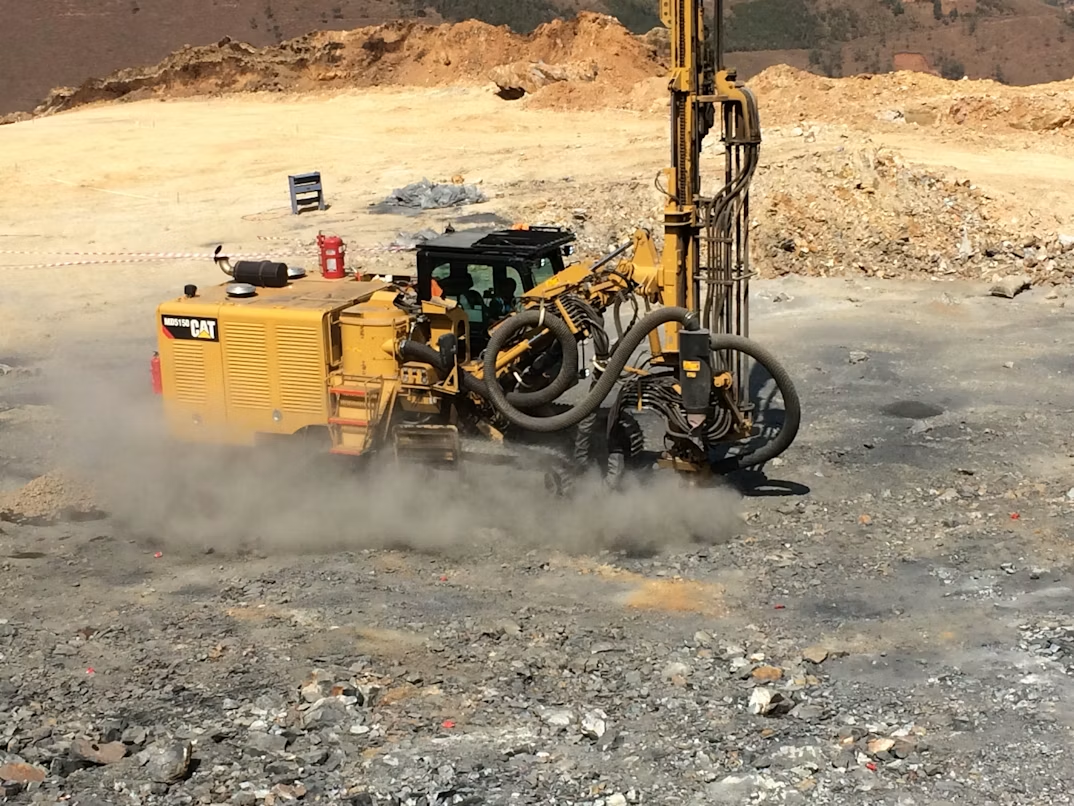
- An 8,000m drill programme is scheduled for the second half of 2026, targeting the highest-priority areas identified through earlier phases of work.
- Copper-gold targets at Luanga have been reclassified from IOCG to the closely related ISCG deposit type, based on a recent review of the geological characteristics of the property.
- A dedicated Copper-Gold Exploration Division has been established with its own team and budget, with a mandate that includes evaluating acquisition opportunities across the broader Carajás region.
Bravo Mining Corp. (TSX.V: BRVO | OTCQX: BRVMF) is a Canadian and Brazil-based mineral exploration and development company advancing its Luanga Project in the Carajás Mineral Province of Pará State, Brazil. The company's team of local and international geologists has a track record of PGM, nickel, and copper discoveries in the region, having previously taken a copper-gold project from initial discovery through to production in Carajás. The Luanga property is situated on accessible freehold farmland near operating mines, with road, rail, and hydroelectric power infrastructure nearby. Bravo describes itself as one of the most active explorers in the Carajás region.
2026 Copper-Gold Exploration Programme Development
Bravo has outlined a structured, phased approach to copper-gold exploration at its wholly owned Luanga property for 2026. The first stage centres on target refinement through detailed geological mapping and expanded geochemical sampling of soil and rock across the property. This work is intended to identify and prioritise the most prospective copper-gold targets before geophysical surveys and drilling commence.
Once the initial mapping and sampling are complete, the programme advances to geophysical surveys. The centrepiece is approximately 50 line-km of deep-Induced Polarisation (deep-IP) surveying, a technique that uses electrical currents to detect sulphide minerals at depth. Designed to reach beyond 300m below surface, the deep-IP coverage will also extend over portions of the existing Luanga PGM deposit to assess the potential for deeper mineralisation alongside the known platinum, palladium, gold, rhodium, and nickel zones.
Additional geophysical work, including Time-Domain Electromagnetic (TEM) surveys, will be carried out at targets where copper-gold mineralisation has already been confirmed, such as T5 and T16, to trace the extent of known high-grade zones along strike and at depth. An approximately 8,000m drill programme is then planned for the second half of 2026 to test the most prospective targets generated from this earlier work, with scope to extend the programme based on results.
ISCG/IOCG Deposit Classification and Geological Understanding
When Bravo first identified copper-gold targets at Luanga, they were interpreted as belonging to the Iron Oxide Copper-Gold (IOCG) deposit type, the most widely recognised style of copper-gold mineralisation in the Carajás Mineral Province. IOCG deposits are characterised by copper and gold hosted within rocks containing significant amounts of iron oxide minerals such as magnetite and haematite. A recent review of the geological characteristics of the Luanga tenement has led to a revised classification.
The targets are now classified as Iron Sulphide Copper-Gold (ISCG) deposits, a closely related deposit type within the broader Copper-Gold-Iron mineral system. In ISCG systems, the iron oxide minerals typical of IOCGs are absent and replaced by iron sulphides, mainly pyrrhotite and pyrite. The presence of abundant quartz, particularly in hydrothermal breccias (rock fragments cemented together by mineral-rich fluids) at T5 and T16, is consistent with this interpretation. ISCG and IOCG deposits share similar geochemistry, alteration patterns, and paragenetic sequences, and commonly occur within the same geological provinces.
A practical implication of the ISCG classification is that magnetic surveys, which are effective at detecting IOCG deposits due to their iron oxide content, have limited application here. This informed the decision to prioritise deep-IP as the principal geophysical tool for the 2026 campaign. The company has noted the Antas Norte deposit, located approximately 40 km southwest of Luanga and previously mined by Avanco Resources, as a notable ISCG analogue within the Carajás Mineral Province.
Copper-Gold Division Strategy and Growth Opportunities
Bravo has established a dedicated Copper-Gold Exploration Division, led by newly appointed Head Fabio Masotti, operating with its own budget and team. The division's mandate covers the advancement of copper-gold targets at Luanga as well as the evaluation of acquisition opportunities in the Carajás Mineral Province. Its formation runs alongside the company's ongoing PGM development activities, with both programmes advancing concurrently.
Chairman and CEO Luis Azevedo commented:
"With Fabio Masotti joining to lead our Copper-Gold Exploration Division, we are taking a disciplined and structured approach to advancing the broader mineral potential of our Luanga property. The 2026 program is designed to progressively refine targets through detailed geological mapping and expanded geochemical sampling and then test priority areas through integrated geophysics and drilling, while also assessing the potential for additional discoveries and extensions of known mineralization. Together, these efforts position us to unlock further value at Luanga across what we increasingly view as a multi-commodity opportunity."
The division has begun reviewing selected acquisition opportunities in the region. The company notes that the Carajás Mineral Province presents opportunities for the development of copper-gold deposits that could support a dedicated mine development or a hub-and-spoke scenario inclusive of Luanga's copper areas.
Chairman and CEO Luis Azevedo added:
"Following the successful closing of our public offering and private placement, Bravo is now fully funded to advance both our core PGM+Au+Ni development plans and a comprehensive copper-gold exploration strategy in parallel. This positions us to systematically build a pipeline of copper-gold opportunities alongside our flagship project, including the evaluation of selective acquisition opportunities outside of Luanga, while maintaining a disciplined focus on capital allocation and long-term value creation."
Outlook
Near-term activities at Luanga include geological mapping, geochemical sampling, and deep-IP surveys across priority copper-gold targets. Drilling is expected to begin in the second half of 2026, with an initial 8,000m programme targeting the areas identified through earlier phases, and with scope to extend based on results. In parallel, infill drilling continues as part of ongoing work toward the completion of a Pre-Feasibility Study (PFS) on the Luanga PGM+Au+Ni deposit.
Analyst's Notes





Subscribe to Our Channel






Stay Informed


