




Vizsla Silver: Panuco Project Moves from Planning to Execution


Vizsla Silver's Panuco Project moves to execution with full funding, 20M oz/year production plan, and first silver targeted for H2 2027. Permits expected mid-2026.
- Vizsla Silver’s Panuco Project is transitioning from planning into execution, supported by a completed feasibility study and full project funding.
- The district-scale, 100%-owned project spans more than 40,000 hectares, giving Vizsla full operational control across a consolidated historic silver belt.
- A revised mine plan prioritizes higher-grade material, supporting approximately 20 million ounces per year over the first five years and strengthening early cash flow.
- Construction readiness is advanced, with infrastructure in place, contractors engaged, and an 18-month build timeline targeting first silver in H2 2027.
- The project is fully funded with over $450 million in cash and additional equity positions, with construction costs of $239 million largely supported by contracted pricing.
- Risk has been reduced through underground test mining, phased development, and disciplined environmental and community investment.
- Permitting remains the key near-term catalyst, with environmental approval expected in mid-2026, unlocking construction and the next phase of value creation.
Building Panuco
Vizsla Silver recently updated its Panuco Project in Sinaloa, Mexico. The project is district-scale and 100% owned, giving the company full control over decision-making. Modern exploration methods are being applied across a newly consolidated land package, which has grown fourfold since January 2024 to now cover more than 40,000 hectares.
Panuco is considered the world’s largest undeveloped high-grade primary silver resource and is steadily moving toward production. Work is underway to upgrade the existing resource into higher-confidence categories, helping to better define the contained ounces. Conversion drilling has been completed, and a test mine began in Q4 2024 to reduce risk and prepare for early production. The current goal is to produce the first silver in the second half of 2027.
The company is financially strong, with no debt and supported by in-the-money options and warrants. Backed by an experienced management team and board, Vizsla has shared clear plans showing readiness to execute while outlining project economics, giving confidence in the path forward.
Key Development: Strategy & Mine Design
Vizsla Silver confirmed that its feasibility study has been completed, closely building on the earlier preliminary assessment rather than changing direction. Management emphasized that the study did not “go backwards,” delivering what had been previously outlined, with production assumptions remaining conservative and grounded in drilling results converted into reserves.
Michael Konnert, President and CEO, stated:
“Just touching on the feasibility study highlights, we are developing this world-class asset. When in production, it'll be the largest single asset producer globally and the third largest in terms of assets in any company.”
The revised mine plan supports producing roughly 20 million ounces per year for the first five years, compared with around 20 million ounces for only the first two years in earlier plans. This shift prioritizes higher-grade material early in the mine life, which management notes significantly improves early cash flow and overall project economics.
“The cash flow that we see coming from this project at today's prices is worth of a billion dollars a year after tax, free cash flow in year one,” Konnert said.
The processing design remains consistent with earlier plans, using conventional crushing, milling, leaching, and wet tailings. Minor adjustments planned later in the mine life aim to improve flexibility and recovery, with test results indicating about a 1% boost in gold and silver recovery.
Construction Readiness & Financing
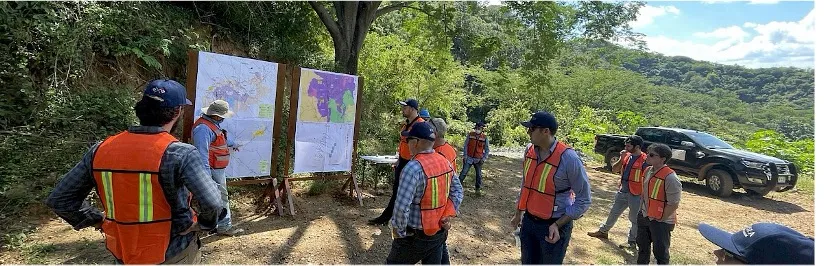
Initial production is expected after an estimated 18-month construction period. Strong progress has been made on site, with key infrastructure in place and contractors lined up, allowing construction to start immediately once the final permit is received.
“We're moving into the permitting for finalizing the permitting phase here. We expect permits to come sometime around the middle point of the year, Q2, Q3 of 2026, at which point we'll undertake about just under a year and a half of construction and achieve first silver by the end of 2027,” Konnert said.
The project is fully funded, with over $450 million USD in cash and an additional $40 million in equity positions. Total construction costs are estimated at $239 million USD, well within the available capital. A large portion of funding came from a $300 million USD convertible debenture, structured to limit shareholder dilution. Over 90% of construction costs are supported by real quotes and negotiated contracts, including mining services, and operating costs are estimated at $10.60 per ounce of silver equivalent, or roughly $85 per ton processed.
Broader Perspective: Economics, Expansion, & Environmental Considerations
Panuco did not start as a greenfield project. Years of prior work, including land consolidation, drilling, and expansion of known mineralized zones, grew the project footprint from about 7,000 hectares to over 40,000 hectares in a historic silver belt. Early exploration established high-grade zones such as Copala and Napoleon, forming the foundation for the current development plan.
Vizsla’s development strategy is strengthened by deliberate district consolidation. Recent acquisitions filled strategic gaps around high-value targets and unified multiple large-scale projects under a single operating framework, enabling modern exploration and mine planning across a historically productive silver district. This consolidation improves capital efficiency, reduces future expansion risk, and includes equity participation from local Mexican partners, aligning long-term development with regional and community interests.
“Important to note that each of these deals that we've done, whether it was Fresnillo or other vendors, each of those parties has taken shares in the company, and now we have this Mexican support. All those companies were Mexican-owned, local support as our shareholders. That's really aligned with the communities here. So, we're very proud of that,” said Konnert.
A key risk reduction measure has been the underground test mine, with more than 800 meters of development completed. This allows the company to study real ground conditions, test mining methods, and drill from underground, rather than relying solely on surface data. Early underground access helps confirm grades, geology, and mine design before full production begins.
The mine is designed to balance strong economics with responsible growth. Being 100% underground limits surface impact, while the mill sits on previously disturbed land. Water use is carefully managed, drawing mainly from underground sources and rainwater. Vizsla Silver has invested $8.6 million into community and environmental projects and has received recognition for its sustainability efforts, with support from the Mexican government.
The Investment Thesis for Vizsla Silver
- Clear transition from development to execution: The completion of a feasibility study that closely follows earlier plans, combined with full project funding, moves Panuco firmly out of the planning phase and into execution, with remaining risk largely concentrated in permitting.
- Near-term production with strong early cash flow profile: A revised mine plan prioritizes higher-grade material, supporting approximately 20 million ounces of annual production over the first five years and improving early cash flow as the project approaches first silver in H2 2027.
- Fully funded build with defined costs: With more than $450 million in cash, additional equity positions, and construction costs estimated at $239 million, Vizsla has the capital in place to build without relying on near-term dilution. Over 90% of costs are supported by negotiated contracts, reducing execution uncertainty.
- District-scale upside beyond the initial mining plan: Panuco sits within a consolidated, historically productive silver district, with underground development already underway and ongoing drilling offering potential reserve expansion. Additional projects, including Santa Fe, provide optionality beyond the first mine.
Taken together, Panuco represents a rare combination of scale, funding certainty, and execution readiness. As permitting advances toward mid-2026, investor focus shifts from technical validation to delivery milestones, with construction start, first production, and continued resource growth as the next key drivers of value.
TL;DR
Vizsla Silver’s Panuco Project is transitioning from planning into execution, with a completed feasibility study, robust economics, and full funding. Updated mine plans support steady production of roughly 20 million ounces per year, targeting first silver in late 2027. Early risk has been mitigated through drilling, underground test mining, and site preparation. With permits as the remaining hurdle, the focus is now on construction, delivery, and upside from continued exploration.
FAQ's (AI-Generated)
Vizsla Silver is targeting first silver production in the second half of 2027 (H2 2027). The company expects to receive environmental permits around mid-2026 (Q2-Q3), which will allow them to begin an approximately 18-month construction period. The development timeline positions Panuco to begin production within the next two years.
The project is fully funded with over $450 million in total financing capacity. This includes more than $450 million in cash, $40 million in equity positions, and was supported by a $300 million convertible debenture offering in November 2025. Total construction costs are estimated at $239 million, providing approximately 2x coverage. The financing structure reduces dilution risk and provides immediate access to capital rather than milestone-based tranches.
Panuco demonstrates industry-leading economics with all-in sustaining costs of $10.60-$10.61 per ounce of silver equivalent, positioning it in the lowest cost quartile globally. The feasibility study delivered an after-tax NPV of $1.8 billion (at 5% discount), 111% IRR, and a 7-month payback period. The project features high-grade mineralization averaging 416-534 grams per tonne silver equivalent and is expected to produce approximately 20 million ounces per year in the first five years, which would make it one of the world's largest primary silver producers.
The primary near-term risk is permitting, with environmental approval expected in mid-2026. Vizsla has reduced technical and operational risks through several measures: over 800 meters of underground test mining to validate geology and mining methods, phased development approach, over 90% of construction costs supported by contracted pricing, and strong community relationships including $8.6 million invested in local community and environmental projects. The company has also secured 30-year operating agreements with all five local Ejidos (communal landholders).]
Panuco's current mineral resource estimate includes 222.4 million ounces of silver equivalent in Measured and Indicated categories, plus an additional 138.7 million ounces in the Inferred category. Importantly, the project covers over 40,000 hectares spanning 86 kilometers of vein extent, but only approximately 9-30% of the known vein system has been tested to date. This provides significant exploration upside for resource expansion beyond the current mine plan, with recent acquisitions (including 2,378 hectares from Fresnillo plc) further consolidating the district-scale opportunity.
Analyst's Notes





Subscribe to Our Channel






Stay Informed






