




What Kabanga's First Quarter Numbers Reveal About the Cost of Getting to FID


Lifezone's Kabanga project has a funding runway to advance toward FID, but securing strategic, debt and government agreements remains critical.
- Total liquidity reached approximately $68 million as of April 29, 2026, supported by a $25.0 million registered direct offering and a further $16.7 million drawdown under the Taurus Mining Finance senior secured bridge loan facility.
- Parallel financing workstreams at Kabanga remained active but uncommitted at quarter-end: the Standard Chartered Bank-led strategic investment process reached the term sheet stage, the Societe Generale-led project finance process completed lender roadshows, and US Development Finance Corporation (DFC) due diligence was finalised, with none yet resulting in a binding capital commitment.
- Simulus Laboratories generated $1.2 million in third-party revenue in the first quarter of 2026, up from $0.2 million in the first quarter of 2025, driven by increased external technical and laboratory services.
- The London Metal Exchange (LME) nickel price rose 37% from its late-2025 low; the International Nickel Study Group now projects a 2026 deficit of 32 kilotonnes, reversing a 2025 surplus of 283 kilotonnes.
- Lifezone signed a 14-month exclusivity agreement with the Government of Burundi over the Musongati Nickel Project, a historical resource of more than 140 million tonnes grading 1.31% nickel within the East African Nickel Belt (EANB).
Liquidity Secured; Capital Still Uncommitted
The most important financial fact in Lifezone Metals' (NYSE: LZM) First Quarter 2026 results is not how much was raised, but what it still needs to close. The 3 financing workstreams active at Kabanga, Standard Chartered Bank leading the strategic investment process, Societe Generale leading the project finance process, and the US Development Finance Corporation (DFC) advancing further funding workstreams after completing due diligence, each progressed materially during the quarter. None produced a binding capital commitment. That gap between advanced process and committed capital remains the defining open variable in Kabanga's path to financial close.
The bridge financing that funds the gap is well-structured. As of March 31, 2026, $25 million had been drawn under the $60 million Taurus Mining Finance senior secured bridge loan facility, with a further $16.7 million received on April 29, 2026. On April 23, 2026, Lifezone closed a $25.0 million registered direct offering at $4.40 per share, generating net proceeds of $23.3 million, bringing total liquidity to approximately $68 million as of April 29, 2026, comprising approximately $50 million in cash and $18.3 million remaining available under the facility. The bridge loan proceeds are designated for Kabanga pre-final investment decision (FID) activities, early works, development activities, and the project financing workstream.
Government Alignment & Pre-FID Execution
The Framework Agreement renegotiation with the Tanzanian government remained a key active workstream during the quarter, with negotiations progressing to amend the agreement, agree on the staging concept, and define fiscal benefit-sharing through a joint financial model. Chief Executive Officer Chris Showalter met Tanzania's Minister of Finance, Balozi Khamis Mussa Omar, at the International Monetary Fund and World Bank Group Spring Meetings in Washington, D.C., while the Kabanga site hosted Acting US Ambassador to Tanzania, Andrew Lentz, on March 31, 2026. Negotiations are described as advancing constructively.
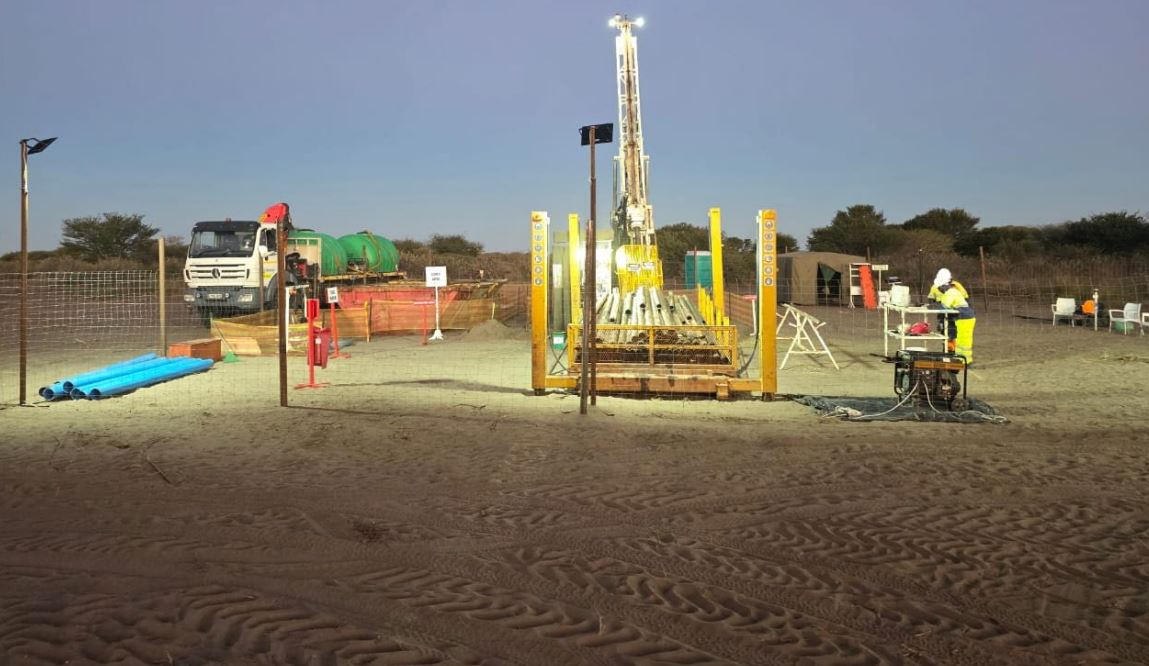
On site, pre-FID geotechnical investigations included 163 test pits, geotechnical holes for 8 ventilation raises, and a production water borehole drilled to 132 metres, yielding 28,000 litres per hour. The Project Execution Plan was developed across 5 execution pillars, the Project Labour Plan was submitted to the Tanzanian Labour Commissioner, and the Kabanga Owner's team was scaled up across 7 critical senior pre-FID roles.
The project recorded more than 2.7 million hours worked without a lost time injury (LTI), with 230 employees and contractors on site as of March 31, 2026. An ISO-compliant Life Cycle Assessment confirmed a low climate change emission impact for nickel concentrate production, with a full release scheduled for the second quarter of 2026.
Nickel Market Reversal Strengthens the Economic Case
The London Metal Exchange (LME) nickel price rose 37% from its late-2025 low by April 2026, driven by Indonesian government policy measures including a reduced 2026 mining quota of 270 wet metric tonnes against expected demand of 345 wet metric tonnes, a shift to annual quota validity, revised benchmark pricing, and tiered royalty rates.
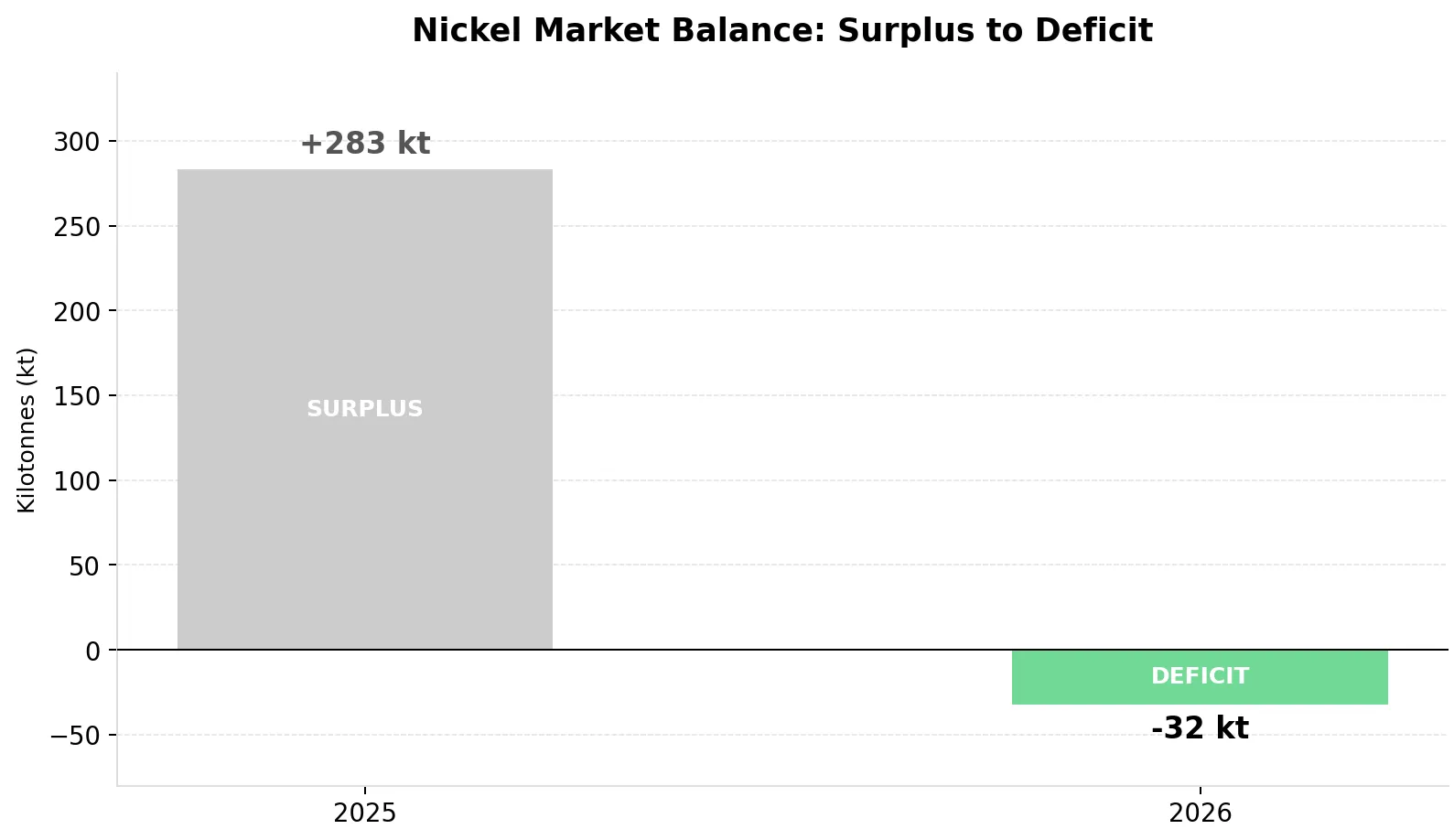
The International Nickel Study Group revised its 2026 market balance from a surplus of 283 kilotonnes to a projected deficit of 32 kilotonnes. Spot prices for nickel, copper, and cobalt were already above those used in Kabanga's 2025 Feasibility Study (FS) as of the reporting date.
Musongati & PGM Recycling: Expanding the Platform
On March 10, 2026, Lifezone entered into a 14-month exclusivity agreement with the Government of Burundi over the Musongati Nickel Project, located approximately 200 kilometres southwest of Kabanga within the East African Nickel Belt (EANB). A 2011 resource estimate based on 321 drillholes indicates more than 140 million tonnes grading 1.31% nickel, with potential by-products including copper, cobalt, platinum group metals (PGMs), and scandium. During the quarter, Lifezone geologists reviewed historical drilling data, inspected core storage, and initiated a preliminary infill drilling programme.
At Simulus Laboratories, the PGM recycling pilot processed one tonne of US-sourced spent automotive catalytic converter material, demonstrating recovery of up to 99% for platinum and palladium, and 95% for rhodium. The PGM Recycling Project FID is targeting the second quarter of 2026. In January 2026, Lifezone Recycling US, LLC submitted 2 US Department of Energy (DOE) applications requesting $41.5 million in federal funding against a $24 million private cost share.
Financial Position & What Comes Next
First Quarter 2026 investing cash outflows totalled $6.2 million, with $6.3 million invested directly into Kabanga. Net cash used in operating activities was $1.2 million, a $2.0 million improvement over the first quarter of 2025. Income before tax of $2.4 million included $8.7 million in non-cash fair value gains on embedded derivatives, warrant liabilities, and deferred consideration to BHP.
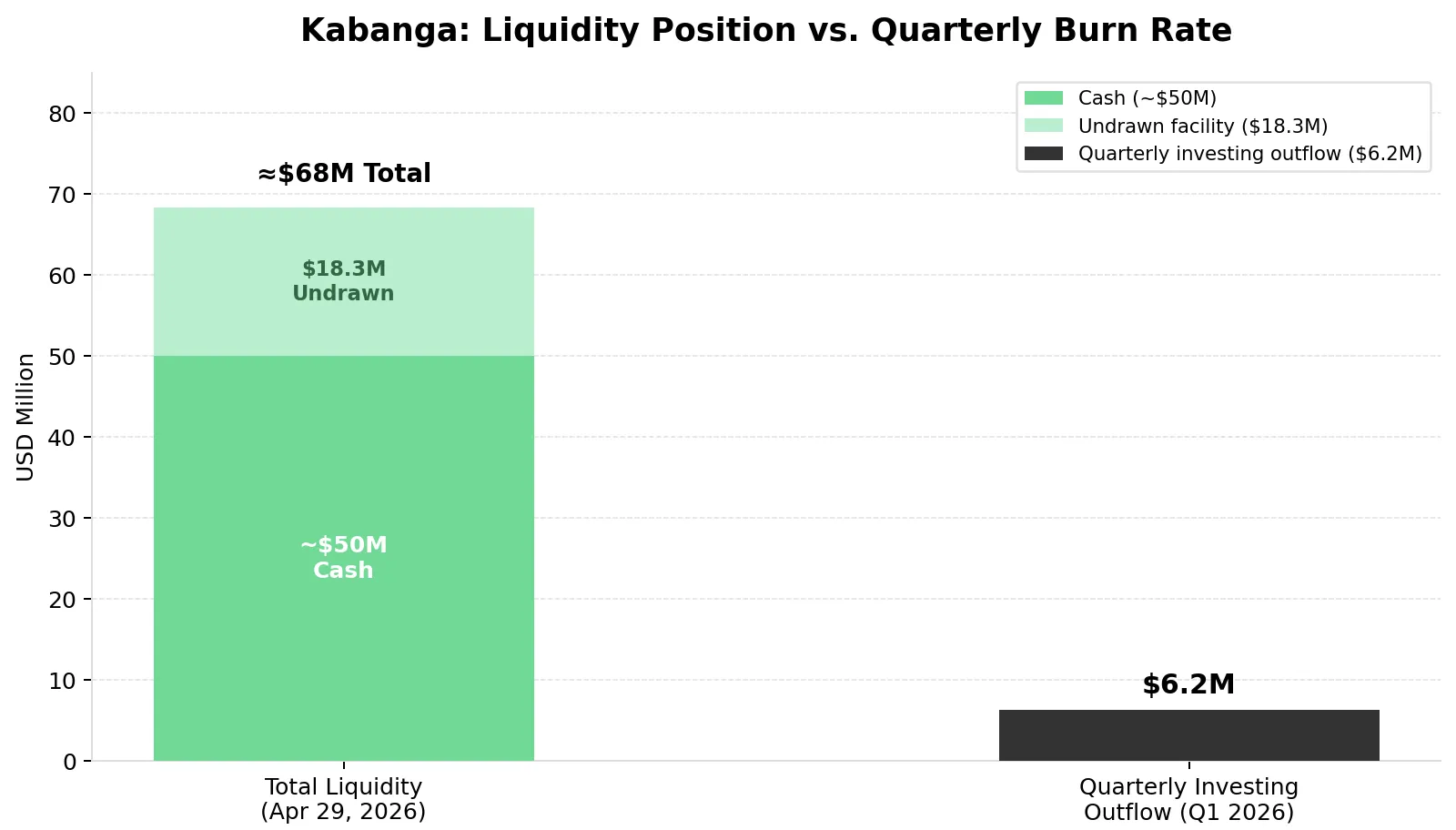
The first quarter numbers frame the runway clearly: $6.2 million in investing outflows per quarter, largely absorbed by Kabanga pre-FID work, against a liquidity position of approximately $68 million as of April 29, 2026. Simulus revenue of $1.2 million in the first quarter of 2026, up from $0.2 million in the first quarter of 2025, reduces the net operating burn but does not materially alter the timeline calculus. What determines whether that runway is sufficient is the pace of resolution on 3 fronts: the Framework Agreement negotiations, the Standard Chartered strategic investment process, and the Societe Generale project finance process. Each of those workstreams was active and advancing at quarter-end. None was closed.
FAQs (AI-Generated)
Analyst's Notes





Subscribe to Our Channel


.png)

.png)

Stay Informed


