





.webp)

IsoEnergy Ltd.
NYSE: CLOSED
TSE: CLOSED
LSE: CLOSED
HKE: CLOSED
NSE: CLOSED
BM&F: CLOSED
ASX: CLOSED
FWB: CLOSED
MOEX: CLOSED
JSE: CLOSED
DIFX: CLOSED
SSE: CLOSED
NZSX: CLOSED
TSX: CLOSED
SGX: CLOSED
NYSE: CLOSED
TSE: CLOSED
LSE: CLOSED
HKE: CLOSED
NSE: CLOSED
BM&F: CLOSED
ASX: CLOSED
FWB: CLOSED
MOEX: CLOSED
JSE: CLOSED
DIFX: CLOSED
SSE: CLOSED
NZSX: CLOSED
TSX: CLOSED
SGX: CLOSED

By Metal or Resource

By Project Stage
By Exchange
By Geography
By Investment Theme

F3 Uranium Corp

Crux Investor Index
6
–
Market Cap (USD)
66025825
Symbol
TSXV:FUU
Stage of development
Development
Primary COMMODITY
Uranium
Additional commodities
No items found.
Company Overview
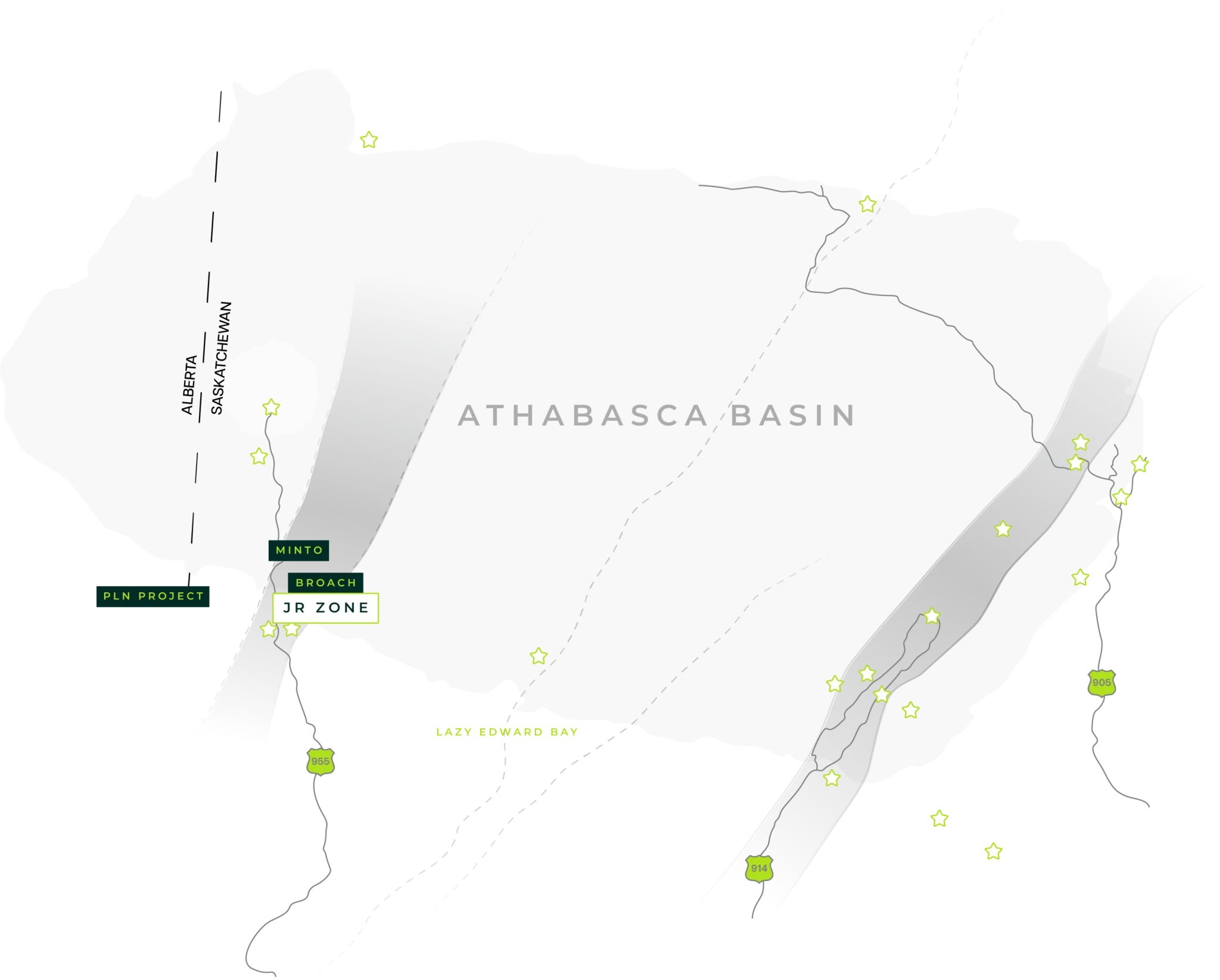
F3 Uranium Corp. is a Canadian uranium explorer focused on high‑grade discoveries in Saskatchewan’s Athabasca Basin, a Tier‑1 jurisdiction with the world’s highest uranium grades. The company is advancing the Patterson Lake North (PLN) project anchored by the high‑grade JR Zone discovery made in 2022, while expanding the 2025 Tetra Zone discovery on the adjacent Broach property. Recent drilling at JR has delivered standout intercepts, including 7.5 m at 30.9% U3O8 with 4.5 m at 50.1% in hole PLN24‑176, underscoring the zone’s potential.
Early Tetra work has returned broad composite radioactivity and initial assays up to 1.0 m at 2.50% U3O8 within 22.5 m at 0.26% in discovery hole PLN25‑205, with subsequent step‑outs showing 67.0 m of composite radioactivity in PLN25‑217. F3 trades on TSX‑V (FUU), OTCQB (FUUFF), and FSE (GL7), and benefits from a discovery pedigree that includes J Zone (2010), Triple R (2012), JR (2022), and Tetra (2025).
Opportunity
F3 offers exposure to an improving uranium cycle driven by global nuclear expansion targets, including pledges to triple nuclear capacity by 2050 and upper‑case scenarios that imply long‑term supply deficits. Athabasca Basin grades, often 10–20x the global average, can translate into compact, high‑margin development opportunities as projects mature. Within this macro, F3 presents dual vectors for value: advancing JR Zone toward resource-definition through continued high‑grade drilling and expanding the emerging Tetra Zone along conductor strike where the zone remains open.
Strategic support includes a C$15 million investment from Denison Mines via a 9% five‑year convertible debenture at C$0.56, alongside a 2025 spin‑out of F4 Uranium to surface value from the broader portfolio while preserving PLN focus and limiting dilution. With a 42,661 ha land position across PLN, Broach, and Minto, multiple geophysical conductors, and drill‑ready targets, F3 is positioned for sustained discovery and delineation catalysts.
Management
F3 Uranium Corp. is led by a highly experienced management team with a strong track record of uranium exploration success in the Athabasca Basin. At the helm is Dev Randhawa, Chairman and CEO, a veteran mining executive known for his leadership in building and financing successful uranium companies, including Fission Uranium and Fission Energy.
President and COO Raymond Ashley, P.Geo., serves as Qualified Person and has 40 years of exploration experience, including key roles in discovering the J Zone, Triple R, and leading the technical team behind the JR discovery at PLN.
VP Exploration Sam Hartmann, P.Geo., adds extensive Athabasca uranium experience spanning discovery, resource drilling, and feasibility, having served as a senior technical leader on Triple R before joining F3.
The broader team includes senior project management, a dedicated geotechnical group, EHS leadership, and GIS/data specialists, enabling parallel advancement of resource delineation and greenfield exploration. This deep technical bench, coupled with a discovery‑first culture, underpins F3’s ability to progress JR and accelerate Tetra while generating and testing new targets across A1/B1 shear systems and the A4 grid.
Growth Strategy
F3’s strategy focuses on converting discovery into defined mineralized zones at JR while rapidly expanding Tetra along the BL‑03 conductor through step‑outs and tighter‑spaced ground geophysics. At JR, continued infill and step‑out drilling leverages a sequence of high‑grade intercepts to support eventual resource work. At Tetra, discovery hole PLN25‑205 was followed by PLN25‑210 (32 m step‑out), PLN25‑212 (39.5 m composite radioactivity), and PLN25‑217 (67.0 m composite radioactivity with 49.0 m continuous), with the zone remaining open and a revised strike model guiding the next campaign.
Parallel programs on the A1/B1 shear corridors and the A4 grid provide additional discovery shots, including B1’s extended implied strike to ~2.7 km with strong alteration and pathfinder signatures. Across the 42,661 ha footprint (PLN ~4,074 ha; Broach ~19,023 ha; Minto ~19,864 ha), F3 plans systematic geophysics, conductor testing, and targeted drilling to balance near‑term delineation at JR and Tetra with pipeline growth.
Financial Overview
As of October 15, 2025, F3 reported a market capitalization of approximately C$100 million, cash on hand of C$28.5 million, and 624,471,893 basic shares outstanding. On a fully diluted basis, including 38.3 million options, 26.7 million RSUs, 35.2 million warrants, and the convertible debenture, total shares are 751,488,831. The C$15 million Denison Mines convertible debenture carries a 9% coupon over five years and is convertible at C$0.56 per share, representing a 30% premium to the five‑day VWAP at announcement in October 2023.
Equity research coverage is noted from multiple firms, with estimates presented as independent and informational. This capital structure and strategic funding provide runway for JR Zone advancement, Tetra expansion drilling, and key geophysical programs on priority conductors, aligning with a 2025 plan designed to sustain news flow and increase geological confidence across targets.
Risk Factors and Mitigation
Principal risks include uranium price volatility, exploration uncertainty (continuity, grade, geometry), permitting timelines, and financing requirements for multi‑asset advancement. F3 mitigates these through a focus on Athabasca Basin targets with strong alteration/pathfinder halos, systematic geophysics to constrain structures and conductors, and a diversified target set across PLN, Broach, and Minto that reduces single‑zone dependence.
The Denison debenture strengthens liquidity, while the F4 Uranium spin‑out preserves PLN‑centric capital allocation and avoids dilution on non‑PLN exploration. Jurisdictional advantages in Saskatchewan and third‑party Digbee ESG certification, with board‑approved disclosures aligned to global standards, support long‑term permitting readiness and stakeholder engagement.
Operationally, tighter‑spaced surveys at Tetra and disciplined step‑outs are intended to refine strike interpretation and de‑risk follow‑up drilling, while JR’s high‑grade intercepts guide resource‑oriented drilling designed to build confidence and continuity.
Conclusion
F3 Uranium pairs a Tier‑1 jurisdiction with a proven discovery team and two complementary growth engines: the high‑grade JR Zone trending toward resource‑definition work and the emerging Tetra Zone demonstrating rapid expansion potential along conductor strike. Within a constructive uranium market backdrop and increasing nuclear ambitions, F3’s strategy emphasizes catalyst‑rich work programs, from JR infill and step‑outs to Tetra expansion and conductor testing across A1/B1/A4.
Strategic funding from an industry peer and a capital‑efficient corporate structure post‑spin‑out position the company to sustain exploration momentum. For investors seeking discovery and delineation upside in the Athabasca Basin with credible ESG practices and multiple shots on goal, F3 offers a compelling profile with near‑term drilling and geophysics as clear catalysts.
Article
F3 Uranium Corp Analyst Notes

No analyst notes
Company Resources
Submitted by
F3 Uranium Corp
Charts
Similar Companies



Stay Informed
Sign up for our FREE Monthly Newsletter, used by +45,000 investors
By clicking send you'll receive occasional emails from Crux Investor. You always have the choice to unsubscribe within every email you receive.

