




A Rare Western Palladium Asset: Inside Chalice Mining’s Gonneville Story


Chalice Mining advances Australia's premier palladium project: A$3.3B NPV8, $370/oz costs, construction 2028-29. Rare Western supply amid Russian/South African dominance.
- Chalice Mining is developing the leading palladium-nickel-copper project in the Western world, discovered in 2020, now at PFS stage with plans for FID and construction in 2028-29
- The project features exceptional economics: open-pit mining from surface, $370/oz all-in sustaining costs versus $900-1,800 for South African operations, positioning it in the second quartile of the global cost curve
- PFS shows 23-year mine life with NPV8 of A$3.3 billion (at current prices) and 40% IRR, producing 170,000 oz/year initially, scaling to 250,000 oz/year in stage two
- Palladium has surged from $880/oz to $1,800/oz in seven months, driven by supply constraints (90%+ from Russia/South Africa) and slower-than-expected EV adoption supporting hybrid vehicle demand
- Two-stage development approach: A$820 million stage one capex, 50-70% debt-funded, with strong government support and abundant critical minerals financing available from sovereign wealth providers
In an era of heightened geopolitical tensions and critical minerals scarcity, Chalice Mining (ASX:CHN) is advancing what CEO Alex Dorsch describes as "the leading palladium nickel copper project in the Western world." The Perth-based company's Gonneville project represents a rare development opportunity in a market dominated by Russian and South African supply, offering investors exposure to a strategic metal experiencing significant price recovery. With palladium prices surging nearly 105% from recent lows and the project advancing toward a Final Investment Decision (FID), Chalice presents a compelling case study in how geological advantage, operational simplicity, and market timing can converge to create investment opportunity.
From Discovery to Development: The Chalice Journey
Alex Dorsch joined Chalice in 2017 when it was "a very small company with about five employees and 40 million market cap." The company's fortunes transformed with the 2020 discovery of the Gonneville deposit, a major greenfield find that has since been advanced through the prefeasibility study (PFS) stage. Dorsch, a mechanical engineer with finance background and experience at BHP's Olympic Dam, oil and gas drilling, and McKinsey consulting, has led the company through eight years of systematic de-risking and advancement.
The development timeline reflects deliberate progression: discovery in 2020, scoping study in 2023, PFS completed in December 2025, and now a bankable feasibility study underway targeting regulatory approvals in early 2028 and construction beginning in 2028-29. This measured approach has allowed Chalice to invest A$325 million raised during favourable market conditions into comprehensive technical work, spending A$15 million on metallurgical testing alone - an order of magnitude more than typical junior mining companies at this stage.
The Palladium Market: Supply Constraints and Demand Resilience
The palladium market's recent performance underscores the strategic value of developing new supply sources. Palladium has climbed from a low of approximately $880 US per ounce about seven or eight months ago to currently trade around $1,800 an ounce. While below the 2022 peak of $3,400/oz reached following Russia's invasion of Ukraine, current prices reflect fundamental supply-demand dynamics rather than purely geopolitical premium.
The supply side presents a structurally constrained picture. Russia accounts for about 40% of the palladium market with South Africa providing the balance, plus a small amount from Zimbabwe. These operations represent aging, mature assets with very deep underground mines. The South African operations employ narrow reef style mining at extreme depths that result in mining costs ranging from $80 to $200 US per ton compared to Chalice's projected $3 to $5 US dollars per ton for open-pit mining.
"They're something like a tenth of the abundance of gold in terms of how many deposits there are globally. There's not a lot of supply options. When you see elevated prices, prices can stay high for several years because there's really no supply response to high prices typically."
Demand dynamics have shifted favourably as well. The anticipated rapid transition to electric vehicles has not materialised as expected. The perceived electrification of the transport sector has happened far slower than anticipated, which has put platinum and palladium in strong deficit conditions. This reality supports palladium demand, as the metal remains essential for catalytic converters in hybrid and internal combustion vehicles.
Project Economics: The Open-Pit Advantage
Gonneville's exceptional economics stem from a fundamental geological advantage: the deposit starts at surface, enabling open-pit mining rather than expensive underground operations. The PFS outlines a 23-year mine life with headline NPV8 of A$1.4 billion and IRR of 23% at base case prices. However, with current spot prices approximately 40-50% higher, these metrics improve dramatically to a pre-tax NPV8 of about 3.3 billion Australian dollars with IRR today at spot prices around 40%.
The project's cost position is transformative. Dorsch emphasises:
"Our PFS is predicting a second quartile cost position in the cost curve. The Russians operate at around about $300 an ounce. We're going to be operating at around the same level at $370 an ounce."
By contrast, South African operations range from $900 to $1,800 US an ounce, providing Chalice with substantial margin protection even in bearish price scenarios.
Revenue diversity provides additional stability, with palladium representing 55-60% of revenues and nickel-copper comprising 35-40%. "We are the true sort of hybrid between the two," Dorsch notes, providing exposure to both precious and base metals markets. Current copper prices at record highs around $13,000/ton and nickel's recovery to $18,000/ton from $14,000/ton lows further enhance project economics.
Interview with Alex Dorsch, MD & CEO of Chalice Mining
Technical De-Risking: Flowsheet Simplification and Metallurgical Confidence
A critical evolution between the 2023 scoping study and 2025 PFS involved flowsheet redesign. The initial approach involved considerable complexity, particularly on the nickel side, because the company couldn't create a nickel product that would be saleable without doing further hydrometallurgical treatment. In 2024 and 2025, Chalice reset the flowsheet and went back to the drawing board to work out how to get just a simple concentrator and leach plant to deliver saleable products.
The simplified approach produces three standard products - copper concentrate, nickel concentrate, and PGM doré - all "very much commercially standard products" processable by conventional smelters.
"We don't need to rely on these unproven sort of downstream technologies. We don't need to rely on the South African downstream sector to process our PGM products."
Metallurgical confidence derives from extensive testing. Chalice has spent about $15 million on metallurgical test work - compared to other junior projects in the nickel or PGM space where it wouldn't be unusual to see half a million or $1 million spent to get to a PFS. The company has done orders of magnitude more test work and considerable variability work across the deposit, drilling 33 dedicated metallurgical holes to make sure that every corner and every geomet domain within the deposit is adequately tested.
Development Strategy: Staged Approach and Capital Efficiency
Chalice's two-stage development strategy balances ambition with capital discipline. Stage one involves 5 million tonnes per annum processing capacity at A$820 million capex, targeting production of 170,000 ounces annually over the first four years when the operation goes through the highest grades in the deposit. Stage two expands to 14 million tonnes per annum capacity, increasing production to approximately 250,000 ounces annually.
"We've tailored that to try and find the balance of value and risk, sizing the capital to not take too much risk and over capitalise on the asset but at the same time bring the full value or demonstrate the full strategic value of the deposit."
The initial scale allows Chalice to fund construction through "a split of debt and equity" with "in the order of sort of 50 to 70% of that of the project funded with debt."
Notably, at the moment there's no corporate partner or any strategic partner in place in the asset. Chalice maintains an early relationship with Mitsubishi Corporation which has been with the company on the journey since late 2023. Now the company is at a point where formal binding offtake agreements need to be put together and product committed to smelters or metals traders. The priority at the moment is bringing that funding stack together through either debt, equity, prepayments, streams or other sources.
Location Advantages: Infrastructure and Permitting
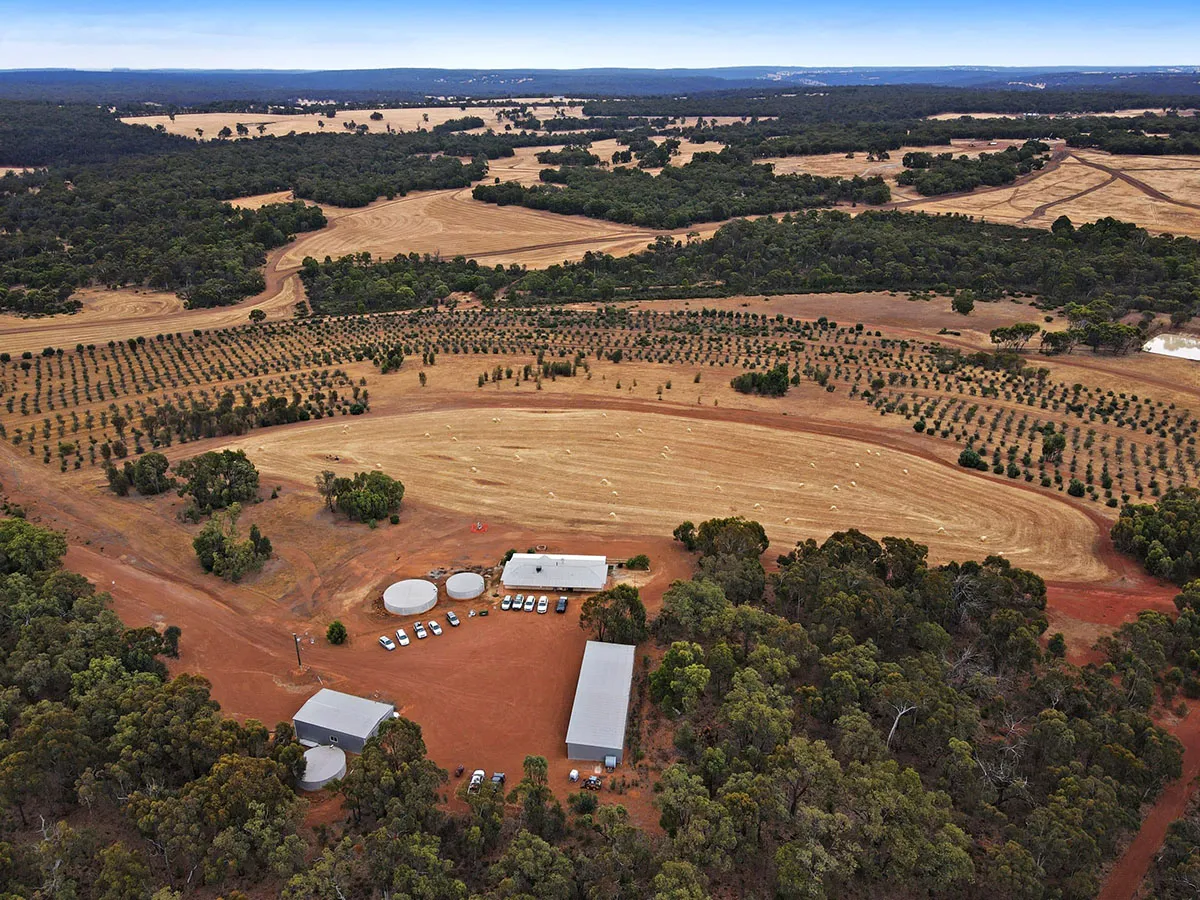
Gonneville's location on Perth's outskirts provides substantial advantages. Workers sleeping in their own beds creates contractor attractiveness in the active Western Australian market. Infrastructure requirements total only A$200-250 million versus multi-billion dollar bills typical of remote projects requiring hundreds of kilometers of new infrastructure. Most capital focuses on mining and processing, with established infrastructure nearby.
The project represents a unique opportunity as Western Australia's only operation close enough for true residential workforce outside Kalgoorlie. With Perth's 2 million population, labor access and reliability are exceptional. Chalice has proactively purchased 24 square kilometers of farmland where infrastructure will sit, de-risking approvals. Strong state and federal government support reflects Western government urgency around critical minerals projects.
The company is halfway through regulatory processes, with major submissions planned for second half 2026. Once modelling is provided to regulators, formal assessment begins leading to approvals anticipated in early 2028, aligning with construction timelines.
Financing Landscape: Critical Minerals Capital Abundance
The critical minerals financing environment appears exceptionally favourable. Dorsch notes:
"German, Finnish, Canadian, US, Australian, and Japanese credit agencies are saying exactly the same thing: build as big a project as possible so that we can lend you as much money as possible."
Despite this capital abundance, Chalice has maintained discipline, sizing stage one at A$820 million to balance opportunity with risk.
With a current market cap around A$900 million, the market signals this capital requirement is fundable. The life of mine average cost of $370/oz implies substantial headroom even in bearish scenarios, enabling significant debt capacity. Current cash of A$75 million fully funds the path to FID, with 50-70% debt financing anticipated for construction.
Regarding commodity volatility, palladium has ranged from $2,000/oz at discovery in 2020 to $3,400/oz peak, down to $880/oz, now back to $1,800/oz. However, the flowsheet redesign and staging ensure that even at bottom-of-cycle prices, the project maintains investable metrics. As Dorsch emphasises:
"What makes us very excited about the palladium market is just the lack of supply options. There is really no ability for an existing supplier to add more metal to the market."
TL;DR: Executive Summary
Chalice Mining's Gonneville project offers rare exposure to palladium development outside Russia/South Africa, with open-pit economics ($370/oz costs vs. $900-1,800/oz competitors) delivering A$3.3B NPV8 and 40% IRR at current prices. The A$820M stage one capex appears highly fundable through 50-70% debt given strong margins and abundant critical minerals financing, with construction targeting 2028-29 following regulatory approvals in early 2028. Palladium's 105% price recovery from recent lows reflects structural supply constraints and resilient hybrid vehicle demand, while simplified flowsheet and extensive metallurgical work ($15M invested) substantially de-risk execution.
Analyst's Notes





Subscribe to Our Channel
.jpg)
.jpg)

.webp)

.png)

Stay Informed


