




Frontier Energy’s Waroona Project Clears the Financing Hurdle & Moves to Construction


Frontier Energy (ASX:FHE) is fully funded and building its 132MW Waroona solar-battery project in WA, with revenue certainty locked in to 2042.
- Frontier Energy is fully funded and under construction on Stage One of the Waroona Renewable Energy Projec for a 132MW solar and an 81.5MW (6.9-hour) battery.
- A A$110 million equity raise is completed with an up to A$280 million in credit-approved debt underwritten by Natixis CIB and SMBC, financial close targeted October-November 2026.
- All major equipment and engineering, procurement and construction (EPC) contracts signed on a fixed-price, free-issue basis, capping cost exposure through to completion.
- Reserve Capacity payments of A$32m/yr, locked to 2032) plus Capacity Investment Scheme support extend revenue certainty to 2042.
- Stage Two already has development approval with company assessing data centre demand as further offtake opportunity.
Frontier Energy Limited (ASX:FHE) has crossed the threshold that separates most renewable energy developers from the small number that actually get built: it is fully funded, fully contracted, and now has boots on the ground. Speaking days after mobilisation began at the company's Waroona Renewable Energy Project in Western Australia, CEO Adam Kiley confirmed that both the equity and debt sides of the capital stack are locked in, all major construction contracts are signed on a fixed-price basis, and the project has government-backed revenue support running until 2042. For a sector where capital cost blowouts and stalled financing routinely sink projects before they generate a dollar of revenue, that combination is the story.
Fully Funded & Under Construction
Stage One of the Waroona project comprises 132MW of solar generation paired with an 81.5MW, 6.9-hour battery energy storage system, at a total capital cost of $310 million plus A$22 million contingency. Frontier raised A$110 million in equity, lifting institutional ownership on its register from roughly 10% to around 30%, with directors and executives contributing over A$3.3 million of that raise.
On the debt side, Natixis CIB and Sumitomo Mitsui Banking Corporation have signed an underwriting letter for up to A$280 million in credit-approved facilities, comprising a A$250 million construction and term facility, a A$13 million bank guarantee facility, and a A$17 million debt service reserve facility, geared at 65% and amortised over a notional 18-year period. Long-form documentation and syndication are being finalised, with financial close expected around October or November 2026 and first debt drawdown in the first quarter of 2027.
Fixed-Price Contracts De-Risk the Build
Frontier's contracting strategy is central to its investment case. Rather than handing a single lump sum to its EPC contractor, the company purchased equipment directly from tier-one suppliers on fixed-price contracts and "free-issued" it to Monford, the EPC contractor responsible for construction and integration. Equipment suppliers include LONGi Solar (roughly 200,000 panels, 30-year warranty), Trina Solar (156 battery energy storage system containers, 20-year warranty), SMA (26 power conversion units), and Nextracker (1,885 trackers), while Global Power Solutions is building the substation and Western Power itself is delivering the grid connection. As Kiley explained:
"We're pretty confident because these are fixed price contracts. They're like the simplified Meccano sets that you basically piece together on the way through."
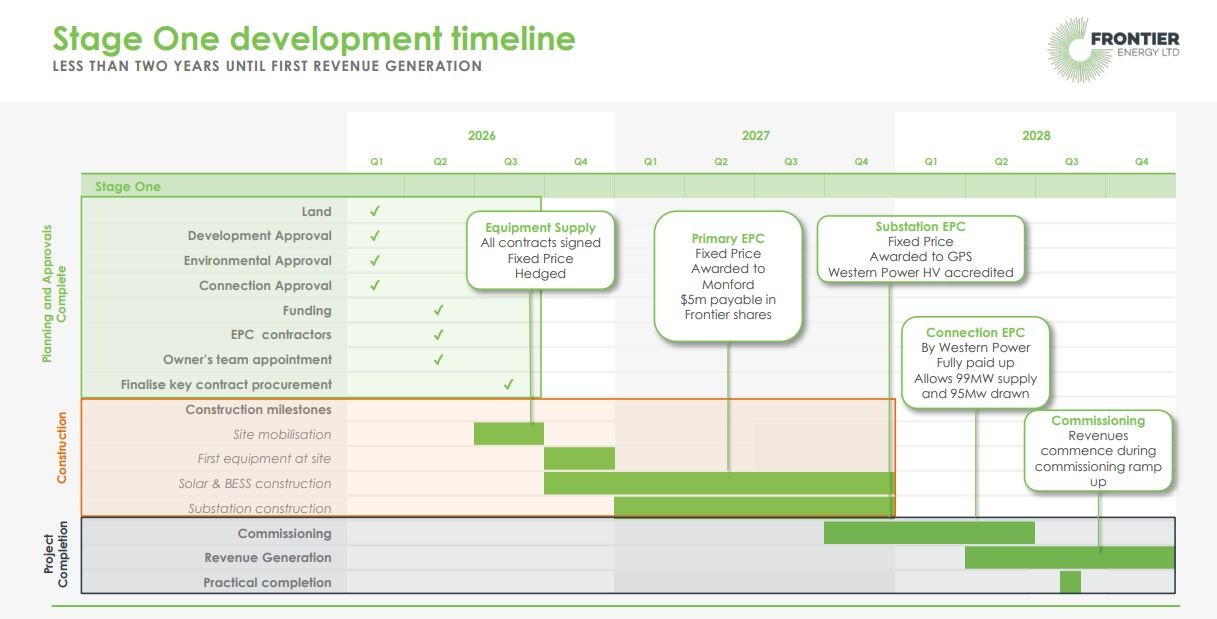
The free-issue structure removes contractor mark-ups and, critically, insulates Frontier from input cost inflation: panel and battery pricing is locked regardless of subsequent moves in underlying commodity prices such as silver. Long-lead equipment, including transformers, was ordered up to 12 months ago, and a three-to-four-month EPC early works process was used to iron out scope gaps before financial close rather than after. Site mobilisation began in mid-September 2026, with land clearing and road works over the following two months, pile driving from December, panel deliveries from January 2027, and a peak workforce of around 200 on site. Cold commissioning is targeted for late 2027, with first revenue generation in 2028.
Multiple Revenue Streams Underpin Cash Flow
Independent energy market forecaster Aurora, engaged as part of the debt financing process, models average annual revenue of A$72.5 million over Stage One's first five years, comprising A$32 million of fixed-price Reserve Capacity payments, roughly A$40.5 million of energy sales (battery arbitrage and excess solar), and around A$4 million from carbon credits and balancing payments.
Against forecast opex of A$10 million, that produces average EBITDA of A$62.5 million, an 86% margin, and a post-tax IRR of approximately 20% with a payback period of around six years. After debt servicing of roughly A$22.5 million per year and tax, free cash flow averages around A$35 million annually in the first five years, moderating to above A$30 million thereafter as the fixed Reserve Capacity price steps down.
Government-Backed Revenue Certainty to 2042
Reserve Capacity, a Western Australia-specific mechanism that pays generators for being ready to supply during peak demand, underpins roughly 90% of Stage One's revenue base. Frontier has been awarded 88 capacity credits at a fixed price of A$360,700 per megawatt, locked and CPI-indexed until 2032. Beyond that, Stage One also carries a Capacity Investment Scheme (CIS) allocation from the federal government, one of only three WA projects selected in the relevant funding round, which tops up revenue if it falls below an agreed floor and shares 50% of any upside above an agreed ceiling with government. Combined, the two mechanisms extend a minimum level of revenue protection to 2042. The CIS contract itself has not yet been executed; Kiley described it as "imminent" but confidential in its specific terms.
Interview with Adam Kiley, CEO of Frontier Energy
Stage Two & the Data Centre Opportunity
Frontier owns 830 hectares of freehold land at Waroona in total, of which Stage One uses around 300. Stage Two, targeting approximately 130MW of solar and 80MW of battery storage, already has development approval and an environmental assessment complete, with a connection application progressing and a WA "critical project status" designation expected within about a month of the interview. Its main outstanding requirement is its own revenue certainty mechanism, which management is pursuing through further Reserve Capacity or CIS rounds, or power purchase agreements. On that front, Kiley pointed to data centre operators as a fast-growing category of prospective offtake, noting that Stage One's energy output is not yet locked into a long-term PPA and so remains available, while the substation is being built with headroom to roughly triple the project's capacity using existing transformer and connection infrastructure.
Investment Thesis for Frontier Energy
- Stage One is fully funded and under construction, removing the risks equity and debt financing that most commonly stall early-stage renewable developers before they reach site works.
- Fixed-price, free-issue equipment contracts with tier-one suppliers cap Frontier's capital cost exposure through to project completion, reducing budget overrun risk.
- Reserve Capacity payments of roughly A$32 million per year locked to 2032 combined with Capacity Investment Scheme support to 2042, provide government-backed revenue certainty covering close to 90% of Stage One's forecast revenue base.
- Forecast average free cash flow of around A$35 million per year in the first five years positions Frontier for potential re-rating toward the 15-20x EBITDA multiples typical of ASX-listed renewable energy peers, once the project is operating.
- Stage Two and further expansion across 830 hectares of freehold land on WA's largest 330kV transmission corridor give Frontier a low-incremental-capex growth pipeline, contingent on securing its own revenue certainty mechanism.
- Structural WA market tailwinds in coal and gas retirements, tightening domestic gas supply, and rising data centre demand support both near-term wholesale pricing and the case for Stage Two.
Macro Thematic Analysis
Western Australia's electricity market is tightening faster than most investors appreciate. Coal, still around a quarter of the state's supply, is being retired on a fixed schedule (Collie in 2027, Muja in 2029) while gas, the backbone of the system at 42% of supply, faces a looming domestic gas shortage that is forecast to push prices higher from 2029. No major new renewable generation project has connected to the South West Interconnected System since 2021. The state's own market operator estimates an additional 11.5 TWh of generation, a 56% increase on current consumption, is needed by 2031 simply to replace retiring capacity and meet modest demand growth; by 2036, that gap widens to 18.3 TWh. Layered on top of retirements is a genuinely new source of demand: data centres, whose global electricity consumption is forecast to more than double by 2030, with Australia's installed capacity expected to grow roughly fivefold over the same period as developers seek jurisdictions with spare grid capacity, land, and low geopolitical risk.
The framing matters for how investors should read Frontier's opportunity: this is less a story about policy-driven decarbonisation and more one about physical asset retirement colliding with new, price-insensitive demand, in a market that has already recorded the highest wholesale electricity prices of any Australian state. Frontier's position: development-ready land, an existing grid connection, and a construction-stage project, is precisely what that supply gap requires, and its 830 hectares of remaining freehold land represent low-cost optionality on a market that has more buyers than sellers of capacity.
TL;DR
Frontier Energy is fully funded and under construction on Stage One of its Waroona Renewable Energy Project in Western Australia - 132MW solar paired with an 81.5MW, 6.9-hour battery. A A$110 million equity raise and up to A$280 million in credit-approved debt cover the A$310 million (plus A$22 million contingency) build, all contracted on a fixed-price basis. Reserve Capacity payments to 2032 and Capacity Investment Scheme support to 2042 provide government-backed revenue certainty. First revenue is targeted for 2028, with a similarly sized Stage Two already development-approved.
FAQ (AI-generated)
Analyst's Notes





Subscribe to Our Channel
.jpg)


Stay Informed


