




P2 Gold: Nevada Project Advances as Gold Prices Rise



P2 Gold reports drill results from Gabbs Project as gold trades at $5,595/oz. Feasibility study scheduled Q4 2026 for a project with 109K oz annual gold production.
- P2 Gold released January 2026 drill results from the Gabbs Project showing intersections of 1.26 g/t gold and 0.59% copper over 15.24 meters, with eleven reverse circulation holes completed at the Sullivan Zone
- Gold traded at $4,664.91 as of January 19, 2026, with institutional forecasts ranging from Deutsche Bank's $4,450 average to UBS's $6,200 mid-year target, driven by central bank buying and fiscal concerns
- The October 2025 Preliminary Economic Assessment outlined a 14.2-year mine life producing 109,000 ounces of gold and 15,000 tonnes of copper annually, with a 62% internal rate of return at current metal prices
- Metallurgical test work indicates gold recoveries of 85% and copper recoveries of 67%, improvements from earlier estimates of 78% and 54% respectively, with faster leach kinetics potentially reducing capital requirements
- The company plans an updated mineral resource estimate for mid-2026 and feasibility study completion in Q4 2026, with potential production by 2028 if permitting proceeds as scheduled
P2 Gold Inc. (TSXV: PGLD, OTCQB: PGLDF) operates as a mineral exploration and development company focused on the Gabbs Project in Nevada. The company released drill results from the Sullivan Zone in January 2026, showing gold and copper mineralization across eleven reverse circulation holes. The project has a preliminary economic assessment completed in October 2025 that outlines production parameters and economic returns.
Gold prices reached $4,690.02 on January 19, 2026, with major financial institutions issuing varied forecasts for the year. UBS raised its target to $6,200 per ounce for the first three quarters of 2026, while Deutsche Bank forecasts an average of $4,450. These projections reflect central bank accumulation patterns, geopolitical factors, and fiscal policy concerns affecting precious metals markets.
This analysis examines P2 Gold's project status, current gold market conditions, and development activities planned for 2026. The evaluation covers drilling results, metallurgical testing outcomes, resource estimation timelines, and feasibility study planning. The company operates in Nevada, which has established mining regulations and existing infrastructure.
Company Overview
P2 Gold Inc. focuses on the Gabbs Project located on Nevada's Walker Lane Trend, a geological corridor containing multiple gold and silver deposits. The management team includes individuals with prior experience in precious metals exploration and mine development. Chief Exploration Officer Ken McNaughton serves as the project's Qualified Person under National Instrument 43-101 standards, overseeing technical programs and verifying exploration data according to regulatory requirements.
The management team previously worked at Pretium Resources on the Brucejack mine project. According to CEO Joe Ovsenek:
"We took the Brucejack mine from discovery through to production in under eight years and raised the money, built it and operated it."
The company acquired the Gabbs Project from Waterton Precious Metals in May 2021 and has since focused on advancing the property toward feasibility study completion.
The Gabbs Project has access to Highway 361, existing power infrastructure, and water resources on site. These facilities reduce infrastructure development requirements compared to projects without existing utilities. The project's Nevada location provides access to established mining service providers and regulatory frameworks that govern permitting and development activities.
January 2026 Drill Results
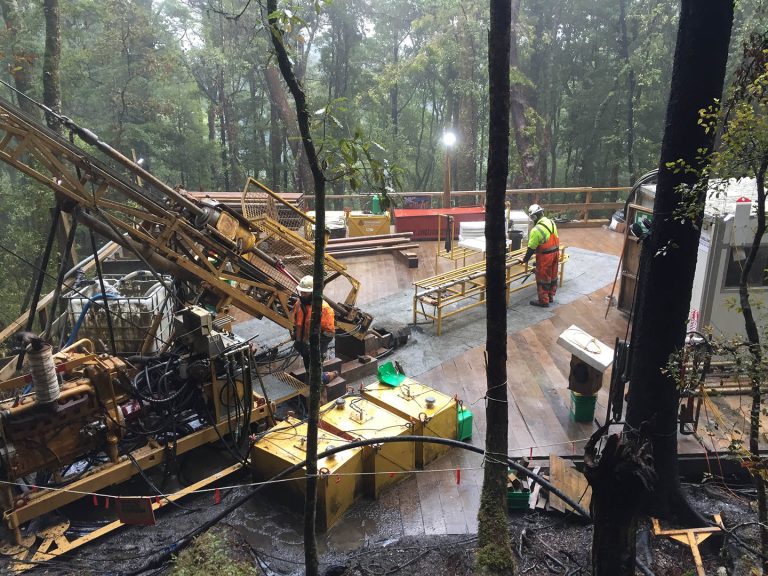
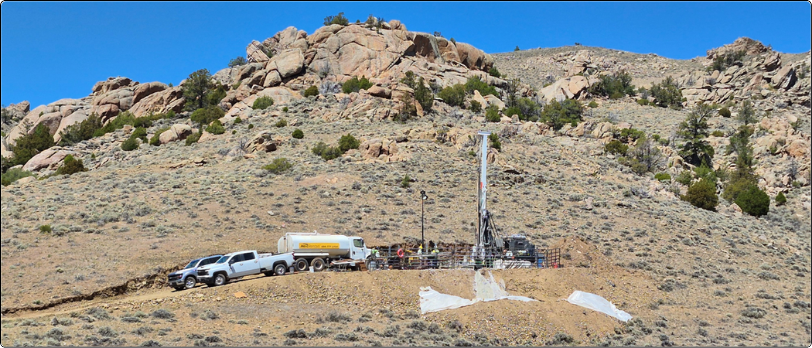
P2 Gold released results from eleven reverse circulation drill holes (GBR-056 through GBR-066) completed at the Sullivan Zone on January 14, 2026. The drilling program included infill work to refine the mineral resource model and expansion drilling to test mineralization extensions to the east and downdip to the southwest. The program forms part of ongoing work to update the resource estimate scheduled for mid-2026.
Notable intersections include Hole GBR-062, which returned 0.54 g/t gold and 0.36% copper over 50.29 meters starting at 32 meters depth, with higher-grade intervals of 1.20 g/t gold and 0.45% copper over 12.19 meters. Hole GBR-064 intersected 0.51 g/t gold and 0.39% copper over 59.44 meters from 47.24 meters downhole, containing 13.72 meters grading 0.91 g/t gold and 0.31% copper. Hole GBR-066 returned 0.69 g/t gold and 0.31% copper over 76.20 meters from 56.39 meters, including 15.24 meters at 1.26 g/t gold and 0.59% copper.
The Sullivan Zone geology consists of gold-dominant mineralization within and below a quartz monzonite unit underlain by pyroxenite, with copper-gold mineralization in the footwall. Combined mineralized thicknesses reach 175 meters. All assays were processed through ALS Global facilities using fire assay with atomic absorption finish for gold and standard analytical methods for copper. The presence of both gold and copper provides two revenue streams in the project's economic model.
Gold Market Context
Gold traded at $4,664.91 as of January 19, 2026, reaching an all-time high of $4,690.02 on the same day. Major financial institutions have issued varied forecasts for 2026. UBS raised its target to $6,200 per ounce for the first three quarters of 2026 on January 29, 2026, expecting prices to ease to $5,900 by year-end following US midterm elections. Deutsche Bank forecasts an average of $4,450 per ounce with a range of $3,950-$4,950. Goldman Sachs projects $5,400 by December 2026, while J.P. Morgan anticipates prices near $5,000 by Q4 2026.
These forecasts incorporate factors including central bank accumulation patterns, portfolio diversification trends, de-dollarization, US fiscal outlook, and fixed-income market conditions. Central banks added 1,045 tonnes of gold in 2024, the third consecutive year above 1,000 tonnes, according to World Gold Council data. Exchange-traded fund flows and investor demand for assets without counterparty risk also influence price projections.
For development stage companies, gold price movements affect project economics through revenue projections and material cutoff grades. According to CEO Joe Ovsenek, applying spot metal prices to the May 2024 PEA results in "around 62% internal rate of return and a net present value at a 5% discount was about $700 million US." Higher gold prices also affect financing conditions and strategic interest from larger mining companies seeking to replace depleting reserves. The presence of copper as a co-product provides an additional revenue stream alongside gold production.
Development Path to Feasibility
P2 Gold has completed 39 reverse circulation holes, with 24 targeting the Sullivan Zone and 15 at the Lucky Strike Zone. Eight diamond drill holes focused on metallurgical testing and geotechnical analysis. The company plans to prepare an updated mineral resource estimate in mid-2026, followed by feasibility study completion in Q4 2026. The October 2025 Preliminary Economic Assessment outlined a 14.2-year mine life producing an average of 109,000 ounces of gold and 15,000 tonnes of copper annually.
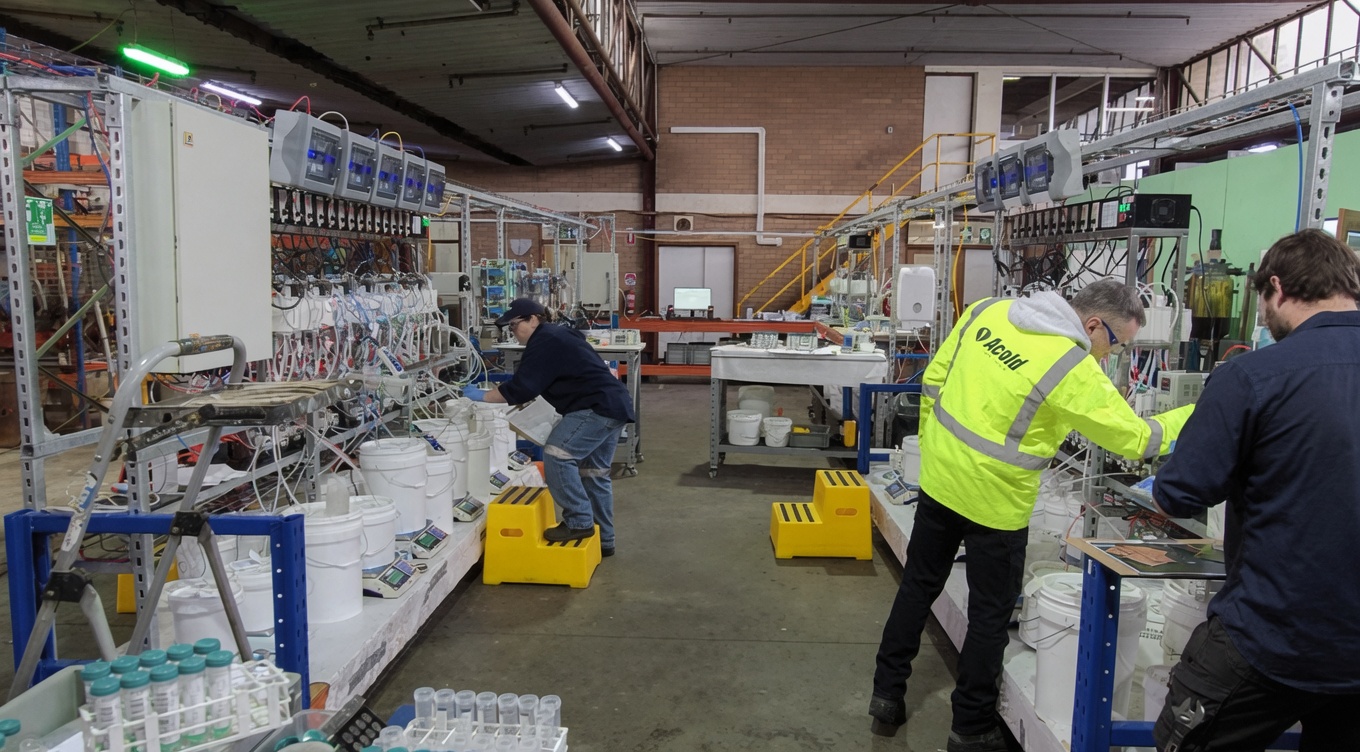
Metallurgical test work shows changes from previous assumptions. Gold recoveries increased from 78% to 85%, while copper recoveries improved from 54% to 67%. According to Olsen, "we had 98% of the gold recovered in 58 days and 85% of the copper recovered in 58 days." Faster leach kinetics may affect project design considerations. Olsen noted,
"Because of the leach kinetics, because it's coming out so much quicker, we can maybe drop the footprint size of our project and drop our capex."
The project utilizes SART (sulfidization, acidification, recycling, and thickening) process technology for recovering both gold and copper from oxide ores. The feasibility study will include updated engineering details and metallurgical test work. Management has indicated potential production by 2028 if permitting and development proceed as planned. The company is currently securing financing and reports investor interest in the project.
For Investors
- NPV/market cap ratio (28:1), IRR analysis, dual revenue streams, peer comparisons
- Metallurgical improvements, leach kinetics, drill confirmation, resource upside, proven technology
- Nevada Tier-1 status, existing infrastructure savings, established mining belt benefits
- Specific 2026 milestones with dates: Q1 mining plan, mid-year resource update, Q4 feasibility study, 2027-28 construction
- Gold price environment, central bank buying, M&A potential, management credibility
- Development execution, metal price sensitivity, financing/dilution, resource conversion, operational complexity, liquidity constraints
- Entry points, milestone evaluation criteria, capital estimate benchmarks, permitting monitoring, strategic interest tracking, position sizing guidance
P2 Gold operates a development stage project in Nevada where mining regulations and permitting processes are established. The preliminary economic assessment indicates an internal rate of return of 62% using current metal prices, compared to a market capitalization of approximately $25 million. According to Olsen,
"We're getting a lot of interest right now because of the simplicity, because of the location, because of your track record. Nevada, everybody loves Nevada, especially heap leaching in Nevada."
Technical considerations include drilling results showing mineralization continuity and geological controls affecting resource estimation. Metallurgical test work indicates gold recoveries of 85% and copper recoveries of 67%, compared to earlier estimates of 78% and 54% respectively. The project has access to existing infrastructure including roads, power, and water, which affects capital requirements compared to projects requiring new infrastructure development.
Development projects face standard risks including permitting timelines, cost estimates, metallurgical validation in feasibility studies, construction schedules, and metal price fluctuations affecting project economics. The company stated it is "in the midst of a financing" and has "a lot of interest" with "cash to really start picking up the pace of advance." Planned milestones include filing a mining plan of operation within four to five months, ongoing drill results over six months, and feasibility study completion in Q4 2026.
TL;DR
P2 Gold is advancing its Nevada Gabbs Project with drill results showing gold-copper mineralization up to 1.26 g/t gold over measured intervals. The company's economic analysis at current metal prices indicates a 62% IRR and $700M NPV compared to a $25M market capitalization. Metallurgical test work shows gold recoveries of 85% and copper recoveries of 67%, increases from earlier estimates of 78% and 54% respectively. Gold traded near $4,690 per ounce in mid-January 2026, with financial institutions forecasting prices ranging from $4,450 to $6,200 per ounce at various points in 2026. Scheduled milestones for 2026 include mining plan filing within four to five months, updated resource estimate at mid-year, and feasibility study in the fourth quarter. Potential production timing is 2028 subject to permitting and development activities proceeding as planned.
FAQs (AI-Generated)
The October 2025 PEA indicates production of 109,000 oz gold and 15,000 tonnes copper annually over 14.2 years, with a 62% internal rate of return at current metal prices.
The feasibility study is scheduled for Q4 2026. Construction decisions will follow feasibility study completion, with potential production by 2028 if permitting proceeds as planned.
The Gabbs Project has access to Highway 361, existing power infrastructure, and on-site water resources, reducing infrastructure capital requirements compared to projects without existing utilities.
Standard development risks include permitting timelines, metallurgical validation in the feasibility study, capital cost estimates, construction schedules, and metal price fluctuations affecting project economics.
Development stage companies offer different risk and return profiles than producers. P2 Gold provides exposure to a Nevada project with a 2026-2027 feasibility and development timeline.
Analyst's Notes





Subscribe to Our Channel



Stay Informed


