




Brazil's Regulatory Stability, Logistics Access & Workforce Depth Give Pedra Branca a Structural Edge in PGE Development


Pedra Branca benefits from Brazil's regulatory stability, paved port access, and a domestic mining engineering workforce larger than the US and Canada combined.
- Approximately 80% of annual platinum group element output originates from Southern Africa, with no near-term primary production alternative to offset the risk of geopolitical disruption.
- Primary platinum mine output from Southern Africa has declined from more than 6 million ounces in 2021 to approximately 5.5 million ounces in 2026, according to forecasts.
- ValOre Metals operates Pedra Branca in Ceará State, Brazil, with an all-Brazilian team spanning exploration, permitting, development, and operations.
- ValOre's 2022 inferred resource at Pedra Branca stands at 2.198 million ounces of two platinum group elements plus gold across seven near-surface zones, open to expansion from more than 6,000 metres of subsequent drilling.
- Bench-scale hydrometallurgical testing has returned palladium and platinum extractions of 73% to 74%, with a Preliminary Economic Assessment targeted for completion by year-end 2026.
PGE Supply Concentration & Geopolitical Risk
The global platinum group elements (PGE) market operates with a supply base structurally exposed to two dominant geographies. Approximately 80% of annual PGE production originates from Southern Africa, specifically South Africa and Zimbabwe, with Russia accounting for a further significant share. Approximately 90% of the world's PGE reserves are located in South Africa alone. For automotive manufacturers and industrial consumers that depend on platinum and palladium for catalytic converter applications, this concentration leaves no meaningful primary production alternative within reach.
The structural implications are compounded by the demand picture. The PGE market is currently running a multi-year structural deficit of 500,000 to 700,000 ounces; above-ground stocks have been reduced by 42%, leaving less than five months of forward coverage. Platinum surged to an all-time high of US$2,700 per ounce in early 2026 before closing at approximately US$2,000 per ounce; palladium passed US$2,000 per ounce before closing at approximately US$1,700 per ounce; and gold passed US$5,000 per ounce before closing at approximately US$4,600 per ounce.
Demand reinforcement comes from multiple directions. Automotive applications account for 40% of platinum demand and approximately 80% of palladium and rhodium demand, and hybrid vehicles consume 10% to 20% more PGEs than internal combustion engine equivalents. Physical platinum investment demand in China grew from near zero in 2019 to over 400,000 ounces in 2025.
Chief Executive Officer and Director of ValOre Metals (TSX-V: VO), Nick Smart, addresses the geopolitical exposure this supply concentration creates:
"There's a geopolitical risk here when you've got such a concentration within South Africa, Russia, and Zimbabwe. There's going to be a realisation of that and a desire to diversify some of where those metals are coming from, and we've seen that across a number of critical metals. PGEs are critical metals."
Southern African Production Headwinds
The supply base that industrial consumers depend on is not positioned to expand. Primary platinum mine production from Southern Africa has declined from a peak of more than 6 million ounces in 2021 to a forecast of approximately 5.5 million ounces in 2026. The sources of that decline are structural rather than cyclical: the mines are ageing deep-level underground operations, energy costs have risen materially, and fuel supply chains are exposed to geopolitical disruption.
Smart addresses the cost and infrastructure pressures constraining Southern African production capacity:
"There are some serious headwinds to adding additional capacity and increasing production output from the platinum and palladium mines there. These are older mines, deep-level mines, reliant on electricity, and electricity within the Southern African context is really challenging. Electricity costs have increased by about 60% over that five-year period from 2021 to 2026."
Approximately 60% of South Africa's diesel passes through the Strait of Hormuz, introducing a fuel supply vulnerability beyond producers' control. The combination of rising electricity costs, aging underground infrastructure, and fuel route exposure means the dominant PGE supply geography faces declining output, not a recovery to peak production levels.
Brazil's Regulatory & Jurisdictional Profile
Brazil's position as a PGE development jurisdiction rests on two distinct foundations: formal regulatory stability and its status as one of a small number of geographies globally where economic PGE deposits occur. The country maintains regulatory frameworks that support investment and streamline approvals, and it is a top-10 global gold producer, a function of a mature national mining industry with established permitting infrastructure and institutional experience processing large-scale resource development applications.
That predictability translates into a more reliable development pathway than jurisdictions where infrastructure constraints and geopolitical environments have introduced severe operational uncertainty in recent years. For Pedra Branca, where the technical and geological case is being built systematically ahead of formal permitting engagement, this framework provides a defined development pathway. The combination of geological prospectivity, regulatory predictability, and geopolitical neutrality positions Brazil as a structurally differentiated destination for PGE capital at a time when the alternatives are concentrated in geographies with documented supply-side vulnerabilities.
Infrastructure & Logistics Access
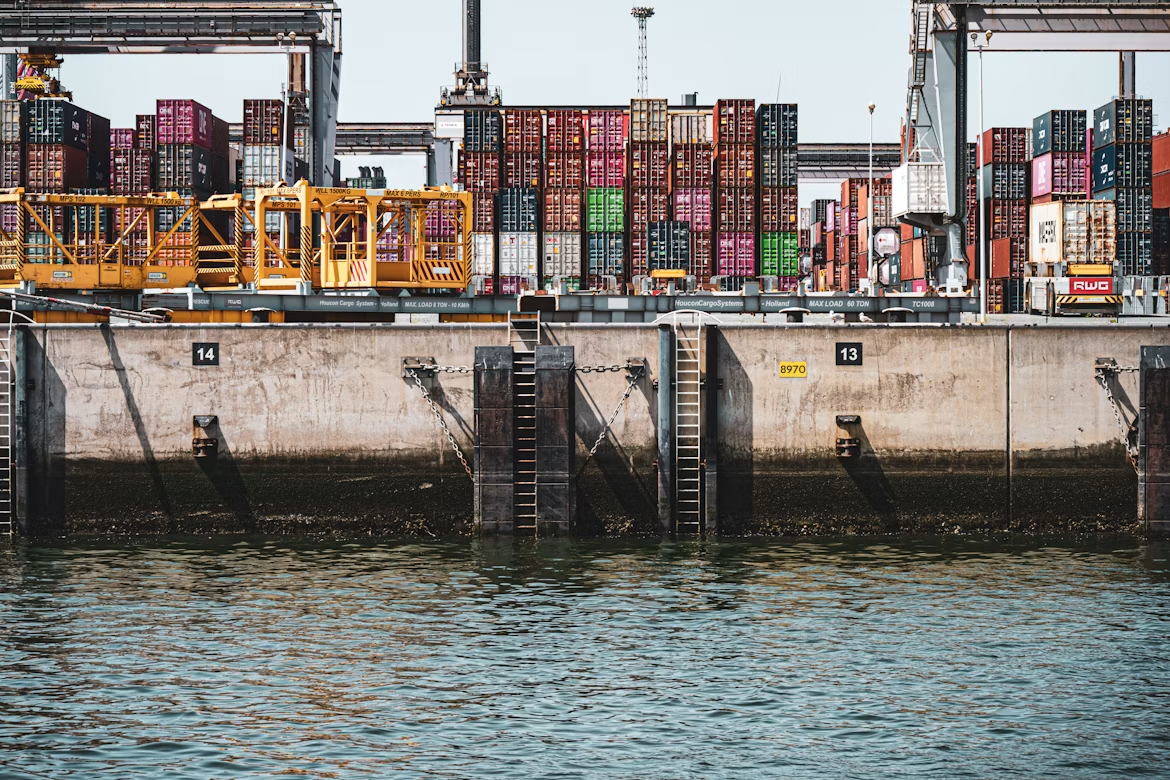
Pedra Branca's physical location removes several cost categories that inflate development budgets at comparable projects in remote or infrastructure-deficient settings. The project is accessible via a four-hour drive on a paved highway, with direct connections to the Fortaleza International Deep Water Port and the Fortaleza International Airport. Existing electricity infrastructure is close to the site, eliminating the need for standalone road construction, dedicated power generation, or a custom logistics buildout, which typically adds significant capital intensity to greenfield development.
Smart describes Pedra Branca's infrastructure position and the development advantages it confers:
"In the case of Pedra Branca, we've got some real advantages. We've got great infrastructure at that site, about four hours by paved highway from a deep-water port, with electricity that runs close by the site. We've got a community that really wants to see this built, so we don't see any major impediments to bringing this project forward."
Brazil's Domestic Technical Workforce
Brazil's engineering talent pipeline represents a structural advantage that no amount of capital allocation can replicate at a remote site in a jurisdiction with a shallow technical labour market. Brazil graduates more mining engineers annually than the United States and Canada combined. For ValOre, this translates directly into project execution capacity: Pedra Branca's exploration, permitting, development, and operational functions are staffed entirely by a local Brazilian team.
The investment significance is twofold. First, local staffing eliminates the recruitment cost, relocation overhead, and turnover risk associated with importing international technical expertise into projects in jurisdictions with thin domestic talent pipelines. Second, locally embedded teams carry contextual familiarity with national regulatory processes, provincial permitting norms, and community engagement expectations that cannot be acquired quickly. In a project development context where permitting timelines compress or extend depending on the competence of the filing team and the depth of community relations, a locally staffed organisation is a schedule risk-management asset as much as an operational resource.
Pedra Branca: Resource Base & Project Status
Pedra Branca is a 100%-owned project located in Ceará State, Brazil, covering 45 exploration licences across 51,096 hectares. ValOre's 2022 National Instrument inferred resource stands at 2.198 million ounces of two PGE plus gold contained within 63.6 million tonnes at a grade of 1.08 grams per tonne, distributed across seven distinct near-surface zones. The four core deposits, Esbarro, Curiu, Cedro, and Cana Brava, contain over 1 million ounces combined; the two southern zones, Trapia and Massape, contain a further 1 million ounces combined.
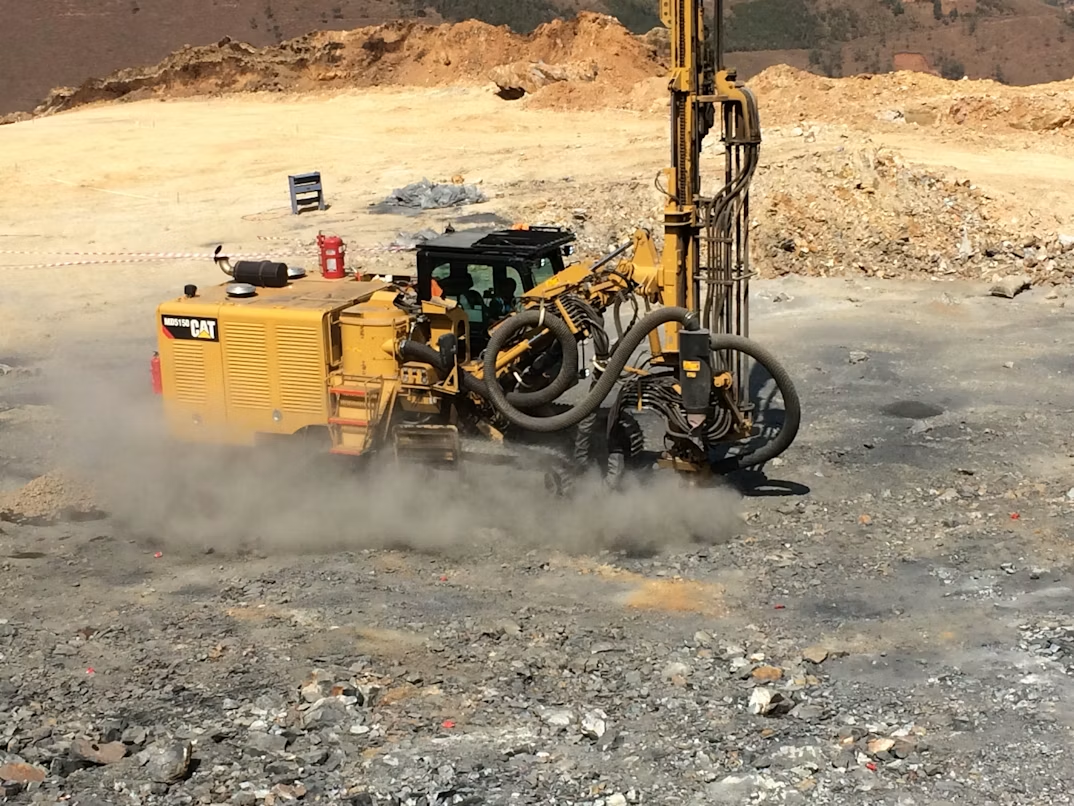
Mineralisation reaches the surface at Pedra Branca, making the deposit amenable to open-cast mining methods rather than the deep-level underground development that characterises the Southern African operations, whose cost and logistics pressures define the incumbent supply base. The current resource estimate excludes more than 6,000 metres of drilling completed in 2023 across five additional exploration zones, including the Salvador target discovery, so the 2.198 million-ounce figure does not reflect the full geological potential of the licence package.
Metallurgical Testing & Processing Pathway
The processing approach for Pedra Branca reflects the specific mineralogy of its near-surface material. The oxidised and weathered PGE material does not respond to traditional sulphide flotation, a standard route that is inapplicable to this deposit type. Hydrometallurgical testing using leaching combined with a pre-treatment step has been developed as the processing pathway, with complex high-grade chromitite boulders within the deposit addressed through a hot caustic pre-treatment protocol.
Bench-scale testing has produced palladium and platinum extractions of 73% to 74%. The University of Cape Town and a process engineering firm are engaged as technical partners in the programme, providing specialist engineering inputs to test work design and interpretation. These results are scheduled for validation through stirred-tank reactor testing and heap-leach column simulation trials, which will confirm whether the extraction performance observed at bench scale holds under larger-scale processing conditions before those results are incorporated into the Preliminary Economic Assessment (PEA).
Development Schedule & Near-Term Milestones
ValOre's 2026 to 2027 development programme is sequenced to move Pedra Branca from metallurgical validation through economic assessment and into the formal permitting process. Stirred-tank reactor testing and heap-leach column simulation trials are scheduled to follow in 2026. Completion of the PEA is targeted by year-end 2026. Formal licensing initiation and an Environmental Impact Assessment (EIA) are targeted for the first quarter of 2027.
The transaction to dispose of ValOre's interest in Hatchet Uranium Corp., its 51%-owned subsidiary, by way of amalgamation with a Future Fuels Inc. subsidiary is ongoing, with an outside completion date extended to the end of April 2026, pending TSX Venture Exchange acceptance. Completion of that transaction will position ValOre as a focused precious metals company, removing the uranium asset from the portfolio and aligning the capital structure with the Pedra Branca development programme.
Each milestone is a prerequisite for the next. Metallurgical validation at scale is a prerequisite for defensible economic assumptions in the PEA. The PEA, once completed, provides the basis for the permitting application by establishing the project's development concept, processing configuration, and production profile in sufficient detail to support the EIA. The progression from bench scale through to licensing initiation is designed to minimise rework by resolving the technical uncertainties that could otherwise require plan revisions after permitting has begun.
The Investment Thesis for ValOre Metals
- Platinum group elements supply is concentrated in Southern Africa and Russia, geographies facing declining production, rising costs, and geopolitical exposure, creating demand for alternative sources that few jurisdictions can satisfy.
- Brazil offers regulatory stability, a track record as a top-10 global gold producer, and a permitting environment that provides a more predictable development pathway than jurisdictions where infrastructure constraints and geopolitical environments have introduced severe operational uncertainty.
- Pedra Branca sits four hours by paved highway from a deep-water port, with proximate electricity infrastructure, eliminating the capital costs that routinely inflate greenfield development budgets in remote settings.
- Brazil graduates more mining engineers annually than the US and Canada combined, allowing ValOre to run an all-local team with embedded regulatory and community knowledge.
- Near-surface mineralisation across seven zones makes Pedra Branca amenable to open-cast methods, avoiding the capital intensity and cost profile of the deep-level underground operations that define the incumbent supply base.
- A Preliminary Economic Assessment targeted for year-end 2026 will produce the first formal economic framework for a project whose jurisdictional and geological strengths are not yet reflected in its resource-stage valuation.
Pedra Branca is advancing toward a credible economic study to test its development potential. The year-end 2026 Preliminary Economic Assessment will determine whether the project can support commercial development in a structurally tight PGE market.
TL;DR
ValOre Metals is advancing Pedra Branca toward economic assessment as the PGE market runs a structural deficit of 500,000 to 700,000 ounces with above-ground stocks below five months of coverage. The project's 2022 inferred resource of 2.198 million ounces of two PGEs plus gold sits in Ceará State, Brazil; a jurisdiction with paved deep-water port access, proximate electricity infrastructure, regulatory stability, and a domestic engineering graduate pipeline larger than the US and Canada combined. Bench-scale hydrometallurgical testing has returned palladium and platinum extractions of 73% to 74%. A PEA targeted for year-end 2026, followed by formal licensing and an EIA in the first quarter of 2027, will determine whether Pedra Branca can convert its jurisdictional and geological profile into a development-ready project at a point in the PGE cycle when incumbent supply is contracting.
FAQs (AI-Generated)
Analyst's Notes





Subscribe to Our Channel






Stay Informed


