




Prospectiva's Best Copper Result Yet Leads Into Assays, Metallurgy and Resource Estimate in 2027


Prospectiva Resources drilled 10.02 m at 11.75% copper at São Francisco, Brazil, targeting a maiden resource in mid-2027 and a PEA by end-2027.
- Prospectiva Resources' sixth hole at São Francisco returned 10.02 m at 11.75% copper, 0.87 g/t gold and 1.09% zinc, the project's best intercept to date.
- Holes sited on electromagnetic conductors have hit massive sulfide within about 50 centimeters of the predicted vertical position.
- The company is targeting a maiden mineral resource in mid-2027 and a PEA toward the end of 2027, built on about 13,000 m of drilling.
- Prospectiva holds $2.8 million in cash and trades at a C$13 million market capitalization, while comparable VMS takeovers were priced near C$200 million.
- Pending assays, eastern step-outs, metallurgy and funding for the 5,000 m 2027 programme are the next catalysts.
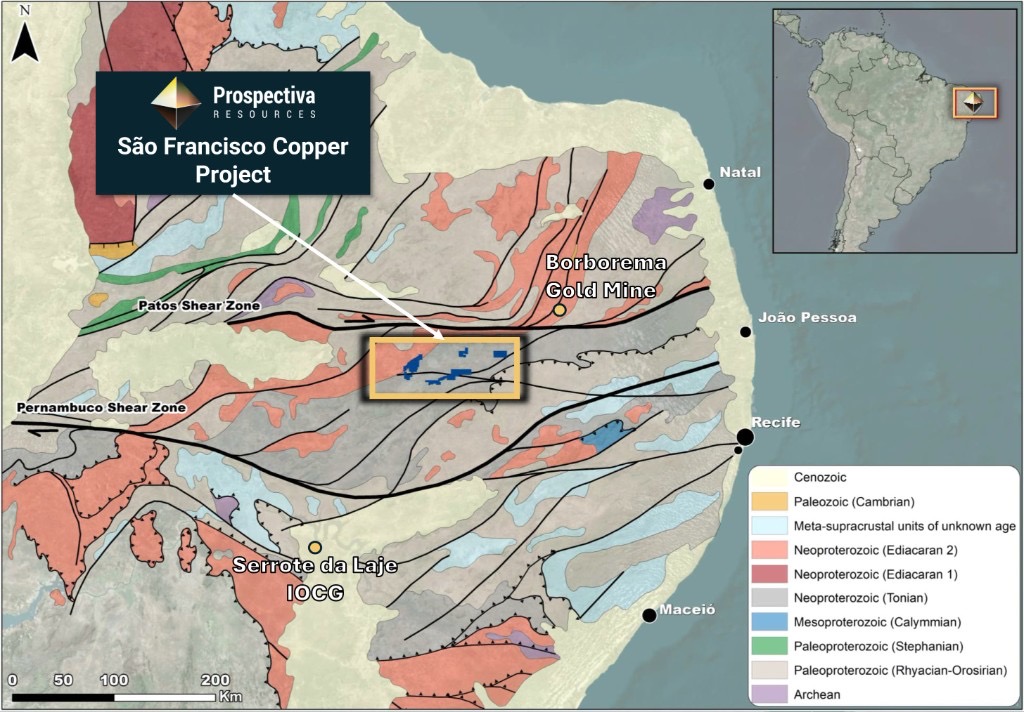
High-grade copper within reach of an open pit is scarce among junior explorers, and recent takeovers of mid-sized volcanogenic massive sulfide (VMS) deposits have put a price on what acquirers will pay for it. Prospectiva Resources Ltd. (TSXV:PSVA) reported a sixth hole of its maiden programme at the São Francisco Copper-Gold Project in Pernambuco State, northeastern Brazil, returned 10.02 meters (m) grading 11.75% copper, 0.87 grams per tonne (g/t) gold and 1.09% zinc from 104.98 m downhole.
It is the best copper intercept on the project to date. It lies about 60 m northeast of the previous high-grade hole and was drilled into a conductor the company had mapped from surface. Prospectiva is now targeting a maiden mineral resource in mid-2027 and a preliminary economic assessment (PEA) toward the end of 2027, built on roughly 13,000 m of historical and new drilling.
Thickest & Highest-Grade Intercept at São Francisco
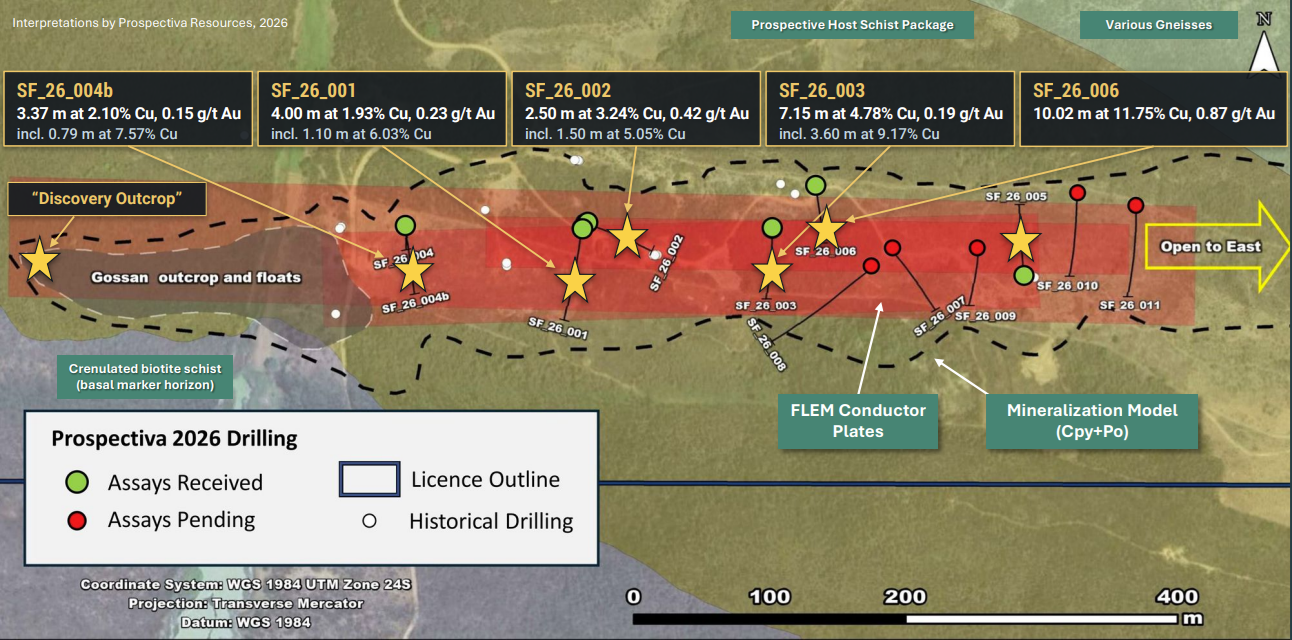
The new interval improves on both grade and thickness compared with earlier holes. The third hole returned 7.15 m at 4.78% copper, including 3.60 m at 9.17% copper. Two near-surface holes to the west returned 2.55 m at 2.02% copper and 3.37 m at 2.10% copper, from about 31 m to 33 m downhole. Reported grades are length-weighted averages above a 0.20% copper cut-off, and true widths have not yet been established.
The gold grade also stepped up. Headline intercepts from the earlier holes returned between 0.03 g/t and 0.42 g/t gold, against 0.87 g/t in the sixth hole. Core from the interval shows massive chalcopyrite and pyrrhotite enclosing angular fragments of host rock, according to the release.
Nine holes are complete, with assays received for the first six. Results from three more are pending, and two further holes are underway to finish the roughly 2,000 m, 11-hole first phase by the end of 2026.
Drilling Into Electromagnetic Conductors
Prospectiva sited the programme on conductor plates from a fixed-loop electromagnetic (EM) survey completed earlier in 2026, and has since added downhole EM. Chief Executive Officer of Prospectiva, Dan James, said the holes have intersected sulfides at the depths the geophysics predicted:
"We've been guided by our fixed loop electromagnetic survey that we completed earlier in the year. And basically where we have these conductors, these electromagnetic conductors, we're drilling and we're hitting massive sulfide directly coincident with these to an accuracy of about 50 cm in the vertical."
The company treats SF1 as a single lens at this stage. Mineralisation is confined to one favorable schist horizon, with a sharp upper contact of massive chalcopyrite and pyrrhotite and a longer tail of disseminated sulfide beneath. James described the body as a flattened, elongate cigar shape folded into a hinge, where deformation has locally remobilized and concentrated the sulfides. The release reports a shallow eastward plunge, with no later refolding identified in recent drilling.
The fifth hole, the deepest step-out to the east, returned 0.85 m at 0.93% copper. James said it still hit massive sulfide where the model placed it, and that the narrower result reflects the pinch-and-swell character already visible in the historical drilling. The next two holes step farther east, and downhole EM is detecting off-hole conductors that leave the system open in that direction.
Interview with Dan James, CEO of Prospectiva Resources
From 13,000 m of Drilling to a Maiden Resource & PEA
Yamana Gold discovered São Francisco in 2019 and drilled 5,900 m there before it was acquired by Pan American Silver. James said Prospectiva holds all of the core and assay sheets, so the full historical data set can be used in a resource estimate. Combined with about 2,000 m from the current programme and a 5,000 m second phase planned to start in the first quarter of 2027, the company is targeting roughly 13,000 m for the maiden resource. Much of the 2027 programme targets the extension from SF1 toward SF2, with some meters reserved for regional targets.
Metallurgical samples are now at the laboratory. Earlier petrological work and trace geochemistry show simple mineralogy and low levels of deleterious elements, and James said copper and gold occur in a broadly consistent ratio. Zinc runs from about 0.5% to 1.5%, and silver from about 20 to 30 parts per million. Recoveries for zinc and silver are not yet known and form part of the test work, while environmental baseline work for the PEA is also underway.
Prospectiva held $2.8 million in cash at November 24, 2026. James said drilling has come in slightly under budget and that the treasury covers the start of 2027 drilling and a 12-month corporate runway. He did not set out how the full 5,000 m programme will be funded, but said investor meetings in London this week with institutions and high-net-worth investors showed clear interest in the company.
Beyond SF1: Testing a Cluster Model
The release describes a prospective corridor of more than 3 kilometers (km) between SF1 and SF2. Prospectiva's presentation shows a wider untested 8 km corridor of favorable geology and soil geochemistry across the project. James said the confirmed model is now being applied to targets including SF3, SF4 and SF10 through a three-step filter: the favorable schist horizon with copper anomalies, then EM conductors at depth, then drilling. Fixed-loop EM surveys are running over those targets now.
The reasoning draws on how VMS deposits occur. James said they are rarely a single point of mineralisation and tend to cluster, overlap and coalesce into separate high-grade pockets. The company's objective is to place SF1 in that wider context and add further lenses.
The Investment Thesis for Prospectiva Resources
- Prospectiva drilled 10.02 meters at 11.75% copper and 0.87 grams per tonne gold at São Francisco, the thickest and highest-grade intercept on the project to date.
- Holes sited on electromagnetic conductors have hit massive sulfide within about 50 centimeters of the predicted vertical position, which gives the company a repeatable way to target the lens along its eastward plunge.
- The company is targeting a maiden mineral resource in mid-2027 and a preliminary economic assessment toward the end of 2027, using about 13,000 meters of historical and new drilling.
- Recent takeovers of volcanogenic massive sulfide deposits near 15 million tonnes at around 2% copper were priced near C$200 million, compared with Prospectiva's C$13 million market capitalization.
- Assays from three completed holes, the step-out holes to the east and the first metallurgical results are the next measurable catalysts.
- Narrow intercepts such as the fifth hole, unestablished true widths and the need to fund the 5,000 meter second phase are the principal risks to the resource timeline.
Prospectiva offers leverage to grade in a jurisdiction with a defined permitting path, with the 2027 resource as the test of whether drill-hole grades translate into tonnes.
Macro Thematic Analysis
Copper explorers with high grades near surface are a thin group. James said meetings with institutions and high-net-worth investors kept returning to the same point: deposits of around 100 Mt grading 0.3% copper are relatively common, while mid-sized, high-grade systems are not. Prospectiva's presentation cites an International Energy Agency projection of a potential 25% copper supply gap by 2035, and S&P Global data showing grassroots exploration took 21% of 2025 nonferrous exploration budgets. It also cites copper near US$14,600 per tonne in October 2026 as an indicative price.
Brazil adds a jurisdictional argument. James described the permitting path from exploration to production as clear and transparent, with other companies already moving along it. Meridian Mining's Cabaçal is advancing through feasibility and permitting in the same country. Prospectiva's presentation links high-grade, near-surface deposits to simpler, staged open-pit development. James argued that tonnage on the scale of a porphyry is not required:
"We don't need 100 million tons in this to make it economic and to make it a real value driver for the company. It needs to be midsize and it needs to be high-grade and near surface and in a good jurisdiction. And I think for that we tick all those boxes, and we're just not seeing many of those around in the market."
The Cygnus Metals and New World Resources transactions show acquirers paying around C$200 million for VMS resources of about 15 Mt at around 2% copper. For a C$13 million explorer, the gap between that range and its current value will be decided by how much tonnage the 2027 drilling can define at grades close to the recent holes.
TL;DR
Prospectiva Resources' sixth hole at São Francisco in northeastern Brazil returned 10.02 m at 11.75% copper, 0.87 g/t gold and 1.09% zinc. It is the project's best intercept to date and lies about 60 m from earlier high-grade drilling. Holes sited on electromagnetic conductors have hit massive sulfide within about 50 centimeters of the predicted depth. The company is targeting a maiden resource in mid-2027 and a preliminary economic assessment late in 2027, using about 13,000 m of historical and new drilling. It has C$2.8 million in cash and a C$135 million market capitalization. Recent volcanogenic massive sulfide takeovers of about 15 million tonnes at around 2% copper were priced near C$200 million.
FAQs (AI-Generated)
Analyst's Notes





Subscribe to Our Channel






Stay Informed


