




Spartan Metals $2.14B NPV Victorio Tungsten-Molybdenum Project Sets Up 2027 Drilling and Partner Talks


Spartan Metals' Victorio study: US$2.14B after-tax NPV8% and 30.9% return for a New Mexico tungsten-molybdenum mine, with US$13.2M of prefeasibility work next.
- Spartan Metals' Victorio PEA models a 24-year tungsten-molybdenum operation with a US$2.14 billion after-tax net present value at an 8% discount rate and a 30.9% after-tax return.
- The base case uses tungsten and molybdenum prices about 49% and 42% below the cited market references, and the after-tax value rises to US$4.02 billion at the higher-price case.
- About 39% of mill feed is Inferred, so twin drilling of historic holes and updated metallurgy are the main 2027 technical priorities.
- Initial capital of US$683.0 million and a 3-year build lead Spartan to plan trade-off studies on mining method, mine plan and the on-site APT plant.
- Spartan is targeting partners and US government funding discussions, with Department of Defense and Department of Energy talks expected to resume early in 2027.
Spartan Metals (TSXV:W) has put a number on the scale of its Victorio tungsten-molybdenum project in Luna County, New Mexico. The preliminary economic assessment (PEA) led by SRK Consulting models a 24-year underground operation with an after-tax net present value at an 8% discount rate (NPV8%) of US$2.14 billion and an after-tax internal rate of return (IRR) of 30.9%. The results use long-term planning prices of US$1,350 per metric tonne unit (mtu) of tungsten trioxide and US$20 per pound (lb) of molybdenum.
The study arrives as the US looks for domestic tungsten supply outside China. It gives Spartan a quantified asset to take into discussions with government agencies and potential partners, and it defines the technical work needed before Victorio can move to a prefeasibility study (PFS). Spartan's management described the PEA as a first step in a longer work programme, with Spartan still working through project data it took on with the option.
Victorio PEA Economics & Price Sensitivity
The base case generates life-of-mine net revenue of US$16.62 billion, a 73.8% operating margin before capital and taxes, and undiscounted after-tax free cash flow of US$6.9 billion. Average annual output is about 9.07 million lb of tungsten trioxide in ammonium paratungstate (APT) and 8.65 million lb of molybdenum in concentrate. Initial capital is US$683.0 million, with an after-tax payback of 3.2 years from the start of operations.
Metal prices drive the result. At US$2,000/mtu tungsten trioxide and US$25/lb molybdenum, the after-tax NPV8% rises to US$4.02 billion and the IRR to 43.3%. At the lowest combination tested, US$750/mtu and US$15/lb, the NPV8% falls to US$392.1 million and the IRR to 14.0%. Recent market references on November 13, 2026 were US$2,650/mtu for tungsten APT and US$34.23/lb for molybdenum oxide, both above the higher-price case.
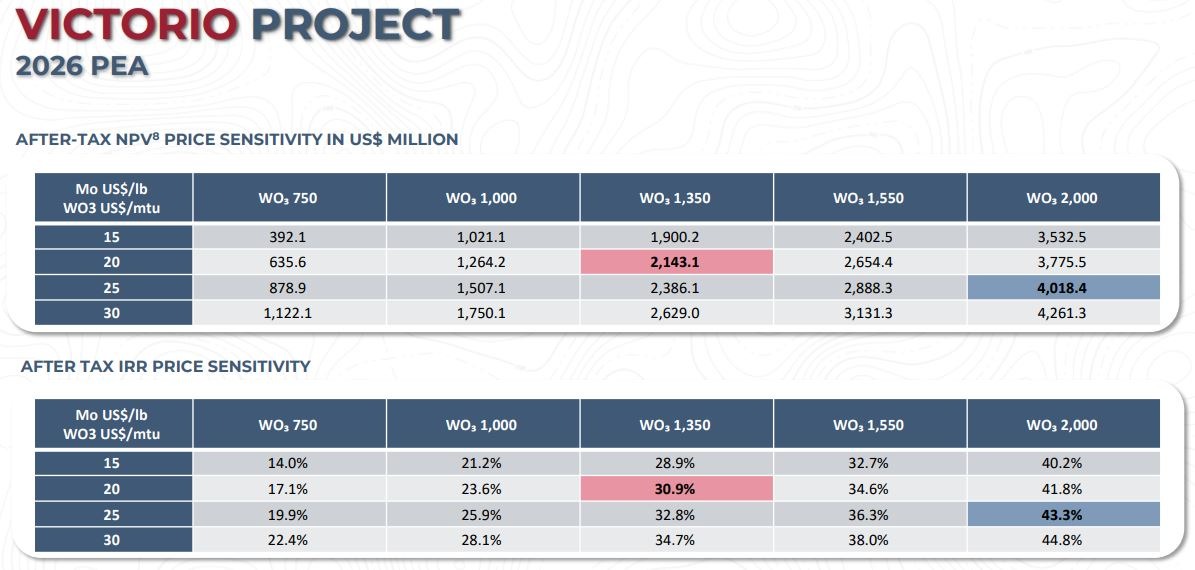
President and Chief Executive Officer of Spartan Metals, Brett Marsh, linked the 14.0% low case to the full sensitivity grid:
"What it does actually show is that the project has pretty good resiliency over a range of prices that we tested, and it also has a considerable upside and really scales well at the higher prices that are closer to the current spot prices that we see in the market."
The company has also identified fluorspar and beryllium as potential by-products. Neither is included in the PEA economics, and Spartan intends to assess both in future studies.
Resource Conversion & Metallurgy Set the Prefeasibility Agenda
The PEA schedules about 199.5 million short tons of mill feed, made up of 10% Measured, 51% Indicated and 39% Inferred Mineral Resources. Marsh said the first 10 years of feed draw mainly on Measured and Indicated material, with Inferred tonnage concentrated in later years. Caves A and B cover roughly the first decade of planned production.
The resource draws on about 85 drill holes, roughly 60 of them historic. Spartan has the geological information for those holes but not signed assay certificates, so they could support only Inferred classification unless they were close to recent holes with certified assays. The company is targeting focused twinning of historic holes to upgrade that material into higher-confidence categories.
Metallurgy is the second workstream. The PEA assumes 85% molybdenum recovery and 72.75% combined tungsten trioxide recovery through concentration and the APT plant. Marsh described the historic metallurgical results as good but in need of updating with modern techniques that could lift recoveries. Spartan has begun categorizing available core to decide where new metallurgical holes are needed, with planning over the winter and drilling targeted for spring.
Capital Intensity & Trade-Off Studies
The PEA uses underground block caving, in which the deposit is undercut so broken rock falls under gravity to collection points. Ore feeds a molybdenum flotation circuit and an on-site APT plant. Initial capital of US$683.0 million is followed by US$2.03 billion of sustaining capital over the mine life, for a total of about US$2.71 billion. The estimate includes 30% contingency on mining, processing and infrastructure and 25% on the tailings storage facility, at PEA-level accuracy of plus or minus 50%.
Spartan included the APT plant because of the operation's scale. Marsh said processing on site avoids the added cost and lower pricing that come with shipping concentrate instead of an intermediate or finished product. He also said the on-site plant will be tested in trade-off studies alongside alternative mine plans and mining methods that could reduce initial capital.
The current design calls for a 3-year build before first ore. Marsh said a lower-capital method could bring tungsten to market sooner, potentially at lower throughput. The PEA was delivered on a short schedule, so several of its design choices rest on initial assumptions that the trade-off work will now test ahead of the PFS.
Interview with Brett Marsh, CEO, Spartan Metals
Funding the US$13.2 Million Prefeasibility Programme
The PEA recommends a US$13.2 million work programme to gather PFS-level inputs. The largest items are US$4.5 million for geological and resource definition, US$3.0 million for environmental baseline studies and permitting, US$1.9 million for tailings storage design, and US$1.5 million each for geotechnical work and a hydrogeological study. Water supply, flora and fauna, and cultural resources have so far been reviewed only at a high level, and Spartan is preparing requests for proposals for consultants. Marsh described the programme as multi-year, with the size and timing of any raise set by market conditions.
Spartan holds an option to acquire 100% of Victorio, subject to completing the option terms announced on March 17, 2026. Marsh said the company will advance the studies and then look to partner the project, and potentially the company, to fund development. He cited backing from the board, larger shareholders and strategic partners including Ridgeline Minerals, which is listed among Spartan's major shareholders.
On government funding, Marsh said the PEA was a hinge point for discussions with the US Department of Defense (DoD) and Department of Energy (DoE). He is targeting a resumption of those talks early in 2027 and said there are no guarantees.
Peer Scale & the Eagle Project
Marsh said few tungsten developers with economic studies match Victorio's scale. He named Fireweed Metals' project in Canada, Northcliff Resources and a couple of Australian companies as comparable, and pointed to molybdenum's contribution as the distinguishing feature. Spartan's November 2026 presentation shows its market capitalization at C$20 million on November 16, 2026, against C$468 million for Fireweed and C$159 million for Northcliff.
In Nevada, Spartan's Eagle project covers a district with 3 past-producing tungsten mines. Marsh said basic geological exploration in 2026 expanded the project's scope, and results from a recent drilling programme are pending. Victorio remains the flagship, and Spartan may pursue options at Eagle so work there continues while the company focuses on New Mexico.
The 2 projects give Spartan a tungsten resource base in 2 US states. At Victorio, average annual output of 8.65 million lb of molybdenum sits alongside the tungsten stream, which Marsh described as a balance of metals with long-term demand in Western markets. That second revenue line reduces dependence on a single price, as the sensitivity grid shows: holding tungsten trioxide at US$1,350/mtu, a US$30/lb molybdenum price lifts the after-tax NPV8% to US$2.63 billion.
The Investment Thesis for Spartan Metals
- The preliminary economic assessment for Victorio outlines a 24-year underground operation with an after-tax NPV8 of US$2.14 billion and an after-tax IRR of 30.9% at long-term planning prices.
- Base case prices are about 49% below the cited tungsten market reference and about 42% below the cited molybdenum reference, which leaves room for upside if current prices hold.
- About 39% of scheduled mill feed is Inferred material, so planned twinning of historic drill holes, about 60 of which lack signed assay certificates, is the main route to higher confidence in the mine plan.
- Updated metallurgical test work and geotechnical studies for the block cave will show whether the modelled recoveries and caving behaviour hold at prefeasibility level.
- Initial capital of US$683.0 million is large relative to Spartan's current market value, so partner selection, non-dilutive government funding and capital-reducing trade-off studies will shape shareholder outcomes.
- Monitor the resumption of Department of Defense and Department of Energy discussions early in 2027, the spring drilling start at Victorio and pending drill results from Eagle.
Victorio offers scale and dual-metal exposure at conservative prices, and the 2027 work programme will test whether the resource, metallurgy and caving assumptions can support a prefeasibility study.
Macro Thematic Analysis
China supplies about 80% of tungsten mine production and 85% of APT, according to S&P Global's October 2026 report cited by Spartan. The same report projects tungsten demand growth of about 10% between 2026 and 2030. Export restrictions and the time needed to finance, permit and commission new mines and processing plants can slow new supply.
US procurement rules add a demand driver. From January 1, 2027, Defense Federal Acquisition Regulation Supplement clause 252.225-7052 extends covered-country restrictions on specified tungsten products back through the ore and feedstock stages, subject to its exceptions. An on-site APT plant would place Victorio's output at the intermediate stage where China's share is highest. Molybdenum adds a second exposure, since part of its supply comes as a by-product of copper mining.
Marsh said policy differences after the US midterm elections may slow the process at first without removing the funding:
"Critical metals security for the supply chain in the US is probably one of the only issues that both sides of the aisle in the United States really agree on."
Development timelines remain the constraint. Resource definition, engineering, permitting, construction and product qualification can take many years. Supplying defense customers would also require product quality, traceability and downstream qualification.
TL;DR:
Spartan Metals' preliminary economic assessment for its Victorio tungsten-molybdenum project in New Mexico models a 24-year underground block cave mine with an on-site ammonium paratungstate plant. It shows an after-tax net present value of US$2.14 billion at an 8% discount rate and a 30.9% internal rate of return, at long-term prices well below current markets. Initial capital is US$683.0 million. About 39% of mill feed is Inferred, so the next step is a US$13.2 million prefeasibility programme covering twin drilling of historic holes, metallurgy, geotechnical and environmental work. Chief Executive Officer Brett Marsh plans to seek partners and is targeting renewed US government funding discussions in early 2027.
FAQs (AI-Generated)
Analyst's Notes





Subscribe to Our Channel






Stay Informed


