




Q1 Silver Recap: Why the 38% Fall Did Not Change the 67Moz Deficit


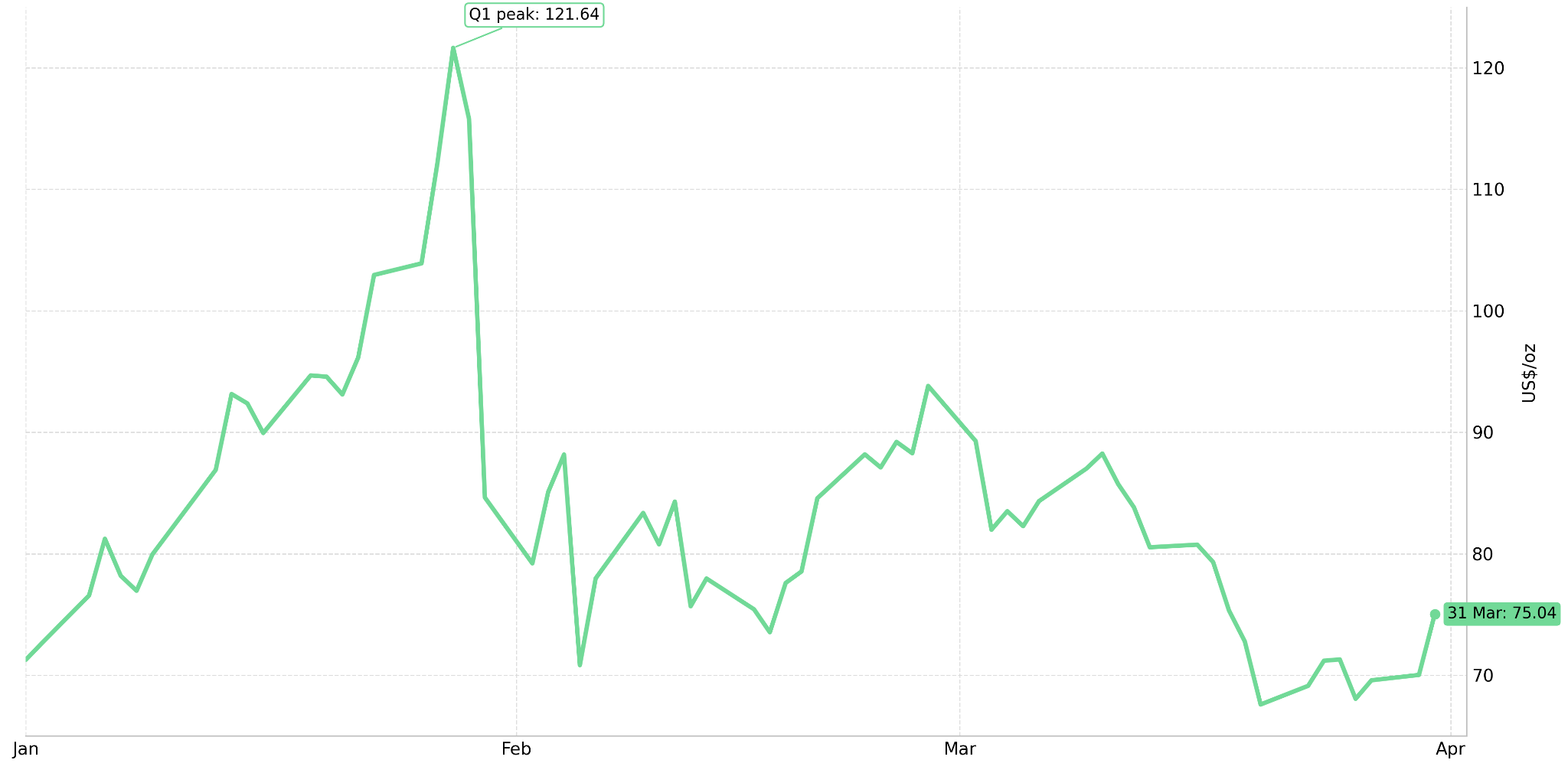
Silver peaked at $121.64/oz in Jan 2026, fell 38% to $75.04/oz by March 31 on rate repricing - 2026's 67Moz deficit is the sixth consecutive year of undersupply.
- Silver's 38% correction from its January 2026 peak of $121.64/oz reflects extreme sensitivity to monetary policy expectations, not deterioration in long-term supply-demand fundamentals.
- Structural supply deficits remain intact, with a projected shortfall of approximately 67Moz in 2026 - the sixth consecutive year of undersupply against the total annual supply of 800 to 850Moz.
- Industrial demand is undergoing a non-linear transition as solar manufacturers shift toward copper metallization, while AI infrastructure and EV electronics represent growing but less predictable offset demand.
- Gold declined approximately 16.4% from its January 29 peak of $5,594.82 to $4,677.28 on April 2, 2026, while silver fell 38% over the same period—a spread that quantifies silver's higher beta to monetary policy repricing relative to gold.
- Select primary silver producers operating in the upper quartile of global grade curves, with all-in sustaining costs below $15/oz and near-term operational catalysts, retain asymmetric earnings leverage to any monetary policy-driven repricing cycle.
Silver Hit $121.64/oz in January: What Erased 38% in 10 Weeks
Silver declined approximately 38% from its January 2026 peak of $121.64/oz to $75.04/oz by March 31 - a drawdown driven by monetary policy repricing. The correction occurred against an unchanged 2026 supply deficit of approximately 67Moz, the sixth consecutive year of undersupply against a total annual supply of 800 to 850Moz. The nomination of Kevin Warsh subsequently shifted market expectations toward tighter monetary policy, triggering broad precious metals liquidation and driving silver to $75.04/oz by March 31 2026, a 38% decline from peak.
Silver's 146.85% year-over-year gain reflects the cumulative effect of six consecutive annual supply deficits and inelastic primary production, not the speculative inflows that drove the January 2026 peak, conditions that the 1Q correction leaves intact.
The 67Moz Deficit: Six Consecutive Years of Undersupply
The Silver Institute projects a 2026 global silver market deficit of 67Moz, the sixth consecutive year the market has failed to produce enough metal to meet demand. Total supply is forecast to rise 1.5% to 1.05 billion ounces, with recycling up 7%, but that increase does not close the gap.
Demand composition has shifted rather than contracted. A 20% surge in physical investment is absorbing the volume lost from declining jewelry, silverware, and photovoltaic fabrication, meaning the deficit is being sustained by different buyers, not the same ones at higher volumes.
Dollar Strength and the Iran Escalation Widened Silver's Decline Beyond Gold's
Silver's higher beta to monetary policy repricing is directly measurable against gold's 1Q performance. Gold fell approximately 16.4% from its January 29 spot peak of $5,594.82 to $4,677.28 on April 2, 2026, while silver declined approximately 38% over the same period, a spread of approximately 25 percentage points that reflects silver's industrial identity, creating additional selling pressure beyond what monetary repricing alone would produce. Silver lagged gold specifically because its demand base includes industrial offtake, which is subject to slowdown risk, introducing a second selling rationale that pure monetary metals do not carry during geopolitical shocks.
Escalating US military action in Iran simultaneously strengthened the US dollar, compressing dollar-denominated commodity prices and reducing purchasing power for non-dollar buyers. Safe-haven flows partially offset gold's decline but provided no equivalent support to silver, where the industrial demand discount widened the gap.
When rate expectations tighten and geopolitical risk hits simultaneously, silver gets sold on two fronts: monetary positioning and industrial demand fear, while gold only gets sold on one. That is why silver's correction ran deeper than gold's, and why the re-entry discount is wider than gold's decline alone would suggest, measured against a 67Moz deficit that hasn't moved.
Supply Constraints: Why Higher Prices Do Not Translate to Higher Output
Despite silver trading above $70/oz, supply growth remains structurally inelastic. The 2026 projected deficit of approximately 67Moz against the total annual supply of 800 to 850Moz marks the sixth consecutive year of undersupply.
Approximately 70% of global silver production is generated as a co-product of copper, zinc, lead, and gold mining operations. Production decisions in these operations are driven by base metal economics, not silver prices. New primary silver projects face compounding constraints: permitting timelines of five to ten years and capital intensity that requires sustained price levels above financing thresholds before development capital is committed. Oliver Turner, Executive Vice President of Corporate Development at Americas Gold and Silver, frames the investment consequence directly:
"Primary silver is very scarce. It's a scarcity play; there are only so many ways to actually get exposure to primary silver miners."
Americas Gold and Silver operates the Galena Complex in Idaho's Silver Valley, carrying a resource base that Oliver Turner describes as follows:
"This mine has an absolutely enormous resource endowment, well over 150 million ounces of silver."
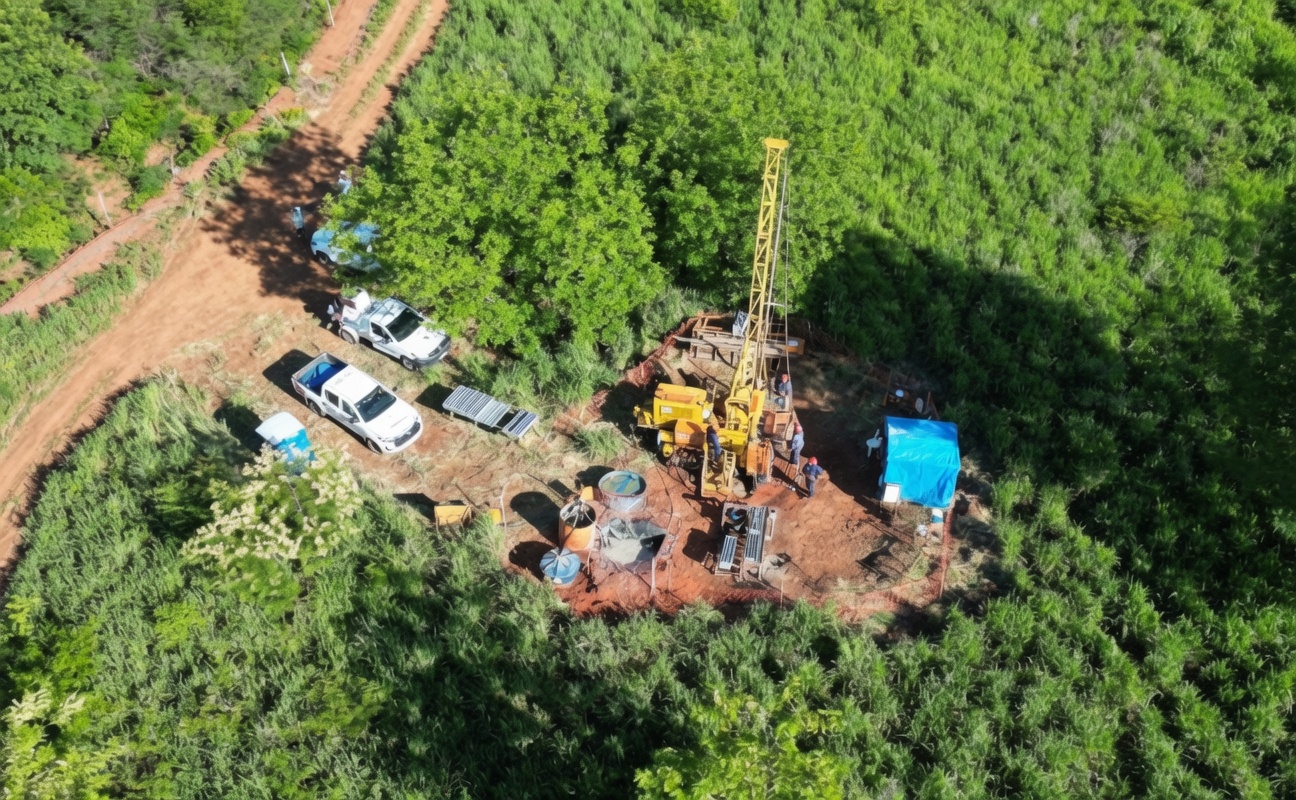
GR Silver Mining's consolidated resource of 134Moz AgEq across San Marcial (68Moz AgEq) and Plomosas (66Moz AgEq), represents a second example of primary silver scarcity at an institutional scale. Recent step-out drilling returned intercepts of 10,550 g/t and 6,532 g/t silver, with multiple sub-parallel zones identified in 2025. The company holds C$28.2 million in cash and zero debt, fully funding a 20,000-meter resource expansion program and a Bulk Sample Test Mining program in H1 2026, with an MRE update and Maiden PEA targeted for H2 2026. Plomosas operates under existing permits as a past-producing mine.
Operational Leverage in Volatile Markets: Cost Structures & Margin Expansion
Silver producers' resilience through price volatility is primarily a function of cost discipline. Americas Gold and Silver's EC120 Mine carries an all-in sustaining cost of approximately $10.80/oz, producing a significant margin at current silver prices and providing structural downside protection relative to the broader primary silver producer universe. The company has implemented a transition from underhand cut-and-fill to long-hole stoping at Galena, reducing cost per tonne while increasing ore throughput through the existing mill infrastructure. Oliver Turner quantifies the compounding margin effect:
"We're attacking your cost line, you're also increasing the number of ounces you're bringing out for that same cost, expanding margin, bringing up ounces."
The integration of the Crescent Mine, carrying grades above 900 g/t silver and located nine miles from Galena, spreads fixed milling costs across a larger ore volume, further compressing unit costs. Americas Gold and Silver is also funding the largest exploration drill program in its history, targeting approximately 64,000 meters across both assets, with results expected to extend resource life and support reserve base re-rating.
Industrial Demand Disruption: Solar Substitution & Emerging End Markets
The cost of silver paste per 450W photovoltaic module rose from $5.22 to $17.65 as silver prices increased, incentivizing Chinese manufacturers to transition to copper metallization and cadmium telluride thin-film technologies. Solar capacity growth no longer translates directly to silver demand growth, meaning one of the demand assumptions underpinning the prior bull case now requires a discount.
AI infrastructure requires silver for thermal-conductivity applications in data center hardware, and electric-vehicle battery systems exhibit a significant silver intensity per unit. These markets are less mature than the established photovoltaic supply chain, and consumption volumes remain harder to forecast with the precision required for institutional demand modeling. The net effect is that demand is diversifying rather than contracting, but long-term bullish theses must now incorporate substitution risk in solar while assigning probability-weighted value to AI and EV-driven demand growth.
The Investment Thesis for Silver
- Six consecutive years of supply deficits, with a projected 67Moz shortfall in 2026, establish a structural floor beneath silver demand that cannot be resolved through price signals, given the 70% by-product dependency of global production.
- Approximately 70% of global silver output is tied to base metal economics rather than silver price incentives, making the production profile inelastic to elevated silver prices and sustaining deficits regardless of short-term price action.
- Silver's measurably higher beta to monetary policy shifts, producing a 38% drawdown against gold's approximately 16.4% decline from January peaks, creates defined re-entry windows for investors with cost-basis discipline and a verified view on the structural deficit.
- Industrial demand is transitioning from solar dependence toward AI infrastructure and electric-vehicle electronics, diversifying the demand base without reversing the deficit trajectory established over the prior five years.
- Primary silver producers operating in the upper quartile of global grade curves offer margin resilience during price volatility and disproportionate earnings leverage during repricing cycles relative to lower-grade operations.
- Companies with secondary exposure to defense-critical minerals, such as antimony, gain valuation support from domestic policy initiatives, independent of precious metals market conditions, broadening the institutional investment case.
The Correction Changed the Entry Price - It Did Not Change the Deficit
Silver's 1Q 2026 performance reflects a market caught between monetary policy repricing and structural scarcity. A 27% drawdown from the January peak, running approximately 10.6 percentage points deeper than gold's concurrent decline, has obscured conditions that remain unchanged: a sixth consecutive year of supply deficit, an inelastic production profile constrained by by-product dependency, and a demand base that is diversifying rather than contracting.
TL;DR
Silver fell 38% from its January 2026 peak of $121.64/oz to $75.04/oz by March 31, driven by the Kevin Warsh nomination shifting rate expectations toward tighter monetary policy and simultaneous US dollar strengthening from Iran escalation, not a change in supply-demand conditions. The 2026 deficit of approximately 67Moz, the sixth consecutive annual shortfall against total supply of 800 to 850Moz, was unaffected by the correction. Silver's decline ran approximately 23.6 percentage points deeper than gold's 16.4% drawdown because industrial demand fear added a second selling rationale that pure monetary metals do not carry. Solar substitution, driven by silver paste costs rising from $5.22 to $17.65 per 450W module, removes a previously reliable demand pillar, while AI infrastructure and EV battery systems represent demand offsets with less established volume forecasts. Primary producers with all-in sustaining costs below $15/oz retain defined margin protection at current prices and disproportionate earnings leverage when monetary conditions allow capital to re-engage.
Analyst's Notes





Subscribe to Our Channel




Stay Informed






