




US Distillate Inventories Remain 10% Below Average as Hormuz MOU Stabilizes Brent, Raising Refinery Margin Risk



Brent stabilized as the Hormuz MOU held, but US distillate inventories remain 10% below average, leaving refinery margins exposed to renewed supply shocks.
- US commercial crude oil inventories fell to 412.1 million barrels, 7% below the five-year seasonal average and down 6.1 million barrels from the prior week.
- US distillate fuel inventories are 10% below the five-year seasonal average, leaving limited supply if Hormuz disruptions reduce fuel shipments.
- Iran has exported more than 40 million barrels of crude since the US lifted its naval blockade under a 60-day MOU, while oil sells at 20% above pre-war prices and Iran retains control over shipping arrangements in the Strait of Hormuz.
- Brent fell about $45 per barrel from Q1 to Q2 2026, its largest quarterly decline since the 2008 financial crisis, as ceasefire progress removed the war premium from April's $118 peak.
- Iran refused to meet US envoys Kushner and Witkoff directly in Doha on July 1, choosing to negotiate through Qatari mediators in the first diplomatic setback since the June 17 MOU.
Iran Rejects Direct US Talks, Lifting Brent Prices
Brent rose 0.45% to $73.28 per barrel after Iran confirmed it would meet Qatari mediators rather than US envoys Jared Kushner and Steve Witkoff directly in Doha. WTI gained 0.49% to $69.84. The rebound followed a roughly $45-per-barrel decline in the first half of 2026, Brent's largest since the 2008 financial crisis, as progress toward ending the Middle East conflict removed the war premium that pushed prices to $118 in April.
The rebound comes despite crude prices falling about 40% from their war peak, as downstream fuel inventories have not recovered.
Lower Brent Leaves Fuel Inventories Tight
US commercial crude oil inventories stood at 412.1 million barrels, 7% below the five-year seasonal average and down 6.1 million barrels from the prior week, while distillate fuel inventories remained 10% below the five-year average. US on-highway diesel averaged $4.832 per gallon, up $1.057 from a year earlier, keeping fuel costs elevated for industrial and agricultural users despite crude's decline from its war peak.
US crude imports averaged 5.6 million barrels per day, 4.1% below the four-week average a year earlier, indicating refiners are operating with lower import volumes.
MOU Leaves Hormuz Control Unchanged
Iran's parliament speaker and chief negotiator Mohammad Bagher Ghalibaf said Iran and Oman hold sovereignty over the Strait of Hormuz and that Iran determines shipping arrangements through the waterway. The 60-day MOU governs toll-free transit but does not transfer or limit Iran's control over the waterway after it expires. Satellite and vessel-tracking data indicate Iran exported about 50 million barrels of crude after the blockade was lifted, showing exports have recovered despite unresolved diplomatic negotiations.
Vanda Insights founder Vandana Hari said the Strait of Hormuz has reopened unevenly and that crude prices are unlikely to resume their decline without a new US-Iran agreement. US Vice President JD Vance said the US will not accept Iran collecting tolls on ships transiting the Strait of Hormuz. Ghalibaf said Iran will not surrender its claimed rights over the Strait of Hormuz, leaving both governments with opposing positions on control of the shipping route.
MOU Expiry Raises Refinery Margin Risk
US on-highway diesel averaged $4.832 per gallon, up $1.057 from a year earlier, raising fuel costs for industrial and agricultural users. A renewed Hormuz disruption would raise crude input costs while low distillate inventories limit fuel supply, squeezing refinery margins through higher feedstock costs and constrained product availability.
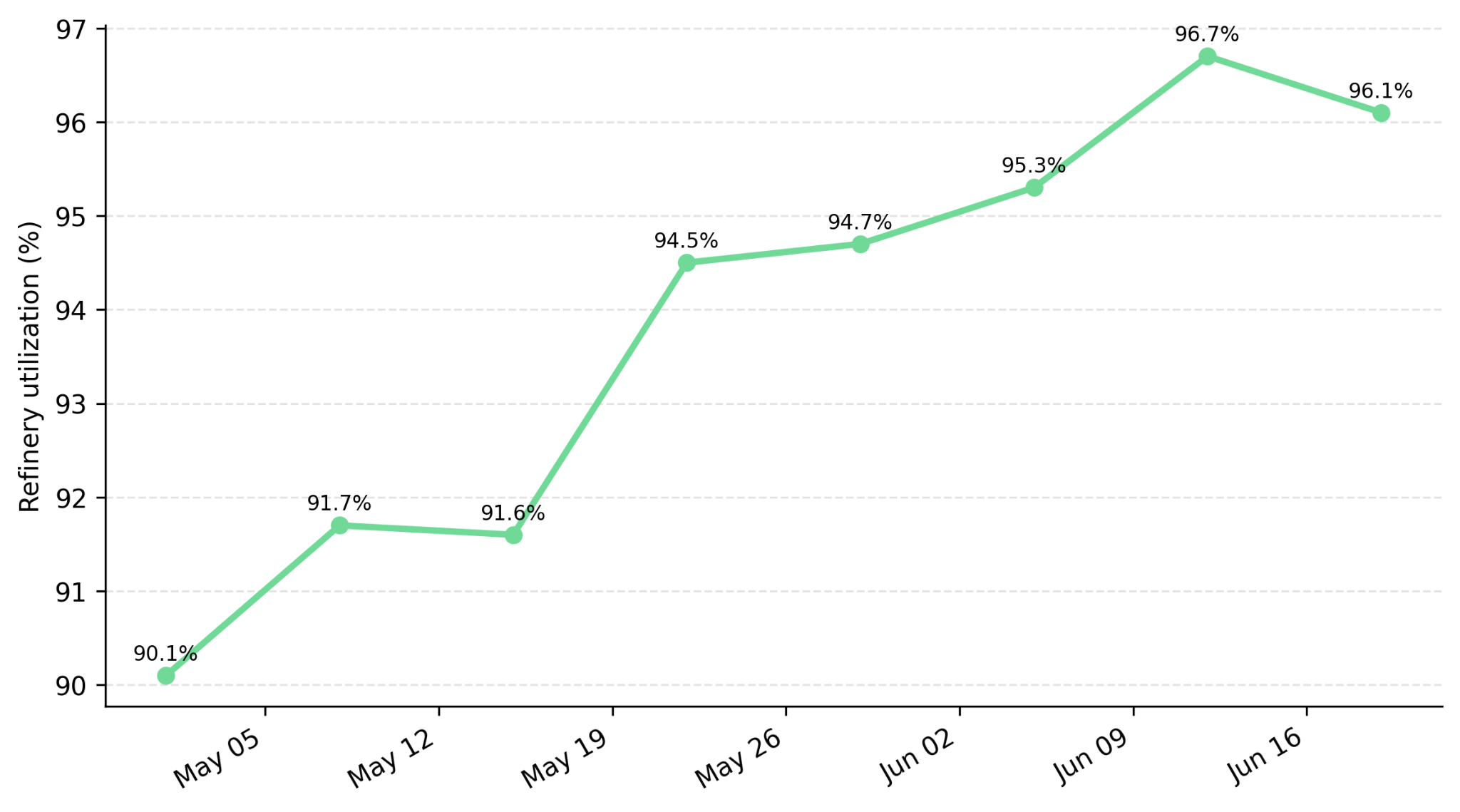
A refiner's operational resilience depends on whether it can replace Gulf crude imports with domestic or Western Hemisphere supplies within a quarter. Refiners that rely on Gulf crude face higher supply disruption risk than those sourcing primarily from domestic or Western Hemisphere producers.
EIA Distillate Inventories Signal Refinery Risk
Brent at $73.28 reflects expectations that the 60-day MOU will hold and shipping through the Strait of Hormuz will continue to normalize. Iran has exported 40 to 50 million barrels of crude since June 17, supporting global supply even as US crude and distillate inventories remain below their five-year averages. Maintaining that price will likely require a follow-on agreement before the 60-day MOU expires.
In the base case, the MOU is extended, Brent remains near $73 per barrel, and lower crude costs help US distillate inventories recover through H2 2026. In the bear case, negotiations fail, shipping through the Strait of Hormuz is disrupted again, Brent moves toward its war peak, and higher crude costs squeeze refinery margins. Brent would likely need to rise above $90 per barrel only if negotiations collapse and Hormuz disruptions resume or the conflict broadens beyond the MOU. Neither condition had occurred by July 1, 2026.
Distillate inventories falling to 12% or more below the five-year seasonal average in consecutive reports would indicate fuel demand continues to exceed inventory replenishment, increasing the risk that any renewed Hormuz disruption would drive diesel and heating oil prices higher.
Analyst's Notes





Subscribe to Our Channel




Stay Informed


