




US Strikes Push Brent Above $90 as Markets Price Physical Supply Losses, Not Just Geopolitical Risk



US strikes and disrupted Hormuz shipping lifted Brent above $90, raising mining fuel costs as markets shifted from geopolitical risk to supply losses.
- Nine consecutive nights of US strikes on Iran lifted Brent to $90.18 a barrel, up 2.4%, and WTI to $84.18, up 2.1%, as markets priced in higher Gulf supply risk.
- Tehran's reported strikes on two tankers cut Hormuz transit to a handful of vessels, reducing Gulf crude export flows and tightening near-term oil supply.
- Quantum Strategy's David Roche sees Brent trading at $95 to $105 a barrel in the base case, while AMP's Shane Oliver says Brent could approach $150 if reduced Hormuz transit cuts supply enough to force demand lower.
- With no timeline for the strikes or a Hormuz reopening, mining operators face greater uncertainty over diesel hedge duration and fuel cost planning.
- Brent falling below the pre-strike range, or a named ceasefire, would begin removing the Gulf risk premium from crude prices and reduce pressure on diesel costs.
Physical Supply Disruptions Replace Geopolitical Risk in Oil Pricing
Brent rose 2.4% to $90.18 a barrel while WTI gained 2.1% to $84.18. Brent closed above $90 a barrel for the first time in more than a month. The rally followed a ninth consecutive night of US strikes on Iran, raising concerns over Gulf oil supply.
Hormuz transit fell to a handful of vessels after Tehran said it struck two tankers, reducing Gulf crude export flows. Quantum Strategy's David Roche said the market has shifted from pricing the risk of disruption to pricing actual supply losses as shrinking Gulf exports tighten global crude balances.
Restricted Hormuz Transit Reduces Gulf Oil Exports & Extends Supply Uncertainty
US Central Command has targeted Iran's coastal surveillance, air-defense systems, maritime assets, and drone and missile storage sites, increasing the risks for vessels operating in the Gulf. US forces have also struck Islamic Revolutionary Guard Corps units linked to the July 17 attack in Jordan, broadening the scope of the conflict. As military operations expanded, tanker traffic through Hormuz fell to a handful of vessels, reducing Gulf crude exports and supporting higher oil prices.
The campaign has no defined end point because both Washington and Tehran continue military operations. US Central Command describes the operation as ongoing until Iran's ability to threaten shipping through Hormuz is reduced, rather than as a one-time retaliatory strike. Tehran's claim that it struck two vessels shows the contest over Hormuz continues, leaving no defined timeline for the conflict or Gulf shipping disruptions.
Persistent Supply Disruptions Widen Oil Price Scenarios & Extend Cost Uncertainty
Quantum Strategy's David Roche said US oil inventories could tighten by September as Gulf supply disruptions persist, supporting Brent prices in the $95 to $105 a barrel range.
Continued US strikes into September would keep Gulf supply disruptions in place, supporting Brent within David Roche's $95 to $105 a barrel range and extending higher diesel costs for mining operators through the third quarter of 2026.
If Hormuz transit remains limited to a handful of vessels and the conflict widens, Brent could approach $150 a barrel as higher prices ration demand against reduced Gulf oil supply. AMP's Shane Oliver said this is a high-risk rather than a base-case scenario. At those price levels, mining operators would face another increase in diesel costs until Gulf export flows recover.
Higher Oil Prices Raise Diesel Costs & Fuel Hedges Delay Margin Pressure
Diesel is a core operating input for open-pit and remote mines, powering haul trucks, generators, and processing equipment. The national average retail diesel price rose $0.218 to $4.796 a gallon in the week ending July 13, 2026, $1.038 above the year-earlier level. Higher Brent prices pass through wholesale fuel markets into diesel supply contracts, increasing operating costs and compressing mine cash margins before realized commodity prices can adjust.
Existing fuel hedge coverage determines how quickly higher diesel costs flow through to mine earnings. Rather than trying to predict when the conflict will end, investors should monitor weekly EIA oil inventories and Fed rate expectations. Oil inventories indicate whether supply constraints are easing, while interest-rate expectations shape miners' financing costs, together determining two of the largest pressures on operating margins.
What to Monitor: EIA Oil Inventories, Hormuz Transit, & Fed Rate Expectations
Continued US strikes and restricted tanker traffic through Hormuz would support Brent above $90 a barrel, sustaining higher diesel costs for mining operators. Separately, J.P. Morgan Chief Economist Bruce Kasman said "the balance of risks is shifting in the direction of an earlier hike," pointing to higher bond yields as a risk to gold. Gold slipped 0.1% to $4,013 an ounce Monday as rising yields offset some of the safe-haven demand generated by the conflict.
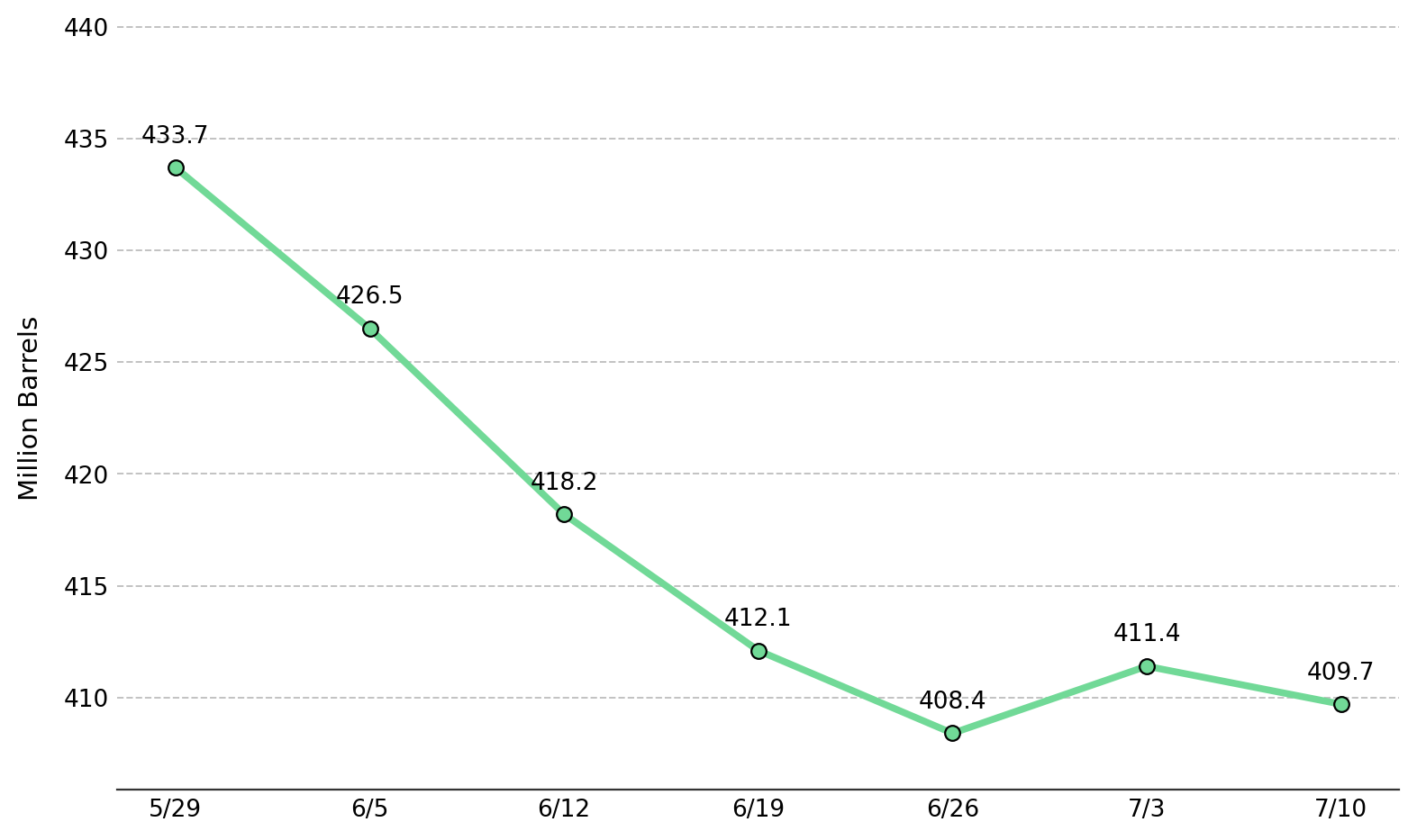
A ceasefire or Brent returning to the pre-strike range of $84 to $85 a barrel would signal that the Gulf risk premium is unwinding, easing diesel cost pressure for mining operators.
The EIA's Weekly Petroleum Status Report will show whether the 1.7-million-barrel crude inventory draw reported for the week ending July 10 continues, signaling tighter oil supplies, or reverses, indicating easing supply pressure. Fed rate expectations are the second key indicator, with futures implying a 60% probability of a September rate hike. Together, these indicators will determine whether fuel costs and financing costs continue to pressure mining operating margins.
Analyst's Notes





Subscribe to Our Channel





Stay Informed


