




China's 8.1% Refinery Run Drop Signals Crude Stock Builds, Pressuring Brent


High tanker rates may limit further declines, while unit costs, hedge coverage, and secure export routes help identify oil producers worth holding.
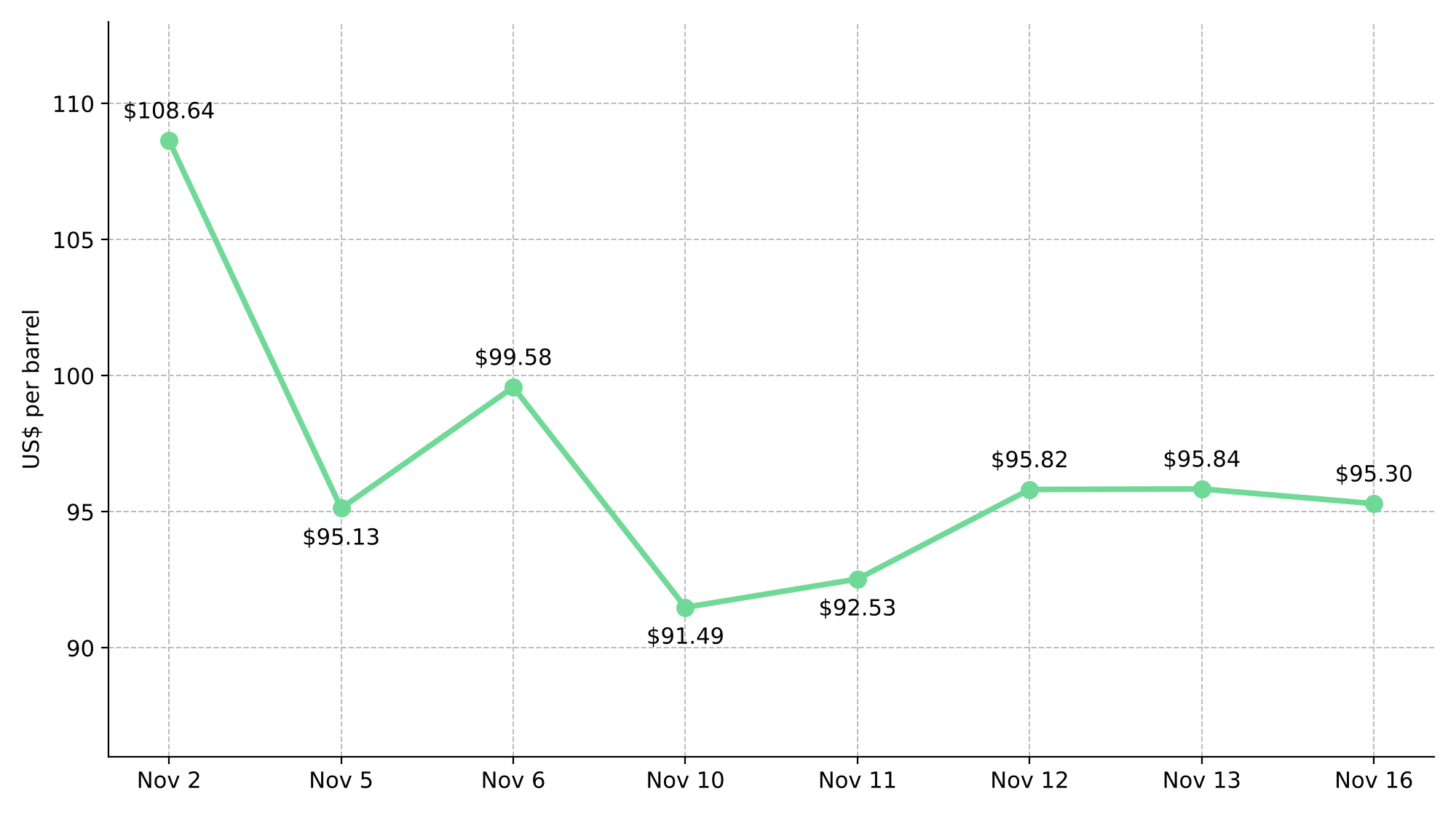
- Brent fell 0.6% to $95.30 a barrel on November 16, 2026, after China's National Bureau of Statistics (NBS) reported October refinery throughput 8.1% below a year earlier.
- Lower refinery runs alongside higher domestic output and imports left an implied 492,000 barrels per day flowing into Chinese crude storage in October.
- Brent retests its $91.49 November 10 settlement if the 1.7 million barrel per day fourth-quarter surplus forecast by the International Energy Agency (IEA) holds, while renewed Strait of Hormuz attacks point toward $99.58.
- High tanker rates and Iranian state media’s November 15 report of a tanker mine strike could delay further Brent declines despite the forecast oil surplus.
- Brent could recover if the IEA's December Oil Market Report restores its pre-November 13 forecast of a fourth-quarter supply deficit.
China's Refinery Slowdown Pulls Brent Down to $95.30
Brent crude futures fell 54 cents, or 0.6%, to $95.30 a barrel on November 16, 2026, while West Texas Intermediate (WTI) lost 22 cents to $88.34. The move followed NBS data released the same day showing Chinese refinery throughput in October fell 2% from September and 8.1% from October 2025.
On November 13, 2026, the IEA forecast that oil supply would exceed demand by 1.7 million barrels per day (bpd) in the fourth quarter, reversing its earlier deficit forecast. Three days later, China's refinery data showed lower crude processing, supporting the surplus forecast.
Excess Crude Supply Implies a 492,000-bpd Inventory Build
China's lower October refinery runs, alongside higher imports and domestic output, implied a crude inventory build of 492,000 bpd based on government data. However, satellite estimates showed onshore inventory draws of 7 million barrels at Kpler and 12 million at Vortexa, challenging the implied build. Recovering Middle East oil exports support the IEA's forecast for global supply to average 105 million bpd in the fourth quarter.
The IEA linked weaker oil demand to higher prices driven by the nine-month war, with negotiations still stalled. Its members will make 71 million barrels of emergency reserves available by the end of February 2027, providing a buffer against supply disruptions.
Tanker Scarcity Limits Further Price Declines
Hormuz transit risks and ship-to-ship transfers tie up tankers, keeping freight rates high. Tim Waterer, Chief Analyst at KCM Trade, said traders are weighing a potential oil surplus, but high shipping costs continue to support crude prices. Brent's 18.5% decline over two weeks nevertheless reduces revenue per barrel for producers selling at spot-linked prices.
Lower Spot Prices Compress Producer Cash Margins
Lower Brent prices compress cash margins for producers without forward sales because operating costs do not fall in step. US diesel buyers benefit as average retail prices decline from a record $6.519 to $5.998 per gallon.
Producers that bypass the Strait of Hormuz can deliver crude without its shipping risks, although their revenue remains exposed to Brent prices. Iraq exports crude by truck through Syria, while bypass pipelines and domestic refinery sales provide other routes to buyers.
BMI analysts project a preliminary agreement to reopen Hormuz in the first quarter of 2027, but neither party has confirmed a date. Holders of spot-priced producer equity have more to gain from reviewing hedge coverage and unit costs in quarterly filings than from positioning around an unconfirmed timeline, although hedge disclosures may be outdated by publication. Capital remains at risk under either scenario.
What Does China's Implied Stock Build Favor
China's lower refinery throughput and implied inventory build support the IEA's fourth-quarter surplus forecast as oil shipments through Hormuz recover. Despite continued shipping attacks, Brent has declined.
For spot-priced producers, falling Brent makes unit costs central to valuation as the war premium becomes less reliable. The IEA estimates that 2026 oil supply will be 4.8 million bpd below 2025 levels, compared with a 2.7 million bpd decline in demand, so the first surplus quarter could begin replenishing inventories drawn down earlier in the year. Lower prices could also restore some demand lost to earlier price increases.
For multi-year holders, the next step is to compare unit costs and hedge coverage in quarterly filings, then check whether producers can deliver crude without crossing Hormuz. This supports favoring low-cost producers with secure delivery routes rather than exiting crude entirely.
Analyst's Notes





Subscribe to Our Channel








Stay Informed


