




Dykes Extend GR Silver's San Marcial Silver Case Toward Depth: 6 Things to Know


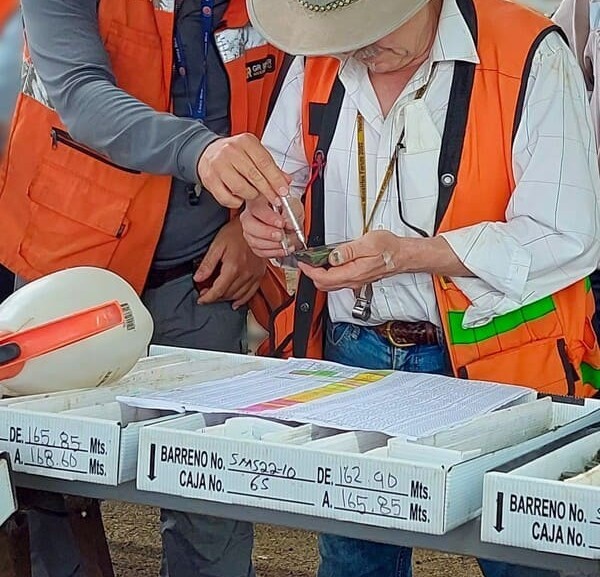
GR Silver's San Marcial dykes and intrusive-source model extend the silver case toward depth ahead of the first half 2027 resource update.
Why the Case Is Extending From Length to Depth
GR Silver Mining Ltd. (TSXV: GRSL | OTCQX: GRSLF | FRA: GPE) has traced silver-bearing breccia along strike at San Marcial in Sinaloa, Mexico, and that system now runs approximately 1 kilometer. The September 8, 2026 holes recorded dykes that silver mineralization cuts through, and GR Silver's model ties the silver to an intrusive body below the breccia.
1. Silver Mineralization Cuts Through Andesitic & Dioritic Dykes
Dykes are narrow sheets of igneous rock that intruded the host rocks before the silver arrived. At San Marcial, one of the September 2026 southeast holes intersected andesitic and dioritic dykes, and both silver and lead-zinc mineralization crosscut them. GR Silver interprets the cross-cutting relationship as showing that the mineralizing fluids were emplaced after the Oligocene intrusive complex.
The dyke rock is part of the reported silver zones. One interval, 42.35 meters (m) true width, averages 95 grams per tonne (g/t) silver and includes andesitic dyke, and a second interval, 11.7 m true width at 147 g/t silver, is logged as hydrothermal breccia and andesitic dyke. As of September 8, 2026, assays were pending from 7 holes.
2. Dykes Become More Consistent Toward the Southeast
The September 2026 step-out holes extended the breccia at least 300 m southeast and 75 m deeper than the 2023 resource boundary, and one hole found dykes becoming more consistent toward the southeast extension. GR Silver interprets them as subvolcanic Oligocene intrusive units, and reads the silver-bearing dykes and diorites at the southeast end as support for a closer relationship between the mineralization and an underlying intrusive body.
A total of 6 holes tested the southeast area, and dyke rock is logged within the reported silver zones of 2 of them.
3. The Geological Model Puts an Intrusive Body Under the Breccia
GR Silver President and Chief Executive Officer Eric Zaunscherb describes San Marcial as an intrusive body with hydrothermal breccia draped over it. Fluids and energy pulse out from the intrusion, break the rock, and reach dilation zones created by cross-cutting structures radiating from the intrusive body. He explained what happens in those zones:
"The depressurization as it hits that dilation zone allows the metal to drop out. Now we know that this happened at least 4, potentially 5 times."
The multistage breccias and stockwork zones in both host units indicate superimposed silver and polymetallic events. That overprinting has concentrated high-grade silver in wide, continuous, structurally controlled breccia zones along strike and at depth.
4. GR Silver Sees a Potential Epithermal-to-Porphyry Transition at Depth
The company's model allows for a transition from epithermal to porphyry-style mineralization at depth. Geochemical and structural vectoring studies are ongoing to evaluate the potential for large-scale mineralized systems beneath the breccia, and GR Silver describes the discovery as lying on the edge of a potential new porphyry system.
The 2023 resource holds 46 million ounces of silver indicated and 14 million ounces inferred at San Marcial. No completion date is stated for the vectoring studies, and the porphyry-style idea is a potential target under study with no resource figure yet.
5. Chasing the Zone Southeast Means Drilling Under Rising Ground
The deepest holes at San Marcial reach roughly 500 to 600 m, and the company wants to follow the dilation zone deeper toward the southeast. Zaunscherb described the constraint:
"We're chasing this beast down to the southeast at depth in a place where the topography goes up."
The next step is permitting an access tunnel that would serve as a drill station, supply a bulk sample for metallurgical studies, and could later be enlarged for production. An application at the end of 2026 and a permit in 2027 would allow underground drilling in late 2028. San Marcial as a standalone project is 5 to 7 years from any potential cash flow if everything goes according to plan, and an environmental impact assessment and a change of use for the property are still ahead.
6. The 20,000 m Program Is the Depth Test Ahead of the First-Half 2027 Update
About 7,000 m of the 20,000 m program is drilled, with roughly 13,000 m to go. Security issues, the rainy season, and access through the mountains from Durango slowed the pace, and the company has launched initiatives targeting re-acceleration in the fourth quarter. GR Silver has 3 rigs on site, one of which is being replaced, and it is targeting a 4th and possibly a 5th rig.
Facing pressure to cut off the database after only a few thousand m, GR Silver chose to complete the program so the update captures the results of the best hole to date and the holes drilled around it. The mineral resource estimate update and a preliminary economic assessment are both targeted for the first half of 2027.
What This Changes
The observed facts are dykes cut by silver and more of them toward the southeast. The upside case is depth: GR Silver reads the mineralization as open at depth with no indication of a significant decrease in grade or mineralization intensity, and sees a potential transition to porphyry-style mineralization at depth, which is a model output under study with no resource figure yet.
The next measurable points are assays from the 7 pending holes, the fourth-quarter drilling pace, the access tunnel application targeted for the end of 2026, and the mineral resource estimate update and preliminary economic assessment targeted for the first half of 2027.
Analyst's Notes





Subscribe to Our Channel

%20(1)%20(1).jpg)


Stay Informed






