From 47Mlb to 58Mlb in One Drill Campaign: Why Atomic Eagle's Zambia Project Is Coming Into Focus Just as Uranium Supply Runs Short


AEU grew its resource 24% to 58.8Mlb, declared a maiden 28Mlb ore reserve at US$32/lb opex, and still trades at a discount to peers as uranium heads toward a structural supply deficit.
- Atomic Eagle holds a 47.4Mlb uranium resource (40.0Mlb M&I) in Zambia, one of Africa's most mining-friendly jurisdictions.
- The stock trades at A$2.53 per pound of M&I resource, well below developer peers Deep Yellow (A$5.42/lb) and Bannerman Energy (A$3.33/lb).
- Global uranium reactor requirements are estimated at 68,920 tU in 2025, rising to over 150,000 tU by 2040 in the WNA Reference Scenario, representing a near-doubling of demand that existing supply cannot meet.
- The company is fully funded with A$20M cash and has launched its largest exploration campaign in 17 years.
- Upcoming catalysts including a JORC Exploration Target, drilling results, ESIA approval, and a Feasibility Study review create a dense near-term re-rating pipeline.
The Case for Uranium: Why Now?
The global energy transition has produced an unlikely winner: nuclear power. Once politically radioactive in the aftermath of Fukushima, nuclear is now being embraced by governments, utilities, and the technology sector alike. Google, Amazon, Microsoft, Meta, and Oracle have all moved to secure nuclear-backed electricity as part of their long-term energy strategies, adding a demand layer to uranium markets that simply did not exist in previous cycles.
The numbers back the thesis firmly. According to the World Nuclear Association (WNA), approximately 440 commercial nuclear power reactors are operable in over 30 countries today, with about 70 more under construction, 115 planned, and over 300 proposed worldwide. The WNA's 2025 Nuclear Fuel Report projects global reactor requirements of 68,920 tU in 2025, rising to over 150,000 tU by 2040 under the Reference Scenario and potentially exceeding 204,000 tU under the Upper Scenario. Global nuclear power capacity is forecast to nearly double from 398 GWe to 746 GWe by 2040.
"Imbalance in uranium supply and demand pointing to higher price."
Supply is where the real tension lies. The WNA's 2025 Nuclear Fuel Report projects that mine output from existing operations cannot keep pace with that demand growth. According to Cameco's 2025 supply and demand data, the uranium spot price averaged US$73.54 per pound for the full year, ranging from a low of US$63.17 per pound in March to a year-high of US$83.33 per pound in September. The long-term contract price reached a 14-year high of US$86.50 per pound in December 2025, a clear signal that utilities are now locking in supply at materially higher prices.
Who Is Atomic Eagle?
Atomic Eagle Limited (ASX: AEU) listed on the ASX in late 2025 following its acquisition of the former GoviEx Uranium assets in Zambia. What it inherited is significant: a JORC-compliant resource of 47.4Mlb U3O8 across five deposits, all sitting on Mining Licences within the Muntanga Project, a 1,126km2 tenement in Zambia's Karoo Sandstone Basin. The effective date of the mineral resource statement is 31 January 2024, prepared by SRK Consulting (Canada) in accordance with CIM Definition Standards.
The project is not a blank canvas. Previous technical studies confirm shallow open-pit mining with conventional acid leach processing, at least 90% uranium recovery with low acid consumption, sealed road access to site, nearby power and water within the Mining Licence boundary, and established export routes to both Western and Eastern markets. That combination puts Muntanga well ahead of most exploration-stage peers on the development readiness curve.
"Low technical risk, cost efficient operations."
The capital structure as at 26 November 2025 is straightforward: 391 million shares on issue, a market capitalisation of A$121 million, A$20 million in cash, and an enterprise value of A$101 million. On a per-pound-of-M&I-resource basis, that equates to A$2.53, a figure that becomes compelling when placed alongside the peer group.
Why Zambia? The Jurisdiction Advantage
In resource investing, jurisdiction is everything. Zambia ranks third in Africa for mining investment attractiveness according to the Fraser Institute's 2025 Annual Survey of Mining Companies, conducted between August and November 2025 across 256 respondents covering 68 jurisdictions globally, placing behind only Botswana in first and Morocco in second. The country is also the world's seventh-largest copper producer, with a mining industry that has drawn decades of international capital and built the supporting infrastructure to match.
The fiscal regime is investor-friendly: a 5% royalty rate, 30% corporate tax, no import duties or tariffs, and a 10-year carry-forward for tax losses. The geological setting adds a further layer of appeal. The Karoo Sandstone Basin, host rock for the Muntanga Project, is 30% larger than the western US uranium basins yet remains substantially under-explored. Coincident radiometric and radon anomalies have already been identified across the tenement, supported by cross-cutting geological structures consistent with uranium mineralisation seen at nearby significant deposits.
"Karoo Basin 30% larger than western US basins."
The Valuation Gap: Where the Opportunity Sits
Peer comparison is where Atomic Eagle's investment case becomes most concrete. As of 26 November 2025, AEU traded at A$2.53 per pound of M&I resource. Deep Yellow (ASX: DYL), developer-stage in Namibia and Australia, traded at A$5.42 per pound on a 250.7Mlb M&I resource base. Bannerman Energy (ASX: BMN), also developer-stage in Namibia, traded at A$3.33 per pound on 149.7Mlb M&I. Aura Energy (ASX: AEE) in Mauritania traded at A$3.58 per pound on 39.9Mlb M&I.
The valuation discount is striking on its own. The grade comparison makes it more so. Atomic Eagle's M&I resource grades at 359ppm U3O8, higher than Deep Yellow at 285ppm, Bannerman at 223ppm, and Aura at 220ppm. In mining economics, grade is a primary determinant of operating cost per pound of production. Higher grade generally means lower unit cost, making Atomic Eagle's resource quality an underappreciated part of the investment story.
"Peer comparisons provide proof of strategy, already undervalued on EV/Resource basis prior to significant resource growth program."
The company is clear about the path to closing that discount. The market rewards long-life, large-scale projects, as evidenced by the premium valuations carried by Deep Yellow and Bannerman. Atomic Eagle's largest-ever exploration campaign is designed to build exactly that kind of resource profile.
Drilling Down: What Is Happening Right Now?
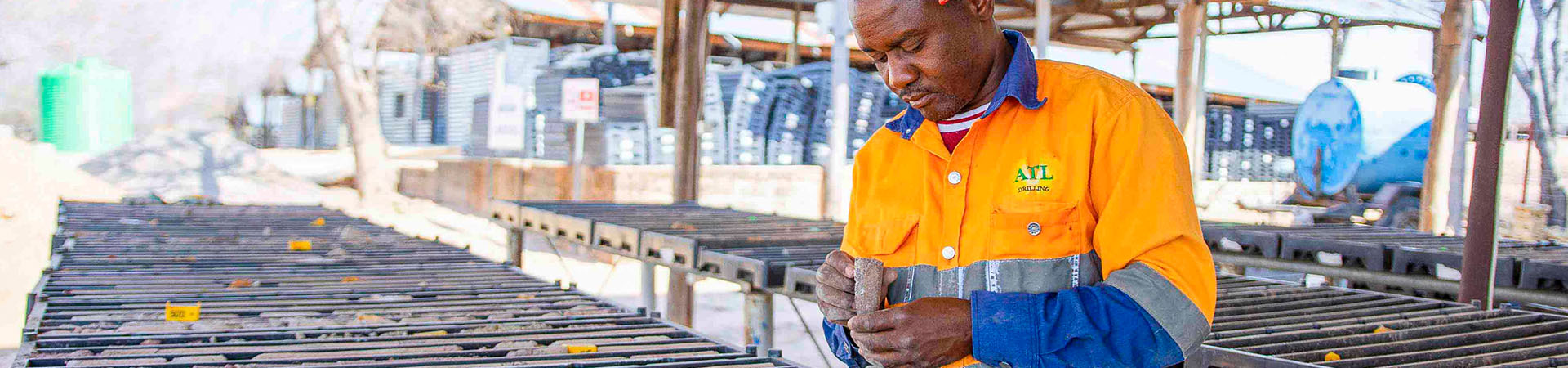
The Muntanga Project's five defined deposits give investors a clear picture of what already exists on the ground. Dibbwi East holds 29.6Mlb at 356ppm (Indicated). Muntanga Central contributes 9.1Mlb at 348ppm. Njame adds 3.5Mlb at 341ppm, Gwabi 2.9Mlb at 346ppm, and Dibbwi 2.3Mlb at 244ppm. All figures are as at the 31 January 2024 resource statement. The JORC Exploration Target, scheduled for release in December 2025, will provide the first formal estimate of the district's broader potential beyond these five deposits, a step the company believes could materially reframe market perception of the project's scale.
Drilling at Chisebuka and Muntanga East is active, with each result carrying its own newsflow potential. The broader market context amplifies the urgency. According to Cameco's 2025 data, approximately 116 million pounds of uranium was placed under long-term contracts by utilities that year, yet the annual contracted volume remained below replacement rate. Cumulative uncovered utility requirements are therefore growing, and that is precisely the environment in which a high-grade, district-scale resource becomes strategically valuable to utilities securing future supply.
"Fully funded for largest exploration program in 17 years."
The Price Signal: What the Data Actually Shows
The AEU presentation cites the WNA Nuclear Fuel Report 2025 to make a pointed argument: a uranium price of over US$100 per pound in inflation-adjusted terms would be required to incentivise new greenfield production at the scale achieved during the last development cycle. As at end-November 2025, Cameco reported the uranium spot price at US$75.80 per pound and the long-term contract price at US$86.00 per pound, the highest long-term price of the year and up 8.86% year-to-date.
Sprott Asset Management described the long-term price move as evidence that utilities are accepting higher prices in long-term contracts, with the spot price characterised as well-supported and carrying potential for a catch-up trade in 2026. The OECD NEA and IAEA's 2024 Red Book was equally direct, stating that substantial investment in new mining projects will be essential and that, given the long lead times for project development, identifying and advancing new projects in the near to medium term is crucial to avoid potential supply disruptions.
"District-scale growth opportunity in known uranium belt."
The Investment Thesis for Atomic Eagle
- Buy the valuation gap. AEU trades at A$2.53/lb M&I versus developer peers at A$3.33 to A$5.42/lb. Closing that gap through resource growth would deliver material upside to patient investors.
- Watch the December 2025 Exploration Target. The first formal district-wide resource estimate is the most important near-term re-rating catalyst on the calendar.
- Monitor the long-term uranium contract price. At US$86.00/lb at end-November 2025, it is trending toward the WNA-identified greenfield incentive threshold of over US$100/lb.
- Track drilling results from Chisebuka and Muntanga East. Each result provides geological confirmation of the exploration model and a foundation for future resource upgrades.
- Consider jurisdiction quality. Zambia ranks 3rd in Africa for mining investment attractiveness in the Fraser Institute 2025 survey, with a 5% royalty rate and no import duties.
- Size positions for exploration-stage risk. Development and production remain uranium-price dependent. Diversify across the uranium equity space accordingly.
Atomic Eagle enters the public markets at a structurally compelling moment. The WNA projects global reactor uranium requirements to rise from 68,920 tU in 2025 to over 150,000 tU by 2040 under the Reference Scenario. The OECD NEA and IAEA are unambiguous: substantial new mine investment is essential, and the lead times for that investment are long. At A$2.53 per pound of M&I resource, with A$20 million in cash, a high-grade resource grading 359ppm M&I, a fully funded drill campaign, and a dense near-term catalyst pipeline, Atomic Eagle offers a rare early entry point into the uranium story before the market re-rates it to peer levels.
The risks are equally clear. This is an exploration-stage company. Mineral resources are not mineral reserves. The uranium spot price at US$75.80/lb at end-November 2025 remains below the greater-than-US$100/lb inflation-adjusted threshold the WNA identifies as necessary to incentivise new large-scale greenfield supply. Development and production timelines are uncertain. Investors should seek independent financial advice before acting.
The opportunity and the risk exist in the same place: a high-grade, district-scale uranium asset in a mining-friendly jurisdiction, trading at a discount to every comparable peer, with the biggest exploration program in its history now underway. Whether that discount closes will depend on what the drills find.
TL;DR
In the weeks since listing on the ASX in November 2025, Atomic Eagle has already delivered a 24% resource upgrade to 58.8Mlb U3O8, declared a maiden ore reserve of 28.0Mlb at 320ppm, confirmed a 12-year mine life and US$32.20/lb operating cost through an independently reviewed feasibility study, and outlined an Exploration Target of 40 to 100.5Mlb sitting on top of the existing resource base. The discovery cost came in at approximately US$0.05 per pound, against a uranium spot price near US$89/lb at the time of announcement. The stock still trades at a meaningful discount to developer-stage peers. For investors watching a uranium market that Goldman Sachs forecasts will reach US$91/lb by end-2026, the question is whether that discount can last.
FAQs (AI-Generated)
The Muntanga Uranium Project in Zambia, a 1,126km2 tenement with a JORC resource of 47.4Mlb U3O8 across five deposits on Mining Licences, with an effective resource date of 31 January 2024.
AEU trades at A$2.53/lb M&I resource versus developer-stage peers Deep Yellow (A$5.42/lb), Bannerman (A$3.33/lb), and Aura Energy (A$3.58/lb), despite carrying a higher average M&I grade of 359ppm than all three.
The JORC Exploration Target for the Muntanga Project area, expected in December 2025, which provides the first formal view of the broader district's resource potential beyond the five currently defined deposits.
The WNA Nuclear Fuel Report 2025 implies over US$100/lb in inflation-adjusted terms. The uranium spot price was US$75.80/lb and the long-term price was US$86.00/lb at end-November 2025.
Exploration-stage execution risk, uranium price dependency for any development decision, the absence of a completed mineral reserve estimate, and no current development approval.
Analyst's Notes





Subscribe to Our Channel








Stay Informed