




Gold Slips Toward $4,000 as Rate-Hike Bets Rise: Physical Demand Offers a Floor


Gold fell 3.4% as rising December Fed rate-hike odds outweighed dollar and yield support, with investors watching key $4,000 support and physical demand.
- Gold fell 3.4% for the week as May PPI posted its largest annual increase in 3.5 years, lifting expectations for a December Fed rate hike and increasing the opportunity cost of holding non-yielding assets.
- Traders are pricing a 60% probability of a December Fed rate hike, while ANZ cut its year-end gold target by $400 to $5,200 and SPDR Gold Trust holdings fell 0.3%, signaling weaker institutional sentiment.
- Gold remained under pressure despite a 0.41% decline in the dollar index and an 8.7-basis-point drop in the 10-year Treasury yield, indicating that rate expectations currently outweigh traditional macro support.
- Physical demand improved as India's dealer discounts narrowed from $87 to $35 per ounce and the PBoC increased gold reserves for a 19th consecutive month, providing support as gold approached the $4,000 level.
Energy-Driven Inflation Lifts December Rate-Hike Odds
Spot gold fell 0.7% to $4,183.19 per ounce and was on track for a 3.4% weekly loss. August gold futures rose 2.2% to $4,204.40 after gold rebounded from a six-month low of $4,022.29. Gold closed at $4,219.69 after Trump cancelled planned military strikes on Iran, though Iran said no final agreement had been reached. Spot silver fell 1.8% to $66.13 per ounce and platinum lost 0.3% to $1,715.44, while palladium rose 1.6% to $1,289.75 and was up about 5% for the week.
May US producer prices recorded their largest annual increase in 3.5 years as higher energy costs linked to the Iran conflict lifted inflation. Gold has fallen about 20% since the war began as rising inflation increased expectations for rate hikes and raised the opportunity cost of holding a non-yielding asset. Traders are pricing a 60% probability of a December US rate hike.
Gold Falls 3.4% Despite a Weaker Dollar & Lower Yields as Rate Expectations Dominate
Gold's weekly loss reflects inflation-driven rate-hike expectations that could persist even if a ceasefire is announced. May PPI recorded its largest annual increase in 3.5 years as higher energy costs linked to the Iran war lifted inflation. Even if Strait of Hormuz shipping resumes, the inflation data could continue supporting expectations for a December Fed rate hike. SPDR Gold Trust holdings fell 0.3% to 923.89 metric tons, indicating reduced institutional exposure.
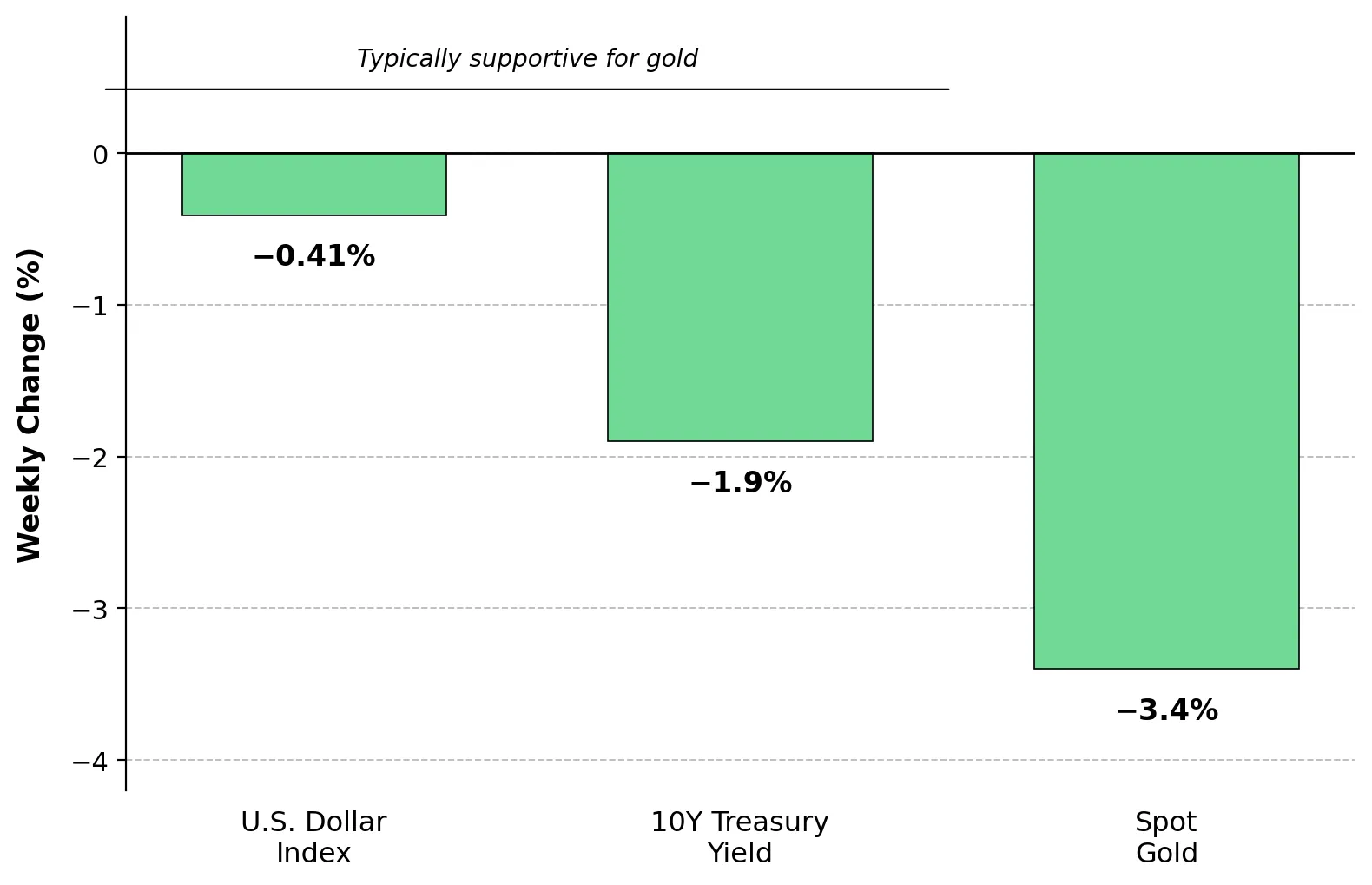
Gold remained under pressure despite typically supportive macro conditions. The dollar index fell 0.41% to 99.64 and the 10-year Treasury yield declined 8.7 basis points to 4.453%, yet gold still tracked a 3.4% weekly loss. ANZ also cut its year-end gold price target by $400 to $5,200, signaling a more cautious outlook.
Gold's $4,000 Support Hinges on December Rate-Hike Expectations
A recovery in gold would likely require a ceasefire, restored Strait of Hormuz shipping, and lower energy prices. Edward Meir said Fed guidance may become a more important driver than geopolitical developments, warning that hawkish signals could push gold below $4,000 even without a rate hike.
In the base case, a peace agreement and lower rate-hike expectations could help gold stabilize above $4,000, with ANZ's $5,200 target implying upside from current levels. In the bear case, December rate-hike odds rise above 70% before a formal deal is reached, pushing gold below $4,000 and increasing pressure on producer margins. At 60%, the implied probability remains the key indicator for investors to monitor.
India Demand Improves & PBoC Extends Buying Streak, but Higher Tariffs Limit Growth
Gold producers face pressure from lower gold prices, higher operating costs, and reduced institutional exposure. Spot gold fell 3.4% for the week, while May PPI reached a 3.5-year high, reflecting energy-driven inflation that raises mine-site costs. SPDR Gold Trust holdings also fell 0.3% to 923.89 metric tons, indicating lower investor exposure.
Physical demand is providing some support as India's dealer discounts narrowed from $87 to $35 per ounce and the PBoC increased gold reserves for a 19th consecutive month. However, India's higher import duties may limit demand growth. Gold's next major move may depend more on Fed signals than Iran peace talks, with a rise in December rate-hike odds from 60% to 70% increasing downside risk for gold and gold equities.
December Rate-Hike Odds & Iran Deal Progress Will Determine Gold's Next Move
The implied 60% probability of a December Fed rate hike remains a key driver of gold weakness. May PPI recorded its largest annual increase in 3.5 years, strengthening the case for higher rates. Despite a weaker dollar and lower Treasury yields, gold still posted a 3.4% weekly loss, indicating that rate expectations outweigh traditional macro support.
Edward Meir and Peter Fung both identified $4,000 as a key support level for gold. While a formal Iran peace agreement could reduce inflation pressure, investors are focused on Fed signals after December rate-hike odds briefly reached 70% earlier this week. A return to that level would increase downside risk for gold and gold equities.
Analyst's Notes





Subscribe to Our Channel




Stay Informed






















