




GR Silver Mining’s Depth Extension as a Valuation Multiplier


GR Silver extends San Marcial mineralisation to 500m depth, signalling resource growth, lower unit costs, and potential valuation upside ahead of 2026 MRE and PEA.
- High-grade silver mineralisation confirmed to 500 metres depth at San Marcial, with geological indicators suggesting the system remains open for at least another 100 metres, distributing fixed development costs across more tonnes and reducing mining cost per tonne extracted.
- Recent drilling discovered two distinct mineralised zones, including an upper zone in a previously barren andesitic dyke, opening new exploration potential above the main hydrothermal breccia system.
- The 20,000-metre step-out drilling programme targets expansion of the 134 million ounces silver equivalent resource base at C$0.17 cost of discovery per ounce silver, positioning the company to compress enterprise value per ounce metrics.
- The second-half 2026 Mineral Resource Estimate (MRE) update will incorporate drilling results and feed directly into the first Preliminary Economic Assessment (PEA) modelling production scenarios, capital requirements, and project-level economics.
- San Marcial is characterised as a silver discovery on the edge of a porphyry system rather than an isolated epithermal vein, with recent drilling defining the boiling zone boundary to vector future high-grade targets at depth.
What Has Happened
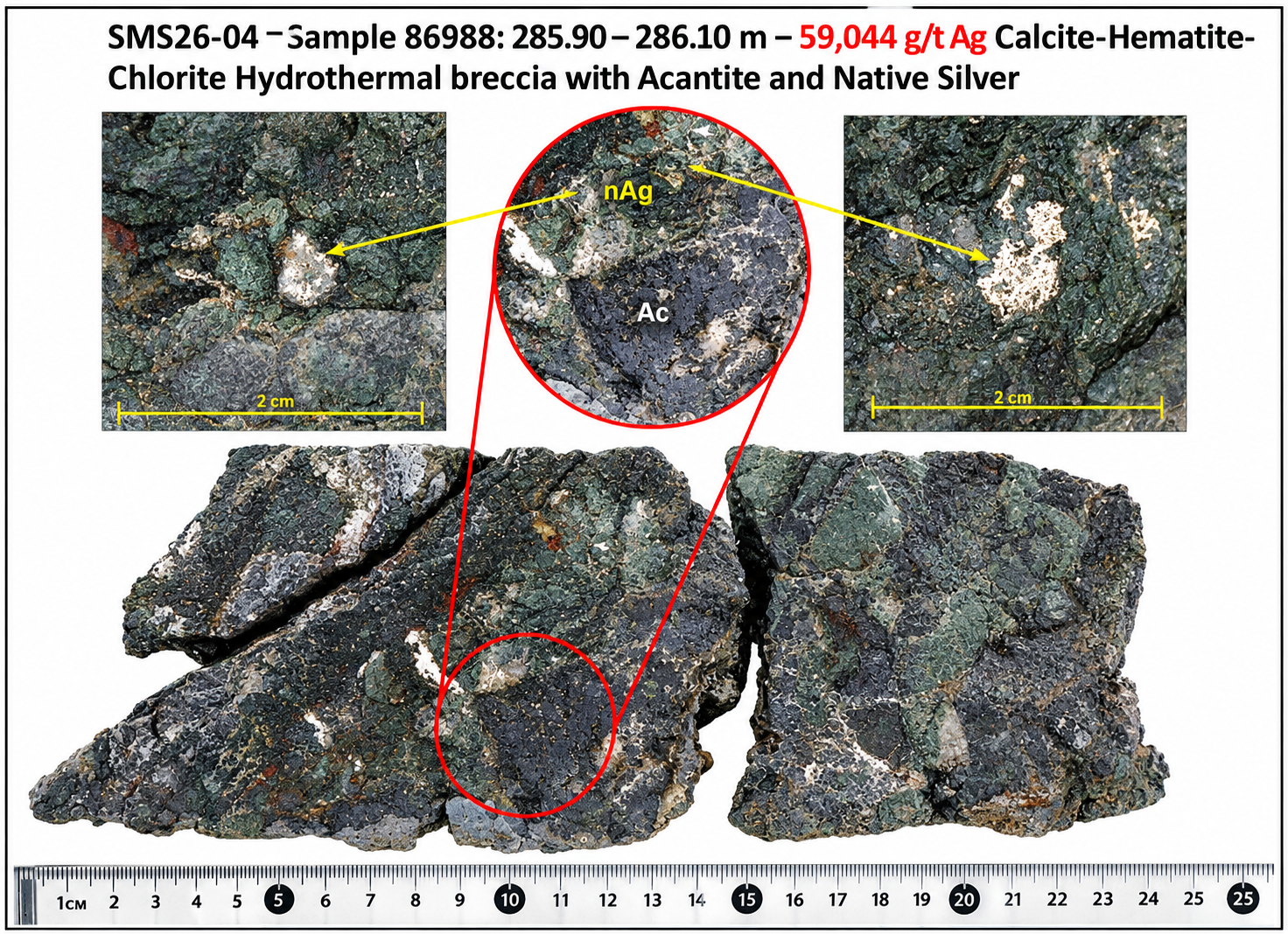
GR Silver Mining (TSXV: GRSL | OTCQX: GRSLF | FRA: GPE) has confirmed high-grade silver mineralisation continuity to 500 metres down dip from surface in the San Marcial Southeast (SE) Area. Recent drilling returned 15.6 metres at 351 grams per tonne (g/t) silver, including 2.5 metres at 1,395 g/t silver, alongside two distinct mineralised zones: an upper zone within an andesitic dyke returning 6.45 metres at 498 g/t silver and a lower zone in chlorite-hematite-rich breccias returning 61.15 metres at 15 g/t silver. The intercepts were completed as part of the company's 20,000-metre step-out drilling programme targeting resource expansion, with two drill rigs on site and additional rigs in transit to complete the programme by the second half of 2026.
Vertical Continuity Extends Economic Depth & Reduces Mining Unit Costs
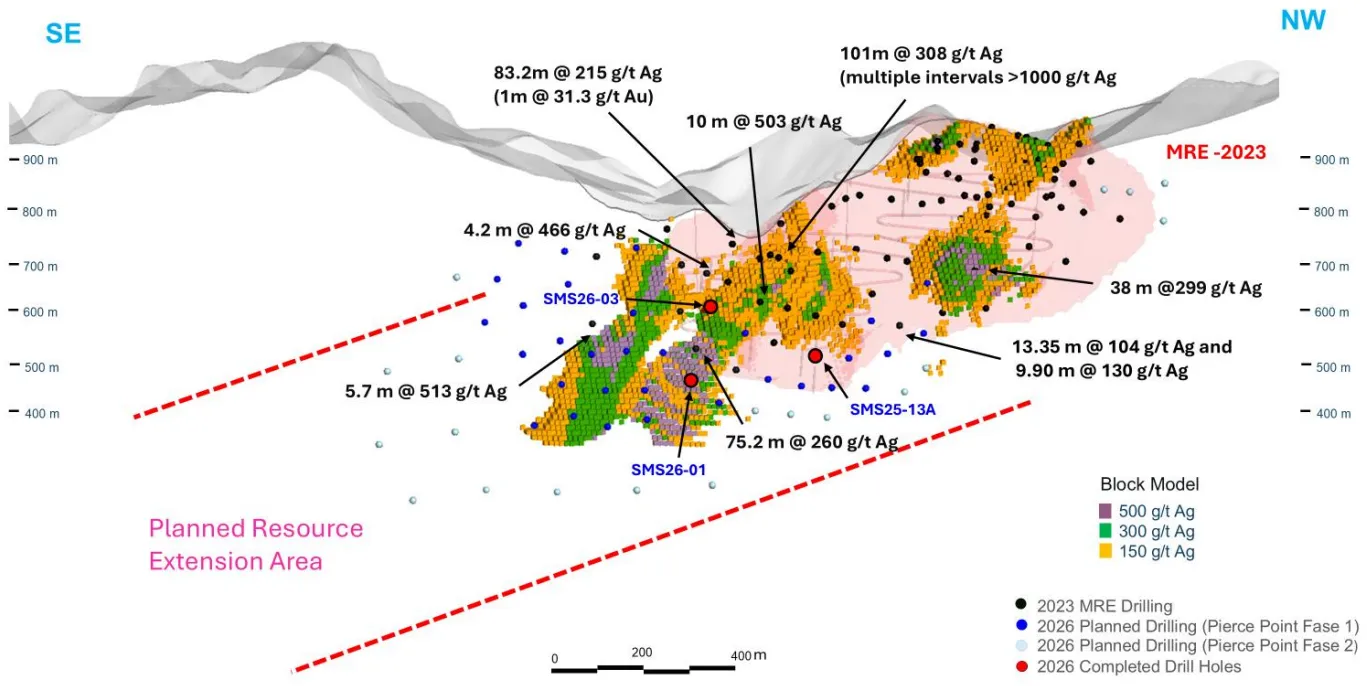
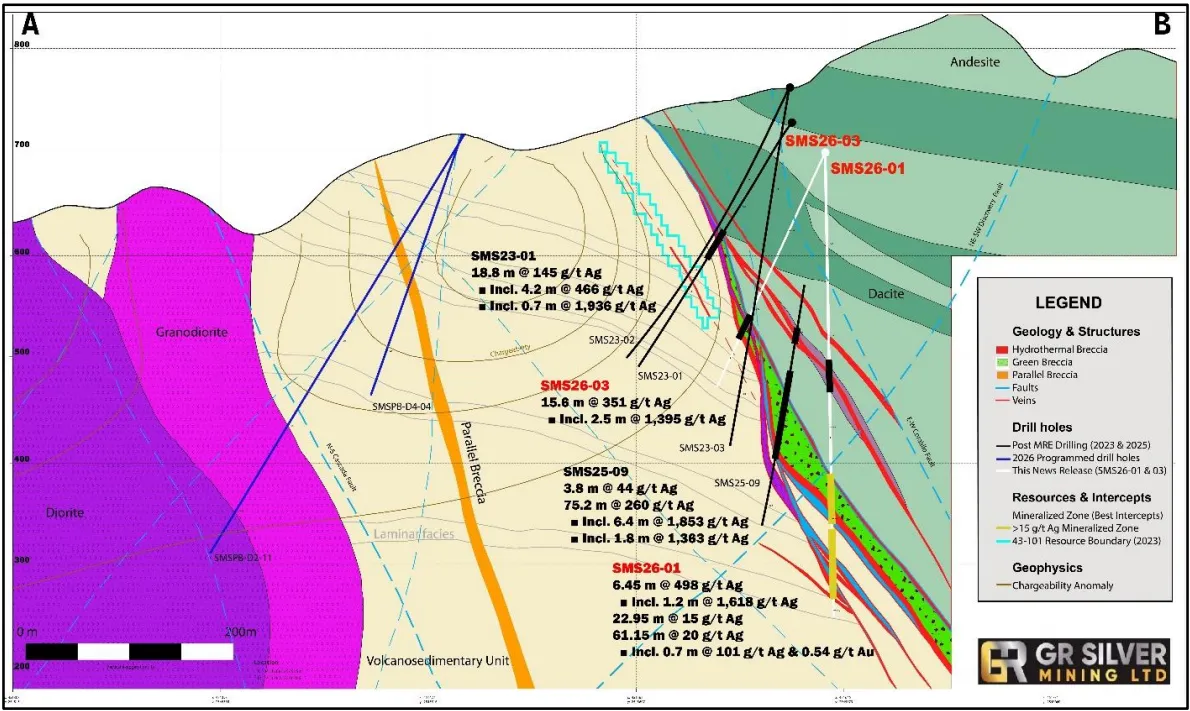
The recent release confirms high-grade silver mineralisation at San Marcial persists to 500 metres depth in the SE Area, extending the vertical envelope of economic mineralisation beyond the 2023 Mineral Resource Estimate (MRE) footprint. The 2023 MRE reported 134 million ounces of silver equivalent across the combined San Marcial (68 million ounces of silver equivalent) and Plomosas (66 million ounces of silver equivalent) resource areas. Recent drilling sits between earlier intercepts of 18.8 metres at 145 g/t silver and 75.2 metres at 260 g/t silver, confirming continuity of high-grade silver mineralisation within chlorite-hematite-rich breccias from surface to 500 metres depth.
The release states that boiling textures with calcite and high-grade silver minerals suggest high-grade silver mineralisation should remain open at depth for at least another 100 metres below current intercepts. If confirmed through further drilling, this would position the system's base at 600 metres depth or deeper, which distributes fixed development costs across more tonnes and reduces mining cost per tonne extracted. The San Marcial Resource Area, with a Planned Resource Extension Area extending below and alongside the existing 2023 MRE block model, illustrates expansion potential both vertically and laterally.
Multiple Mineralised Structures Expand Lateral Footprint & Target Inventory
Recent drilling intersected two distinct mineralised zones controlled by the intersection of the northwest-southeast trending San Marcial breccia and northeast-trending faults. The upper zone in an andesitic dyke cross-cutting the upper Oligocene volcanic sequence was previously interpreted as barren, and this intercept opens new exploration potential in the upper part of the system above the hydrothermal breccias. The lower zone, hosted within chlorite-hematite-rich breccias approximately 75 metres below an earlier high-grade interval, comprises a broad interval of continuous low-grade silver mineralisation, indicating the system remains open at depth.
The company confirms multiple sub-parallel silver mineralised zones were discovered in 2025 and identifies distinct structures in a 3D geological model, including a Chlorite-Rich Hydrothermal Breccia, a Discovery Parallel Breccia, and a Silicified Breccia. A plan map shows the San Marcial Chargeability Anomaly remains 80% untested, and additional drill rigs will start targeting the Parallel Breccia target located approximately 300 metres from the 2023 Resource Area. The release notes that this target is influenced by granodiorite and diorite intrusions and supports the definition of a large mineralised system hosted along the edge of a regional porphyry intrusive with northwest-southeast-trending breccias parallel to the main San Marcial trend that could expand the size of the deposit.
134 Million Ounces Silver Equivalent as a Platform for Resource Growth
The Plomosas Project holds a combined 134 million ounces of silver equivalent (2023 MRE) across San Marcial and Plomosas, described as growing in connection with the planned 2026 MRE update. The 20,000-metre step-out drilling programme is actively driving resource expansion and de-risking, with ongoing drilling confirming resource growth. The company references the project's blue sky potential and resource growth, framing current resources as a starting point for expansion through ongoing drilling rather than a static inventory.
The release states recent results, together with geochemical modelling, advanced petrographic studies, and a robust geological and structural model, provide strong confidence in defining a significantly larger epithermal system. The company's low cost of discovery per ounce of silver stands at C$0.17, leveraging from the discovery of wide high-grade silver mineralisation. If the 20,000-metre step-out programme delivers comparable discovery rates, total resource ounces could increase substantially relative to capital deployed, compressing the enterprise value per ounce silver equivalent metric.
Resource Expansion Feeds Second-Half 2026 MRE Update & PEA Economics
The company's value creation roadmap includes a Resource Update & PEA as major catalysts for the second half of 2026, with maiden economics planned. The MRE update will incorporate results from the 20,000-metre step-out drilling programme, including depth extension and lateral expansion drilling at San Marcial SE Area and the Parallel Breccia target. The PEA will be the first economic study to model production scenarios, capital requirements, operating costs, and project-level economics for the combined Plomosas Project, incorporating both San Marcial and Plomosas resource areas.
The company is de-risking through permit expansion and integration of the San Marcial and Plomosas areas, with a five-year drill permit granted in September 2025, allowing step-out drilling without permitting delays through at least 2030. Existing infrastructure at the Plomosas Mine, described as a past-producer mine with permits that offer restart time efficiencies, reduces the capital intensity of initial production scenarios relative to greenfield projects. The company is advancing Bulk Sample Test Mining (BSTM) with infrastructure and permits, targeting commencement in 2026, with 21 underground areas accessible for BSTM. If the BSTM programme validates metallurgical assumptions and processing costs, the PEA's economic model will carry reduced uncertainty on recovery rates and unit operating costs
Intrusive-Related Porphyry Setting Positions San Marcial as a District-Scale System
The company characterises the San Marcial Area as a silver discovery on the edge of a new porphyry system, with geological modelling supporting the definition of a large mineralised system hosted along the edge of a regional porphyry intrusive. This geologic setting positions San Marcial within a broader porphyry district rather than as an isolated epithermal vein system, which carries implications for exploration scale and vertical extent. Recent drilling confirms the Central Area shows an increasing tendency to lead and zinc grades, with an intercept including 0.65 metres at 54 g/t silver, 7.8% lead, and 0.6% zinc, helping define a potential boundary of the boiling zone and supporting the theory that the plunge of mineralisation trends toward the southeast at depth.
What to Watch Next
The 20,000-metre step-out drilling programme remains the near-term operational focus, with two drill rigs on site and additional rigs in transit to complete the programme by the second half of 2026. Results from the Parallel Breccia target will indicate whether the lateral footprint expands beyond the current resource envelope, while additional depth extension drilling below 500 metres will test whether high-grade silver mineralisation persists another 100 metres deeper.
The second-half 2026 MRE update will incorporate step-out drilling results, with the magnitude of resource growth determining whether depth extension and lateral expansion materially change project scale. This feeds directly into PEA economics through higher throughput scenarios, longer mine life, and improved unit cost structures. The BSTM programme at Plomosas, targeting commencement in 2026, will validate metallurgical recovery assumptions and processing costs. The PEA will deliver the first project-level economics, including capital expenditure, operating costs, mine life, net present value (NPV), and internal rate of return (IRR), with sensitivity analysis quantifying the impact of resource growth on project NPV.
FAQs (AI-Generated)
Analyst's Notes





Subscribe to Our Channel




Stay Informed






