




India's 15% Gold Tariff Is Crushing Demand Just as Brazil's Permit Crackdown Threatens Supply



India's gold tariff hike and Brazil's ghost-permit scandal are creating conflicting supply and demand signals for gold investors worldwide.
- India's increase in gold import tariffs to 15% from 6% widened dealer discounts to $106/oz, indicating that lower prices alone are not yet sufficient to revive physical demand.
- Chinese gold premiums narrowed to $9-12/oz from $10-20/oz as buyers delayed purchases, signaling weaker end-user demand across Asia's two largest physical gold markets.
- Permits linked to 98 inactive Brazilian forest areas were used to justify 26.8 tonnes of gold production between 2018 and March 2026, allowing potentially illegal supply to enter formal commercial channels.
- Indian jewellers remain unwilling to rebuild inventories despite lower domestic prices, suggesting physical orders and wholesale demand may remain subdued in the near term.
- Gold's next directional move may depend on whether spot prices hold near $4,360/oz and whether Chinese premiums break above $12/oz, two signals that would indicate renewed investor and physical buying interest.
Indian Tariffs & Chinese Buying Delays Are Suppressing Demand Before Brazil Can Tighten Supply
Spot gold fell to $4,365.76/oz on May 29 before recovering on reports of a potential US-Iran ceasefire. The more consequential development was unfolding in Asia's physical market. Indian dealer discounts widened to $106/oz from $78/oz a week earlier after import tariffs increased to 15% from 6%, while Chinese premiums narrowed to $9-12/oz from $10-20/oz as buyers delayed purchases amid Middle East uncertainty.
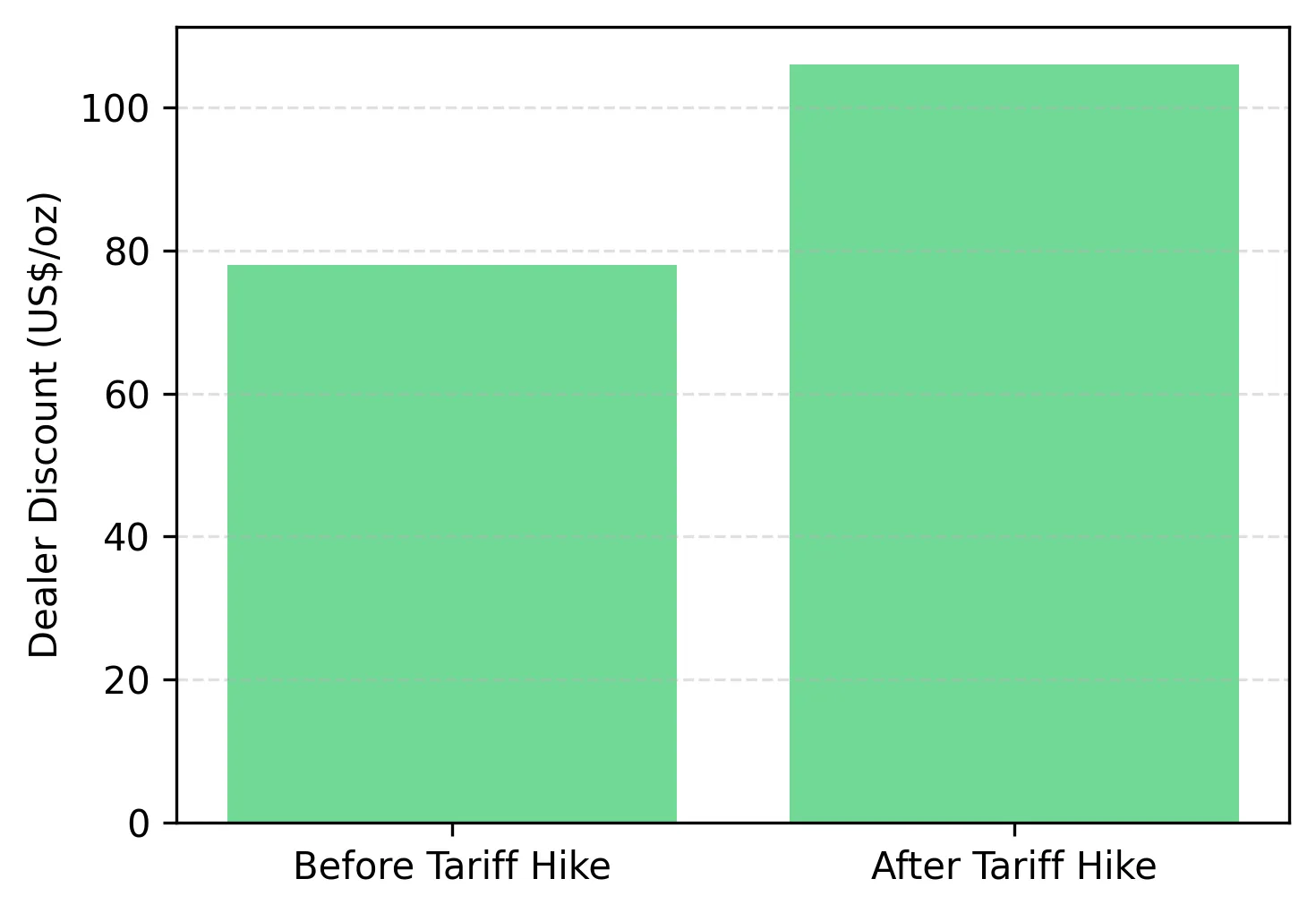
Physical premiums and discounts are among the market's clearest measures of end-user demand. Their simultaneous deterioration across India and China suggests lower prices are not yet attracting meaningful buying interest. This matters as weakening physical demand is occurring at the same time that Brazilian permit enforcement threatens future supply, leaving gold investors with a market where demand signals and supply signals are moving in opposite directions.
Ghost Permits Linked to 26.8 Tonnes of Gold Keep Brazilian Supply in Commercial Markets
A Greenpeace study identified 98 inactive forest areas whose permits were used to validate gold production elsewhere. Documentation linked to inactive concessions can still accompany gold shipments, allowing refiners and traders to accept material supported by apparently legitimate paperwork. Reuters reported that permits associated with these inactive areas were used to justify 26.8 metric tons of gold production between 2018 and March 2026.
President Luiz Inácio Lula da Silva pledged in 2023 to eliminate illegal mining, but Reuters reported that Brazil's mining regulator continues to face oversight challenges across thousands of permits. This shifts the key supply variable from mine output to regulatory enforcement. Any tightening of permit verification could remove previously accepted supply from commercial channels, altering market availability without a corresponding change in production capacity.
Indian Jewellers Are Refusing to Rebuild Inventories Despite Lower Gold Prices
A Mumbai-based dealer working with a bullion-importing bank told Reuters that jewellers remain unwilling to build inventories despite lower domestic prices. This carries more investment significance than daily spot-price moves because inventory decisions determine future physical orders.
Jewellery retailers face weaker turnover as consumers delay purchases following the tariff increase. Gold producers face a different risk: enforcement actions that remove illegally sourced supply could tighten market availability even as retail demand remains weak. Those forces operate on different timelines, creating conflicting signals for investors.
Brazilian enforcement actions are difficult to trade because regulators control the timing. Indian discounts, Chinese premiums, and jeweller inventory activity provide more reliable indicators of whether physical demand is returning.
$4,360/oz Gold & $12/oz Chinese Premiums Are the Key Signals for Demand Recovery
The first level to watch is $4,360/oz. Peter Fung told Reuters that buying interest could emerge near that price. A sustained defence of $4,360/oz would indicate that investors remain willing to accumulate gold despite weak physical demand in Asia, limiting further downside pressure.
The second indicator is China's current premium range of $9-12/oz. Physical premiums reflect the willingness of end-users to purchase metal at prevailing prices. A sustained move above $12/oz would suggest that Chinese buyers are returning to the market and that demand is recovering rather than simply stabilising.
Until either signal changes, the gold market remains caught between weak physical demand and unresolved supply risks. Indian discounts continue to point to cautious consumer buying, while uncertainty surrounding Brazilian permit enforcement clouds the outlook for future supply. This combination makes it more difficult for investors to determine whether price movements reflect changing fundamentals or short-term shifts in market sentiment.
Analyst's Notes





Subscribe to Our Channel



Stay Informed


