




Indonesia's Second Lever: How the April 2026 HPM Reform Reshapes the Nickel Cost Curve


Indonesia's April 2026 HPM reform raises the cost floor for NPI and HPAL producers. Here is what changed, who absorbs the burden, and where Crawford sits.
- Indonesia's April 2026 Harga Patokan Mineral (HPM) formula reform raises the minimum cost of producing ore already restricted in volume by the country's December 2025 quota measures, two levers operating through distinct mechanisms.
- The April 2026 HPM reform raised the nickel pig iron (NPI) metal-price percentage from 17% to 30% and added previously free byproducts to the ore price calculation, lifting Indonesian ore prices by 5% to 6%.
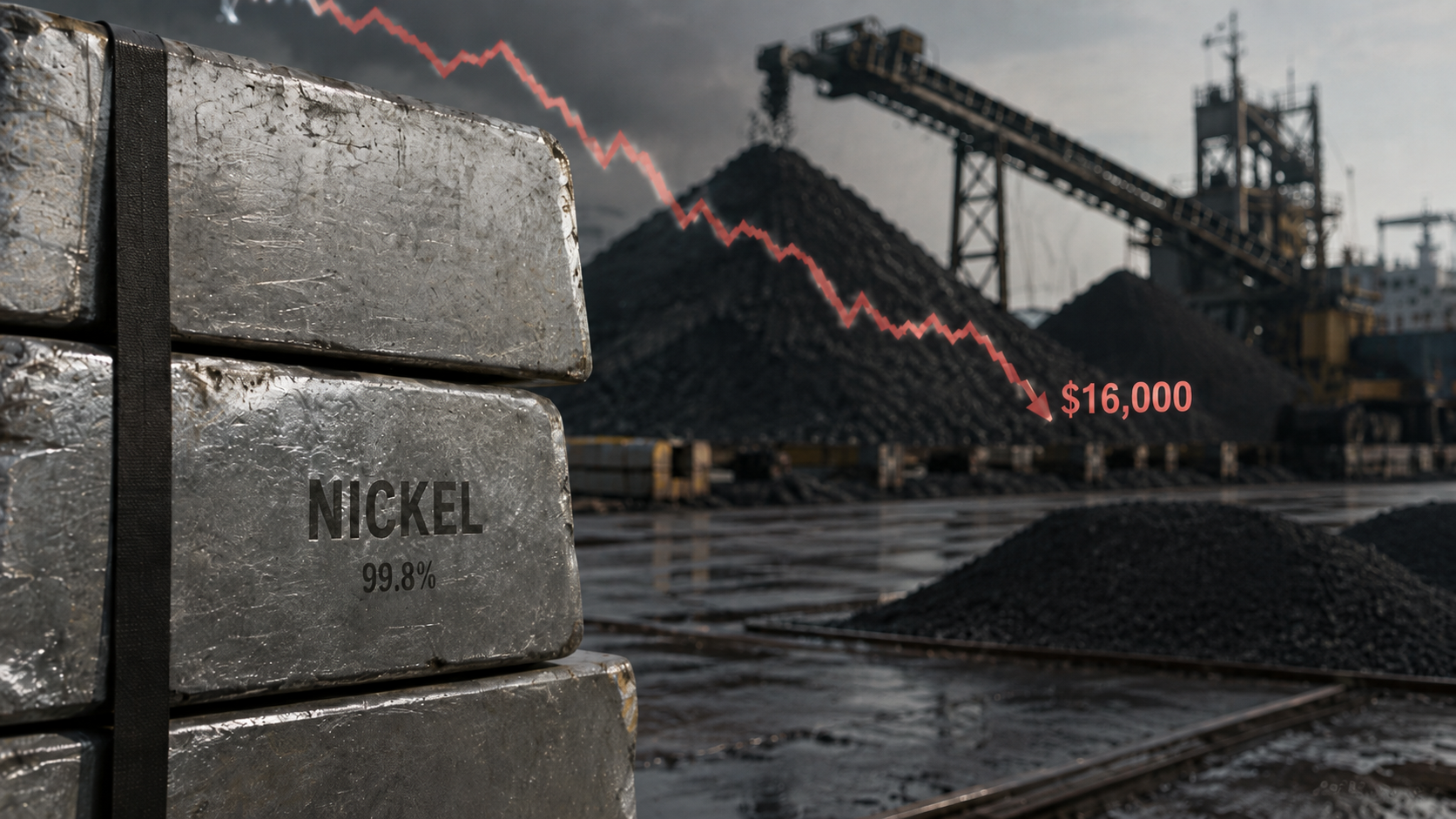
- NPI production costs rose by almost $500 per tonne following the reform; high-pressure acid leach (HPAL) producer costs rose by over $2,500 per tonne of nickel.
- Non-integrated producers who buy merchant ore absorb the reform's full cost increase; integrated operators with their own mine supply, such as Tsingshan, are partially insulated.
- Crawford's life-of-mine net C1 cash costs of US$0.39 per pound and net all-in sustaining costs (AISC) of US$1.54 per pound place it in the global first quartile of a cost curve that the HPM reform has now extended further to the right.
Indonesia's Two-Lever Policy Framework
In December 2025, Indonesia moved to curtail nickel ore supply by reducing quotas and cutting mining licence terms from 3 years to 1 year. Those actions are volume restraints: they set a limit on the quantity of ore entering the market. The April 2026 Harga Patokan Mineral (HPM) reform operates through a different channel entirely. The HPM formula determines the minimum price at which Indonesian nickel ore can be sold, and changes to its construction set the baseline cost at which downstream producers can source it. Whatever volume does reach the market under the December restrictions is now produced at a structurally higher net cost.
Chief Executive Officer of Canada Nickel (TSXV: CNC | OTCQX: CNIKF), Mark Selby, frames the two actions as operating through separate channels.
"The powerful piece of this is you've got the volume now restrained based on the December announcement and policy changes leading up to that, and now whatever volume is going to come out is going to be produced at a net higher cost to the market, to the benefit of the Indonesians during that time frame."
The two levers operate independently, which means the cost pressure cannot be offset by routing to alternative ore volumes; whatever supply survives the December restrictions still carries the April cost floor.
HPM Formula: April 2026 Changes
The April reform restructured the HPM formula in ways that shift material costs onto downstream processors rather than simply adjusting headline ore prices. First, it incorporated byproducts contained in the ore that downstream processors had previously obtained without payment. For high-pressure acid leach (HPAL) producers, cobalt alone can account for 30% to 50% of revenue, making byproduct inclusion a material change to effective input costs. Second, the formula's metal-price percentage for nickel pig iron (NPI) production was raised from 17% to 30%. The combined effect pushed the minimum price floor up to match prevailing market prices, driving ore prices higher by 5% to 6%, and by 8% to 10% for limonite-grade producers, with the value gain flowing directly to the Indonesian state and to miners.
Selby is precise on both modifications to the formula.
"They made two big changes. One, they included a bunch of byproducts in the ore that these producers effectively got for free before. For HPAL, cobalt can be anywhere from 30 to 50% of revenue, so it's a big number. The other piece is for different grades; they've changed the percentage of the metal price that is included in the formula, so for NPI production, that went from 17% to 30%."
Both modifications shift costs upward at the input level, before ore reaches the processing stage.
NPI & HPAL Cost Curve Impact
The formula changes and associated ore price increases pushed NPI production costs up by almost $500 per tonne. For HPAL producers, costs rose by over $2,500 per tonne of nickel. The burden falls most heavily on non-integrated producers who purchase ore on the merchant market rather than sourcing it from their own mining operations: these operators absorb the full cost increase with no internal offset. Integrated producers such as Tsingshan, which own their mine supply, are partially insulated. The reform's net effect is to extend the cost curve's right tail, imposing structurally higher input costs on producers who lack the supply chain integration to absorb them.
Crawford's Cost-Curve Position
The producers now facing higher input costs from the HPM reform serve as the benchmark against which Crawford's cost structure is most clearly differentiated. Life-of-mine average net C1 cash costs of US$0.39 per pound and net all-in sustaining costs (AISC) of US$1.54 per pound, equivalent to US$3,395 per tonne, place the project in the global first quartile, according to the company's bankable feasibility study results. Both figures are net of byproduct credits from cobalt, palladium, platinum, iron, and chromium recovered over the mine's 41-year life. At peak production across 27 years, the project is projected to produce 48,000 tonnes per year of nickel, 800 tonnes per year of cobalt, 13,000 ounces per year of platinum group metals, 1.6 million tonnes per year of iron, and 76,000 tonnes per year of chromium, with life-of-mine totals reaching 1.6 million tonnes of nickel, 58 million tonnes of iron, and 2.8 million tonnes of chromium.
Crawford's mineralogy reinforces its cost position. Ultramafic sulphide mineralisation produces a high-grade concentrate that runs 2.5 to 3 times typical concentrate grades, reducing downstream processing costs. The project holds the world's second-largest proven and probable nickel reserve at 3.8 million tonnes of contained nickel, and is projected to rank as the third-largest nickel sulphide operation globally.
NPI and HPAL producers pushed right on the cost curve by the HPM reform are the reference group Selby has in mind when he addresses the company's position.
"If you've got a production operation that can now operate to the left of these guys in the cost curve, and again a bunch of them have just been pushed out further to the right, it's really good news for the handful of us with advanced stage projects in the West."
That structural gap between Crawford's cost floor and the Indonesian producers' rising cost base is what makes the HPM reform a net positive for the project's investment case.
Federal Permitting & Construction Timeline
Crawford's development timeline compresses the period between its current first-quartile cost position on paper and production at scale. A federal permitting decision and funding package are targeted for summer 2026, with physical construction scheduled to begin by year-end 2026. Front-end engineering and design (FEED) economics, finalised in March 2025, support the scale of that commitment: an after-tax net present value at an 8% discount rate (NPV8%) of US$2.8 billion, an internal rate of return (IRR) of 17.6%, and initial capital expenditure (capex) of US$2.0 billion, figures that put Crawford's cost advantage on a funded development path at the moment Indonesian producers are absorbing rising input costs.
FAQs (AI-Generated)
Analyst's Notes





Subscribe to Our Channel


Stay Informed


