




Iran's 60-Day Oil License & 13% US Distillate Deficit Create an August 21 Oil Market Catalyst



Iran's 60-day oil license lowered crude prices, but tight US fuel inventories and high refinery utilization keep supply risks in focus ahead of August 21.
- Brent crude fell 1.22% to $76.95 a barrel after the US Treasury issued a 60-day license allowing the production, delivery, and sale of Iranian crude through August 21.
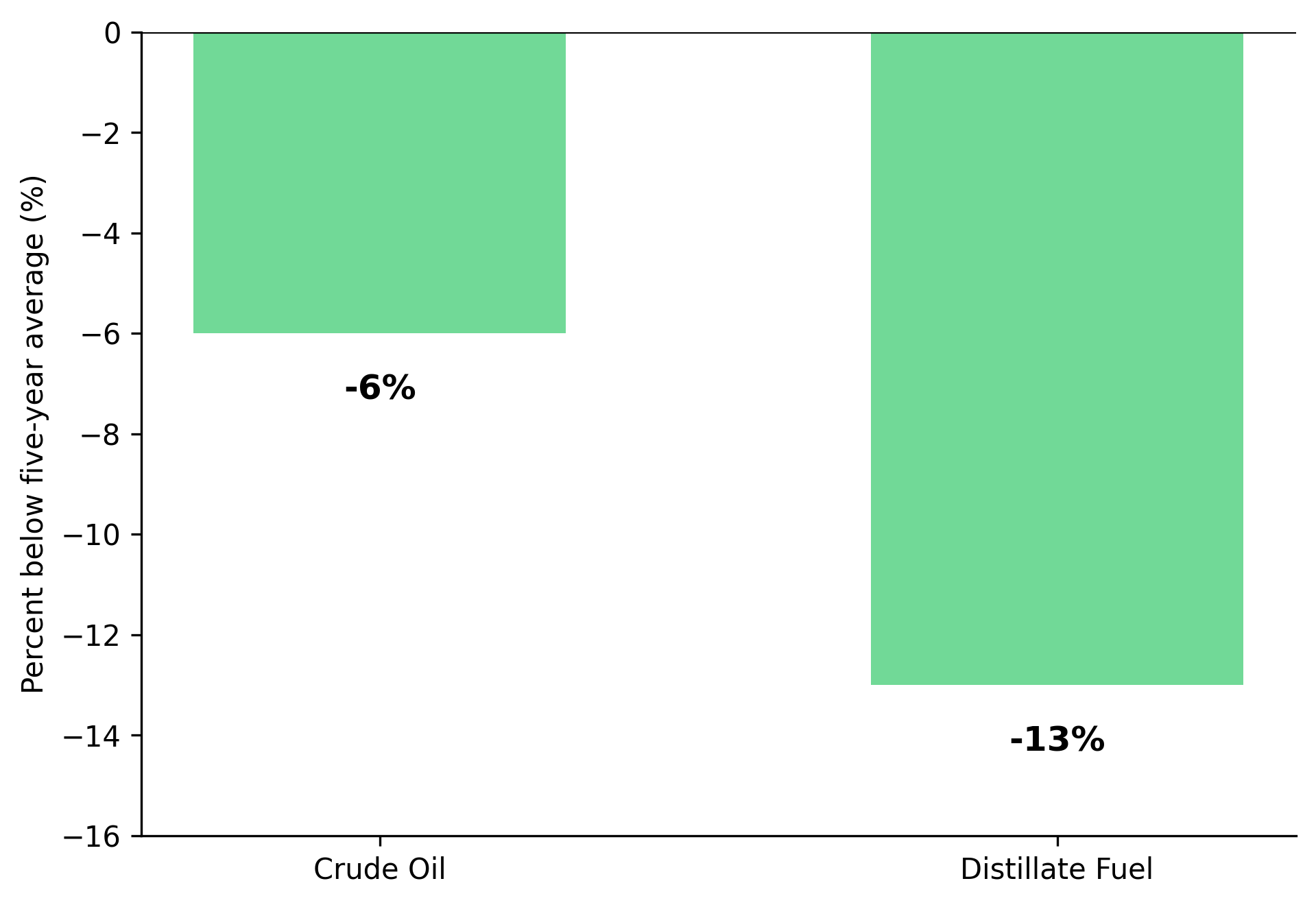
- US commercial crude inventories fell 8.3 million barrels to 418.2 million barrels, leaving stocks 6% below the five-year average.
- Distillate inventories remain 13% below the five-year average despite a 1.0-million-barrel build, while refinery utilization held at 96.7%.
- Fed funds futures price a 54% chance of at least two 25-basis-point rate hikes before year-end, up from 15.2% a week earlier.
- WTI crude averaged $88.62 a barrel on June 12, 2026, $5.70 lower than the prior week but $14.78 higher than a year earlier.
Oil Markets Reprice Supply Risk as Brent Falls 1.22%
Brent crude fell 1.22% to $76.95 a barrel as the US Treasury issued a 60-day license allowing the production, delivery, and sale of Iranian crude. August WTI futures traded near $74.19, up 0.45% intraday. US Central Command also confirmed the Strait of Hormuz remained open despite Iran's claim that it had been closed.
Citi's Scott Chronert said the move reflects growing confidence that the conflict is nearing an end, reducing concerns that higher energy prices will fuel inflation. The decline removed much of the risk premium that entered crude markets during the disruption scare, while the US continued to import 5.1 million barrels of crude per day.
Low Fuel Inventories Raise Oil Market Sensitivity to Supply Shocks
The Treasury license does not restore normal trade with Iran. It creates a 60-day window through August 21 during which Iranian crude can be imported into the US and paid for in dollars. The license expires while distillate inventories remain 13% below the five-year average despite a 1.0-million-barrel build, and commercial crude stocks sit 6% below average after an 8.3-million-barrel draw. Refiners are processing 17.2 million barrels per day at 96.7% utilization, limiting operational flexibility if supply tightens.
The August 21 license expiry provides the next clear catalyst for oil markets as negotiations continue. President Trump declined to guarantee Iran would not use oil-sale proceeds to rebuild its military, saying "we'll see," leaving the future of sanctions relief uncertain beyond that date. Iran's claim that it closed the Strait of Hormuz, despite US Central Command confirming the waterway remains open, shows that supply disruption risks remain part of the market's pricing framework.
Higher Rate Expectations Drive Defensive Market Positioning
Fed funds futures price a 54% chance of at least two 25-basis-point rate hikes before year-end, up from 15.2% a week earlier.
Pepperstone's Chris Weston said "these are far from dull markets" as investors rotated into more defensive positions and away from AI-led equities. The shift coincided with a 2.9% decline in the MSCI Asia-Pacific index outside Japan and an 8.1% drop in the Kospi.
Refining Capacity Constraints Increase Exposure to Supply Disruptions
Distillate inventories remain 13% below the five-year average even as production reached 5.2 million barrels per day, leaving fuel markets more exposed to supply disruptions than crude markets with higher inventory coverage.
Refinery utilization reached 96.7% while the US imported 5.1 million barrels of crude per day, leaving less operational flexibility if crude supplies tighten.
License Expiry & Inventory Data Define the Next Oil Market Test
The base case is that the license remains in effect through August 21, with Brent trading near the $76-78 range seen on June 23 and easing the inflation pressure Chronert flagged.
In the bear case for crude bulls, Iran's Hormuz rhetoric escalates before the license expires, compounding the EIA's tight 418.2-million-barrel crude inventory level and pushing WTI back toward the $88.62 level recorded on June 12 within weeks rather than months.
The next EIA Weekly Petroleum Status Report, covering the week ending June 19, will show whether the 8.3-million-barrel draw extends or reverses, providing the signal of which scenario is unfolding.
Analyst's Notes





Subscribe to Our Channel





Stay Informed


