




Low-Acid Leaching at 167 ppm Backs a Larger Muntanga Build


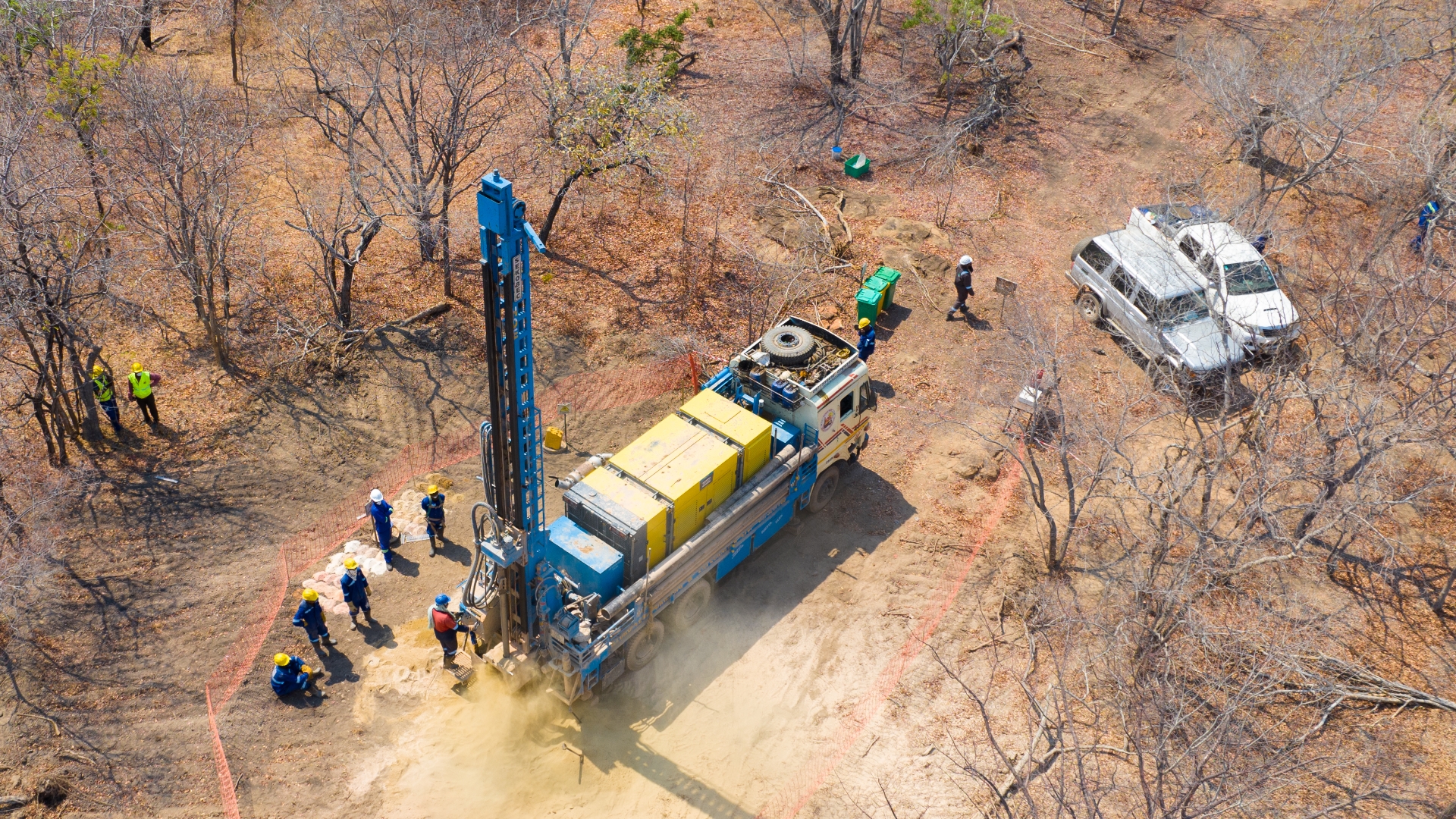
Atomic Eagle's Muntanga East test work recovered 81% to 86% of uranium from 167 ppm material, using about 3 kg/t of acid during extraction.
- Atomic Eagle's Muntanga East test work recovered about 81% to 86% of the uranium.
- Extraction was substantially complete after about 20 days, using about 3 kilograms per tonne (kg/t) of acid.
- The composites graded about 167 parts per million (ppm), lower than mineralization historically tested at several other Muntanga deposits.
- The 2025 feasibility study (FS) did not consider 44% of Muntanga's JORC resource.
- The results will be incorporated into ongoing technical studies on Muntanga.
Atomic Eagle (ASX: AEU | OTCQX: AEUXF) has completed metallurgical test work on diamond drill core from the recently discovered Muntanga East uranium deposit, part of its 100%-owned Muntanga Uranium Project in Zambia. Leach tests recovered between about 81% and 86% of the uranium, with extraction substantially complete after about 20 days and acid consumption of about 3 kilograms per tonne (kg/t) over that period. The material was lower in grade than mineralization historically tested from several of the project's other deposits, and recoveries came in line with those of previous programs.
Muntanga East Leach Test Results
Mintek in South Africa ran the program on 2 representative composite samples, blends of core intervals built to represent the deposit. That core was obtained specifically for metallurgical evaluation after the Muntanga East mineral resource was delineated. Samples were crushed to a nominal top size of 25 millimeters. They then underwent diagnostic leach testing, which shows how uranium splits between minerals that dissolve easily and those that do not, as well as bottle roll and column leach testing. Geotechnical assessments tested the material's suitability for heap leaching, in which crushed ore is stacked and irrigated with an acid solution.
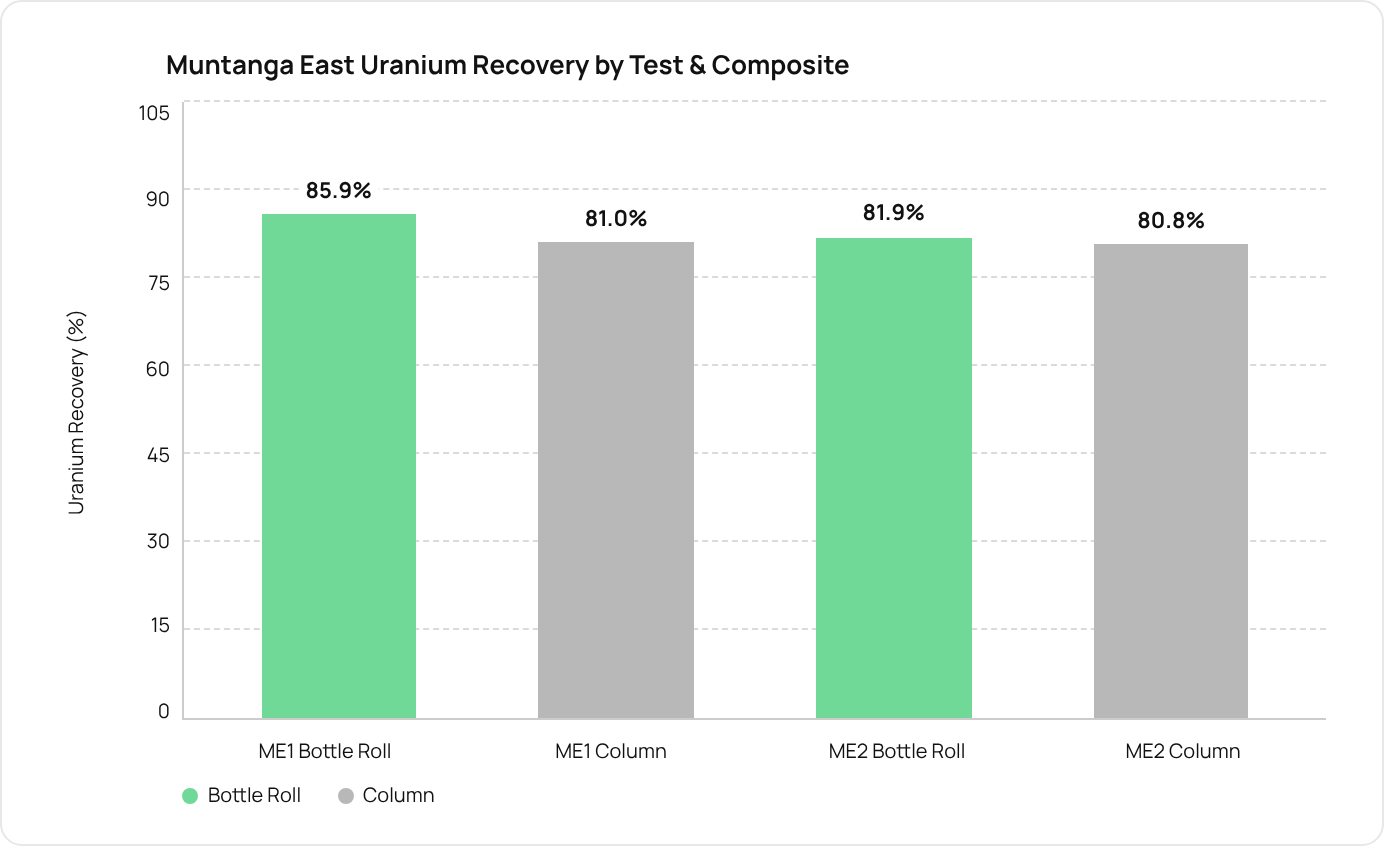
The composites had an average head grade, the grade of the material fed into a process, of about 167 parts per million (ppm) uranium oxide. In bottle roll tests, where crushed samples are leached in rotating containers, composites ME1 and ME2 recovered 85.9% and 81.9% of their uranium after 25 days, with acid consumption at about 3 kg/t throughout. Dissolution was nearly complete after about 7 days, and the results indicate that about 80% of the uranium occurs in minerals that dissolve readily under conventional acid heap leach conditions. Tests in 1-meter-high columns, run under conditions representative of a heap leach, recovered 81.0% and 80.8%, with recovery curves flattening after about 15 to 20 days, while acid use stood at about 3 kg/t. Leaching continued for 62 days, yielding only a modest further recovery, with total acid consumption rising to between 7.0 kg/t and 7.6 kg/t.
Particle size analysis showed low fines content, meaning little very fine material, and minimal fines generation during leaching, which reduces the risk of a heap losing permeability. Stacking tests simulating a 6-meter heap returned favorable bulk density and porosity, and hydraulic conductivity, the rate at which solution passes through stacked ore, of about 4,396 to 4,537 liters per square meter per hour. That is more than 4 times the design threshold typically required for heap leaching operations.
Muntanga & the Zambian Setting
The Muntanga Project is fully permitted, with its resources on mining licenses and environmental and resettlement approvals in place. Its license package covers 1,126 square kilometers and has seen limited exploration in the last 15 years. The project's infrastructure includes a sealed road, power nearby, water within the mining license, and export via a known uranium port.
Zambia is the world's 7th largest copper producer and ranks 3rd in Africa in the Fraser Institute rankings, with a favorable tax regime.
Feasibility Study Baseline
The 2025 feasibility study (FS) outlined an open-pit mine with a low strip ratio, the waste rock moved for each tonne of ore, and heap leaching with industry-standard, conventional processing. It assumed recoveries of more than 90% over the mine life and acid consumption averaging 20 kg/t of ore treated. The study covers a mine life of about 12 years and 39.6 million tonnes of ore at 320 ppm, through a plant processing 3.5 million tonnes per annum. Production totals 25.3 million pounds of uranium oxide, averaging 2.2 million pounds per year. The study has a pre-production capital cost of US$282 million and operating costs of US$32.20 per pound.
Atomic Eagle is targeting a larger-scale project built on existing resources that the FS did not include, as well as on resource growth. Of the JORC resource, 44% was not considered in the FS. That share comprises 8.7 million pounds of satellite deposits, 6.0 million pounds of inferred resources at Muntanga and Dibbwi East, excluded under NI 43-101 rules, and 11.4 million pounds from the 2026 resource upgrade.
Lower-Grade Feed & the Scale-Up Case
Muntanga East's acid consumption of about 3 kg/t during extraction is below the average across the broader Muntanga Project. The results extend the company's understanding of metallurgy across the broader Muntanga trend to a newly discovered deposit.
Chief Executive Officer of Atomic Eagle, Phil Hoskins, ties Muntanga's economics to a bigger production profile rather than a higher price:
"In our opinion, increasing the resource, having that flow through to a larger production profile for a heap leach project is how you make the economics stack up, and that's without the uranium price increasing."
The results provide additional confidence in the potential integration of Muntanga East into future mine development planning.
Resource & Exploration Scope
Muntanga holds a JORC mineral resource of 58.8 million pounds of uranium oxide at 309 ppm. As of August 2026, a 30,000-meter drilling program was underway at Chisebuka, Muntanga North, and the Namakande 1 and 2 targets. Chisebuka hosts a resource of 9.7 million pounds at 220 ppm.
Atomic Eagle also has a 60% interest in the Madaouela Uranium Project in Niger, which hosts a foreign estimate of 116.5 million pounds at 1,282 ppm, prepared in accordance with NI 43-101 and not reported under JORC.
Speaking in August, Hoskins looked to this year's drilling for more discoveries:
"We've been really encouraged by what we've been finding with the drilling there this year. So, we're confident of making additional discoveries in the back half of the year."
The Muntanga East results will be incorporated into the ongoing technical studies supporting the project's advancement, alongside the resource growth the drilling program targets.
FAQs (AI-Generated)
Analyst's Notes





Subscribe to Our Channel







Stay Informed


