Atomic Eagle's Funding Now Locked In: Parallel Zambia & Niger Execution Begins


SEO summary: Atomic Eagle's Menel option exercise funds both Zambia and Niger uranium projects through 2028, shifting the story from deal-making to parallel execution.
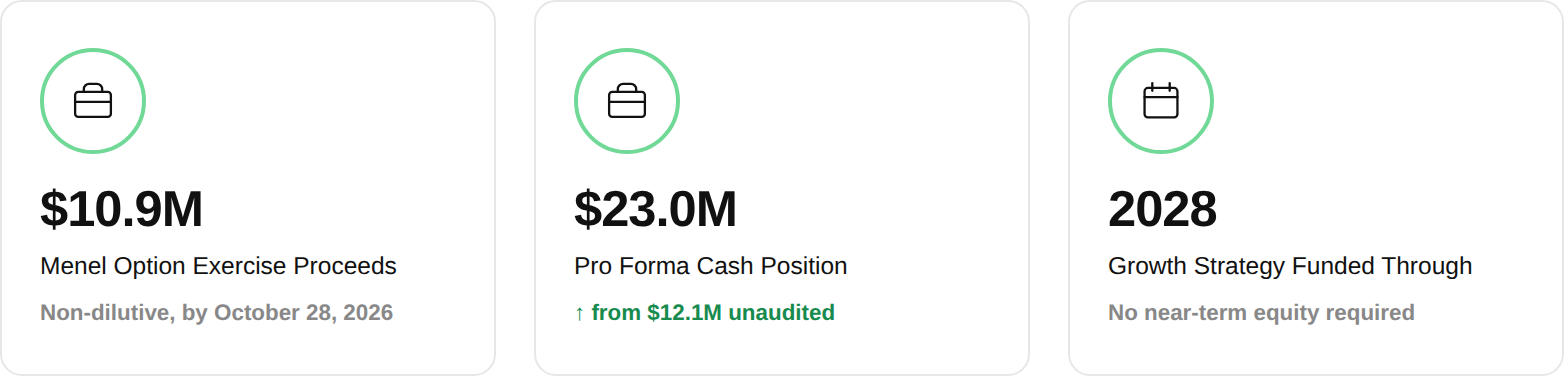
- Atomic Eagle's largest shareholder, Menel Energy and Resources Limited, has signed a binding commitment to exercise 35,149,113 options by October 28, 2026, delivering approximately $10.9 million in non-dilutive funding and lifting pro forma cash to approximately $23.0 million.
- Management has framed the funding as enabling Muntanga in Zambia and Madaouela in Niger to be advanced in parallel rather than sequentially, ending the sequencing question that came with reacquiring a second advanced asset.
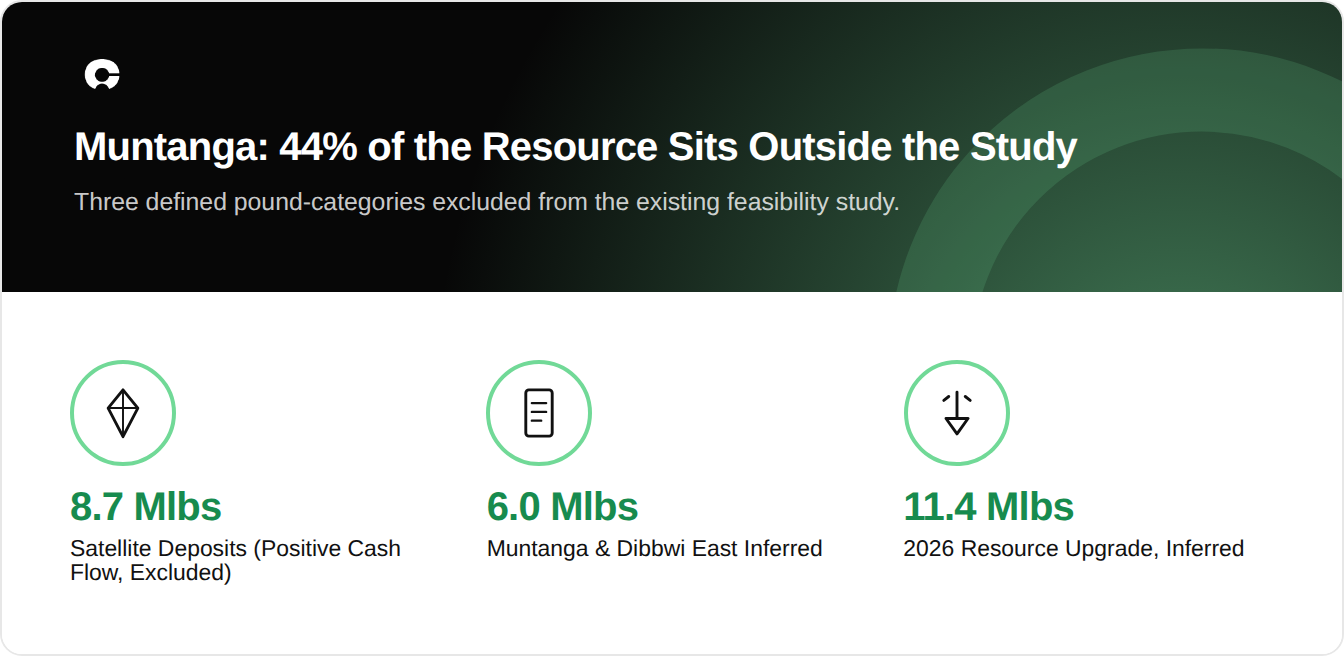
- 44% of Muntanga's current resource, comprising 8.7 million pounds of satellite deposits, 6.0 million pounds of inferred resources, and 11.4 million pounds from the 2026 upgrade, sits outside the existing feasibility study and represents unconverted scale.
- At Madaouela, management has identified an optimization opportunity in the historical room-and-pillar underground mining method, which left uranium behind; an updated study aims to recover it through a revised open-pit and underground blend.
- Madaouela's 116.5 million-pound foreign estimate is scheduled for conversion to a JORC resource in the back part of 2026, ahead of a feasibility process targeting both resource conversion and mine-method optimization.
What Has Happened
Atomic Eagle (ASX: AEU | OTCQX: AEUXF) confirmed on September 14, 2026, that Menel Energy and Resources Limited, its largest shareholder, has signed a binding commitment to exercise 35,149,113 options at $0.31 per option, ahead of their May 5, 2027 expiry. The exercise would deliver about $10.9 million in proceeds by October 28, 2026, by converting existing on-issue options rather than issuing new securities at a discount. With a current unaudited cash position of approximately $12.1 million, the proceeds would raise available cash to approximately $23.0 million, which the company says is sufficient to fund its growth strategy through 2028 without near-term equity financing. A further approximately $5.5 million remains available if the roughly 17.9 million remaining options in the same category, held mainly by long-term shareholders, are also exercised.
The funding milestone follows Atomic Eagle's confirmed return of the Madaouela Uranium Project in Niger, converting the company from a single-asset Zambian developer into a 2-country uranium platform.
Funding Answers the Sequencing Question
The most immediate objection to running 2 African uranium developments at once is capital: a junior with 1 balance sheet advancing 2 feasibility-stage projects risks starving one to fund the other. The Menel commitment addresses that directly.
Chief Executive Officer of Atomic Eagle, Phil Hoskins, described the effect of the funding:
"The commitment leaves the Company fully funded to accelerate delivery of our objectives across both our exciting uranium projects in Zambia and Niger. This decision is a powerful vote of confidence from a shareholder with a long history alongside our projects and allows us to pursue both Zambia and Niger in parallel, rather than sequentially."
That distinction matters for how investors should read the next 12 to 18 months. Rather than a staged approach where Madaouela's studies wait on Muntanga's progress, or vice versa, the company now has the balance sheet to run technical work-streams on both simultaneously. A dedicated team is focused on Zambia's technical work, while the company is also standing up a separate study team.
Hoskins was explicit that Muntanga is not being deprioritized in favor of the larger, higher-grade Niger asset:
"I definitely don't want anyone thinking that we're letting Muntanga take a backseat. We had eyes on that project specifically, which is why we pursued the transaction to begin with."
Muntanga's Unconverted Resource Is a Ready-Made Growth Lever
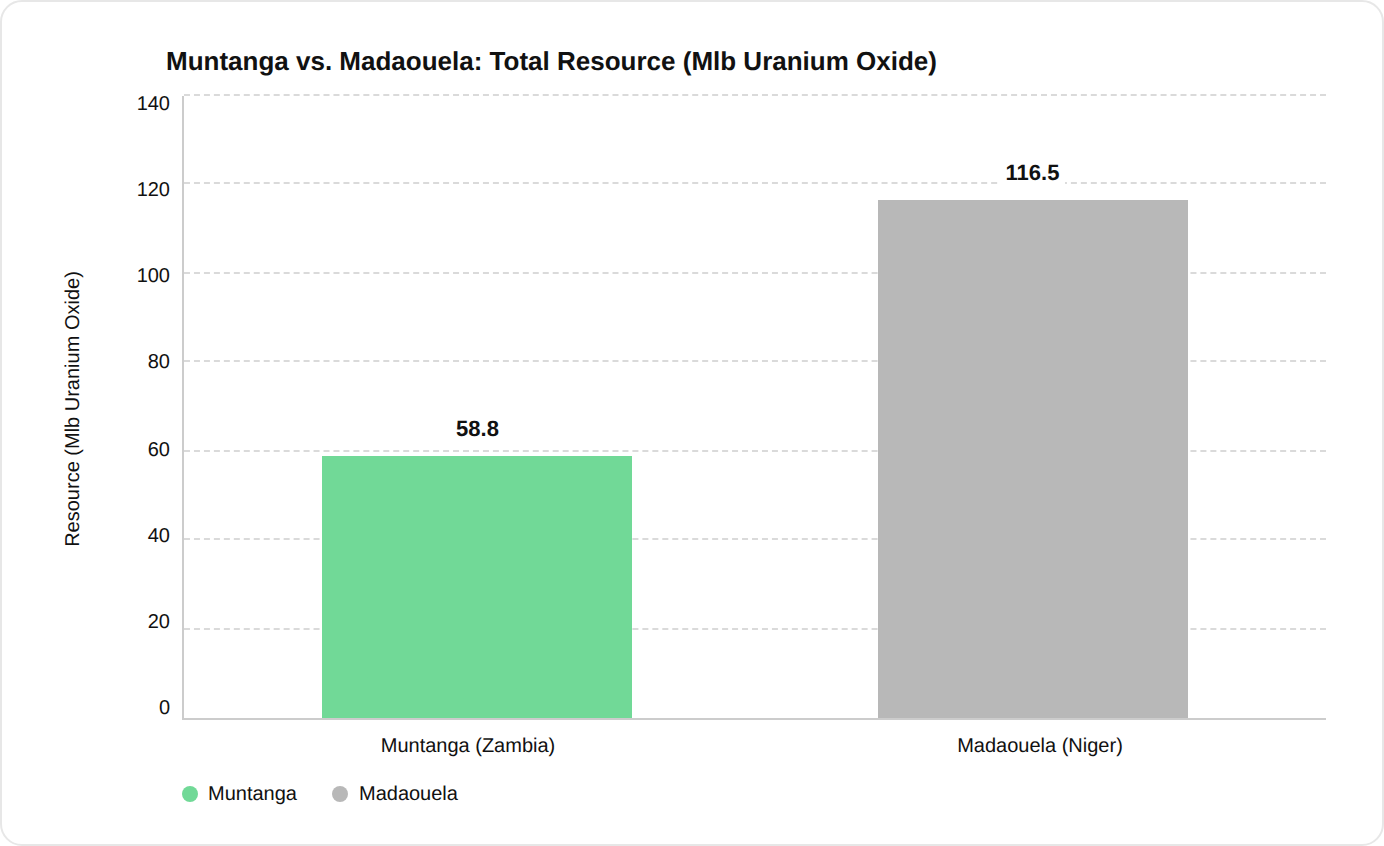
Funding removes one constraint; the resource base itself supplies the next opportunity. Muntanga's existing 58.8 million-pound JORC resource at 309 parts per million was only partially captured by the prior feasibility study (FS). Satellite deposits totaling 8.7 million pounds showed positive cash flow in that study but were excluded. A further 6.0 million pounds of inferred resources at Muntanga and Dibbwi East were excluded under reporting-code restrictions, and the March 2026 resource upgrade added another 11.4 million pounds of inferred material. Combined, these 3 categories account for 44% of Muntanga's current JORC resource sitting outside the study that underpins the project's existing economics.
That gap is not exploration risk in the conventional sense. The pounds are already defined; the work required is technical (infill drilling and study updates) rather than discovery-dependent, and it runs alongside a 30,000-meter drill program already targeting extensional growth at Chisebuka and new discoveries at Muntanga North and the Namakande targets.
Madaouela's Mining Method Has Room to Improve
At Madaouela, the biggest lever is not resource size but the mining method. Management has identified the historical room-and-pillar underground mining approach, similar to the method used at nearby Orano-operated mines in the same district, as having left a meaningful proportion of uranium unmined. The updated study underway will focus on a revised mix of open-pit and underground mining to extract more of that uranium than the original method captured.
The resource itself defines the scope for that optimization. Madaouela's foreign estimate totals 116.5 million pounds of uranium oxide at 1,282 parts per million, split into 30.1 million pounds measured, 66.8 million pounds indicated, and 19.6 million pounds inferred. Of that total, 96.9 million pounds sit in the measured and indicated categories, which can support a study prepared under Canadian reporting standards. Converting the foreign estimate to a JORC resource, targeted for the back part of 2026, is the precursor step before an updated feasibility process can formally incorporate both the additional measured and indicated tonnage and any mining-method improvements.
Broader Context & What to Watch Next
Atomic Eagle's position now rests on 2 separate but connected work programs: continued drill-driven resource growth in Zambia, where the asset is fully permitted and heap-leach economics are already established, and a re-permitting and study-updating process in Niger, where the mining convention signed with the Nigerien government set a 2-year window to update the feasibility study and reapply for environmental approvals. Both are now funded through 2028 without requiring fresh equity.
The near-term sequence to watch is the JORC conversion of the Madaouela resource in the back part of 2026, which will formally establish how much of the 116.5-million-pound estimate carries forward under Australian reporting standards, followed by the start of an updated FS incorporating the mining-method optimization management has described. In parallel, Muntanga's 30,000-meter drill program and the technical work needed to bring the excluded 44% of its resource into a future study will determine whether Zambia's development case scales alongside Niger's, rather than waiting behind it.
FAQs (AI-Generated)
Analyst's Notes





Subscribe to Our Channel








Stay Informed