Low-Cost Gold Miners Keep Wide Margins After Inflation-Driven Sell-Off



Hot US inflation sent gold to a 15-month low of $3,445.89. Why unhedged miners' margins now hinge on the Fed's Dec 9 call, and the level that shows it.
- Gold touched $3,445.89 intraday on November 25, its lowest since August 2025, after US core PCE inflation came in at 3.3% against a 3.2% forecast, then closed 0.1% lower at $3,577.28, Reuters reported.
- CME raised COMEX gold margins from 5% to 6% after the November 24 close, adding about $3,600 of collateral per contract a day before the inflation data.
- Gold ETFs had already lost 20.4 tonnes in the week to November 20: 11.8 tonnes in North America, 6.4 in Europe and 2.2 in Asia.
- The Australian dollar and sterling hit 2026 lows against the US dollar on November 19, so each US-dollar ounce converts into more Australian dollars and pounds.
- The Fed's December 9 hike is fully priced, and odds of a January hike rose to about 55% after the PCE data.
Hot US Inflation Data Drives Gold to a 15-Month Low Before Same-Session Recovery
Spot gold touched $3,445.89 an ounce at 16:13 GMT on November 25, its lowest since August 2025, Reuters reported, after US core PCE inflation rose 3.3% in October against a 3.2% forecast. Headline PCE reached 3.8%, and third-quarter growth was revised up to 4.3%. Gold closed the session 0.1% lower at $3,577.28 and traded at $3,580.87 at 03:17 GMT on November 26, with US markets shut for Thanksgiving.
Gold remains about 37% below its January record, Reuters reported. A December Fed hike was already close to fully priced, so the surprise mainly shifted bets on January. Gold recovered $131 from the low within the same session, a pattern consistent with selling to raise cash rather than a new view on rates.
Margin Hike Lands Before PCE Data as Funds Already Cut Gold Holdings
CME raised margins on COMEX gold futures from 5% to 6% of contract value after the November 24 close, adding about $3,600 of collateral per 100-ounce contract at current prices, a day before the inflation data. Managed funds had already cut their net long by 9,399 contracts to 102,942 in the week to November 17, CFTC data show. The Nasdaq fell 4% on November 25, the same session gold hit its low, and Ilya Spivak, head of global macro at Tastylive, told Reuters gold was being sold to raise cash amid risk aversion.
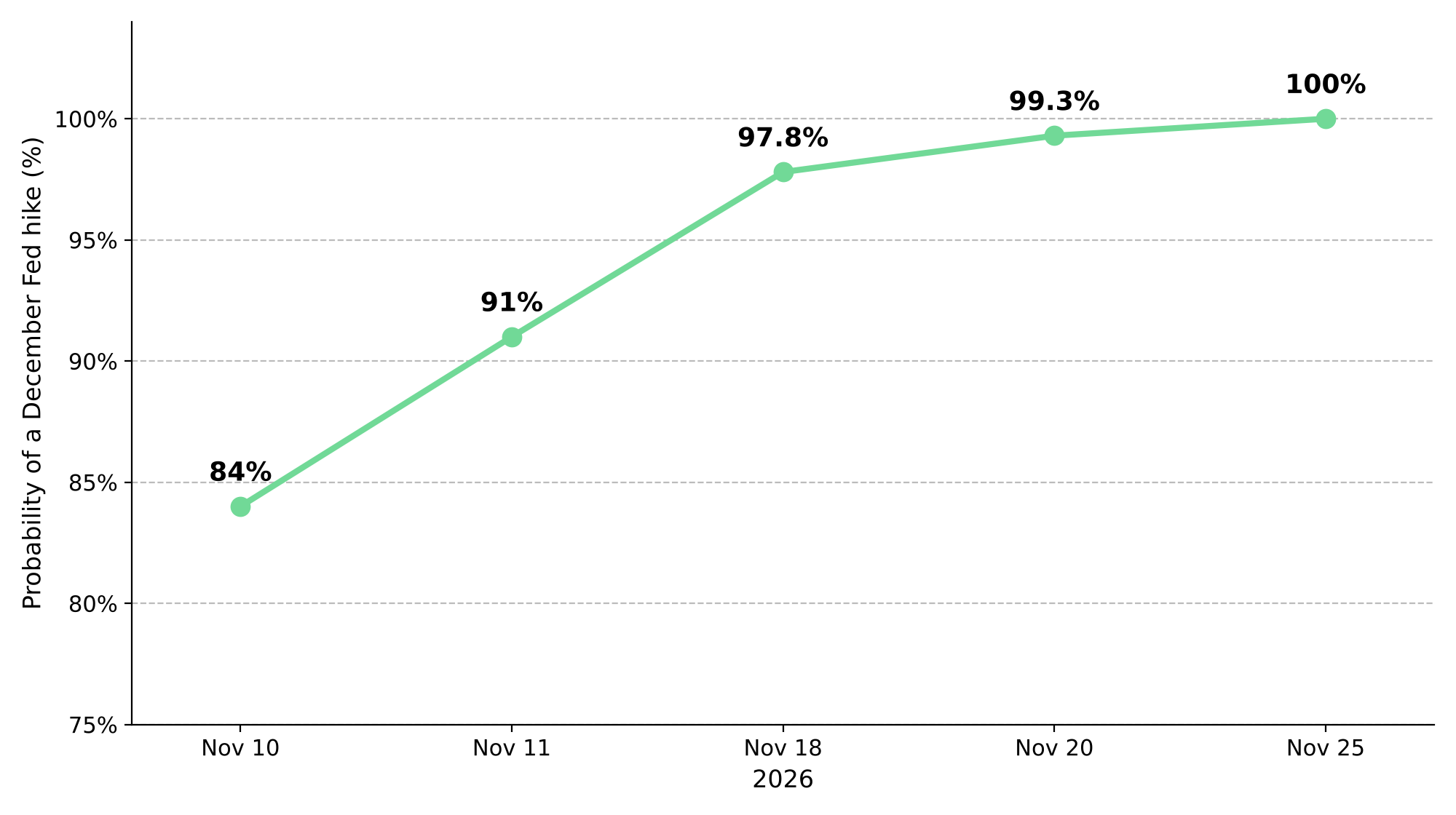
The hot PCE print confirmed a December 9 hike, now fully priced on CME FedWatch, and lifted the odds of another in January to about 55%, FXStreet reported. Fund holders were already leaving: gold ETFs lost 20.4 tonnes in the week to November 20, the most since June, with North America accounting for 11.8 tonnes, Europe 6.4 and Asia 2.2, World Gold Council data show.
Unhedged Producers Carry the Full Swing of the December Fed Decision
The cohort most exposed is unhedged gold producers, whose revenue takes every swing. The industry hedge book fell to about 92 tonnes by end-Q3, the World Gold Council estimates. In Australia, Northern Star has wound down its hedging policy and Westgold, listed in Sydney and Toronto, remains fully unhedged. A December 9 hike with a signal for January would lift yields and put the $3,445.89 low back in play, with Natixis seeing $3,340. A hike with a pause would leave gold in the $3,500 to $3,700 range analysts mark.
The December 9 decision and the next CFTC and World Gold Council flow data decide between them within two weeks. A close below $3,445.89 would show the selling has further to run and push unhedged producer revenue lower into Q4 results.
Weak Australian Dollar Cushions Local Gold Producer Margins
The Australian dollar and sterling hit 2026 lows against the US dollar on November 19, FXStreet reported, so each US-dollar ounce converts into more Australian dollars and pounds. Westgold realized A$6,029 an ounce in the September quarter against AISC of A$2,912. At US$3,581 and the November 19 rate of US$0.666, gold sits near A$5,380, roughly A$2,470 above that cost.
The CME increase lifts collateral on any futures hedge by a fifth. Westgold, debt free with A$1,040 million in cash, bullion and investments at end-September, can carry the swing without hedging; indebted producers have less room.
Holders of unhedged producers cannot know whether December 9 brings a pause or a January signal, and positioning data arrive days late. Trading the meeting is a single binary bet. Producers with US-dollar AISC above $2,500 keep under $1,000 an ounce at the $3,445.89 low, and their shares can fall faster than gold if it breaks.
Cost & Debt Levels Decide Which Gold Producers Withstand a Lower Low
Gold trades near $3,581 an ounce after selling took it to $3,445.89 on November 25 and buyers won back most of the drop in the same session. A December Fed hike is already in that price.
The Fed's December 9 decision sets the rate path: a hike with a signal for January would lift yields and put the November 25 low back in play, while a hike with a pause would leave the selling spent. Weekly CFTC positioning and World Gold Council ETF flows show whether leveraged and fund holders have stopped selling; a close below $3,445.89 would show they have not, and would cut unhedged producer revenue on every ounce.
Gold near $3,581 marks a forced-selling low after a 37% fall from the January record, with ETF holdings still falling as of November 20. Low-cost, debt-free producers keep wide margins at current prices, and the December 9 decision, and whether gold holds above $3,445.89 into it, shows whether the low stands.
Analyst's Notes





Subscribe to Our Channel





Stay Informed