Goldstorm PEA Puts Early Output at 202,262 Ounces a Year, Within Tudor Gold's Target


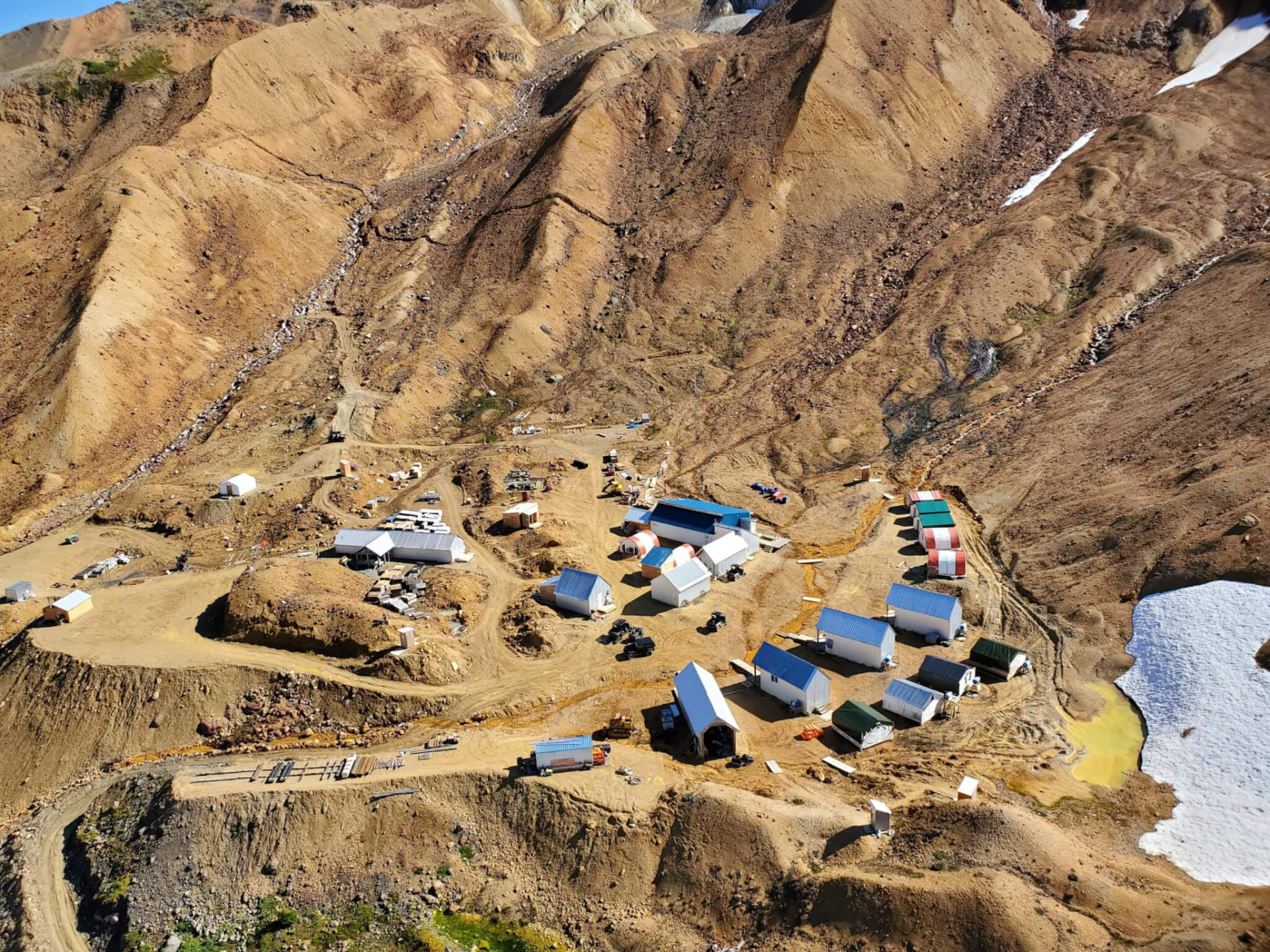
Tudor Gold's Goldstorm preliminary economic assessment outlines a 28.25-year underground mine averaging 202,262 ounces of gold a year in years 3 to 12.
- Tudor Gold's preliminary economic assessment (PEA) outlines an underground mine at Goldstorm with a 28.25-year mine life.
- Years 3 to 12 average 202,262 ounces (oz) of gold a year, at the low end of the 200,000 to 300,000 oz a year management described in October.
- The plan mines SC1 first, the highest-grade zone at 4.06 grams per tonne (g/t) gold.
- Pre-production capital is US$1.54 billion, with a 3.7-year payback period in the base case.
- At US$3,670 per ounce for gold, the after-tax net present value at a 5% discount rate (NPV5%) is US$2.3 billion, and the after-tax internal rate of return (IRR) is 20.0%.
Tudor Gold (TSXV: TUD) has published a preliminary economic assessment (PEA) on an underground mine at the Goldstorm Deposit. Goldstorm is the deposit that carries the resource estimate on the company's 80%-owned Treaty Creek Project in British Columbia's Golden Triangle. The study outlines a mine running at a nominal 10,000 tonnes per day (tpd) over a 28.25-year mine life. The plan projects production of 4,677,902 ounces (oz) of gold, 22,142,780 oz of silver, and 209,862 tonnes (t) of copper. Fuse Advisors prepared the PEA based on the resource estimate announced on January 22, 2026, and the study excludes mineralized material from the property's other zones.
The Mine Management Described in October
Before the study came out, management described the mine it wanted the PEA to show. The plan was a bulk underground operation of about 10,000 tons a day using long-hole stoping, in which rock is blasted from long drill holes between underground levels. Its model was the Young-Davidson mine in Ontario.
President and Chief Executive Officer of Tudor Gold, Joseph Ovsenek, set the study's goal against large deposits that never reach production:
"We want to have something that's a 200 to 300,000 oz gold producer with a 20-plus year mine life just as a start, because what we want to do is show people, look, there are a lot of big deposits with lots of ounces that never become mines because, for one reason or another, they just can't make the economics work."
That target named a yearly gold rate and a starting mine life, and the PEA now prints a figure for each.
What the PEA Outlines
Years 3 to 12 average 202,262 oz of gold, 755,843 oz of silver, and 7,295 t of copper per year, at the low end of the 200,000 to 300,000 oz per year that management described. Over the full 28.25-year mine life, gold output averages 165,589 oz a year, below that range, alongside 783,815 oz of silver and 7,429 t of copper.
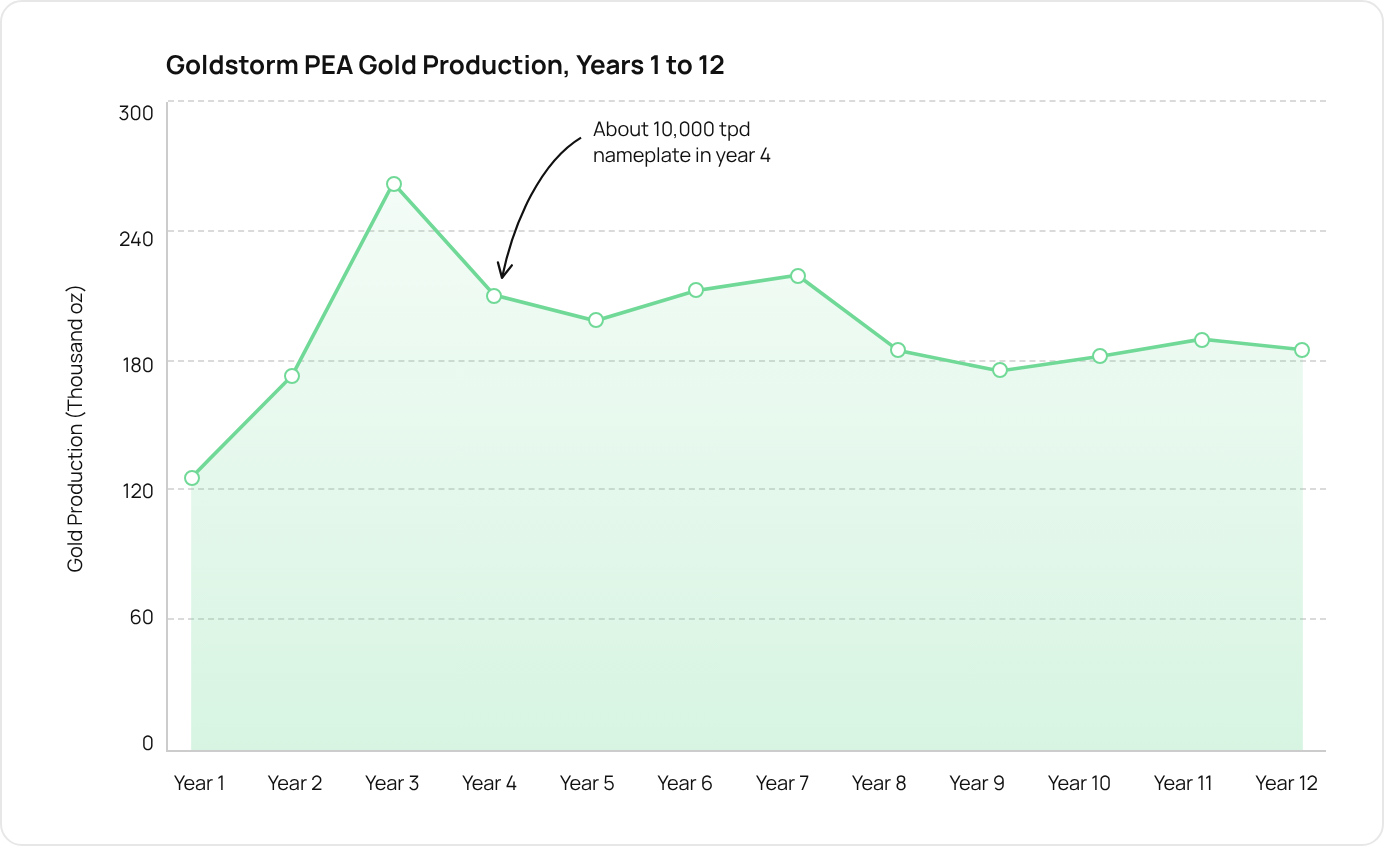
Output builds as the mine is developed. The mining rate rises from 1,060 tpd in year 1 to 6,460 tpd in year 2 and reaches its nameplate rate of about 10,000 tpd in year 4. Gold production in years 1 to 12 is 126.1, 173.4, 262.5, 210.6, 198.7, 212.7, 219.8, 184.9, 175.5, 182.32, 190.2, and 185.3 thousand oz.
The mine is designed for long-hole open stoping with paste backfill, in which mined-out openings are filled with a cemented mix of tailings. Twin declines give access from the surface, and an underground crusher feeds a conveyor to the plant. A flotation plant, which separates sulfide minerals from waste rock using air bubbles, recovers an average of 82.7% of the gold, 85.0% of the silver, and 87.5% of the copper into a bulk sulfide concentrate.
SC1 First, Then the Bulk Zones
The early output comes from mining the highest-grade zone first. The plan sequences 4 zones, SC1, DS5, CS600, and 300HN, across 97.82 million t at an average of 1.80 grams per tonne (g/t) gold. SC1 grades 4.06 g/t gold, roughly double the mine average, across 7.39 million t, and the plan exhausts it by year 14.
DS5, at 2.15 g/t gold, brings the mine to nameplate. CS600 is the largest zone, at 1.26 g/t gold, and holds the mine's copper at 0.46%. The 300HN zone enters the schedule in year 8 as SC1 winds down and runs to closure.
In October, before the study was out, Ovsenek already expected underground drilling at SC1 to reshape the mine plan:
"Now, it's still early days; it's our PEA. There'll be lots of refinement as we go forward, and once we get underground, drill the SC1 zone, we expect that to expand significantly, and we will want to change our mine plan to take full advantage of that growth in the SC1 zone. So, we'll probably do another PEA when that's done."
Underground drilling is also an opportunity the PEA lists: its results would refine stope shapes, cut-off grades, and the mining sequence, with the aim of less dilution, higher head grades, and more higher-grade material in the early years.
Costs & Returns Across 3 Price Cases
Pre-production capital is US$1.54 billion, including contingencies, with a 3.7-year payback period in the base case. The base case uses US$3,670 per ounce for gold, US$50.00 per ounce for silver, and US$5.00 per pound for copper. At those prices, the after-tax net present value at a 5% discount rate (NPV5%) is US$2.3 billion, and the after-tax internal rate of return (IRR) is 20.0%. Spot prices as of November 23, 2026 give the same NPV5% and IRR.
The upside case uses US$4,500 per ounce for gold, US$70.00 per ounce for silver, and US$6.50 per pound for copper. There, the NPV5% rises to US$3.7 billion and the IRR to 26.8%, with a payback period of 2.9 years. All-in sustaining cost, net of silver and copper credits, is US$1,358 per ounce of gold at the base case and US$1,181 per ounce at the upside case.
The mine plan includes 13.6 million t of inferred material grading 3.78 g/t gold, about 29% of the gold ounces mined. No mineral reserves have been declared for Goldstorm.
What Comes Next at Treaty Creek
The underground exploration permit is expected in time to collar the portal and begin the decline in 2027, and underground access would let the company infill drill and expand the higher-grade mineralization at Goldstorm more efficiently. Exploration beyond Goldstorm has aimed at a second deposit on the property, and a 2027 infill and expansion program is planned at the Perfectstorm Zone. If it succeeds, the company plans a maiden resource estimate for its high-grade mineralization by year-end. It would then look to update the PEA, adding that material to the mine plan to increase gold production in the early years.
The study lists the License of Occupation held by Seabridge Gold, which overlaps the planned process plant and underground development, as a risk that may need an agreement or a change of tenure. In October, management named resolving its issues with Seabridge as 1 of 3 catalysts, alongside the release of the PEA. Ovsenek also judged that Seabridge shares Tudor Gold's interest in moving ahead:
"They want to move ahead with their project. They realize, look, it isn't good for anyone to keep the two companies apart."
Next on the schedule are the PEA technical report, due within 45 days of November 24, 2026, and in 2027 the portal and the Perfectstorm infill and expansion program.
FAQs (AI-Generated)
Analyst's Notes





Subscribe to Our Channel





Stay Informed