Asian Gold Buying Offers a Demand Counterweight to Western Fund Outflows



China's bullion demand and India's festive purchases broaden global gold consumption, while strong mining margins support long-term production growth.
- Physical gold buying in China and India provides a demand counterweight to Western selling, as European gold exchange-traded funds (ETFs) recorded 16 tonnes of outflows from November 1 to 20, while North American funds lost 12 tonnes during the week ending November 20.
- Chinese gold bar and coin investment surpassed jewelry consumption for the first time in 2025, a pattern continuing into 2026, while September net gold imports rose 41% year over year to 129 tonnes.
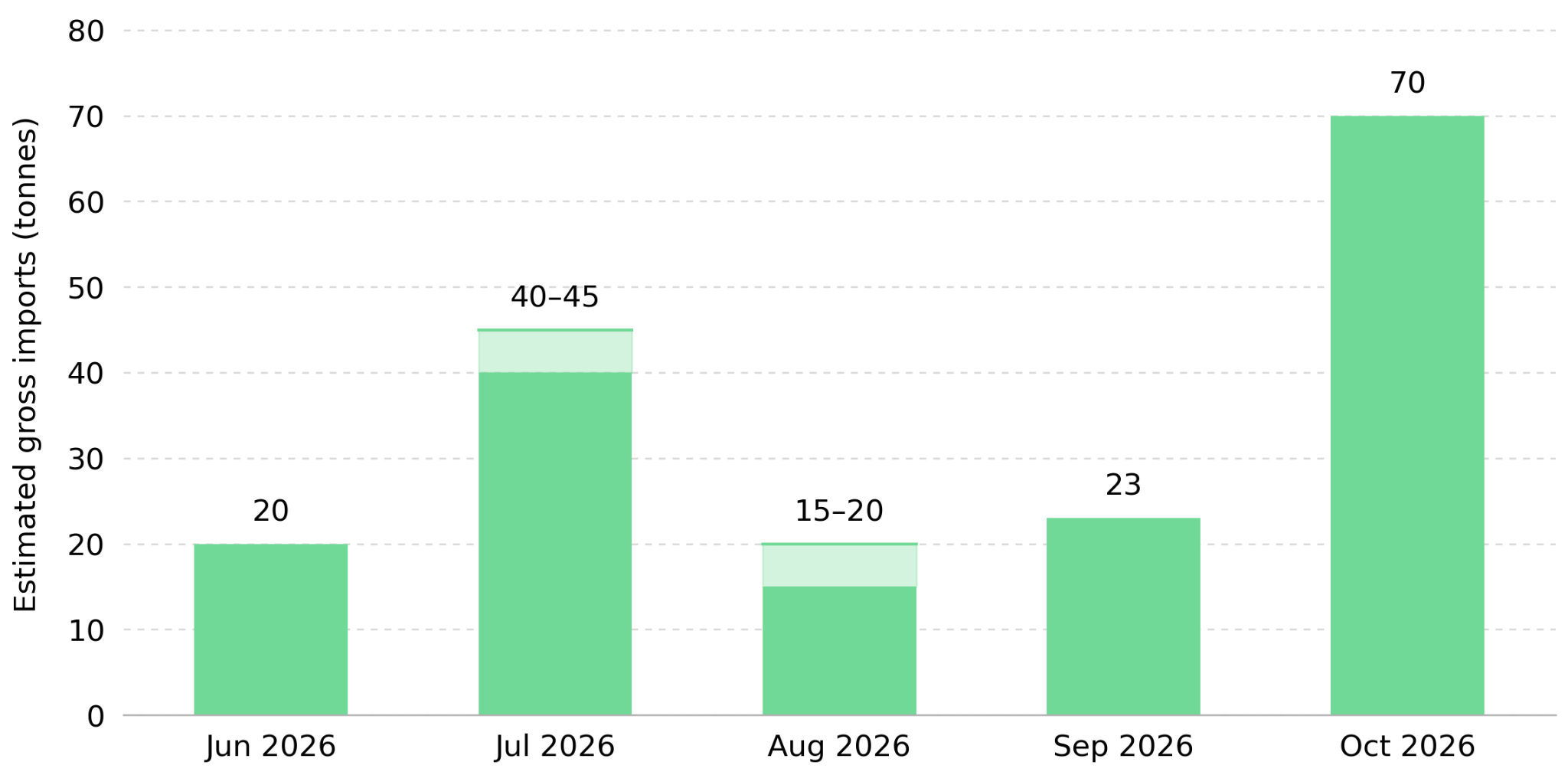
- India's estimated gross gold imports rose from 23 tonnes in September to a six-month high of 70 tonnes in October 2026, likely driven by festive restocking and lower gold prices, with the ongoing wedding season offering further demand potential.
- Indian gold ETFs added 31.3 tonnes to their holdings during the first ten months of 2026, up 22% year over year, expanding domestic investment demand beyond physical gold purchases.
- Global average all-in sustaining cost (AISC) margins rose 52% year over year to US$2,582/oz in the second quarter of 2026, the second highest in the Metals Focus dataset, supporting continued investment in mine operations and production expansion.
Tech Stock Concerns Spur Western Gold Selling Despite Asian Buying
Western gold ETF selling contrasts with recovering physical purchases in China and India. The World Gold Council's (WGC) November 23 Weekly Markets Monitor linked gold selling to broader reductions in financial market exposure as concerns over technology stocks intensified. European gold ETFs recorded 16 tonnes of outflows between November 1 and 20, while North American funds lost 12 tonnes during the week ending November 20.
Combined net gold futures positions held by money managers, other reportable traders, and non-reportable traders on COMEX declined by the equivalent of 75 tonnes through November 17. Open interest, which measures outstanding futures contracts, fell by the equivalent of 35 tonnes through November 20.
Indian domestic gold discounts narrowed from an average of US$66/oz in September to US$5/oz by November 12 as seasonal demand strengthened. Domestic prices nevertheless remained below import parity, indicating adequate supply.
China's Savings Shift Drives Bullion Buying Above Jewelry Demand
The WGC's November China Gold Market Update identifies cautious consumer spending, greater demand for wealth preservation, and late-2025 value-added tax reform as factors favoring investment bullion over jewelry. Chinese gold bar and coin investment surpassed jewelry consumption for the first time in 2025, a pattern that has continued into 2026.
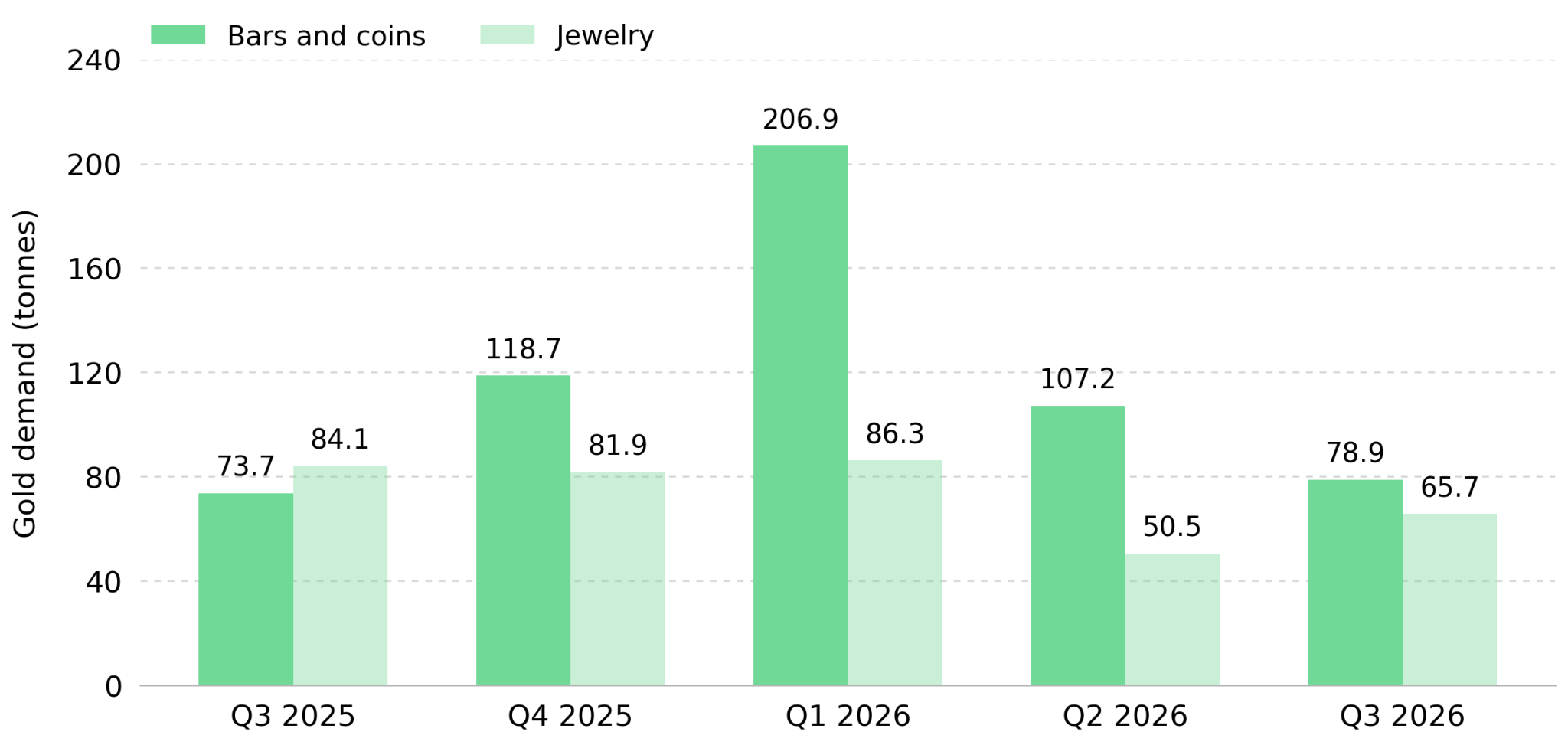
Gold withdrawals from the Shanghai Gold Exchange increased 2% month over month to 94 tonnes in October, reversing the usual seasonal decline following September restocking. Lower gold prices encouraged bullion purchases and jewelry restocking, with the latter also supported by National Day holiday sales. Wholesale demand nevertheless remained 24% below the previous year's level, primarily due to weaker jewelry consumption.
China's September net gold imports reached 129 tonnes, up 5 tonnes from August and 41% year over year. Domestic gold ETFs added 6.3 tonnes in October, lifting holdings to a month-end record of 310 tonnes before modest outflows emerged in early November. The People's Bank of China added 26 tonnes in October, its largest monthly purchase since October 2023, marking 24 consecutive months of gold accumulation.
India's Festive Restocking Lifts Gold Imports to a Six-Month High
According to the WGC's November India Gold Market Update, India's estimated gross gold imports rose from 23 tonnes in September to a six-month high of 70 tonnes in October, likely driven by festive restocking and lower gold prices. Combined imports of 93 tonnes across both months remained below the 2021-2025 average of approximately 180 tonnes for the same period, suggesting that recycled gold and unofficial imports also helped meet domestic demand.
Retailer estimates indicate that India's festive gold demand increased 15% to 25% year over year in value terms, while physical volumes remained largely unchanged or slightly higher. Consumers responded to elevated gold prices by purchasing lighter jewelry and smaller bars and coins weighing 0.5 to 5 grams. Exchanges of existing gold for new jewelry accounted for 40% to 60% of sales at many retailers, reducing the cash required for new purchases.
Indian gold ETFs recorded a fifth consecutive month of net inflows in October, lifting total holdings to 126 tonnes. Holdings increased by 31.3 tonnes during the first ten months of 2026, up 22% year over year, with an estimated further 1.75 tonnes added between November 1 and 11. The addition of 64,163 ETF accounts in October brought the total to 12.74 million, demonstrating broader participation in domestic gold funds.
Historically High Gold Margins Preserve Capacity for Mine Reinvestment
On the supply side, the latest mining cost analysis by the WGC and Metals Focus shows that global average AISC margins reached US$2,582/oz in the second quarter of 2026, up 52% year over year, providing producers with financial capacity to fund operating improvements and mine development.
Integra Resources produced 17,652 gold ounces at Florida Canyon during the third quarter of 2026, generating US$11.1 million in free cash flow. Its cash balance of US$119.5 million at September 30 provides financial flexibility to advance operating improvements and project development. Planned access to higher-grade ore in 2027 is expected to increase production, strengthening the mine's future cash generation potential.
Record Sustaining Capex Raises Value of Funded Expansion
Gold mining sustaining capital expenditure reached a record US$441/oz during the second quarter of 2026, increasing 34% quarter over quarter and 25% year over year. Funded expansion programs allow producers to pursue production growth alongside the capital requirements of maintaining existing operations.
Serabi Gold reported US$63.2 million in cash and no debt at September 30, 2026, underpinning its fully funded expansion program in Brazil. The installation of a fourth ball mill enables Palito to increase processing capacity to 900 tonnes per day. Coringa's operating license, expected in the first half of 2027, would enable further production growth using the company's existing processing infrastructure.
Higher Throughput Reduces Reliance on Price Gains for Profit Growth
Gold production across surveyed mining operations increased 1.6% quarter over quarter during the second quarter of 2026, alongside a 1.4% improvement in average ore grades. Expanding processing capacity offers producers an opportunity to increase revenues through higher gold output rather than relying solely on commodity price appreciation.
TRX Gold reported preliminary record gold production of 29,650 ounces for fiscal 2026, up 57% year over year, following processing improvements at Buckreef in Tanzania. The company has contracted a new processing circuit that would increase combined plant capacity to 5,500 tonnes per day. The expansion is expected to lift average annual gold production beyond the 62,000 ounces originally projected in its preliminary economic assessment (PEA).
Stephen Mullowney, Director and Chief Executive Officer of TRX Gold, explains the key drivers of gold mining profitability:
"Profitability is driven by two aspects, mainly by increased throughputs and cost management as well as an increase in the gold price relative to prior periods. We've done this all in a self-funded model."
Rising Operating Costs Increase the Value of Gold Recovery
Average gold mining cash operating costs increased 18% year over year to US$1,215/oz during the second quarter of 2026, reflecting higher labor and fuel expenditures. Improving gold recovery from existing ore offers producers a means of increasing revenue per tonne processed, helping offset rising operating expenses without a proportional increase in mining volumes.
Luca Mining is advancing processing improvements at its Campo Morado mine in Mexico, which has an existing capacity of 2,400 tonnes per day. Ongoing metallurgical testing is evaluating opportunities to increase gold and silver recoveries. The proposed expansion could increase saleable precious-metal output from existing mineral resources, strengthening gold's contribution to operating revenues and supporting future cash flow growth.
Declining Ore Grades Increase Need for Nearby Resource Development
Gold production and average ore grades across surveyed mining operations declined 4.4% and 3.1% year over year, respectively, during the second quarter of 2026. Integrating nearby deposits with operating mines can extend gold supply through existing infrastructure, while favorable gold prices can increase the volume of economically mineable material.
West Red Lake Gold Mines released an integrated pre-feasibility study (PFS) combining Madsen and Rowan in Ontario, outlining average annual gold production of 108,000 ounces from 2029 through 2034. The study estimates an after-tax net present value (NPV) of C$764 million at a long-term gold price of US$3,568/oz. Utilizing existing infrastructure at Madsen provides a capital-efficient route to higher production through Rowan's development.
Gold Price Volatility Reinforces Conservative Resource Estimation
Gold averaged US$4,266/oz during the third quarter of 2026, down 5.5% from the preceding quarter. As gold exploration budgets are rising, conservative resource estimation combined with phased mine development allows producers to evaluate larger deposits across different gold price scenarios while using cash generated from initial operations to support subsequent investment.
Cabral Gold increased measured and indicated gold resources at Cuiú Cuiú in Brazil by 49% to 998,800 ounces, while inferred resources rose 376% to 2.51 million ounces. Cash flow from its initial heap-leach operation supports further resource evaluation without immediate reliance on equity financing. Management is targeting a PEA for the larger hard-rock resource by the end of the third quarter of 2027.
Alan Carter, President and Chief Executive Officer of Cabral Gold, explains resource cutoffs amid higher gold prices:
"Even though the gold price has risen considerably, even with the pullback, it's double what it was four years ago, but we've been more conservative with our cutoff. So instead of using a 0.26 g cutoff that we used four years ago, we used a 0.35 g cutoff."
Committed Financing Preserves Flexibility for Gold Mine Expansion
With the peak implied federal funds rate for 2027 at 4.5% as of November 20, 2026, securing committed financing in advance allows gold producers to fund project milestones while reducing dependence on future equity issuances.
Mineros S.A. executed US$250 million in committed credit facilities through its subsidiaries on November 25, 2026, including US$150 million to support the development of Porvenir in Nicaragua and La Pepa in Chile. The remaining US$100 million is intended to recover capital previously invested in Hemco's operations. The five-year financing arrangement allows funds to be drawn as needed during the first year, with an 18-month grace period on principal repayments.
Rising Mine Costs Heighten Need to Preserve Operating Cash Flow
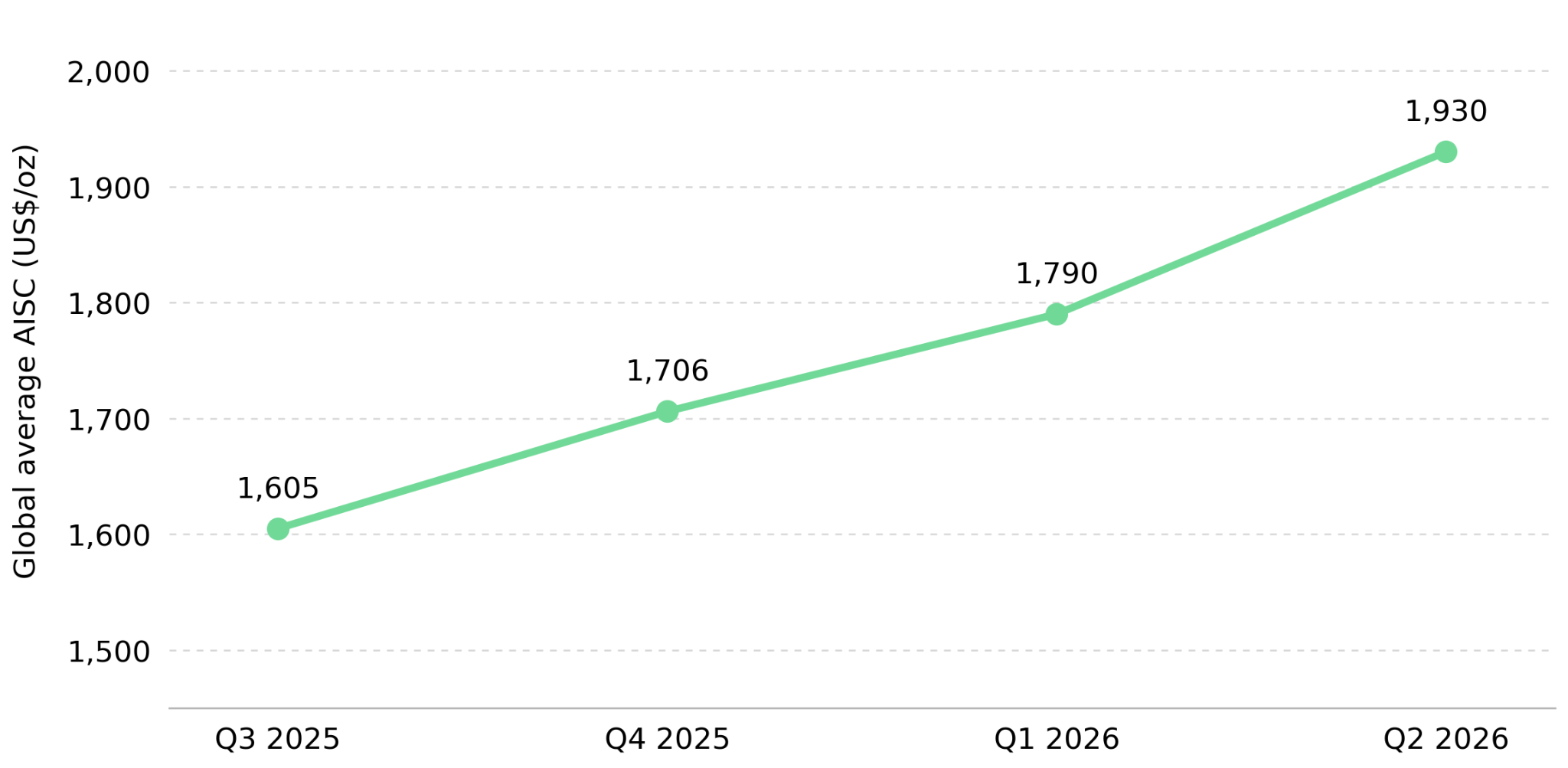
Global average AISC increased 22% year over year to US$1,930/oz during the second quarter of 2026, while royalty and production-tax expenses rose 53% to US$185/oz. Having dedicated development funding in place allows producers to advance new projects while preserving operating cash flow for ongoing business requirements.
New Found Gold reported drilling results of 14.58 grams of gold per tonne over 12 meters at Iceberg on November 24, 2026, supporting mine planning for its fully funded Queensway Phase 1 development. The company is upgrading its existing Pine Cove processing facility to receive initial ore from Queensway in the fourth quarter of 2027, with Hammerdown cash flow intended to fund exploration and corporate expenditures.
Asian Gold Buying Broadens Demand Base for Long-Term Mine Investment
China's gold withdrawals increased 2% month over month to 94 tonnes in October, while India's estimated gross imports reached a six-month high of 70 tonnes. These purchasing patterns reflect demand driven by wealth preservation and seasonal consumption rather than Western portfolio allocations. The physical market recovery offers a demand counterweight to Western ETF outflows, although differences in reporting periods and purchasing measures prevent a direct quantitative comparison.
Global average AISC margins reached US$2,582/oz in the second quarter of 2026, up 52% year over year, providing producers with financial capacity to reinvest in future supply. With average gold prices subsequently declining 5.5% to US$4,266/oz in the third quarter, the investment opportunity centers on production expansion that remains economically viable across commodity price cycles, rather than depending on a reversal of Western fund outflows.
The Investment Thesis for Gold
- Asian household wealth preservation preferences provide alternative sources of physical gold demand beyond Western institutional portfolio allocations.
- Changing Chinese savings patterns increase the relevance of investment bullion as a recurring component of global gold consumption.
- Indian seasonal purchasing and expanding financial gold ownership provide complementary demand channels that operate through distinct economic mechanisms.
- Producers with competitive operating costs, established infrastructure, credible permitting schedules and funded expansion programs offer exposure to recoverable production growth across commodity cycles.
- Assessing regional physical consumption alongside financial flows provides a more comprehensive framework for long-term capital allocation within the gold sector.
Asian gold buying broadens the foundations of global demand beyond Western financial market cycles, with Chinese wealth preservation and Indian seasonal purchasing providing distinct sources of physical consumption. This diversification strengthens the long-term case for gold mine investment, particularly where strong operating margins can fund production growth and resource development. The investment opportunity lies in producers capable of translating geographically diversified gold demand into sustained cash flow and long-term shareholder returns by expanding processing capacity and converting mineral resources into economically viable reserves.
TL;DR
Recovering physical gold demand in China and India provides a counterweight to Western ETF outflows. Chinese bar and coin investment continues to exceed jewelry consumption, while India's estimated gold imports reached a six-month high of 70 tonnes in October 2026. Indian gold ETF holdings also increased by 31.3 tonnes during the first ten months of the year. Meanwhile, global average AISC margins rose 52% year over year to US$2,582/oz in the second quarter, supporting mine reinvestment despite rising operating costs. Gold producers with competitive costs, established infrastructure, and funded expansion programs are positioned to translate diversified demand into economically viable production growth and long-term cash generation.
FAQs (AI-Generated)
Analyst's Notes





Subscribe to Our Channel













Stay Informed