




Canada Nickel Buys Time to Limit Dilution Ahead of Crawford's 2027 Financing


Canada Nickel extends its Auramet loan to February 2027 to limit dilution while Crawford's US$2.5B nickel financing targets ITCs and government funds.
- Canada Nickel extended its Auramet International loan to February 9, 2027 and reduced the principal to US$27,777,299 from US$32 million, paying a US$694,432 fee and issuing 7,500,000 warrants at $1.10.
- The new maturity falls in the first quarter of 2027, the same quarter the company targets for its investment tax credit facility and the full financing package for the Crawford Nickel Sulphide Project.
- Crawford's US$2.5 billion funding plan targets US$1 billion of equity from tax credits, a US$100 million Samsung SDI project option, government programs and a potential joint venture (JV), with the tax credits at mandate stage and the government and JV pieces still targets.
- Management says near-term share issuance will be limited to bridge financings and starter positions for large funds, with 327.2 million fully diluted shares outstanding.
- New Canadian government funds are set to begin deploying capital in 2027, according to management, and the company is targeting a final investment decision (FID) in the third quarter of 2027.
Canada Nickel Company Inc. (TSXV: CNC | OTCQX: CNIKF) spent 2026 moving its Crawford Nickel Sulphide Project in Timmins, Ontario from permitting into execution. It funded that work with bridge debt, a C$21 million private placement in August 2026 and a willingness to wait for capital that does not come from new shares. Its November 9, 2026 corporate update extended that bridge, and the terms show what the wait costs.
The company's choice is between issuing equity at current share prices or paying lenders for time while government funds, tax credits and strategic partners convert into signed commitments. For 2026, Canada Nickel chose time. The extension moves the main financing tests into the first quarter of 2027.
What Has Happened
Canada Nickel extended the repayment date of its loan facility with Auramet International, Inc. from November 9, 2026 to February 9, 2027. The facility, first announced on February 6, 2026 at US$32 million, now stands at US$27,777,299 after the company repaid part of the principal.
For the extension, Canada Nickel will pay Auramet a US$694,432 fee and issue 7,500,000 warrants, each exercisable for 1 common share at $1.10 for 1 year. The exercise price is a 10% premium to the 5-day volume-weighted average price (VWAP) ending November 6, 2026. As the TSX Venture Exchange (TSXV) requires, 5,500,000 warrants at $1.52 issued to Auramet in August 2026 will be cancelled. The extension and the new warrants both remain subject to TSXV approval.
The company set the new maturity to match its current expectations for completing several financing initiatives, and it continues to target a construction decision in 2027. It also terminated a share-settled services agreement with a third-party provider.
What the Extension Costs & What It Buys
The cost comes in 2 parts: the US$694,432 cash fee and the warrant reset. Auramet gives up 5,500,000 warrants exercisable at $1.52 and receives 7,500,000 warrants exercisable at $1.10 for 1 year, a larger count at a lower exercise price. The company's October 2026 capitalization table shows 327.2 million fully diluted shares, made up of 258.8 million basic shares, 32.3 million warrants, 19.4 million stock options and restricted share units, and 16.7 million shares issuable on conversion of debentures.
The benefit is timing. The original November 9, 2026 maturity came before every 2027 financing milestone on the company's timeline. The February 9, 2027 date falls within the first quarter of 2027, when Canada Nickel is targeting its investment tax credit (ITC) facility, definitive agreements for the mining fleet, fleet financing with Taykwa Tagamou Nation (TTN) and the full Crawford financing package. On a pro forma basis, cash stood at C$29 million and debt at C$61 million as of July 31, 2026, with both figures adjusted to include the C$21 million private placement completed in August 2026.
A Funding Plan Built to Limit Share Issuance
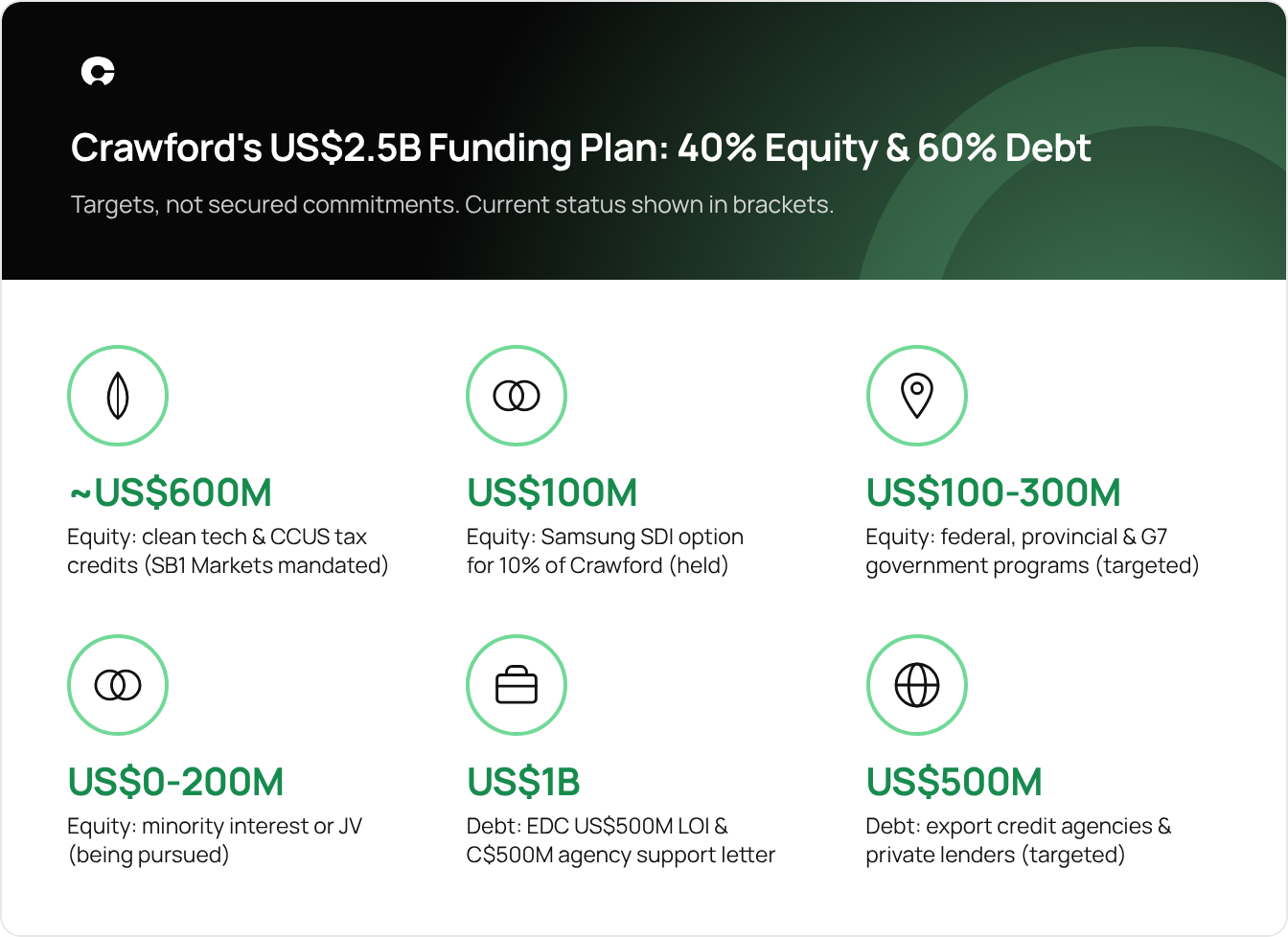
Canada Nickel's US$2.5 billion funding plan for Crawford splits 40% equity (US$1 billion) and 60% debt (US$1.5 billion), set against initial capital of about US$2.0 billion after Front End Engineering and Design. On the equity side, the company is targeting about US$600 million of Clean Technology Manufacturing and carbon capture, utilization and storage ITCs, US$100 million from the Samsung SDI option, US$100 million to US$300 million from government funding programs, and up to US$200 million from a minority interest or joint venture (JV) being pursued with Scotiabank and Deutsche Bank. These are targets, not secured commitments: the government and JV components are stated as ranges, and the tax credit facility is at mandate stage. The equity label describes the plan's capital structure and is not a target for issuing Canada Nickel shares. The tax credits and government programs are the non-dilutive government support the company highlights in the plan.
On the debt side, Export Development Canada (EDC) has issued a letter of intent (LOI) for US$500 million as Mandated Lead Arranger, a leading Canadian financing agency has provided a C$500 million support letter, and the company is targeting a further US$500 million from export credit agencies and private lenders. SB1 Markets was mandated in June 2026 to arrange up to US$600 million through the ITC facility, and the company plans to take that facility to market in early January 2027.
The Samsung SDI option gives the battery maker the right to acquire a 10% direct interest in Crawford for US$100 million, which values the project at US$1 billion. Exercising the option would bring a 10% life-of-mine (LOM) nickel offtake plus a further 20% for 15 years, an arrangement the company says directly supports debt capacity for lenders. Samsung SDI already holds 6.0% of Canada Nickel, alongside Agnico Eagle at 8.7%, Anglo American at 5.3%, and TTN at 6.1%, following the conversion of its equity participation agreement.
Government Checks Set the Pace
The government layer of the equity stack draws on federal and provincial programs, including Canadian Minerals Infrastructure, Canada Growth, Critical Minerals Sovereign, First & Last Mile and Ontario Critical Mineral Processing. It also draws on global and G7 sources such as Infravia in France, the German Resource Fund, Japan's JOGMEC and Korea.
Chief Executive Officer Mark Selby described financing as the frustrating part of 2026, with several pieces of government funding the company expected earlier in the year still outstanding. Canada's new accelerator fund, administered by EDC, is intended to provide non-dilutive capital to companies, while the new First & Last Mile fund replaces an earlier infrastructure fund with a broader mandate and more flexible deployment. Both will begin writing checks for critical minerals projects in 2027. In the US, nickel was included in the first-round call of the Defense Industrial Base Consortium, and Korea's mineral agency, which reviewed Crawford for Korean battery companies, is regaining capacity to invest.
Selby weighed the delay against the alternative of raising equity sooner:
"If you can take a little extra time and get a decent chunk of non-dilutive capital, then I think that's a worthwhile investment."
Deadlines, Delivery & Equity Discipline
Canada Nickel went from the fifth drill hole at Crawford to a feasibility study (FS) in 4 years, and to a federal permit in 7 years. The July 2026 federal Decision Statement was the first mining approval under Canada's amended Impact Assessment Act since 2019. Ontario added Crawford to its One Project, One Process framework in January 2026, and the project was also selected for the federal Major Projects Office.
Selby acknowledged that the company has missed some of its own targets, and explained why it keeps setting them tight when outside groups control the next step:
"If I gave them an extra year of deadline, they would still take the extra year of deadline. It won't make things go any faster."
Management applies the same discipline to equity. With a market capitalization of C$336 million at C$1.30 per share, Selby says near-term equity raises will be limited to bridging timing gaps, or to giving multi-hundred-billion-dollar funds a starter position in a company of Canada Nickel's size.
Broader Context: Nickel Prices & the Cost of Capital
The case for waiting depends partly on where nickel prices go. Canada Nickel's shares traded between C$0.97 and C$2.59 over the 52 weeks to October 2026, with a 20-day VWAP of C$1.40. At a lower share price, every dollar raised requires more shares, so a higher share price would reduce the number of shares needed for any equity that remains in the plan. With nickel just under US$16,000 per tonne, a firm commitment on Indonesia's 2027 quota, due before the end of December, will lift prices to US$19,000 to US$20,000 per tonne.
Crawford's projected LOM net C1 cash cost of US$0.39 per pound of nickel places it in the first quartile of the global cost curve, according to Wood Mackenzie 2022 data. The company states that Crawford generates positive free cash flow at nickel prices well below current spot levels, which gives lenders and partners a margin of safety that does not depend on Indonesia's quota decision.
What to Watch Next
The near-term markers are TSXV approval of the Auramet extension and warrants, Indonesia's 2027 quota announcement before the end of December, and SB1 Markets taking the ITC facility to market in early January 2027.
The first quarter of 2027 then brings the targeted ITC facility, definitive fleet agreements with Komatsu and SMS Equipment, fleet financing with TTN, the full financing package and the February 9, 2027 Auramet maturity.
Beyond that, Canada Nickel is targeting provincial and federal construction permits and a final investment decision (FID) in the third quarter of 2027, followed by construction starting in the fourth quarter of 2027, over a period the company puts at 27 months, and first production targeted for the fourth quarter of 2029. The company’s goal is to have the financing package assembled and the company in a position to make the FID by the end of 2027.
FAQs (AI-Generated)
Analyst's Notes





Subscribe to Our Channel





Stay Informed


