




Nickel Slips Below $17K, but Strong Fundamentals Signal Rebound Ahead



Nickel below $17K on USD strength; fundamentals intact. Indonesia tightens supply. Canada Nickel advances $600M ITC bridge financing toward 2027 construction.
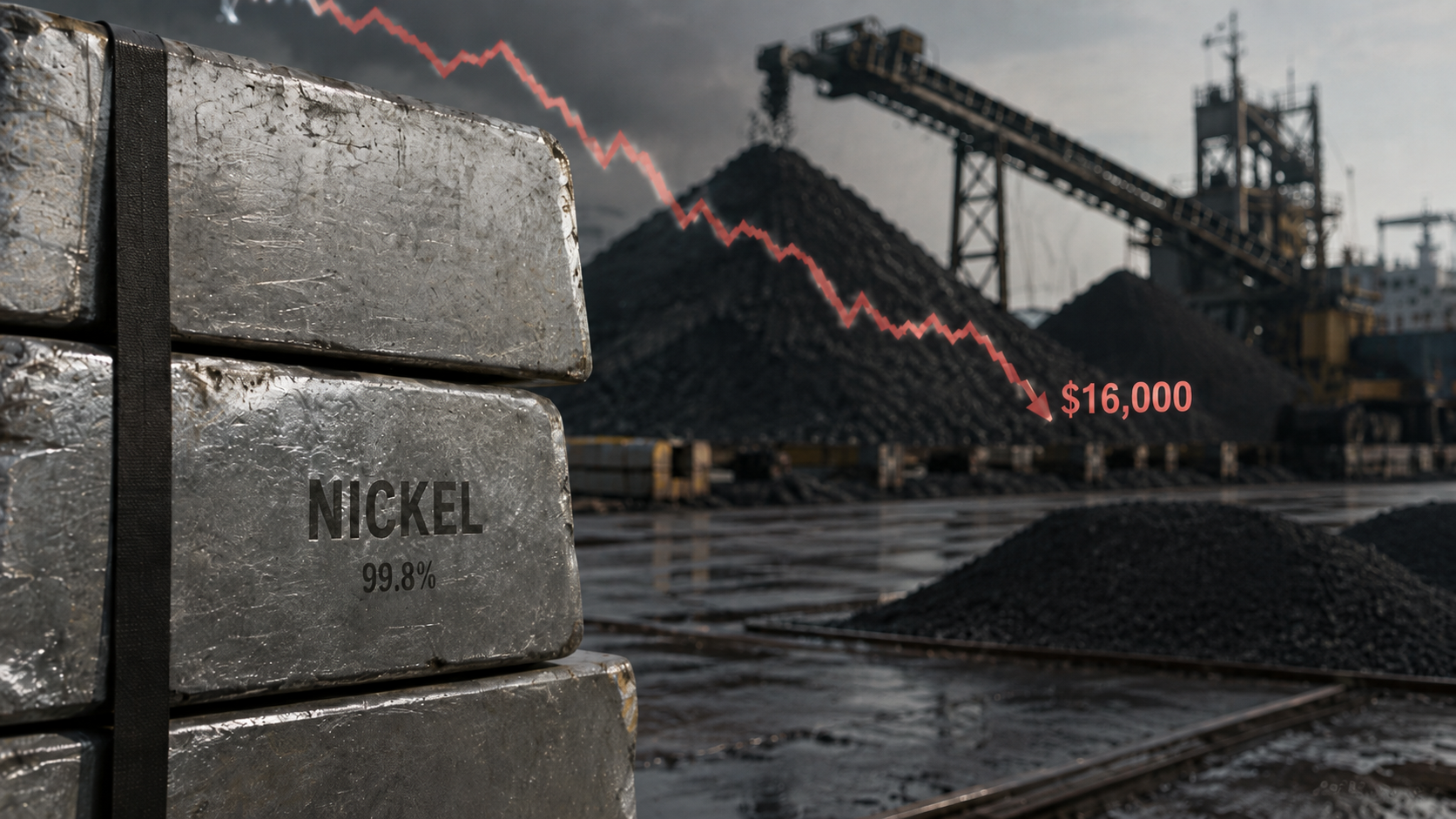
- Nickel prices have fallen below $17,000/tonne from the $18,500-$20,000 range seen for most of 2026, driven by US dollar strength following a trade settlement rather than deteriorating fundamentals.
- Indonesia's nickel policy changes have transferred significant economic value from Chinese processors to Indonesian miners and government, with China reportedly warning of $50 billion in at-risk downstream investment - though analysts view this primarily as a negotiating posture.
- Canada Nickel Corporation has engaged SB1 Markets, a Scandinavian investment bank, to structure bridge financing against approximately $600 million in Canadian government investment tax credits, ahead of an anticipated federal environmental permit and a 2027 construction decision.
- EV battery deployment data for April 2026 showed approximately 6% year-over-year growth, with the broader nickel market increasingly described by analysts as moving into supply deficit.
Mark Selby, CEO of Canada Nickel Corporation shared deep insights on the shifting geopolitical dynamics between Indonesia and China, rising demand from electric vehicles, and corporate developments across several nickel-focused companies. The discussion came at a moment of short-term price weakness, set against what Selby and a growing number of analysts are characterising as structurally tightening supply fundamentals.
Nickel Prices: Macro Pressure, Not Fundamental Weakness
Nickel prices declined to below $17,000 per tonne in late June 2026, retreating from the $18,500 to $20,000 range that had prevailed through much of the year. Selby attributed the move primarily to US dollar strength following a trade-related settlement, rather than any deterioration in underlying supply and demand conditions.
The timing matters here. The Philippines, one of the world's largest producers of nickel ore, generates close to half of its annual ore output during the second quarter. With Q2 drawing to a close, the market is currently at its seasonal peak of ore availability - a period when prices would typically face downward pressure. Against that backdrop, the limited magnitude of the decline is, in Selby's view, a constructive signal.
"This is peak ore availability... the fact that it's only come off a buck or two at this point is great."
Nickel pig iron and stainless steel prices have also held close to their year-to-date highs, further suggesting that macro currency movements - rather than fundamental deterioration - are driving near-term price action. Selby expressed confidence that once dollar strength abates, underlying nickel fundamentals will reassert themselves, and he advised investors to treat current weakness as a buying opportunity.
Indonesia and China: A Structural Shift in Global Nickel Supply
One of the more consequential themes in the discussion was the ongoing realignment between Indonesia and China in global nickel supply chains. Indonesia holds approximately two-thirds of the world's nickel supply and has implemented policy changes that transfer a meaningful share of economic value away from Chinese processors toward Indonesian miners and government through higher ore prices and increased tax revenue.
China's response has been pointed. Reporting from the Financial Times cited a formal letter from the Chinese government warning that up to $50 billion in downstream investment could be at risk. However, Selby suggested this represents negotiating posture more than an actionable threat, given that Indonesia's supply dominance leaves China with few credible alternatives at scale. New Caledonia's ore is largely committed to domestic operations, Madagascar's potential is a multi-decade development horizon, and Brazilian saprolite deposits are insufficiently sized to offset Indonesian supply.
"Indonesia has this leverage in terms of being the Saudi Arabia of nickel," Selby said, describing the country's structural position in the global market.
With significant vested interests - including government officials and institutional stakeholders - tied to higher ore prices, Selby argued that any reversion to prior pricing levels is unlikely. He projected that as ore availability tightens again in the fourth quarter, prices could recover back above the $20,000 per tonne level.
EV and Battery Demand: Constructive Signals
On the demand side, recent data has been encouraging. EV deployment figures for April 2026 showed battery uptake up approximately 6% year-over-year, with a broader restocking cycle running through the supply chain - a trend Selby noted has also contributed to upward pressure on lithium prices. He projected nickel demand from the EV sector to continue growing in the high single-digit percentage range going forward, representing a consistent and expanding demand base for battery-grade material.
The US government's increasing engagement in critical minerals was also highlighted as a structural tailwind. Hard nickel has been designated a priority metal by the US defense industrial base consortium, and government funding directed at domestic and allied-nation nickel projects is expected to increase through the remainder of 2026.
Canada Nickel Corporation: Structured Financing Progress
On the corporate front, Canada Nickel Corporation announced a mandate with SB1 Markets - a Scandinavian investment bank with an established natural resources debt practice - to structure bridge financing against Canada's investment tax credit program. The company expects to receive approximately $600 million in ITCs, and the SB1 mandate is designed to allow those credits to function as a form of non-dilutive quasi-equity ahead of a construction decision expected in 2027.
"If the government is going to give you $600 million of free money, you might as well use it as equity to minimise the dilution you need to do."
The receipt of the primary federal environmental permit, described as imminent, is expected to formally initiate the SB1 process. Selby emphasized that the engagement with SB1 reflects a substantive relationship rather than a routine capital markets announcement, pointing to the firm's established track record in the sector.
Company Updates Across the Nickel Sector
Selby offered brief assessments of several other nickel-related companies. Nickel 28 was described as one of the most undervalued stories in the sector, with an 11% interest in an operating asset generating cash flow at costs of approximately $3 per pound. As debt is retired, access to additional free cash flow is expected to increase. Selby noted the asset carries Chinese-ownership and Papua New Guinea jurisdiction risks, but characterized the operational track record as having reduced those concerns materially over time.
Regarding Sherritt International's Cuban operations, Gillon Capital - described as having links to the current US administration - has signed an exclusivity agreement for the nickel refinery. With ore supply to Cuba blocked and inventories depleted, the facility is winding down. Whether it can eventually be repositioned as part of North America's critical minerals infrastructure remains an open question.
First Atlantic Nickel published metallurgical test work showing awaruite concentrate at approximately 71% nickel, though Selby raised questions about overall recovery rates, which appeared to be below 50% based on available data. He called for more comprehensive recovery disclosures before investors could draw meaningful conclusions.
NexMetals reported an updated resource for its open-pit deposit in Botswana - just under 100 million tonnes grading 0.2% nickel, 0.2% copper, and approximately 0.5 grams per tonne platinum group metals - representing a 60% increase in copper-equivalent resource. Importantly, recent metallurgical work has improved concentrate grades sufficiently to potentially enable sales to third-party smelters, removing the previous requirement for dedicated smelting infrastructure.
Key Takeaways
The near-term nickel price weakness appears to reflect macro currency dynamics rather than any structural demand deterioration. Indonesia's consolidation of supply leverage, combined with growing EV battery demand and increasing US government engagement in critical minerals, supports a constructive medium-term outlook for the metal. For Canada Nickel Corporation specifically, the SB1 mandate represents a tangible step toward structuring a financing pathway that minimises shareholder dilution using committed government capital ahead of a 2027 construction decision. Across the broader junior nickel space, the gap between companies with robust metallurgical data and those still building that case continues to matter to investors assessing relative risk and upside.
TL;DR
Nickel prices have pulled back below $17,000/tonne due to US dollar strength, not fundamental deterioration, with seasonal peak ore availability in Q2 providing additional context. Indonesia's dominant control over global nickel supply - roughly two-thirds of the total - limits China's leverage in any pricing dispute, and analysts increasingly describe the market as moving into deficit. Canada Nickel Corporation has taken a concrete step toward a non-dilutive financing structure by engaging SB1 Markets to bridge $600 million in Canadian government investment tax credits ahead of a 2027 construction decision.
FAQs (AI Generated)
Analyst's Notes





Subscribe to Our Channel





Stay Informed


