




Revival Gold Hits Strong Gold Intercepts In Beartrack-Arnett as Mercur Targets 2028 Construction Decision


%20(1).jpg)
Revival Gold (TSXV:RVG) advances Mercur toward a 2028 construction decision while high-grade underground drilling at Beartrack-Arnett's Joss zone expands.
- Revival Gold's Joss Zone at Beartrack-Arnett has returned one of its strongest-ever intercepts, with hole BT26-255D grading 6.56 g/t gold over 42.5 metres.
- Mercur is advancing toward a 2028 construction decision after a roughly two-year permitting path.
- Revival Gold states its C$27.8 million cash position is sufficient to fund both projects through to Mercur's construction decision.
- The combined project NAV of $1.225 billion compares with a market capitalisation of roughly C$211 million implying a steep valuation discount to peers.
- CEO Hugh Agro frames future free cash flow from Mercur as the intended funding source for underground growth at Beartrack-Arnett, without further shareholder dilution.
Gold has had a volatile eighteen months, spiking to around $5,600 an ounce before resetting near $4,100 and one that has sharpened investor focus on which developers can actually convert ounces in the ground into production. Revival Gold Inc. (TSXV:RVG) is one of them, with two brownfield US gold assets moving on parallel but distinct timelines: Mercur in Utah, heading toward a construction decision in 2028, and Beartrack-Arnett in Idaho, where a fresh round of underground drilling has just delivered one of the strongest intercepts in the project's history.
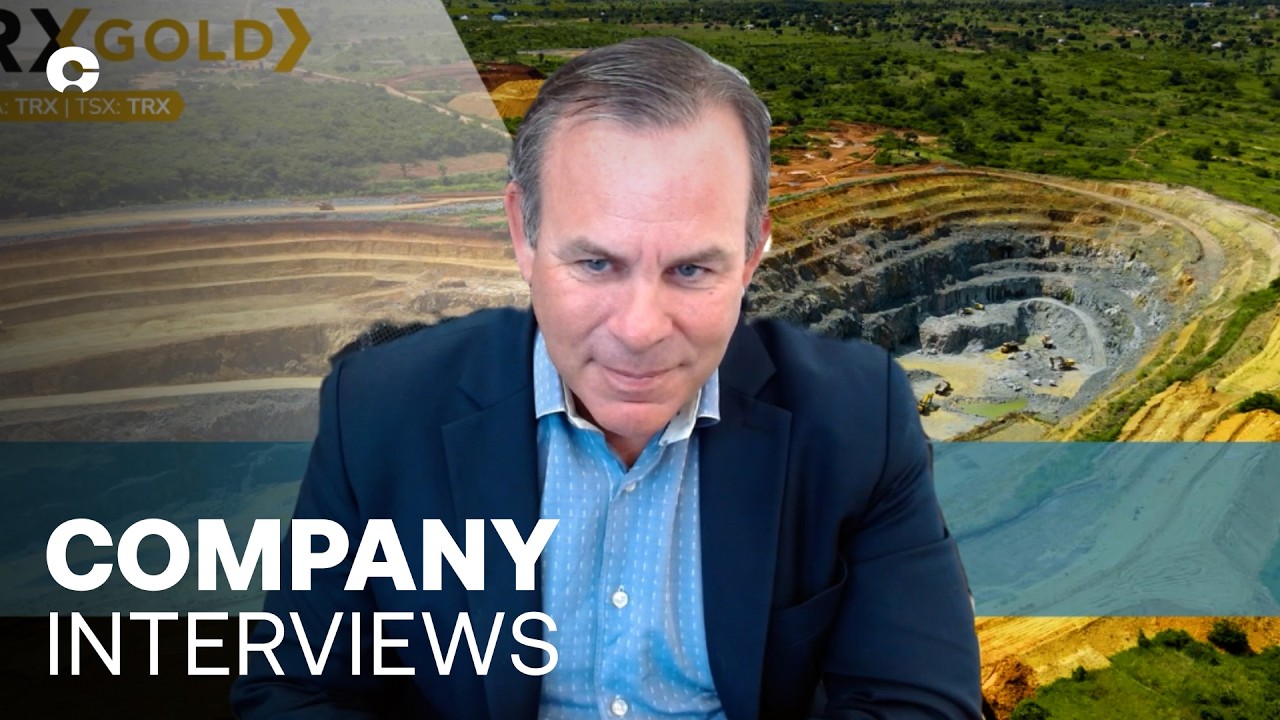
President & CEO Hugh Agro sat down to unpack a busy week for the company, which included a new high-grade result from the Joss zone at Beartrack-Arnett alongside an update on Mercur's progress toward a preliminary feasibility study (PFS).
Two Projects, Two Timelines
Revival Gold's positioning rests on running two projects at different stages simultaneously. Mercur is at the preliminary economic assessment (PEA) stage and on a roughly two-year permitting path. The property covers 7,200 hectares, with core claims 100% owned or optioned, and holds patented mining claims in a semi-arid setting. Mercur was historically the first Carlin-type gold deposit identified anywhere in the western United States, and produced 2.6 million ounces of gold in its earlier operating life, including 0.9 million ounces at close to 7 g/t gold. Beartrack-Arnett, in Lemhi County, Idaho, is further along at PFS stage for its first-phase open-pit heap leach restart, with a second-phase, higher-grade underground opportunity behind it. Both sites carry the operational advantage of prior production history, established road access and existing power infrastructure, which the company says materially reduces the capital intensity of restarting or building around them compared with a greenfield project.
Revival Gold's plan is to bring Mercur into production first, then layer in Beartrack-Arnett's heap leach restart, while continuing to explore the underground potential at Joss. Ago framed the sequencing decision rather than a resourcing constraint: the company's own combined gold resources across both projects total roughly 6 million ounces, split between 3.2 million ounces measured and indicated and 2.8 million ounces inferred, which the company translates into approximately 19 ounces of gold exposure per 1,000 shares outstanding which shows that shareholders already hold meaningful leverage to a rising gold price without needing the company to add ounces through acquisition.
Joss: High-Grade Continuity at Depth
The catalyst is set on reporting hole BT26-255D at Joss: 3.43 g/t gold over 131.7 metres drilled width, including a higher-grade interval of 6.56 g/t gold over 42.5 metres, itself including 11.58 g/t gold over 12.1 metres. The intercept sits roughly 70 metres above BT22-242D and 150 metres below BT21-240D, extending the known mineralised system to a vertical dimension of about 850 metres across four holes.
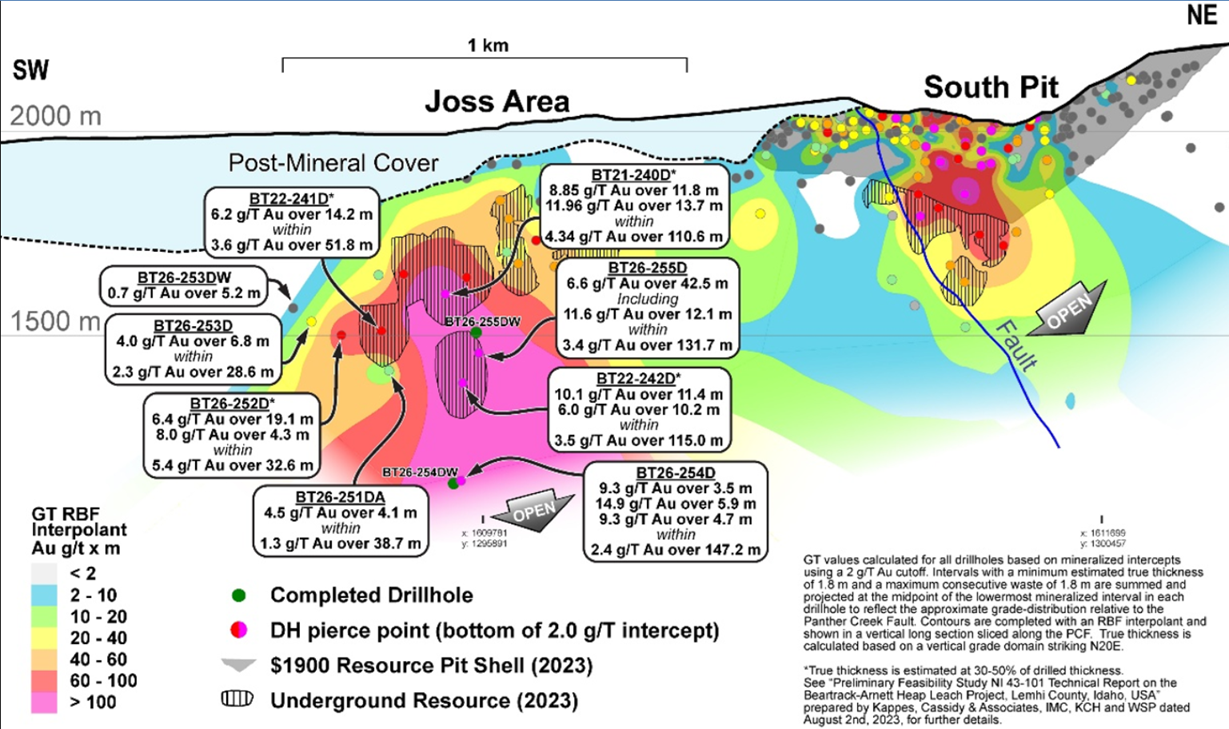
This year's programme comprised 5,500 metres of core drilling, targeting the southern extent of a structurally controlled orogenic gold system hosted within the Panther Creek Shear Zone. Joss hosts an inferred underground resource of 6.7 million tonnes grading 4.05 g/t for 877,000 ounces of gold, separate from Beartrack-Arnett's first-phase open-pit PFS economics, which are built around 65,300 ounces of gold per year over eight years at an all-in sustaining cost of $1,248 per ounce, a pre-production capex of $109 million, and an after-tax NPV of $484 million at an 80% after-tax IRR using $3,000 gold.
Agro framed the 2026 programme as continuity-focused rather than purely exploratory, following on from initial intercepts made in 2022, an initial underground resource of almost 900,000 ounces published in 2023, and follow-up Sharkey-area drilling at Beartrack-Arnett in 2025 that looked for additional zones of mineralisation along strike from Joss. Independent analysis by S&P Global has also ranked Beartrack-Arnett among the largest new US gold discoveries made since 2010, alongside Mercur itself, underlining that both projects are recent additions to the country's gold inventory rather than long-stalled legacy assets.
Interview with Hugh Agro, President & CEO of Revival Gold Inc.
Mercur: Building Toward First Production
While Joss carries the exploration narrative, Mercur is the near-term production driver. The company has completed roughly 8,500 metres of an 18,000-metre drilling programme that started in April, with two rigs currently active and two more due to arrive by the end of August, bringing the total to four. The immediate priority is converting inferred resources to measured and indicated categories ahead of a PFS targeted for completion by the end of the first quarter of 2027.
Metallurgical column test work is also underway, examining crush size, reagent use and agglomeration approaches, with initial results expected before the end of summer. Agro was candid that this work has taken longer than planned, attributing the delay to industry-wide demand for laboratory capacity rather than any project-specific issue. Baseline studies covering biological, cultural, hydrological, geochemical, noise and air factors are due to be completed through 2026, feeding into permitting.
The 2025 PEA outlined a 66 Mt resource grading 0.60 g/t gold, average annual production of 95,600 ounces over a 10-year mine life, initial capex of $208 million, and an after-tax net present value (NPV) of $741 million at a 5% discount rate and $3,000 gold - rising to $1.2 billion at $4,000 gold.
Financial Position and Capital Discipline
The company says cash position is sufficient to fund both projects to Mercur's 2028 construction decision with the closing of the sale of the company's 51% interest in its non-core Diamond Mountain phosphate project to Canadian Phosphate Ltd., which delivered an immediate cash payment of $127,500 plus shares currently valued at roughly $270,000, with a further $255,000 due within a year of the agreement and $765,000 payable on commencement of commercial production at Diamond Mountain.
Combined, Mercur and Beartrack-Arnett represent an after-tax NPV of $1.225 billion at $3,000 gold, against a basic market capitalisation of roughly C$211 million - a 0.11x price-to-NAV ratio the company positions as a discount to US developer peers which averages around 0.35x. On a resource-ounce basis, the company calculates its market cap implies roughly $23 per resource ounce of gold, against a stated $104 per ounce average for US developer peers. The share register is institutionally weighted, with institutions and corporates including EMR Capital, Konwave, Dundee Corporation, Aegis Financial and Sun Valley Gold among named holders.
Agro was direct about the financing philosophy underpinning that gap:
"Cash is king. And we follow the money, right? So, our key investors are looking for us to move concepts, drill holes, engineering studies, permitting into cash flow. That's where we're clearly focused, and that's where most of our money and most of our time and effort is being spent."
Catalysts Through Year-End
Agro outlined a busy back half of 2026: further drill results from Beartrack-Arnett, including pending assays from wedge holes BT26-254DW and BT26-255DW; initial metallurgical column test results from Mercur before the end of August; ongoing infill drilling results feeding the Mercur resource conversion; and a progress update on the PFS engineering and permitting work later in the year, alongside baseline study results covering the biological, cultural, hydrological, geochemistry, noise and air work needed for permitting. He also confirmed the recent addition of roughly 700 acres of land adjacent to Beartrack-Arnett's existing footprint, acquired to provide a faster, lower-cost, and more favourable-from-a-permitting-perspective route to the heap leach pads - describing it as an opportunistic purchase for a couple of million dollars that only became available recently, rather than a long-planned land assembly.
Looking further out, the company's stated development pipeline moves in four steps: first, Mercur's heap leach reaching roughly 95,000 ounces a year on its two-year permitting path; second, adding Beartrack-Arnett's heap leach restart for a further 65,000 ounces a year; third, bringing in Beartrack-Arnett's high-grade underground sulphides once Mercur is generating cash; and a fourth, unspecified expansion phase the company has flagged but not yet detailed, which Agro suggested could eventually eclipse Mercur's own project NPV given the higher grades already demonstrated at Joss.
Investment Thesis for Revival Gold
- Two pure-gold, multi-million-ounce US assets at different development stages provide both a near-term production pathway (Mercur) and organic growth optionality (Beartrack-Arnett underground) without requiring acquisitions.
- Mercur's PEA economics show a 56% after-tax IRR and $741 million NPV at $3,000 gold, against a modest $208 million initial capex, aided by existing infrastructure and a comparatively short permitting timeline.
- The Joss underground zone at Beartrack-Arnett has grown from an initial 2023 resource of roughly 900,000 ounces to a system now demonstrating continuity over an 850-metre vertical extent, with the deposit still open at depth and along strike.
- Combined project NAV of $1.225 billion at $3,000 gold compares with a market capitalisation of roughly C$211 million, implying a 0.11x price-to-NAV ratio versus a 0.35x average for US developer peers.
- Cash of C$27.8 million is stated to fund both projects through to Mercur's 2028 construction decision, reducing near-term dilution risk relative to peers still raising capital for permitting-stage work.
- Watch items: Mercur PFS due end of Q1 2027; pending Joss wedge-hole assays (BT26-254DW, BT26-255DW); initial Mercur metallurgical column test results before end of August 2026.
- Risk factors include reliance on preliminary (non-binding) economic assessments, gold price sensitivity given the projects' pure-gold exposure, and the standard permitting, financing and construction risks facing any pre-production developer.
Macro Thematic Analysis
Gold's round trip over the past eighteen months has reset investor expectations without eliminating the underlying case for the metal: elevated prices by historical standards, continued central bank buying, and persistent macro uncertainty. For developers, that volatility has made capital discipline a more visible differentiator than resource size alone. Companies dependent on continuous equity raises to fund exploration have been punished in a market that increasingly rewards a visible, funded route to production.
Revival Gold's pitch leans directly into that shift. Rather than treating free cash flow as an endpoint, Agro frames it as the mechanism that funds Beartrack-Arnett's underground exploration without further shareholder dilution:
"Cost of capital for developers is quite high. Cost of capital for producers is much lower. And so, I think it's a matter of phasing into production using the free cash flow [to] continue to drive value from our organic growth opportunities without having to do an acquisition along the way. We're not going to dilute our shareholders down the road to find more growth. We have it in the portfolio already."
That framing matters for a sector where junior and mid-tier gold developers are increasingly valued on funding certainty as much as on ounces. A company that can point to a phased, self-funding pathway - production first, exploration upside second - offers a different risk profile to investors than one still dependent on the equity markets to advance every stage of its pipeline.
TL;DR
Revival Gold (TSXV:RVG) is advancing Mercur in Utah toward a 2028 construction decision while Beartrack-Arnett in Idaho delivers high-grade underground drill results at Joss, including 6.56 g/t gold over 42.5 metres. Combined project NAV sits at $1.225 billion against a roughly C$211 million market cap, a 0.11x price-to-NAV multiple. CEO Hugh Agro says the company plans to fund Beartrack-Arnett's underground exploration from Mercur's future free cash flow, avoiding further dilution.
FAQs (AI-generated)
Analyst's Notes





Subscribe to Our Channel


.png)




Stay Informed






















