
Oil's Rebound Lifts Yields and Sinks Gold, Squeezing High-Cost Miners Most


A one-day $3.25/bbl Brent gain added about $4/oz to mining costs, while the rate repricing it triggered cut more than $100/oz from gold.
- Spot gold fell about 3% on November 12, 2026, touching $3,852.14/oz, its lowest since October 3, 2025, after President Donald Trump said the US does not need a deal with Iran and Brent rose 3.3% to $95.82.
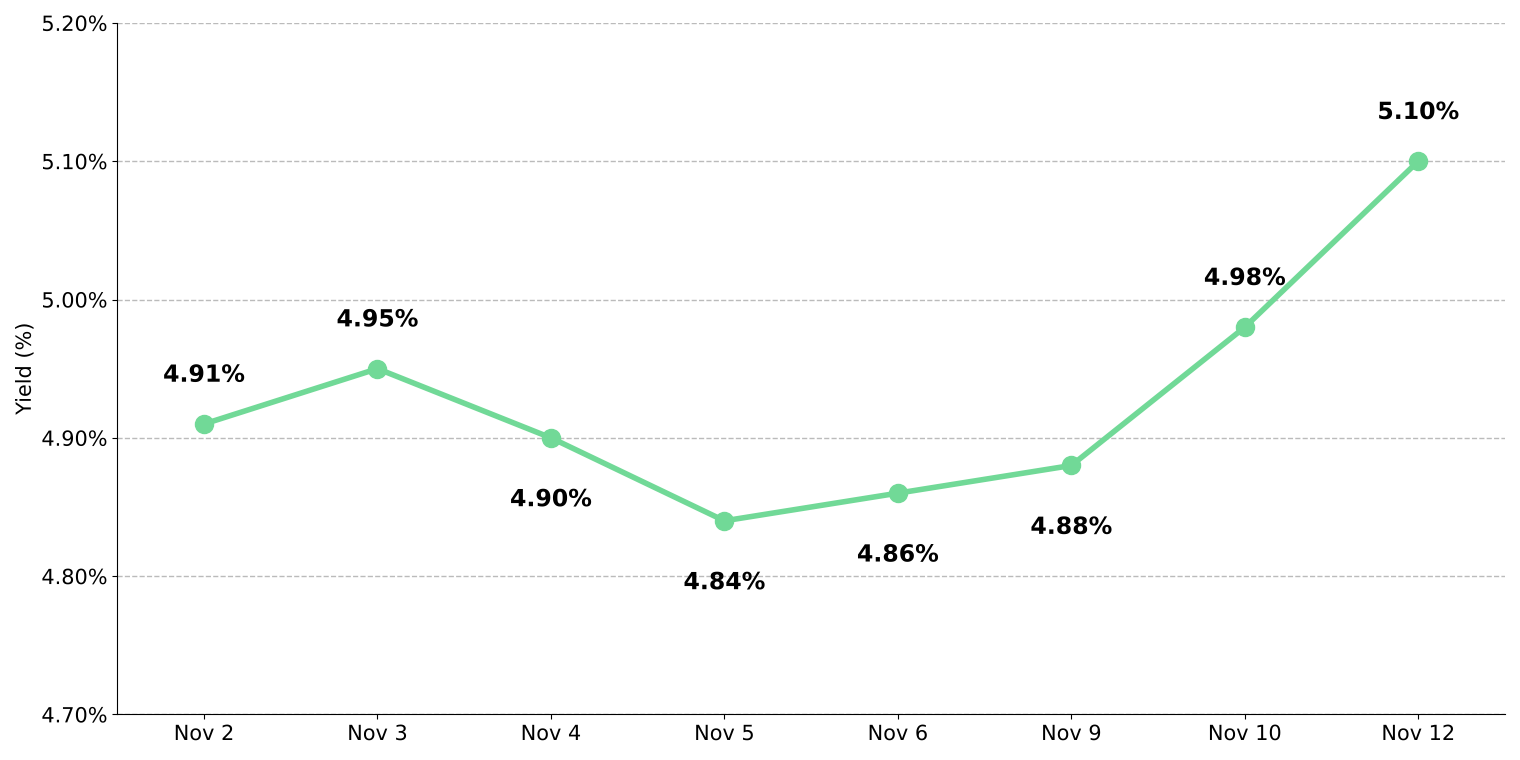
- The oil move worked through rates: the 10-year Treasury par yield closed at 5.10%, and CME FedWatch priced an 89% chance of a December hike.
- At Barrick Mining's disclosed sensitivity, the day's $3.25/bbl Brent gain adds about $4/oz to all-in sustaining costs (AISC), against a gold price drop of more than $100/oz.
- Brent is still down about 20% in November, so for producers near the $1,930/oz industry-average AISC, the gold price is the larger margin risk.
- A 10-year par yield close below 4.90% would signal the rate pressure on gold reversing.
Trump's Iran Remarks Lift Oil and Treasury Yields, Pushing Gold to Its Lowest in Over a Year
Spot gold fell about 3% on November 12, 2026, touching $3,852.14/oz, its lowest since October 3, 2025, according to Reuters. The move followed President Donald Trump's statement that the US does not need a deal with Iran, lifting Brent crude 3.3% to $95.82 a barrel, CNBC reported. The 10-year Treasury par yield closed at 5.10%, up from 4.98% on November 10, according to the US Treasury.
Gold rose 0.7% to $3,903.19/oz by 10:06 GMT on November 13 but remained down nearly 4% for the week, Reuters reported, ahead of October US producer prices due at 8:30 a.m. ET. At that price, the margin over the World Gold Council's record second-quarter 2026 industry-average AISC of $1,930/oz is about $1,970/oz.
Fed Hike Pricing Turns Higher Oil Into Lower Gold Revenue for Miners
Oil reaches gold miners through two routes. The first is the gold price: higher crude lifts inflation expectations, supporting a December Fed hike and higher Treasury yields, which raise the return on interest-paying bonds relative to gold, which pays none. CME FedWatch priced an 89% chance of a quarter-point December hike on November 13, and New York Fed President John Williams said on November 12 that more hikes are likely, Reuters reported. The second route is the cost line: diesel for haul trucks, drills and generators.
Barrick Mining's second-quarter 2026 results put each $10/bbl oil change at $12/oz of AISC, so the $3.25/bbl Brent gain on November 12, from a $92.57 settlement the day before, adds about $4/oz. Spot gold fell more than $100/oz in the same session. Brent is still down about 20% in November, CNBC reported, so fuel costs have moved in miners' favor this month.
Fed Hike Odds, Not Diesel Prices, Set How Far Miner Margins Fall
David Meger, Director of Metals Trading at High Ridge Futures, said on November 12 that higher energy prices continue to justify a hawkish Fed, and with it the higher rates that weigh on gold.
In the first scenario, crude holds near $95 and half-point hike odds, priced at 11% by CME FedWatch on November 13, rise after the producer price release, keeping the price route open. Even then, Barrick's sensitivity implies the fuel premium over its $75 Brent planning base costs about $25/oz, a fraction of the price move. In the second scenario, lower crude and a softer producer price print pull yields back, and the gold price recovers before any fuel savings reach reported costs.
The price route runs to the Fed's December 9 decision and the December 10 CPI release; the cost route runs to fourth-quarter results and 2027 guidance in early 2027. The reversal trigger is a 10-year par yield close below 4.90%, reported in the US Treasury's daily par yield curve, which would favor producers with the most gold-price leverage.
Rate-Driven Gold Losses Hit High-Cost Producers Harder Than Fuel-Exposed Ones
The most exposed cohort is high-cost producers with AISC near or above the $1,930/oz industry average, because fixed per-ounce costs magnify each price decline. Northern Star Resources, Australia's largest gold miner, reported September-quarter AISC of A$3,217/oz (US$2,244/oz), and its shares fell 2.24% to A$26.13 on November 12, Kalkine Media reported. The VanEck Gold Miners ETF, led by Agnico Eagle, Newmont and Barrick, fell 3.95% to $81.84 that day, according to StockAnalysis.
A weaker Australian dollar lifts the local value of US dollar gold sales: gold traded near A$5,735/oz at US$0.6792, Ainslie Bullion data show. OceanaGold had hedged about 80% of annual diesel consumption, the World Gold Council reported. Neither replaces lost US dollar revenue.
Holders of high-cost producer positions cannot know whether the producer price release lifts half-point hike odds or whether the Australian dollar weakens further. Fuel hedges and currency moves reduce cost or translation exposure, not gold price exposure, and positions in either cohort lose value if gold falls further.
Higher Rates Shift Gold Miner Value Toward Low-Cost Producers
Oil's rebound has cost gold producers more through bond yields than through fuel. A single session's gold price decline outweighed the day's added diesel cost many times over, and with Brent lower for the month, rate pricing is the variable that sets miner margins into year-end.
For high-cost producers in Australia and North America, the key metric is cost per ounce. Margin headroom over AISC belongs in valuation, and so does the currency in which costs are paid.
A gold price held down by rates squeezes marginal producers first, slowing new supply, and low-cost producers with intact balance sheets hold the leverage when rates turn.
Analyst's Notes





Subscribe to Our Channel





Stay Informed