




Silver Crown’s Take-or-Pay Royalties on Hidden Silver


Silver Crown Royalties creates pure-play silver royalties on unreported byproduct ounces, using take-or-pay minimums and a producer-royalty valuation gap.
- Silver Crown Royalties creates silver-only royalties on byproduct ounces that operators sell to refiners but leave out of resource and reserve statements.
- The company prices those ounces from refinery sales records reviewed under NDA, and prefers operating mines and restarts with production history.
- Producers trading near 0.4 times NAV can sell silver at about 1 times NAV, and take-or-pay minimums tie delivery to the operator’s gold or copper revenue.
- The company turned cash flow positive in the second quarter of 2026, holds 6 closed royalties and estimates 42,900 to 61,900 oz of 2026 deliveries.
- A 30,000 oz per year transaction is under evaluation but unsigned, and parallel royalty partnerships with larger peers are still at the discussion stage.
Silver Crown Royalties (CBOE:SCRI | OTCQX:SLCRF) is building a royalty portfolio on a slice of silver supply that rarely appears in public disclosure: byproduct ounces that operators sell to refiners but leave out of their resource and reserve statements. The company describes itself as the only pure-play silver royalty company in the market, and it creates its royalties from operators’ own sales data instead of buying existing ones at auction.
The case drew a new backer this year. Michael Gentile, a Strategic Advisor to the company and now its largest shareholder by his own account said he had avoided junior royalty companies for years before investing in Silver Crown about 8-9 months ago. Speaking in London during his European road show, Gentile and the company’s Chairman & CEO Peter Bures laid out how the model prices unreported silver, why operators sign, and what the company needs to execute next.
Why Gentile Broke His Rule on Junior Royalties
Gentile’s objection to the junior royalty model was cost of capital. Large royalty companies such as Franco-Nevada and Royal Gold fund acquisitions with highly valued shares at what he put at a 4% to 5% cost of capital. Junior royalty companies in the $50 million to $200 million range trade at deep discounts to net asset value (NAV), so each acquisition is dilutive, and the large companies can outbid them for any high-quality royalty.
Silver Crown sidesteps that contest by creating royalties. Gentile said about 2,500 mines globally produce silver as an unreported byproduct, either because the amounts are modest or because the mines predate the reporting reforms introduced after Bre-X. With no silver resource or reserve on record, no existing royalty can be bought on those ounces. The company’s presentation counts 2,400 operating mines with silver byproduct and more than 30,000 exploration projects.
Gentile compared the setup with Franco-Nevada in the 1980s, when the company faced little competition, financed itself at about 5% and wrote royalty deals at a 25% internal rate of return (IRR).
Interview with Peter Bures, Chairman & CEO, and Michael Gentile, Strategic Advisor, of Silver Crown Royalties
Pricing Unreported Ounces From Refinery Records
The idea dates to roughly 2020, when the founding team planned a family of single-element royalty companies. Silver came first because the team was already dealing with companies holding silver exposure. Existing silver royalties also covered other metals, so the company chose to create royalties on only the silver in an orebody, whether the primary metal is gold, copper or zinc-lead.
The data comes from the operator’s sales records. Each shipment returns a statement from the refiner or metals trader listing the metals being paid for, including the silver in the doré bar. Under non-disclosure agreements, Silver Crown uses those records to establish a payable silver-to-gold ratio. The company prefers operating mines and restarts over developers because they have a production history. Before Bre-X, operators skipped qualified-person sign-off on minor metals because the cost outweighed the value of silver that might represent 0.1% of revenue. NI 43-101 and JORC standards later required reporting of all metals.
A transaction under evaluation, and not yet signed, involves a mine with a 2:1 silver-to-gold ratio, where 15,000 to 20,000 ounces (oz) of gold output implies 30,000 to 40,000 oz of silver. Silver Crown would ask the operator to commit to a minimum of 30,000 oz of silver per year. Gentile said the agreements are take-or-pay, so the operator’s gold revenue covers the commitment in a quarter when silver output falls short.
A Valuation Arbitrage Between Producers & Royalty Companies
The operator’s incentive is a gap in how the market values the same ounces. Founder, Chairman & Chief Executive Officer of Silver Crown Royalties, Peter Bures, compared it with the deal Silver Wheaton struck for silver from a Mexican gold mine 21 to 22 years ago:
“The producer trades at 1-2x sales. A royalty company will trade at 20-25x sales. So there’s a valuation arbitrage to be done between the operator and the royalty company. So that silver can crystallize value that the operator would have to wait 5 to 15 years to realize.”
Gentile put the same gap in NAV terms. Smaller and private gold producers, including emerging 50,000 oz operators, often trade at about 0.4 times NAV. Silver Crown trades at around 1 times NAV, and Franco-Nevada at 2 times. A producer selling its silver to Silver Crown therefore receives about 1 times NAV for a revenue stream its own share price values at 0.4 times. The company’s presentation puts the royalty’s impact at about 2% of project revenue.
Payment can be cash or Silver Crown shares, which Gentile said means the same dilution for the company. Bures said earlier counterparties that took equity saw $1 million nameplate transactions grow to more than $3 million to $4 million in market value as the shares re-rated. Gentile said he would advise producers to take Silver Crown paper. He expects that paper to gain from multiple expansion toward the 1.5 to 2 times NAV that scaled royalty companies command.
Cash Flow, Cost of Capital & the Current Portfolio
Bures acknowledged the company listed before it generated cash flow, which kept its cost of capital high. Cash flow turned positive in the second quarter of 2026, and he said revenue now flows through to operating cash flow. He credited Gentile’s investment with triggering the share re-rating, and Gentile’s capital markets work is aimed at lowering the company’s cost of capital further.
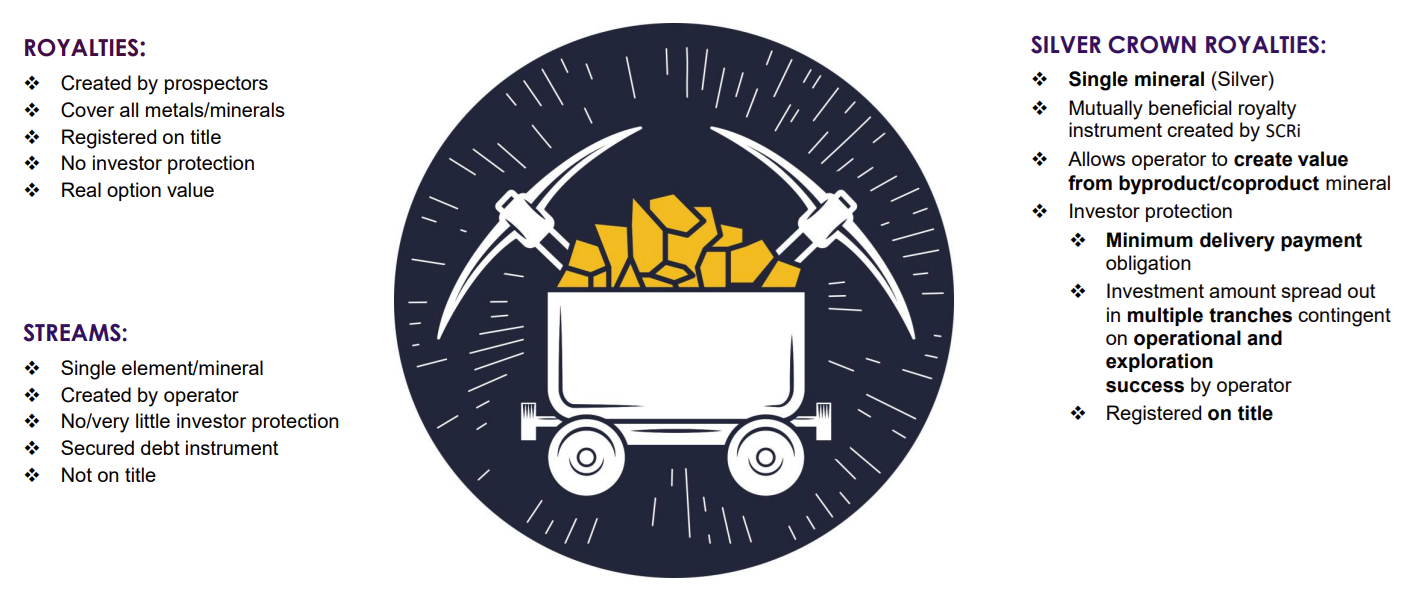
Silver Crown corporate presentation lists 6 closed royalties, including the Elk Gold mine in British Columbia, Scotia Mine restart in Nova Scotia, PGDM gold complex in Brazil, Igor 4 project in Peru, and a tailings reprocessing plant in Ecuador. Contracts include minimum delivery obligations, investments staged against operational milestones and registration on title. The company targets a combined pipeline IRR above 25% and reports more than 10 active discussions at any time. It estimates 2026 deliveries to reach up to 61,888 oz, against an estimated 22,000 oz in 2025.
Competition, Partnerships & Execution Risk
Bures said average deal returns near 25% will eventually attract competitors. For now, he said, no royalty company below $1 billion in market capitalisation is creating new royalties, which gives Silver Crown a first-mover position. He described talks with other royalty companies about running royalties in parallel on separate metals from the same orebody, with Silver Crown taking the silver and partners taking gold or copper. No such agreement has been signed.
Execution risk is concentrated in a small company. Deal flow depends on private operator data and on operators meeting minimum deliveries. The presentation describes the Elk Gold operator as restructuring and lists the Ecuador plant as in development. Equity-funded deals and outstanding warrants add to the share count, and the presentation states that exercise of all warrants would bring in an additional C$30 million. Revenue also moves with the silver price.
The Investment Thesis for Silver Crown Royalties
- Silver Crown Royalties targets byproduct silver that operators sell to refiners but leave out of resource and reserve statements, a pool its presentation puts at 2,400 operating mines.
- The company creates its own royalties from operators’ refinery and sales records, which avoids bidding against large royalty companies for existing assets.
- Minimum annual delivery commitments on a take-or-pay basis tie silver deliveries to the operator’s primary gold or copper revenue.
- Management argues producers trading near 0.4 times net asset value can sell their silver at about 1 times net asset value, which gives operators a financial reason to sign.
- The company turned cash flow positive in the second quarter of 2026 and estimates 2026 silver deliveries of 42,900 to 61,900 ounces.
- Monitor whether the 30,000-ounce minimum delivery transaction under evaluation closes, and whether talks on parallel royalties with larger royalty companies produce a signed agreement.
The thesis depends on repeatable deal-making. Each closed royalty adds minimum ounces, diversifies counterparty exposure and tests whether the valuation gap persuades operators at scale.
Macro Thematic Analysis
Silver has both monetary and industrial demand. The company’s presentation notes that more than half of annual silver demand comes from industrial uses, including electronics, solar panels, batteries and medical equipment. Bures framed the company’s purpose around the monetary side: exposure to a metal that protects against currency devaluation, paid out through a dividend whose purchasing power holds with the metal. The presentation targets a first dividend to shareholders in 2026.
Investors seeking silver exposure through equities have limited pure options. Gentile argued that the largest listed silver producers derive less than half of their revenue from silver:
“Right now in the market, even the Heclas, the Pan Americans, most of the world, they’re barely silver companies. Less than 50% of the revenue is silver. So if you can give generalists that stability, that growth, and that predictability of royalties, and 100% exposure to silver, I truly think it’s going to be a go-to name in the silver space.”
Hecla and Pan American Silver are operators exposed to cost and execution risk, which a royalty holder avoids. Gentile’s longer-term ambition is a portfolio delivering 5 million to 10 million oz of silver per year, which he estimated at $350 million to $700 million of annual revenue. He described his investment as patient capital measured over 3 to 10 years.
Bures extended the case beyond mining funds. He believes a dividend-paying silver royalty vehicle could appeal to retirement plans and fixed income funds and could ultimately compete with bonds and treasuries in a retirement portfolio. That outcome requires a much larger and more diversified royalty base than the company holds today.
TL;DR
Silver Crown Royalties creates silver-only royalties on byproduct ounces that operators sell to refiners but do not report in resource or reserve statements. It uses refinery sales records under non-disclosure agreements to set payable silver-to-gold ratios. Each royalty carries a take-or-pay minimum backed by the operator’s gold or copper revenue. Producers trading near 0.4 times NAV can sell that silver at about 1 times NAV. The company turned cash flow positive in the second quarter of 2026 and has 6 closed royalties. It estimates 42,900 to 61,900 oz of 2026 deliveries. A 30,000 oz per year transaction is under evaluation but not signed. Strategic Advisor Michael Gentile, who calls himself the largest shareholder, is working to lower its cost of capital.
FAQs (AI-Generated)
Analyst's Notes





Subscribe to Our Channel



Stay Informed


