McFarlane Lake Drilling Program to Chase 10Moz Gold Resource, Scoping Study by 2027


McFarlane Lake Mining (CSE:MLM) funds a 50,000 m Phase 2 drill programme at its 6.16 Moz Juby Gold Project, targeting 10 Moz within two years.
- McFarlane Lake Mining has repaid more than US$13 million of a US$15 million acquisition debenture after a C$6.75 million investment from Michael Gentile and Pierre Beaudoin.
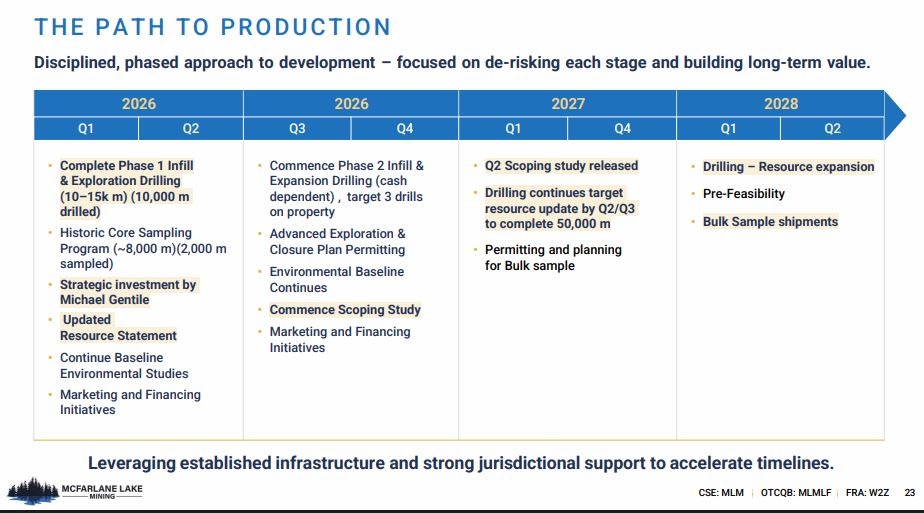
- A C$17.3 million financing funds a 50,000 m Phase 2 drill programme at the Juby Gold Project with three drills on site before November 2026.
- Juby hosts 1.07 Moz Indicated at 0.96 g/t and 5.09 Moz Inferred at 0.87 g/t, and management targets about 10 Moz within two years.
- A scoping study due by the end of Q2 2027, metallurgical testwork and an advanced exploration permit application will test project economics and early cash-flow options.
Ontario's southern Abitibi Greenstone Belt has produced more than 200 million ounces of gold over the past century. Large, bulk-tonnage deposits in the district are being re-examined as gold prices sit far above the levels used in earlier studies. McFarlane Lake Mining (CSE:MLM) holds one of the larger undeveloped examples in the Juby Gold Project near Gowganda. Juby now hosts 1.07 million ounces (Moz) Indicated at 0.96 g/t and 5.09 Moz Inferred at 0.87 g/t. President and CEO Mark Trevisiol has set a target of roughly 10 Moz within two years, backed by a fully funded 50,000 m Phase 2 drill programme.
The interview was recorded in London ahead of the Michael Gentile European Roadshow. It covered how a company carrying a US$15 million debenture earlier this year now has the cash, team and permitting pathway to test that ambition. It also addressed the question that sits behind any sub-1 g/T project: whether the ounces can be mined and processed at a scale the market will reward.
From Debt Overhang to Funded Programme
McFarlane bought Juby from Aris Mining for US$22 million, of which US$15 million was structured as debt due in October 2026. Trevisiol said the turning point came when Michael Gentile and Pierre Beaudoin invested C$6.75 million at the end of May. That capital, and the investor following Gentile brought with it, allowed the company to pay down more than US$13 million of the debenture. Around US$1.7 million remains outstanding. Trevisiol said this balance is now largely held by friendly parties, including a significant portion held by him personally.
A C$17.25 million bought deal financing followed, closing on 9 September after being upsized from C$15 million. Trevisiol said roughly C$12 million of that total was flow-through funding, with the remainder in hard dollars. The company holds approximately C$15 million in cash and a budget of C$16.4 million through to the end of 2027. That budget includes C$12.5 million for 50,000 m of drilling at an assumed C$250 per metre.Trevisiol said the share price is about fivefold higher than six months ago, and he credited the Gentile investment and the resolution of the debt as the main drivers.
Resource Growth & the 10 Moz Target
The August 2026 Mineral Resource Estimate (MRE), prepared by BBA E&C Inc., used a US$3,600/oz gold price and a 0.25 g/t open-pit cut-off. Trevisiol was direct about what drove the increase. He said that at last year's US$2,500/oz price assumption the resource would still have grown by roughly 800,000 to 900,000 oz. The higher price assumption then added a further significant step that took the total above 6 Moz.
Phase 2 is planned at 50,000 m over 12 to 15 months, with three drills expected on site before 1 November. That is nearly four times the 12,982 m McFarlane drilled in Phase 1, and it builds on 116,570 m drilled by previous operators. Two drills will focus on extending known mineralisation along strike and at depth. The third will begin with infill drilling to convert Inferred ounces into the Indicated category. Trevisiol said reaching 10 Moz is the top priority. He also described an internal goal of a roughly even split between Indicated and Inferred ounces at this stage, and said the company will pivot to new targets if results justify it.
Trevisiol framed the programme in terms of the production profile it could eventually support.
"I think the next phase of drilling, I'm not going to be surprised by it because it's going to deliver. We're very confident in the geology, it doesn't start to prove up to a 200,000 or a 300,000 ounce [per annum] deposit. You're starting to look at 500,000 ounces a year and really get to a global setting scale."
Interview with Mark Trevisiol, President & CEO of McFarlane Lake Mining
De-Risking Toward Development
Three workstreams run alongside the drilling. A scoping study is due to begin this quarter, with results targeted by the end of Q2 2027. Environmental baseline studies began in December 2025 and include engagement with First Nations communities. They support an application for an advanced exploration permit, with closure plan documents and financial assurance, which the company aims to submit in Q1 2027. That permit is intended to enable a proposed bulk-sampling programme, subject to regulatory approval and consultation.
Metallurgy is the third workstream. Trevisiol said SGS has already completed significant testwork, and McFarlane is running confirmatory tests on work carried out around eight or nine years ago. When testing confirms, a flotation flowsheet could reduce the capital required at site. No flowsheet development is under way yet, although concepts are expected to emerge during scoping.
The deck also highlights higher-grade subsets within the resource that could support a starter pit. At a 2.00 g/T cut-off, it reports 254,000 oz Indicated at 2.94 g/t and 567,000 oz Inferred at 3.10 g/t. Trevisiol said results have recently come back from a test pit at the Juby deposit. He noted there are 11 mills within a 90-minute drive, and McFarlane has held talks with several operators about toll processing. No milling agreement has been reached, and Trevisiol said the company will not accept terms that do not make economic sense.
Team & Execution
Trevisiol joined Falconbridge in 1988 and spent more than 20 years there, rising to general manager of its Sudbury smelting business unit. He later served as CEO of Crowflight Minerals and Silver Bear Resources before founding McFarlane in 2020. The company has now appointed Gilbert Lamarche as Chief Operating Officer (COO). Lamarche was previously COO of Foran Mining, which Eldorado Gold acquired, and spent more than 15 years at Vale in Sudbury mine management and technical roles. Trevisiol said Lamarche will lead the scoping, metallurgical and environmental workstreams, freeing him to focus on capital markets. McFarlane has also hired two senior field geologists to support three-rig drilling.
Asked whether a major producer would want a project at this grade, Trevisiol said some have already looked at Juby. He argued McFarlane can de-risk the asset faster and more cheaply than a larger owner.
"The way I'd like to manage a project is I want to finish it. And if something happens along the way where it's accretive to shareholder value, so be it. But I'm here to build it."
Investment Thesis for McFarlane Lake Mining
- McFarlane has removed most of the US$15 million debt overhang, with about US$1.7 million remaining and largely held by friendly parties.
- The 50,000 m Phase 2 programme is funded by a C$17.3 million financing and is nearly four times the size of Phase 1.
- The company targets roughly 10 Moz within two years, which would require adding close to 4 Moz to the current 6.16 Moz resource.
- A dedicated infill drill aims to lift the Indicated share, which investors should monitor in the next resource update targeted for Q2/Q3 2027.
- The scoping study due by the end of Q2 2027 will provide the first economic test of the project's scale and grade.
- Higher-grade starter-pit material and nearby milling capacity offer a possible route to early cash flow, though no toll milling agreement is in place.
- Investors should watch assay results from the 826 Zone and Golden Lake corridor as the most likely triggers for resource growth.
Macro Thematic Analysis
The renewed interest in large, low-grade gold systems is a direct product of the gold price. Deposits grading below 1 g/t were often shelved when gold traded at far lower levels. At current levels, bulk-tonnage open pits with long mine lives have become a credible source of new supply in stable jurisdictions. Trevisiol acknowledged that dependence plainly.
"If we were to leave the price the way it was last year and not change anything, our resource would have gone up by about 800,00-900,000 oz. But the gold price increased so we got another bump, significant bump, and moved our resource over 6 million oz. I wouldn't be talking to you today if gold prices weren't where they were."
Ontario's Abitibi offers the infrastructure that makes such projects workable. Juby is accessible by road, power runs nearby and several processing plants operate within reach. IAMGOLD's Côté Gold, about 90 km to the west, is a recent example of a large, low-grade Ontario open pit reaching production, and Trevisiol noted that IAMGOLD is studying an expansion to 70,000 tonnes per day. Alamos Gold operates to the northeast at Matachewan.
For investors, the opportunity and the risk run together. Larger producers need multi-million-ounce projects in safe jurisdictions to replace reserves, and a project at Juby's scale fits that need. Low grades, however, leave little margin for error on capital and operating costs. The flotation question matters for exactly this reason, because a lower-capital flowsheet would improve returns at any gold price. The coming scoping study will indicate whether Juby's ounces can earn their place in a gold price cycle that may not stay at today's levels.
TL;DR
McFarlane Lake Mining has turned a debt-burdened acquisition into a funded growth story at the Juby Gold Project in Ontario's Abitibi belt. Support from Michael Gentile and Pierre Beaudoin helped retire more than US$13 million of a US$15 million debenture, and a C$17.3 million financing now funds a 50,000 m Phase 2 programme with three drills. Juby hosts 1.07 Moz Indicated and 5.09 Moz Inferred, and CEO Mark Trevisiol targets about 10 Moz within two years. A scoping study due by the end of Q2 2027, metallurgical testwork and an advanced exploration permit will test whether a sub-1 g/T system can support an economic mine.
FAQ (AI-generated)
Analyst's Notes





Subscribe to Our Channel





Stay Informed