Astra Exploration Sets Million-Ounce Resource Target as 20,000 Meter Drilling at La Manchuria Launches


Astra Exploration starts 10,000-20,000m of drilling at La Manchuria, chasing a million ounces, with a 2,500m test of Chile's Don Mario target in early 2027.
- Astra Exploration will begin its largest drill season in November with 10,000-20,000 metres planned at La Manchuria using two drills.
- La Manchuria hosts a near-surface bulk disseminated system and open high-grade veins, with the Basalto zone recently returning 2.0 metres at 80.5 g/t gold.
- Management will not publish an updated resource until it believes it can outline roughly a million ounces.
- A programme of about 2,500 metres at Don Mario in Chile's Maricunga belt should deliver a go or no-go decision on a 2 km by 2 km target in early 2027.
- While the stock trades near its 52-week low at around C$0.36, the company holds over C$12 million in cash giving Astra a base for the coming programmes.
Junior gold explorers are competing hard for capital, and fund managers favour larger, more advanced stories. Astra Exploration Inc. (TSXV:ASTR) answers with scale. The company is about to start its largest drill campaign to date at the La Manchuria gold-silver project in Argentina's Santa Cruz province, followed by a maiden programme at the Don Mario project in northern Chile in early 2027. Speaking with Crux Investor's Matt Gordon in London during Michael Gentile's European roadshow, CEO and co-founder Brian Miller explained what the programmes are designed to prove and why a million ounces is the number that matters.
Two Mineralised Systems at La Manchuria
Miller describes La Manchuria as hosting two distinct styles of mineralisation. The first is a bulk disseminated system that starts at surface and remains open. Miller puts grades in this system averaging up to 10 g/t gold. Because it sits at surface on a hilltop, he believes open-pit economics would be very attractive.
The second style is high-grade veins. Individual veins are typically 1-2 metres thick and can carry 50-100 g/t gold, with silver grades in the kilograms per tonne. The Basalto zone, announced as a new discovery in March 2026, shows the opportunity. It is a high-grade vein exposed at surface and remains open. The latest step-out returned 2.0 metres at 80.5 g/t gold and 44 g/t silver. Miller said Astra will advance both systems in parallel.
The Million-Ounce Threshold
La Manchuria already hosts a small existing resource, and Miller said drilling has shown the deposit is substantially larger than previously thought. Even so, Astra has deliberately held back from publishing an updated mineral resource estimate yet. Miller said the company will wait until it believes it can outline roughly a million ounces. In his view, that is the level at which the wider market starts to pay attention.
That discipline aligns with Michael Gentile, who holds about 15% of Astra, noting how Gentile only invests where he believes an asset can become a mine. Miller's position is that La Manchuria will be a mine one day, and the real question is how large it becomes. He credits the project's embedded optionality, combining very high grades, open veins and a growing disseminated system at surface.
Interview with Brian Miller, Director & CEO of Astra Exploration
Phase IV: Searching for a Second Manchuria Hill
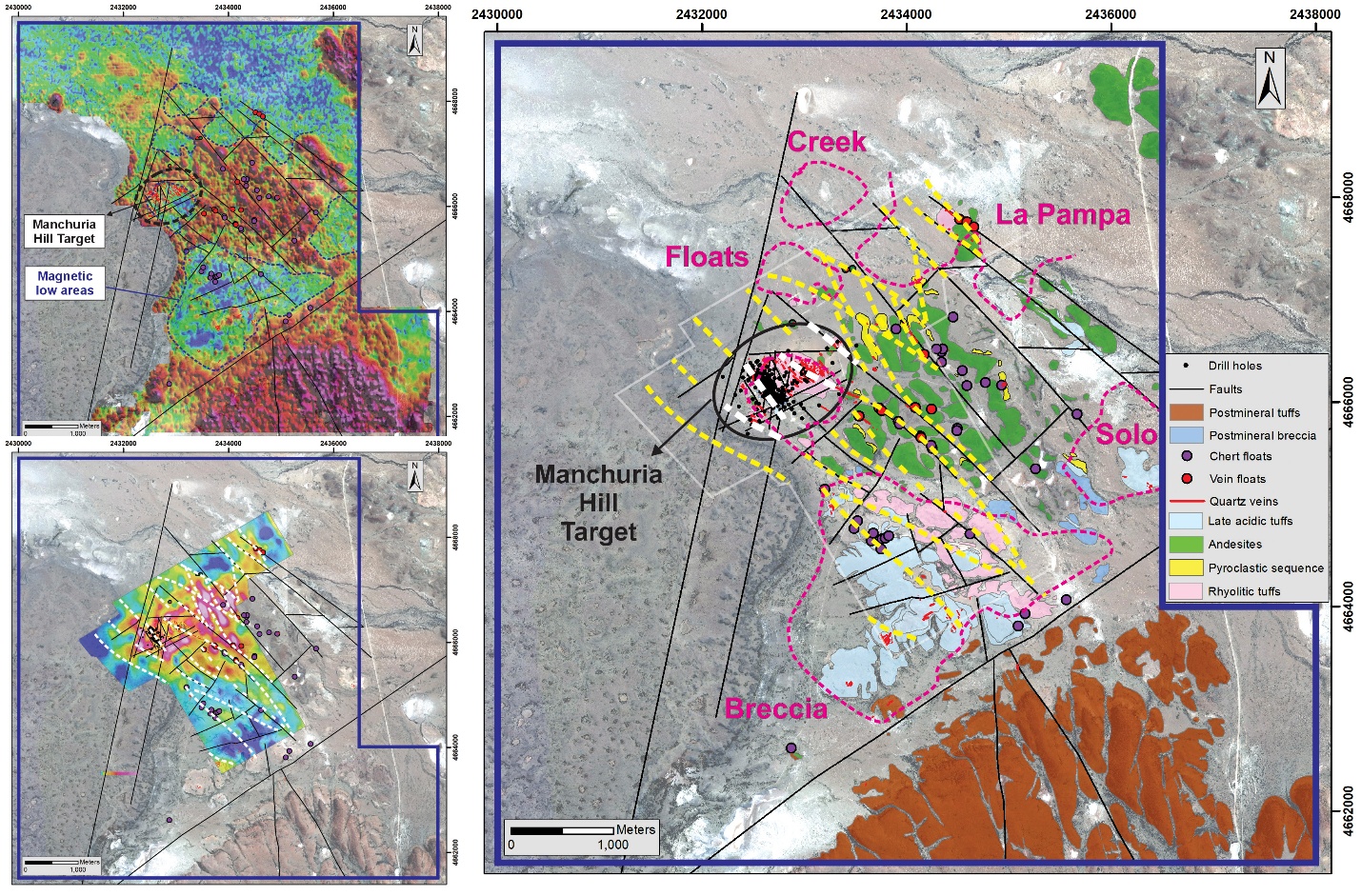
All drilling to date has focused on Manchuria Hill, an area of about 1 km². Alongside the recently completed Phase III programme, Astra extended geophysics into new areas and carried out mapping and sampling. That work generated a set of regional targets. Astra's corporate presentation shows five priority targets across a 4km x 4 km area, within a claim package expanded from about 5,600 hectares to about 39,000 hectares.
Miller singled out two. La Pampa lies to the northeast. The Breccia target, to the southeast, is his preferred target. It sits directly along strike from the existing system, shows evidence of veining and may represent a better-preserved part of the system.
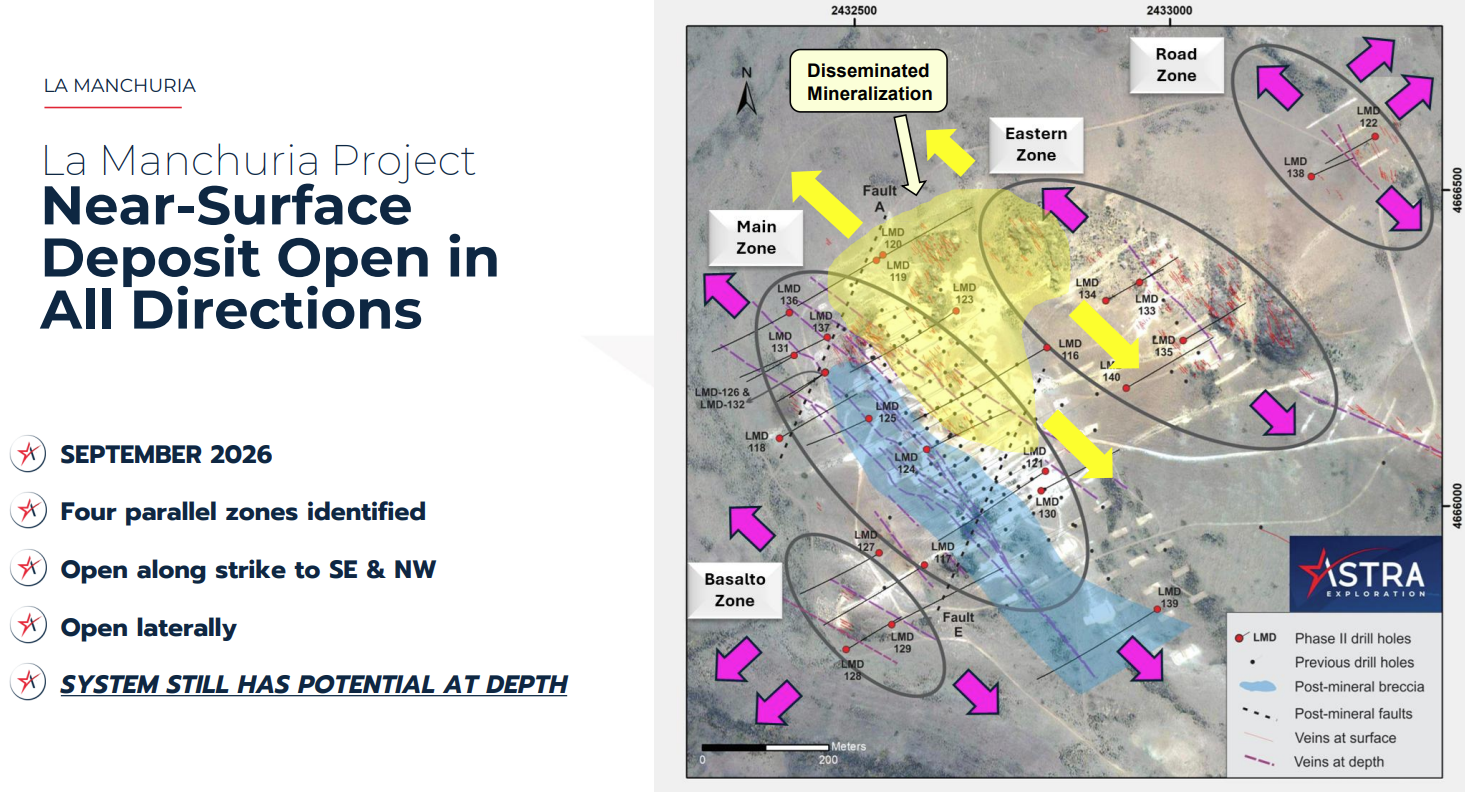
Phase IV starts in November with two drills, planned at a minimum of 10,000 metres and up to 20,000 metres. The final figure depends on results and on how metres are split between Manchuria Hill and the regional targets. Astra expects to begin at Breccia and drill more aggressively there if early results justify it. The company hopes to complete about 5,000 metres by year-end. It then plans about 5,000 metres in the first quarter of 2027 and up to a further 10,000 metres depending on results. Miller hopes the first assays will arrive around February.
Don Mario: A Low-Cost Test of a Large Target
Don Mario is a 100%-owned high-sulphidation epithermal (HSE) project in Chile's Maricunga belt that Astra has held for about six years. Miller was candid about why the company had not drilled it earlier.
"[Don Mario] is high elevation, narrow exploration season, it's expensive. There's a host of challenges up there. You don't go into the Maricunga as a 10 [to] 20 million market cap junior. That's how you blow your company up."
Field work earlier in 2026 brought the project to a drill-ready state, and Miller said the results surprised the team. On most projects, only around half of the geological datasets point to the same place. At Don Mario, every layer of work pointed to the same 2 km by 2 km area, which Miller described as a genuine tier-one target.
The programme is designed to deliver a quick answer. Miller expects about 2,500 metres in roughly seven holes to show whether the project is a go or a no-go. The target is disseminated mineralisation within a lithocap that appears to lie flat just below surface, so relatively shallow holes should be informative. Drilling is planned for January or February 2027. If results are strong, Miller said Astra may look for a joint venture partner straight away.
Infrastructure and Consolidation Potential
Miller argues that nearby infrastructure matters for any future development decision. Within about 100 km of La Manchuria, project partner Patagonia Gold has heap leach production at Cap-Oeste and owns the Martha flotation mill, which is on care and maintenance. Miller believes Martha would likely suit La Manchuria's ore. Further south, Pan American Silver's 2,000 tonne-per-day Manantial Espejo plant is also on care and maintenance. Unico Silver is developing projects to the east.
Miller sees two paths. If La Manchuria ends up around a million ounces or smaller, he believes an open-pit starter scenario is viable and likely profitable. If drilling delivers something much larger, the pool of potential acquirers changes. Astra also keeps looking for acquisitions itself, preferring to earn into projects through exploration spending rather than use cash.
Investor Outlook
Astra's next six months will be defined by drilling. Phase IV will test whether the high-grade veins and near-surface disseminated system on Manchuria Hill can be repeated across a much larger land package, starting with the Breccia target. In parallel, a short programme at Don Mario will decide quickly whether Chile becomes a second growth path, a joint venture candidate or a lower priority.
The company has set a clear benchmark. An updated resource will follow only when management believes it can outline about a million ounces. That gives investors a defined measure of progress. It also means the valuation will stay tied to drill results for some time.
The Investment Thesis for Astra Exploration
- Astra is entering its largest drill season, with a minimum of 10,000 metres planned at La Manchuria and scope to double that if results support it.
- La Manchuria offers two routes to value, a near-surface bulk disseminated system suited to open-pit mining and open high-grade veins such as Basalto.
- Management's stated hurdle of roughly a million ounces before an updated resource gives investors a clear benchmark for judging drilling progress.
- Don Mario provides low-cost exposure to a 2 km by 2 km HSE target, with a go or no-go decision expected from about 2,500 metres of drilling.
- Idle processing capacity nearby could support a smaller development scenario, although these plants remain third-party assets.
- Key risks include the lack of an updated resource, dependence on drilling success, share-price weakness near the 52-week low and potential future dilution.
- Investors should monitor the first Phase IV assays, expected around February 2027, along with early Breccia results and the Don Mario go or no-go decision.
Macro Thematic Analysis
Junior explorers remain near the back of the queue for capital. Astra's presentation notes that micro- and small-cap companies with discovery or development assets are typically the last to re-rate in a precious metals cycle. Miller's comments in London reflected that environment. Fund managers attending this year's roadshow tend to favour larger and more advanced stories. That is why scale has become the central question for Astra.
The Deseado Massif has a history of rewarding scale. According to the presentation, the district hosts Newmont's Cerro Negro and AngloGold's Cerro Vanguardia mines. It has also seen major transactions in past cycles. Goldcorp agreed to acquire Andean Resources, then owner of Cerro Negro, for about $3.4 billion in 2010. Yamana Gold acquired Extorre Gold for about C$413 million in 2012.
Current conditions may also favour buyers. Several processing plants in the district sit on care and maintenance, which could lower the infrastructure hurdle for a new discovery. Miller sees producers as a natural audience for a mid-sized outcome at La Manchuria.
"If I was a CEO of a junior producer, a mature producer looking to grow, this is a company maker. This is something that's got that organic growth ability and high profit margin."
Miller also argued that tough markets reward disciplined buyers, and Astra continues to look for acquisitions while few others are buying. For investors, the broader theme is whether junior explorers can demonstrate enough size to attract capital before generalist money returns to the sector.
TL;DR
Astra Exploration (TSXV:ASTR) starts its largest drill campaign at La Manchuria, Argentina, in November, with 10,000-20,000 metres planned across two drills. The project hosts both a near-surface bulk disseminated system and open high-grade veins, including the Basalto zone, where a recent step-out returned 2.0 metres at 80.5 g/t gold. CEO Brian Miller says Astra will not update its resource until it believes it can outline about a million ounces. Five regional targets, led by Breccia, will test whether a second Manchuria Hill exists. A 2,500-metre programme at Don Mario in Chile's Maricunga belt in early 2027 should give a quick go or no-go on a 2 km by 2 km target. Cash stands at just over C$12 million.
FAQs (AI Generated)
Analyst's Notes





Subscribe to Our Channel





Stay Informed