




Leviathan Metals’ Maiden Drilling Backs Copper Model Next to a Tier-One Mine


Leviathan Metals hits the target contact in 23 of 25 holes at Central, beside MMG's Khoemacau on Botswana's Kalahari Copper Belt. Assays pending.
- Leviathan Metals holds 100% of Central, a previously undrilled copper project sharing a boundary with MMG's Khoemacau operations on Botswana's Kalahari Copper Belt.
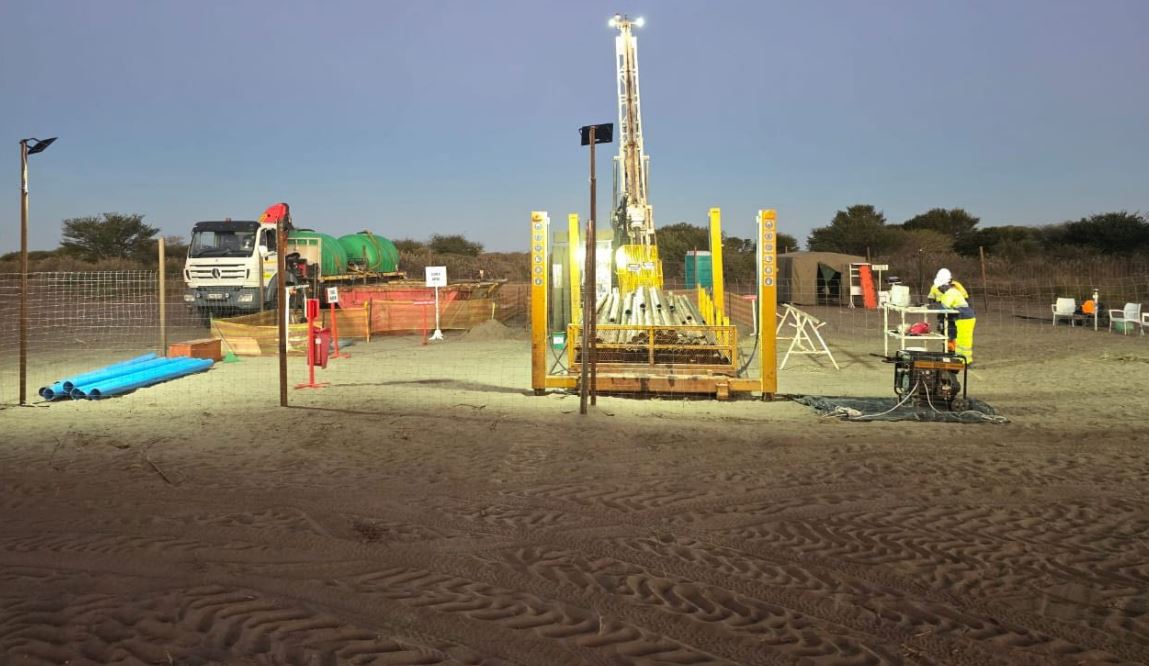
- Maiden diamond drilling of a little over 6,000 metres across 25 holes has intersected the target stratigraphic contact in 23 holes.
- Handheld XRF has detected copper in practically every hole with lead-zinc pathfinders present but grades await laboratory assays.
- Current targeting covers only three to four kilometres of a 24-kilometre strike with the northern limb of the fold emerging as the priority.
- A separate uranium programme of up to 2,500 metres has started at Serule and Foley, beside Lotus Resources' Letlhakane project.
Copper explorers rarely get to drill untested ground on the same structural trend as a tier-one producing mine. Leviathan Metals Corp. (TSXV:LVX) holds that position at its 100%-owned Central Project on Botswana's Kalahari Copper Belt, which shares a property boundary with MMG Limited's Khoemacau operations. Speaking to Crux Investor in London ahead of Michael Gentile's European roadshow, Chief Operations Officer Jeremy Crozier explained what the company's maiden diamond drilling programme has confirmed so far. He also outlined what investors should watch as laboratory assays begin to arrive.
The timing matters. Copper supply growth is constrained by falling head grades at mature mines and long lead times for new discoveries. Ground that sits beside producing infrastructure, in a jurisdiction that follows through on its own administrative process, is scarce. Central had never been drilled before Leviathan began work in June 2026, which makes the current programme a genuine first test of the property's potential.
Prospect Nearby Established Ground
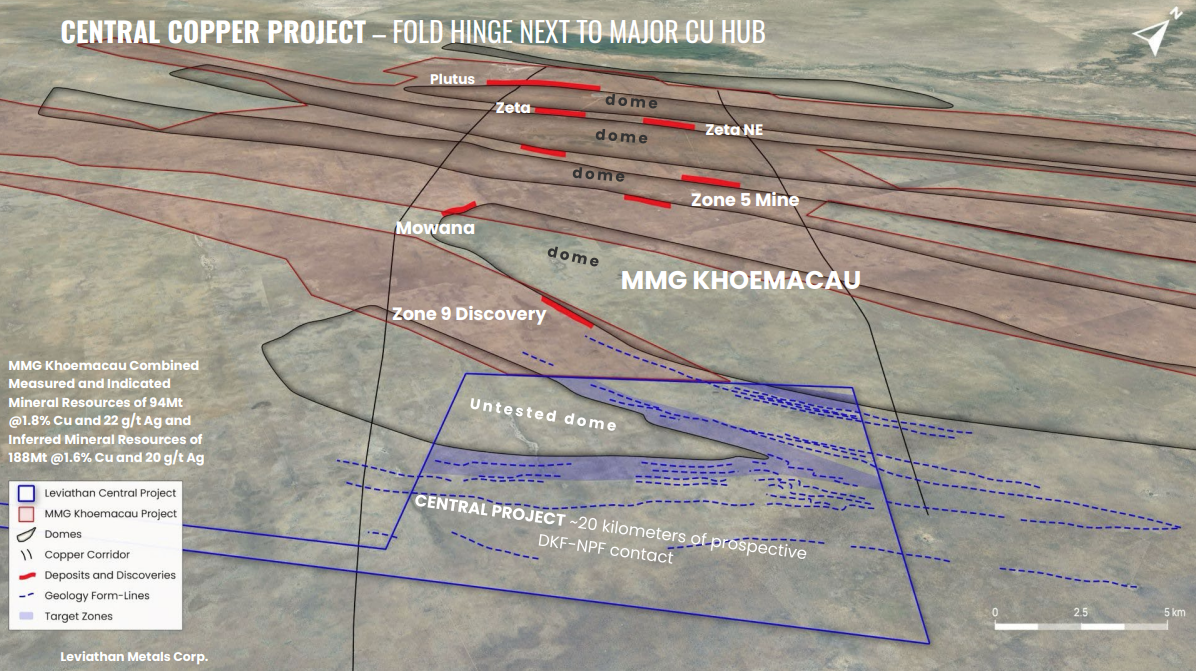
The investment case starts next door. Crozier said MMG acquired the Khoemacau property for $1.9 billion about two years ago. He put global resources at more than 450 million tonnes grading close to 2% copper, with slightly more than 250 million tonnes of that sitting immediately adjacent to Leviathan's ground. He added that MMG has since invested a further $900 million in the operation to double throughput.
Crozier also cited a nearby producing deposit, MMG's Zone 5, at roughly 100 million tonnes grading 1.7% copper, about 15 kilometres from Central. He was careful to describe this as a round, non-compliant number. Investors should treat it as context for the scale of the district rather than as a benchmark for what Leviathan may find.
Proximity is more than a talking point. Crozier said MMG's Zone 9, an area the major is exploring rather than mining, verges towards the shared boundary. The fold structure that hosts it continues onto Leviathan's property.
The Geological Model Behind the Bet
Leviathan's thesis rests on a consistent pattern across the belt, and Crozier was explicit about why it drew the company to Central.
"Every known copper deposit on the [Kalahari] Copper Belt occurs at exactly the same position in the stratigraphy, particularly where those rocks are folded into what we call a structural dome that is discernible at a high level in regional magnetic data."
Leviathan saw evidence of one immediately south of the Khoemacau cluster, which Crozier described as a remarkable, if not unique, opportunity. He added that the belt's deposits sit within a corridor that crosses a series of parallel domes elongated roughly north-east to south-west. In his view, Central holds the next dome to the south and also lies inside that corridor.
There is no surface exposure on the property. The company therefore relied on geophysics and, to a lesser extent, geochemistry to define its first targets. Crozier said the prospective contact runs for 24 kilometres of strike on Leviathan's ground. He acknowledged that the property may look relatively small on a map next to MMG's holdings, but described that strike length as a vast target.
What 6,000 Metres Has Confirmed
Leviathan has completed a little over 6,000 metres of diamond core across 25 holes, as part of a larger 10,000-metre programme. Most laboratory assays are still outstanding. In the meantime, the team has used a handheld X-ray fluorescence (XRF) analyser on site.
Crozier said drilling has intersected the target contact in 23 of the 25 holes, which he called an excellent proof of concept. Handheld XRF has also detected copper in practically every hole. He was clear about the limits of that data. It is spot data, it is incomplete, and it does not yet provide grades. Laboratory assays will replace it.
The early drilling has also refined the model. Crozier said the fold structure is present as predicted and the contact sits roughly where the company expected it. However, the fold has proved somewhat asymmetrical, and the core shows modified and refolded faults.
Copper is not the only signal the geologists are tracking.
"We're not only looking at the copper. In these systems, typically you have the lead and the zinc also running with it. And they're not necessarily economic, but they're... a really, really important pathfinder."
He added that Leviathan is seeing those elements too, either with the copper or around it. As a result, the team does not believe the copper in the XRF data represents isolated spot anomalies.
Interview with Jeremy Crozier, COO of Leviathan Metals
Vectoring Towards the Northern Limb
The first 6,000 metres have given the team a set of geological vectors pointing to more prospective targets. Crozier singled out the northern limb of the fold. He described it as an entire structural system that the company regards as a large trap for copper mineralisation, based on the public scientific literature and what the core shows so far.
The size of the programme allows the team to work in internal stages. It can define targets and then test them within the same 10,000 metres. Crozier noted that this targeting covers only three or four kilometres of the 24-kilometre strike, leaving further primary targets still to be generated elsewhere on the property.
He was candid about what the company cannot yet promise. Crozier said he could not commit to a resource or an economic study. Instead, the plan for 2027 is a faster drilling pace and much more detailed exploration aimed at defining a coherent target.
A Second Front in Uranium
Central is not Leviathan's only asset. Crozier noted that the portfolio also includes a uranium project in Botswana, a property package in Bosnia and legacy assets in Australia. The company has nine geologists on its books, and Crozier counts himself among them.
The uranium work has moved forward. In a press release dated October 19, 2026, Leviathan announced a reverse circulation (RC) and open-hole percussion drilling programme of up to 2,500 metres at its Serule and Foley projects in eastern Botswana. Serule adjoins Lotus Resources Limited (ASX:LOT)'s Letlhakane uranium project, which Lotus brought into its portfolio through its A-Cap Energy acquisition.
According to the release, eight RC holes drilled at Serule by the former owner in 2024 intersected mineralised shale layers at depths of 65 to 130 metres. Laboratory grades ranged from 196 to 1,247 parts per million (ppm) triuranium octoxide (U3O8), and the thickest interval returned 10 metres at 415 ppm U3O8. First-pass drilling is also under way at Foley, 25 kilometres north of Serule, alongside tests of the Letse target. The release notes that neither the qualified person nor Leviathan has verified the information disclosed for the adjacent properties.
Jurisdiction & Team
Botswana's mining framework is a central part of the pitch. Crozier said the main Central licence came up for renewal during the company's deal-making process, which made it a useful test of how the administration works. He reported that the Department of Mines in Gaborone did everything it said it would do.
He described Botswana as a good place to do business, with established infrastructure, deep technical know-how, a strong contractor base and proximity to South African geological expertise. Leviathan's crew is almost entirely Botswanan. The district also hosts major operators. Alongside MMG, Crozier pointed to an Australian-listed producer with a large mine south-west of Central, and to De Beers, whose diamond discoveries underpin the country's prosperity.
On leadership, Crozier said he and Chief Executive Officer Luke Norman are involved day to day. He stressed the role of well-respected geoscientific consultants with direct Kalahari experience in guiding the programme.
Investment Thesis for Leviathan Metals
- Leviathan holds 100% of previously undrilled ground on the next structural dome south of MMG's Khoemacau cluster, inside the corridor that hosts the belt's known deposits.
- Maiden drilling has intersected the target contact in 23 of 25 holes, which validates the core geological model ahead of assays.
- Handheld XRF has detected copper in practically every hole, and lead-zinc pathfinders support the case for a wider mineralised system rather than isolated anomalies.
- Grades remain unknown because XRF readings are incomplete spot data, so laboratory assays are both the key near-term risk and the key catalyst.
- Investors should monitor assay results from the first 6,000 metres and the remaining 4,000 metres of the programme, with the company signalling Central updates in the coming days.
- Current targeting covers only three to four kilometres of a 24-kilometre strike, leaving substantial follow-up scope if early results hold.
- The Serule and Foley uranium programme adds a second exploration front although its supporting data comes from a previous 2024 drilling.
Macro Thematic Analysis
Copper is one of the clearest structural stories in the commodity complex. Electrification, grid investment and data-centre construction all add demand. On the supply side, the industry is contending with ageing mines, declining grades and discovery-to-production timelines that often run beyond a decade. Large producers have increasingly preferred to buy growth rather than build it from scratch, and district-scale positions near existing processing infrastructure attract particular attention.
The Kalahari Copper Belt fits that pattern. It has drawn major capital in recent years, most visibly through MMG's acquisition of Khoemacau and the follow-on investment in throughput that Crozier described. The belt's sediment-hosted deposits share a consistent geological setting, which gives explorers a clear model to test. That consistency is what allows a company with no surface exposure and no prior drilling to target a property with some confidence.
Crozier framed the opportunity in terms of rarity:
"It's very unusual to find such prospective ground next to an operating mine that has a very similar geological structure to the one that hosts the copper mineralisation at Khoemacau except nobody had drilled it previously."
Botswana adds a jurisdictional dimension. Investors in African exploration often apply a discount for permitting and title risk. Crozier's account of the licence renewal suggests the process worked as described during a live transaction. That matters at a time when capital is selective about where it takes geological risk.
Uranium offers a second exposure. Renewed interest in nuclear generation has drawn attention back to established uranium districts, and Serule's position beside Letlhakane places Leviathan inside one of them.
TL;DR
Leviathan Metals is drilling Central, a 100%-owned, previously undrilled copper project that shares a boundary with MMG's Khoemacau operations on Botswana's Kalahari Copper Belt. COO Jeremy Crozier says a little over 6,000 metres across 25 holes has intersected the target stratigraphic contact in 23 holes, with handheld XRF detecting copper in practically every hole and lead-zinc pathfinders supporting a wider system. Grades are not yet known and laboratory assays are pending within a 10,000-metre programme. Current targeting covers three to four kilometres of a 24-kilometre strike. A separate up-to-2,500-metre uranium programme has started at Serule and Foley.
FAQ (AI-generated)
Analyst's Notes





Subscribe to Our Channel







Stay Informed


