

Strong Dollar Sinks Gold but Cushions Miners With Australian & Canadian Costs


Fed hike bets cut spot gold 4.9% from November 6, while weaker Australian and Canadian dollars held local-currency declines to about 2.8% and 3.6%.
- Spot gold touched $3,830/oz on November 16, its lowest since October 2025, and recovered 0.5% to $3,874.41/oz by 06:34 GMT on November 17, Reuters reported.
- CME FedWatch priced a 96% chance of a December hike; after inflation data lifted yields last week, a dollar index at 103.66, its highest since April 2025, drove Monday's leg lower.
- Hawkish Fed minutes on November 18 would extend dollar strength; a dollar reversal would lift US dollar gold and producer currencies together.
- Since November 6, gold fell about 2.8% in Australian dollars, 3.6% in Canadian dollars and 3.5% in sterling, against 4.9% in US dollars. The offset rests on exchange rates that move as fast as gold and does not replace lost US dollar revenue.
- A Fed broad dollar index below 121.37, its November 2 level in the weekly H.10 release, would remove the currency offset.
Fed Hike Bets Lift the Dollar & Push Gold to Its Lowest Since October 2025
Spot gold fell to $3,830/oz on November 16, its lowest since October 2025, as the US dollar traded near its strongest level since April 2025, Reuters reported. The dollar index reached 103.66 on November 17, a sixth straight session of gains, and spot gold was up 0.5% on the day at $3,874.41/oz by 06:34 GMT, Reuters reported.
Even after the rebound, spot gold sits 4.9% below the $4,074.36/oz Reuters reading on November 6. Monday’s low came as the 10-year Treasury par yield fell to 5.12% from 5.15%, according to the US Treasury, and oil fell more than 3%, Reuters reported, leaving the dollar as the active pressure. For producers paying costs in US dollars, the full decline comes off margin per ounce.
Hot US Inflation Data Lifted Yields, Then the Dollar Extended Gold Losses
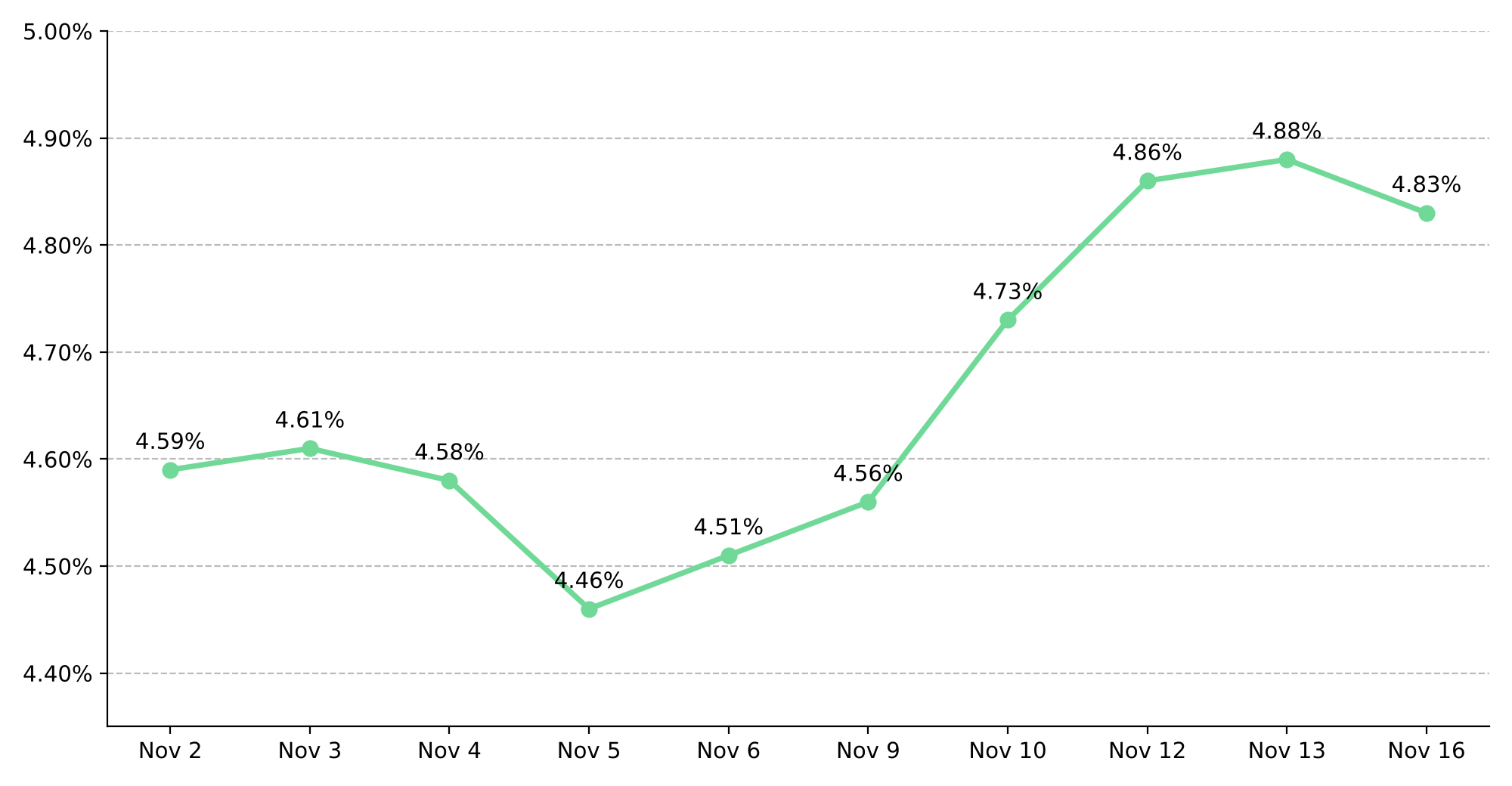
US consumer prices rose 0.4% in October against a 0.3% forecast, Reuters reported, and producer prices rose 6.5% in the 12 months to October, the largest annual gain since November 2022, the US Bureau of Labor Statistics reported on November 13. Hike pricing lifted the 2-year Treasury par yield to 4.88% on November 13 from 4.51% on November 6, raising the return on interest-paying assets relative to gold.
CME FedWatch priced a 96% chance of a December hike on November 17, Reuters reported, and Kansas City Fed President Jeffrey Schmid said on Sunday, November 15, that inflation remained too high. A stronger dollar raises gold’s cost for buyers outside the US. A sell-off in AI-related equities added to the move, pushing the Australian dollar to US$0.6725, its lowest since January, and sterling to US$1.3172, Reuters reported.
Fed Minutes & Dollar Moves Decide How Much Gold Margin Producers Keep
Kyle Rodda, Senior Financial Market Analyst at Capital.com, said on November 17 that gold’s price is being set by what markets expect from US Fed policy in 2027.
In the first scenario, Fed minutes due November 18 show support for hikes into 2027. The dollar extends gains, and weaker Australian and Canadian dollars keep cushioning local-currency gold. In the second, the dollar reverses: Carol Kong, Economist and Currency Strategist at Commonwealth Bank of Australia, named erratic US policymaking and an AI equity correction as downside risks, Reuters reported. Gold recovers, producer currencies rise with it, and US-cost producers capture more of the rebound.
The minutes on November 18 and the Fed decision on December 9 decide between the two. The price effect lands by December 9; the cost effect appears in December-quarter and year-end reports from late January 2027. The reversal trigger is the Australian and Canadian dollars regaining their November 6 levels of US$0.6875 and C$1.4106 per US dollar, reported in the Fed’s weekly H.10 release, which would remove the offset for producers paying costs in those currencies.
Weaker Australian & Canadian Dollars Cut the Margin Hit for Local-Cost Gold Producers
The most exposed cohort is producers paying costs in US dollars, including mines in Nevada and Alaska, because every dollar of decline is lost margin. Local-currency cost producers get a partial offset: since November 6, gold fell about 2.8% in Australian dollars and 3.6% in Canadian dollars, against 4.9% in US dollars, based on Reuters prices and exchange rates and Fed H.10 rates for November 6. In sterling, the decline was about 3.5%.
Northern Star Resources, Australia’s largest gold miner, reported September-quarter AISC of A$2,919/oz at its Kalgoorlie centre on October 21. Between November 6 and November 17, Kalgoorlie’s margin over AISC fell about 5.5% in Australian dollars; a mine with the same cost, fixed in US dollars at the November 6 exchange rate, would have lost about 9.7%. The separating test is the share of costs paid in local currency.
Holders of non-US producer positions cannot know whether the Fed minutes move exchange rates or gold first. The offset reduces currency exposure on costs, not gold price exposure, and positions in every cohort lose value if gold falls further.
Dollar-Driven Gold Weakness Shifts Margin Advantage Toward Non-US Cost Bases
The gold sell-off is a Fed repricing transmitted through yields first and the dollar second, and its cost falls unevenly. In the Kalgoorlie example, the same US dollar gold price cut margins nearly twice as fast on a cost base fixed in US dollars as on one paid in Australian dollars.
For producers in Australia, Canada and the US, the currency of the cost base belongs in valuation alongside AISC, not in a risk footnote. A strong dollar lowers the US dollar cost of every ounce mined outside the US, moving those producers down the global cost curve relative to US-cost peers. That position protects margins while the dollar is strong and gold is weak; it is a feature of the current Fed cycle, not a permanent advantage.
Analyst's Notes





Subscribe to Our Channel




Stay Informed