




US Debt Hits $40 Trillion as Mining Financing Risk Rises



US debt hits $40T as 30-year yields top 5.34%, raising financing costs for mining developers and boosting the case for gold and silver as hedges.
- Total US debt reached $40.047 trillion on August 18, 2026 ($32.266 trillion held by the public, $7.782 trillion intragovernmental), having more than doubled from just under $20 trillion in January 2017.
- The 30-year Treasury yield hit 5.34% on August 18, the highest in nearly two decades, before easing to 5.18% after Treasury doubled its buyback size to $4 billion per operation, running September 9 through November 4.
- Net interest payments hit $1.1 trillion in the first 10 months of fiscal 2026, overtaking Medicare as the second-largest budget line item behind Social Security.
- The Congressional Budget Office projects debt could climb to $64 trillion by 2036, with the $41.1 trillion statutory ceiling approaching within months at the current borrowing pace.
- Sustained 30-year yields above 5.34%, or the debt load crossing $41.1 trillion before Congress acts, would reprice financing costs for capital-intensive sectors, a direct risk to mining developers needing project debt in the next 12-18 months, and a potential tailwind for gold and silver as a Treasury-diversification hedge.
Treasury Debt Crosses $40 Trillion as Long-Bond Yields Surge
The Treasury Department's daily cash and debt statement put total public debt outstanding at $40.047 trillion on Tuesday, August 18, up from $39.987 trillion the day before. Of that total, $32.266 trillion is debt held by the public, and $7.782 trillion is intragovernmental holdings, largely held within the Social Security trust funds. The milestone landed the same week the 30-year Treasury yield hit 5.34% on Tuesday, its highest level in nearly two decades, following a $25 billion long-bond auction that priced at the highest yield since 2021 (Reuters).
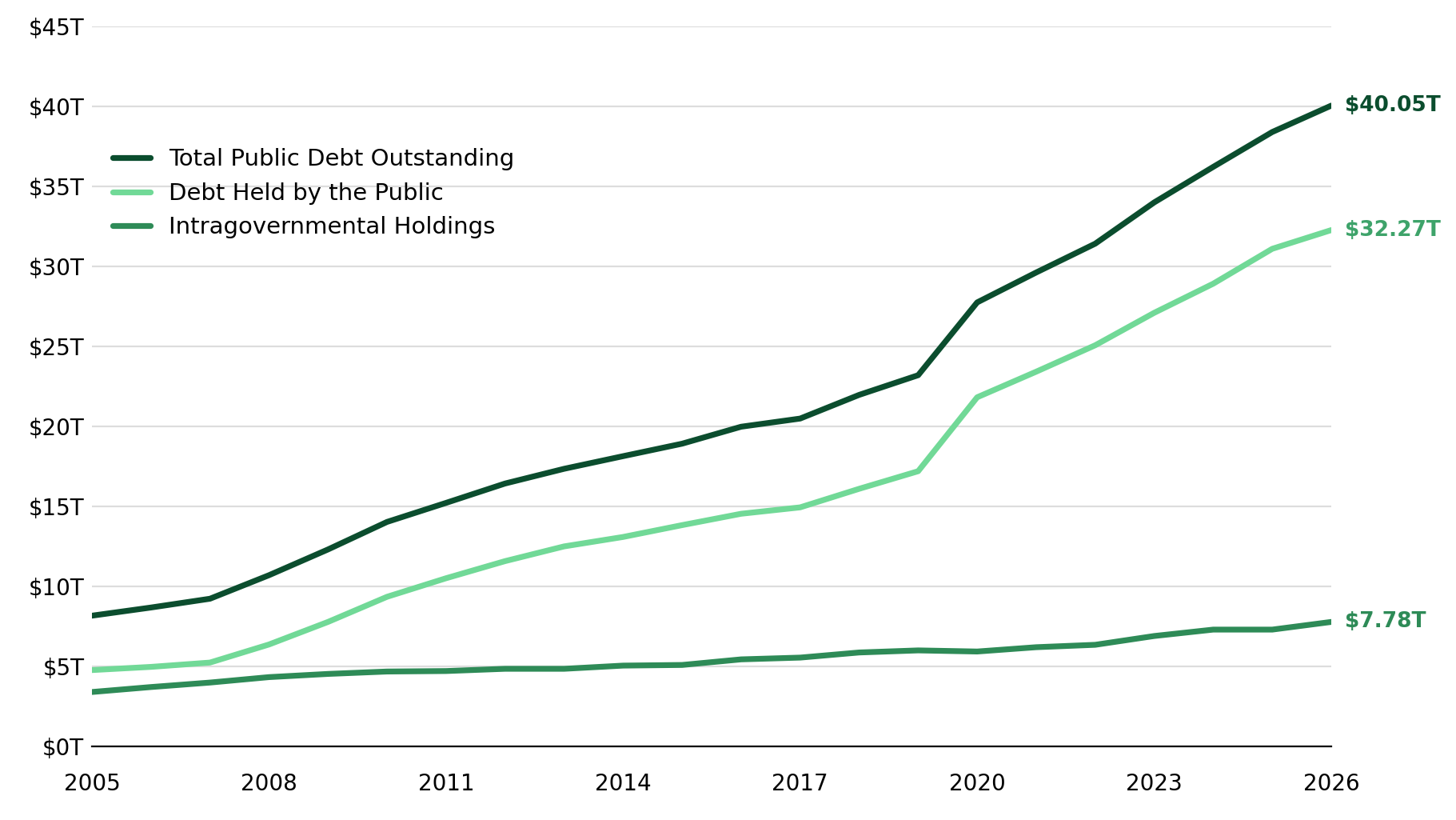
Debt held by the public is now approaching 100% of GDP, a level last seen during World War II, while gross debt-to-GDP stands at 125.8% by IMF measure, higher than the UK's 103.6% and China's 106.9%, though still below Japan's 200%-plus. The pressure showed up immediately in the policy response: Treasury Secretary Scott Bessent announced Wednesday that buyback operations would double to at least $4 billion, aimed squarely at containing long-end yields.
Debt-to-GDP crossing WWII-era levels is a structural, multi-year backdrop, not a catalyst tied to a specific trade. The practical takeaway is to treat US fiscal capacity as a variable in the thesis for any project that depends on long-dated financing or the dollar's reserve status, rather than an assumption that does not need to be revisited.
$1.1 Trillion Interest Bill Narrows US Fiscal Flexibility
The mechanical driver is a widening gap between mandatory spending and revenue. The Treasury reported a $432 billion deficit for July 2026, the fourth-highest monthly shortfall on record, as tariff refunds pushed customs receipts negative for a third straight month. The first ten months of fiscal 2026 have already produced a larger deficit than all of fiscal 2025. Roughly 60% of the government's $7 trillion in annual spending is mandatory: Social Security, Medicare, Medicaid, veterans' care, leaving little room in the "discretionary" budget where cost-cutting efforts have concentrated.
Net interest payments reached $1.1 trillion and have overtaken Medicare outlays as the second-largest federal budget line behind Social Security in the first ten months of fiscal 2026. The CBO estimates that the government is nearing its $41.1 trillion statutory ceiling, with debt projected to reach roughly $64 trillion by 2036. With midterm elections three months away, DZ Bank's Rene Albrecht noted the Treasury has had to "grab into the toolkit" to manage the recent rise in yields rather than address the underlying deficit (BBC).
Mandatory spending crowding out discretionary spending is a slow-moving but directly relevant input for any company or investor relying on government-linked demand drivers: infrastructure spending, defense-related metals demand, or strategic mineral stockpiling programs. It's worth checking whether a thesis depends on discretionary federal spending staying flexible, because that flexibility is visibly shrinking.
$4 Billion Treasury Buybacks Offer Only Short-Term Yield Relief
Treasury's buyback expansion is liquidity management, not deficit reduction, and analysts are treating it that way. Oxford Economics' John Canavan said the increase in buybacks was "unlikely to provide meaningful long-term relief" given the sheer size of outstanding Treasury debt (BBC). Economist Mohamed El-Erian framed the move as a possible step toward broader yield-curve control, warning it "risks collateral damage and unintended consequences", language that points to intervention rather than resolution.
The current, buyback-suppressed yield environment should be treated as a temporary calm, not a new normal. It's a window in which shorter-duration financing looks relatively cheap and stable, useful for near-term project funding decisions, but it's not a basis for locking in long-term capital cost assumptions for a project that won't reach a financing decision until the buyback window has closed or been reassessed.
5%-Plus Long-Term Yields Raise Financing Risk for Mining Developers
Rate-sensitive and long-duration positions face the most immediate margin pressure. With foreign holders' share of Treasuries declining and hedge funds, recorded as "households" in Fed data, absorbing more of the supply using borrowed money, WSJ notes this leverage has previously caused forced selling during stress events, as in April 2025. The dynamic amplifies yield volatility exactly when capital-intensive sectors, including mining developers reliant on project financing, are most sensitive to borrowing costs.
The Treasury's own response is a useful stress test of flexibility: doubling buyback sizes on short notice shows policymakers can temporarily smooth volatility, but Canavan's assessment is that this doesn't alter the trajectory. Investors should treat the debt-ceiling timeline as unpredictable rather than tradeable; Congress has historically resolved ceiling standoffs at the last possible moment, and neither the exact binding date nor the political outcome can be forecast with precision. The constraint is real: nobody can know in advance whether a ceiling breach triggers extraordinary measures, a negotiated increase, or a genuine payment disruption, so positioning around a specific date is speculative.
For anyone holding or evaluating development-stage mining equities, this is a direct read-through to project economics. A developer that needs to raise project debt in twelve to eighteen months is now underwriting against a materially higher cost-of-capital scenario than it would have a year ago. It's worth asking what long-bond yield assumption sits inside their feasibility study discount rate, and whether that assumption has been stress-tested against a sustained move above 5%.
What Would Reprice the Trade
The condition currently holding yields off their highs is Treasury's active buyback support, running at $4 billion per operation from September 9 through November 4. While that program runs, demand for long-duration Treasuries is being artificially supported, which favors positions in shorter-duration instruments and reduces the urgency of hedging against a near-term yield spike.
The level that would flip this is the 30-year yield sustaining above 5.34%, its Tuesday high, for a period beyond the current buyback window, or the debt load crossing the $41.1 trillion ceiling before Congress acts (BBC). Either would reprice financing costs across capital-intensive sectors, including project-stage mining names that depend on debt markets to fund construction, and would likely reinforce the case for precious metals as a diversification hedge given softening foreign appetite for Treasuries.
Softening foreign appetite for Treasuries, reinforcing the case for precious metals as a diversification hedge, is the connective tissue between this macro story and portfolio construction. If foreign central banks continue to diversify reserves away from Treasuries, gold and, to a lesser extent, silver are direct beneficiaries of that reallocation, regardless of whether the 5.34% level is breached. That's a slower-moving, more structural tailwind worth distinguishing from the faster, more speculative trade around the yield threshold itself.
Analyst's Notes





Subscribe to Our Channel





Stay Informed


