Mineros Strong Half-Year Results Set Up Self-Funded Push to 300,000 oz Annual Production


Mineros (TSX:MSA) lifts 2026 guidance to 240k oz, funds its 37.9% IRR Porvenir project from a $230M treasury and trades near 4x EBITDA, says the CEO.
- Mineros' share price has risen roughly 15 times since its current owners became involved, according to CEO Daniel Henao, after more than 50 years as a little-known Colombian-listed producer.
- Nicaragua is driving 2026 guidance of 220,000-240,000 gold equivalent ounces through higher recoveries, a $25 million plant expansion and tighter grade control.
- About $230 million in liquid assets, including roughly 40,000 ounces of gold, funds Porvenir's $206.8 million initial capital for a project with a 37.9% after-tax IRR.
- The Tolima historical estimate of about 28 million ounces and La Pepa's 2.5 million ounces in Chile add large-scale growth options that carry no economic studies yet.
- Henao estimates Mineros trades at about four times annualised EBITDA and is targeting 300,000 ounces a year as its next production milestone.
Record gold prices have lifted cash flow across the producer sector, and Mineros S.A. (TSX:MSA) is putting its share to work on several fronts at once. Speaking at a conference in Colorado Springs, President and CEO Daniel Henao set out plans to build a new mine in Nicaragua from the company's own treasury while pushing group production towards 300,000 ounces a year. The company has mined gold in Latin America for more than half a century and has been listed on the Colombian exchange since the 1980s. It only arrived on the TSX in late 2021. With record half-year results, a growth project funded from the balance sheet and two large undeveloped deposits now in the pipeline, the question for investors is how much of that operating momentum the market has already priced in.
Established Business Under New Ownership
Mineros was founded in Medellín in 1974 and expanded into Nicaragua through the acquisition of Hemco in 2013. In 2025, Sun Valley Investments became its controlling shareholder and installed a new management team and strategy. Henao describes the company as an old story that most North American and European investors have simply never heard of. The new team's agenda combines operational fixes at existing mines, organic growth and acquisitions made at what Henao calls very attractive valuations.
The results are now visible in the numbers. In the first half of 2026, Mineros generated about $260 million in adjusted EBITDA (earnings before interest, taxes, depreciation and amortisation). Its September presentation reports record half-year revenue of $559 million and net profit of $133 million over the same period.
Nicaragua Drives the Guidance Upgrade
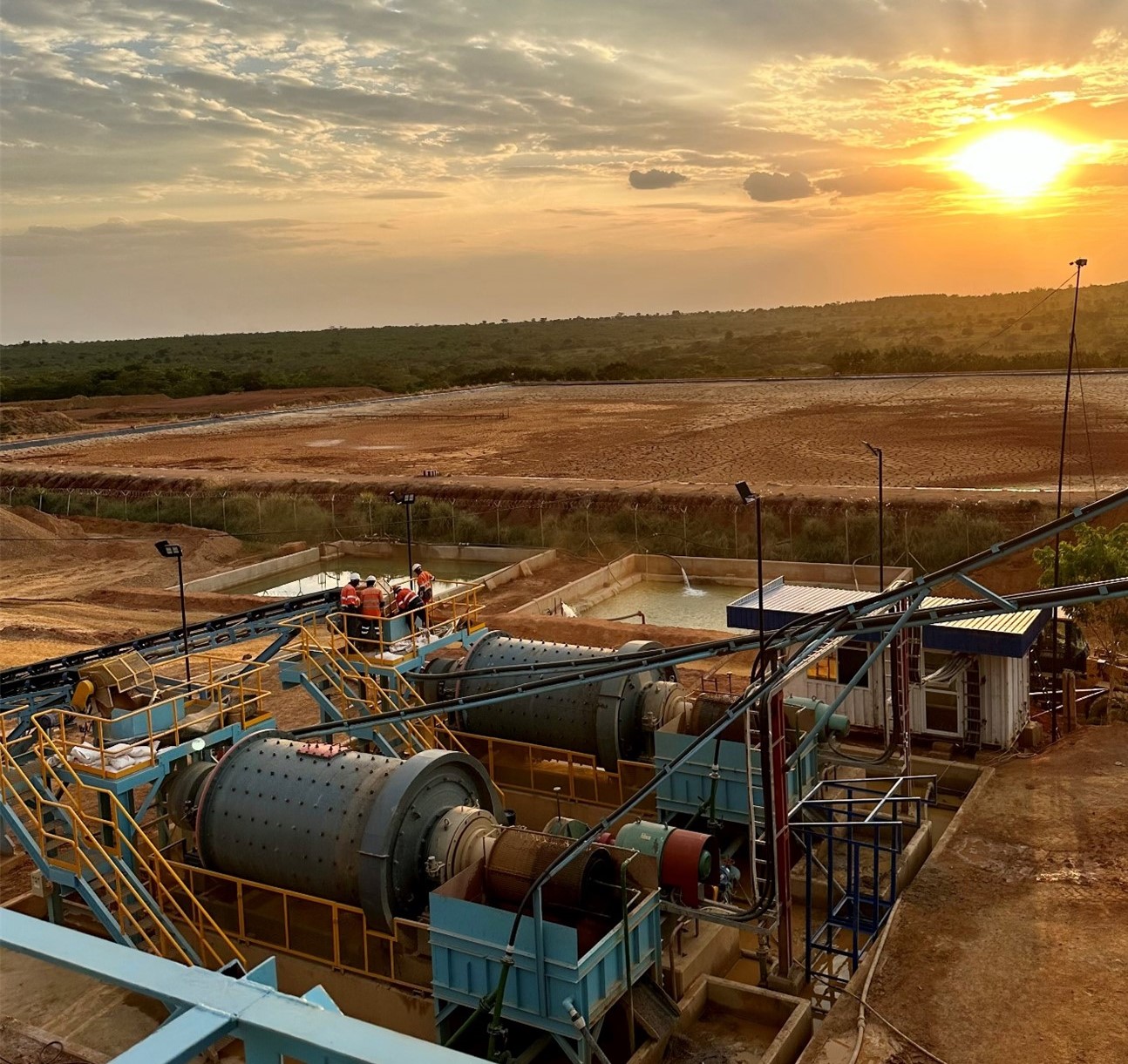
Mineros produces from two jurisdictions, Nicaragua and Colombia. Nicaragua is where the new team found the largest operational gains. Henao outlined three initiatives at the Hemco operation. The first is higher recoveries for both gold and silver. He said silver revenues rose 500% in the first half compared with a year earlier. The second is removing historical bottlenecks in processing capacity. Mineros is spending about $25 million this year on plant expansion, which Henao expects to add roughly 30,000 ounces of production. The third is better grade control through improved mine plans, mining methods and dilution management.
Nicaragua accounts for the increased company guidance, which now stands at 220,000-240,000 gold equivalent ounces for 2026 at an all-in sustaining cost (AISC) of $2,370 - $2,470 per ounce. Henao's ambition is to take Hemco towards 200,000 ounces a year, before counting any contribution from the Porvenir project.
Nechí: A Century of Predictable Ounces
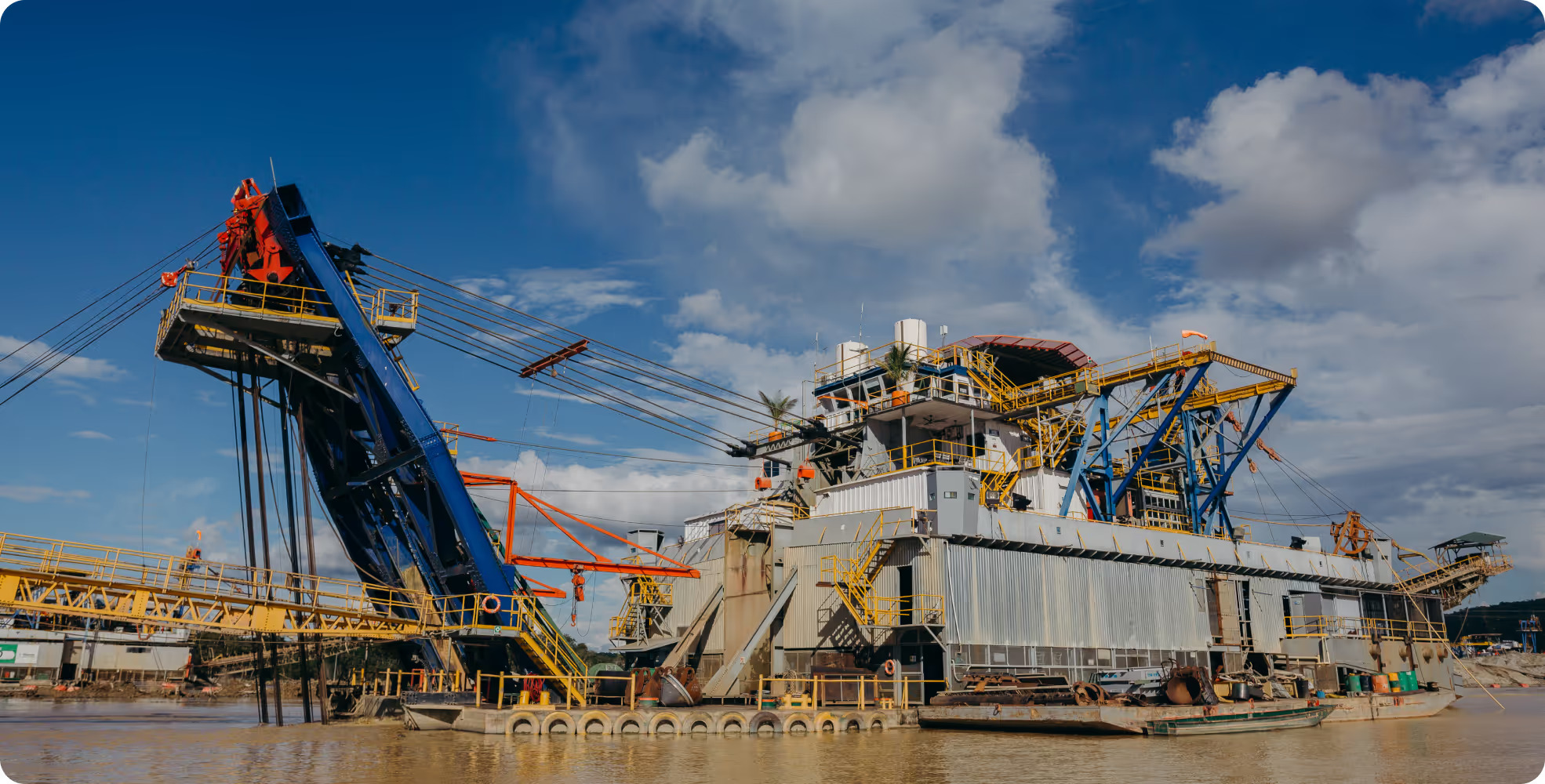
The Nechí alluvial operation in Colombia has been in production for more than 100 years and produced about 90,000 ounces of gold last year. Henao stressed that the method is less exotic than it sounds. It is an open-pit operation beside the river, not in the riverbed. Instead of trucking ore, Mineros pumps it through dredging infrastructure. Gold is recovered by gravity with no chemicals, and the operation runs on hydroelectric power. Over a century, mining has advanced about 30 kilometres north.
Recovery is moving towards 90% or higher. About 10% of Nechí's gold comes from formalised miners working within Mineros' concessions under company guidelines. With roughly 2.2 million ounces in reserves and resources, Henao believes the asset can support 30-40% more output, taking it towards 120,000-130,000 ounces a year. Growth applications to the government are still in preparation. He described Colombia's new government as pro-investment and pro-development.
Interview with Daniel Henao, CEO of Mineros S.A.
Porvenir: Funded From the Treasury
Mineros holds about $230 million in liquid assets, including roughly 40,000 ounces of gold on its balance sheet. It carries almost no debt beyond equipment leases. That treasury is the basis for building Porvenir in Nicaragua without external financing, even after dividends, share buybacks and acquisitions.
The prefeasibility study (PFS), run at a gold price of $3,150 per ounce, shows an after-tax internal rate of return of 37.9% on initial capital of $206.8 million. It also reports an after-tax net present value of $460 million at a 5% discount rate. Porvenir would add about 70,000 ounces a year. Major permits have been received, and two minor permits are expected by the end of the year. A construction decision is targeted for the first quarter of 2027.
Henao frames the 2,000-tonne-per-day plant as a first phase that could double to 4,000 tonnes per day as satellite targets such as Guillermina, Leticia and San Antonio are drilled out. He was explicit about why the company prefers phased development:
"We're a gold mining company, so our priority is to actually take assets into production. That's why we like these phased type approaches, not the model of building things massively and mining the market. We [would] rather mine the gold."
The Nicaraguan district has produced more than 8 million ounces of gold since the 1880s, yet Henao said the company's geological understanding of it remains minuscule. Mineros is drilling about 85 kilometres in the Porvenir district this year with eight rigs. Ownership of the drilling fleet is central to the economics.
"We own our own drilling fleets, and because we own them and we operate them, our drilling cost is about $100 a metre. So that's easily a fourth of what our peers are paying."
Tolima and La Pepa: Optionality on a Larger Scale
Mineros has added two larger development options. The Tolima project in Colombia carries a historical estimate of about 28 million ounces prepared by AngloGold Ashanti as of December 2024. Mineros has not verified this as a current mineral resource. AngloGold invested about $1 billion in the asset, and the data package includes trade-off studies and two prefeasibility studies. Up to $60 million in contingent consideration is tied to mining plan tonnage and environmental licence milestones. Henao said the asset has been declared of national interest. He also said the challenge is not technical. Mineros plans to start with community engagement and will not pursue AngloGold's earlier concept of a mine producing around 1 million ounces a year. Colombia's works-for-taxes mechanism lets Mineros pay part of its income tax by building local infrastructure. This year that includes a school for 2,000 children in the Bajo Cauca region.
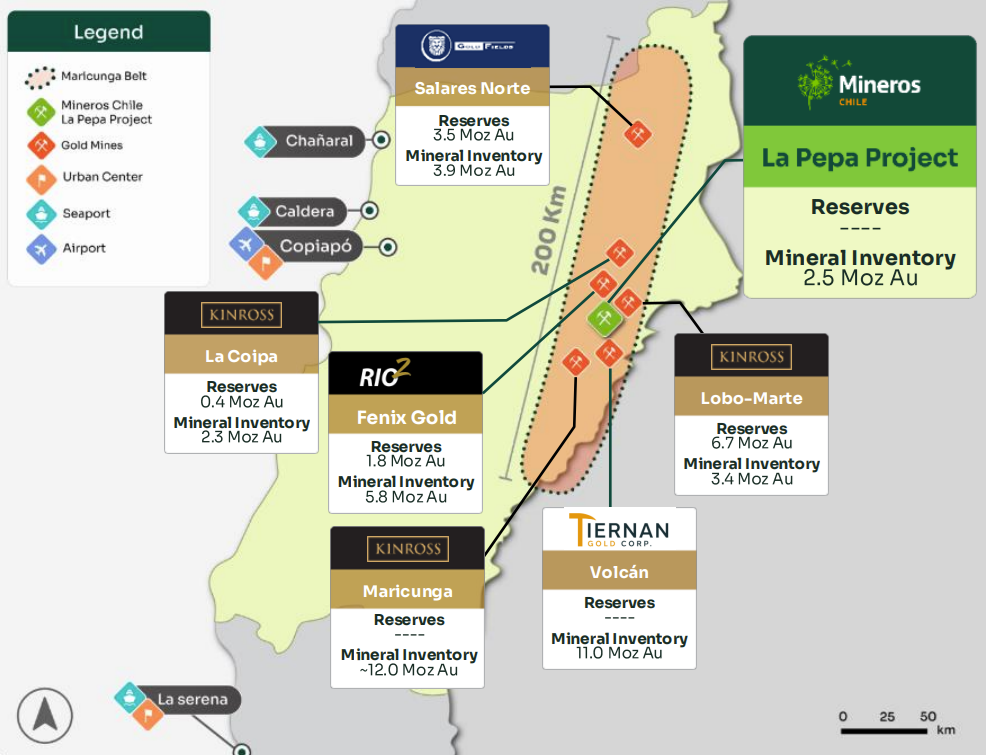
La Pepa in Chile sits in the Maricunga gold belt, immediately south of Rio2's Fenix mine, in a district where Kinross and Gold Fields also operate. It hosts about 2.5 million ounces in resources. Mineros intends to follow Rio2's oxide-first, phased approach. A preliminary economic assessment (PEA) is due early next year, with an internal target of 100,000-150,000 ounces a year. Henao expects Chile to become Mineros' next producing jurisdiction.
Costs, Currency & Valuation
Cash costs at Mineros' own operations run at about $1,200 per ounce. Mining partners in Nicaragua are paid roughly 45% of the spot price, a royalty-like arrangement that raises costs when gold rises but also widens margins. Peso appreciation has added further pressure. Even so, Henao said AISC is tracking below the low end of guidance, consistent with a first-half figure of $2,348 per ounce.
On valuation, Henao annualised first-half adjusted EBITDA to about $500 million. Against a market capitalisation of about $2.2 billion and roughly $200 million in cash and bullion, he puts enterprise value near $2 billion, or about four times EBITDA. The company underscores its lower 2.5 times EV/EBITDA. Neither figure assigns value to the roughly 30 million ounces at Tolima and La Pepa that do not yet have economic studies. Debottlenecking is expected to add a further 30,000-40,000 ounces next year, with 300,000 ounces a year as the next milestone.
Investment Thesis for Mineros S.A.
- Mineros raised 2026 guidance to 220,000-240,000 gold equivalent ounces, with first-half AISC of $2,348 per ounce sitting below the guided range.
- About $230 million in liquid assets, including roughly 40,000 ounces of gold bullion, covers Porvenir's $206.8 million initial capital without new equity or project debt.
- Porvenir's PFS shows a 37.9% after-tax IRR and $460 million NPV at $3,150 gold, with a phased design that could double throughput to 4,000 tonnes per day.
- Management's own arithmetic puts the shares at about four times annualised EBITDA, with no value assigned to roughly 30 million ounces at Tolima and La Pepa.
- Investors should monitor the remaining two Porvenir permits and the construction decision targeted for the first quarter of 2027.
- The La Pepa PEA, due early next year, is the next test of whether Chile can support 100,000-150,000 ounces a year.
Macro Thematic Analysis
Record gold prices have transformed producer cash flows across the sector, but the market has been uneven in how it rewards them. Mid-tier producers with Latin American operations have often traded at a discount to peers in Canada and Australia, reflecting jurisdictional risk premiums and limited coverage among North American funds. Mineros sits squarely in that gap. Its first-half adjusted EBITDA margin of 46.6% is in line with the peer median, according to the company, yet its multiples sit well below many of the producers it is compared against.
How producers deploy windfall cash flow is becoming a differentiator. Some return it, some pursue large acquisitions, and some build balance sheet resilience. Mineros is attempting all three while also holding part of its treasury in physical gold. Henao made the case for that choice in direct terms:
"As mining companies, we're always talking about how constructive our views are on gold. Yet the first thing we do when we produce the metal is change it for paper."
Holding bullion leaves the company more exposed to the gold price, for better and for worse. It also signals conviction that the price environment has further to run, a view that sits alongside wider concerns about fiat currency weakness. Henao noted that the US dollar has lost ground against many currencies, including the Colombian peso.
The second macro theme is social licence. Large undeveloped deposits in the Americas increasingly stall on community opposition rather than geology. Tolima is a clear example of an asset where technical work is advanced but permission to build is not. Mineros' approach through local infrastructure under works-for-taxes is one model for addressing that bottleneck. Its success or failure at Tolima will be closely watched by others holding stranded ounces in the region.
TL;DR
Mineros, a Latin American gold producer with operations in Nicaragua and Colombia, has re-rated roughly 15 times under new ownership, according to CEO Daniel Henao. Nicaragua drives raised 2026 guidance of 220,000-240,000 gold equivalent ounces, with first-half AISC of $2,348 per ounce below the guided range. About $230 million in liquid assets, including roughly 40,000 ounces of gold, funds the $206.8 million Porvenir project, which has a 37.9% after-tax IRR. A construction decision is targeted for the first quarter of 2027. Tolima and La Pepa add about 30 million ounces of unvalued optionality. Henao puts the stock at about four times annualised EBITDA.
FAQs (AI Generated)
Analyst's Notes





Subscribe to Our Channel



Stay Informed