




ATEX Resources Expanding Massive Multi-Deposit Copper District Beyond Initial Discoveries


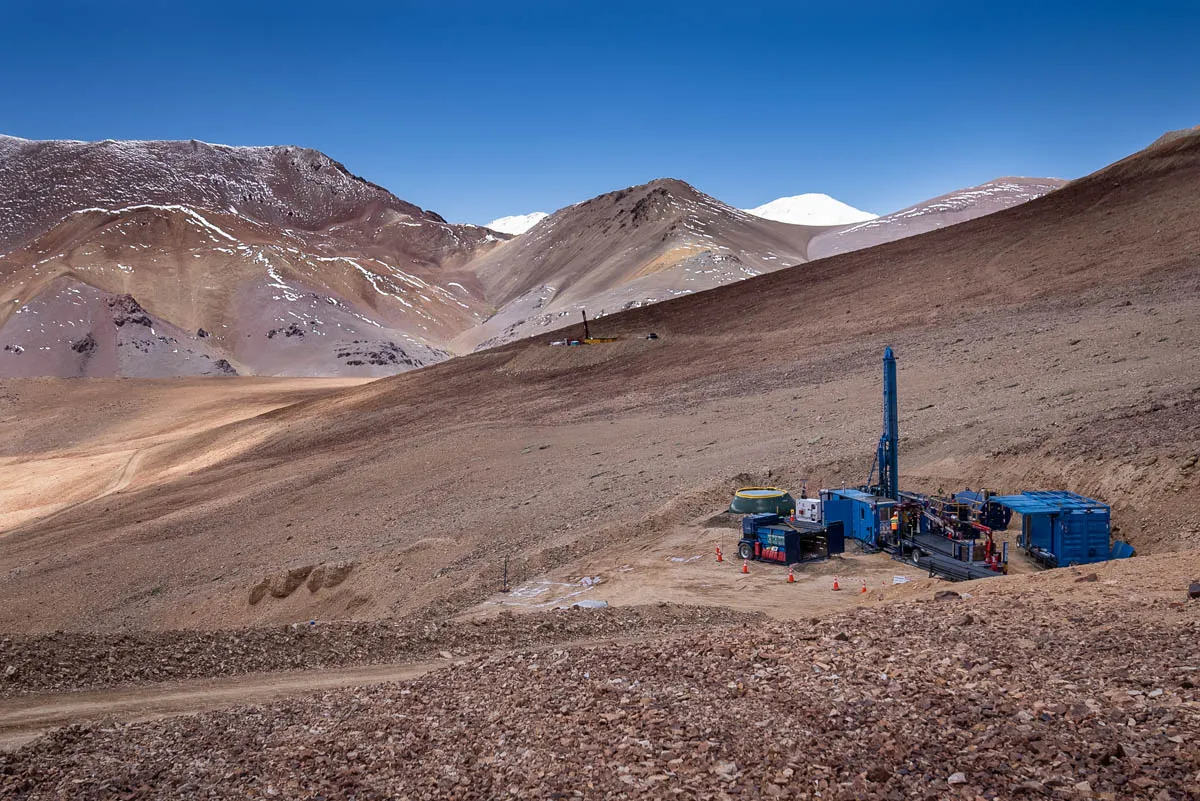
ATEX Resources expands Valeriano's high-grade breccia by 70%, holds $150M cash, and targets district-scale copper discovery across four additional porphyry targets in Chile.
- ATEX Resources is advancing its flagship Valeriano copper-gold project in Chile, which hosts an estimated mineral resource of two billion tonnes of 0.85% copper equivalent, including a high-grade B2B breccia zone sitting above a substantial porphyry system.
- Phase VI drilling is now surpassing 30,000 metres with a key eastern step-out hole intersecting approximately one kilometre of continuous copper-gold mineralisation in rhyolite which effectively increasing estimated B2B breccia tonnage by around 70%.
- Interim President and CEO Chris Beer, who stepped in following Ben Pullinger's departure in late January, outlined a dual exploration strategy focused on expanding and defining the high-grade breccia to attract a broader range of development partners.
- The company holds approximately $150 million in cash, providing an estimated two-and-a-half to three years of drilling runway across five to six active rigs, supported by efficiency gains from directional drilling in partnership with Recon Technology and with no immediate requirement for equity financing.
- Strategic shareholders including Agnico Eagle with a stake exceeding 15% provide institutional credibility, while Chile's regulatory environment is improving, with the new government signalling an intent to accelerate permitting following meetings with both outgoing and incoming Chilean mining ministers at the recent PDAC.
ATEX Resources (TSXV:ATX) is at an active stage in the development of its Valeriano copper-gold project, located in Chile's emerging porphyry copper district between the established Maricunga district to the north and the El Indio district to the south. The company's Phase VI drill programme is delivering results that are reshaping geological understanding of the project, while a well-capitalised balance sheet provides the operational flexibility to continue aggressive exploration across multiple targets. With a leadership transition underway and a formal CEO search in progress, Atex is navigating both an operationally significant and institutionally attentive period in its development.
Valeriano: Scale, Grade & Geological Context
Valeriano is the cornerstone of ATEX's portfolio. The project hosts a mineral resource of approximately two billion tonnes at close to 0.85% copper equivalent, comprising a large, buried porphyry system that until relatively recently had evaded modern exploration due to its depth. The district sits in an 80-kilometre corridor that geologists had long considered prospective for copper porphyries, but surface expressions were limited, making initial identification difficult.
Above the main porphyry body sits the B2B breccia, a high-grade zone that ATEX has been systematically defining and expanding. The current resource within the breccia stands at over 30 million tonnes and is being targeted to reach at least 50 million tonnes grading above 1.5% copper equivalent. Below the breccia, the porphyry itself contributes a further approximately 500 million tonnes at around 1% copper equivalent in the higher-confidence portions of the resource, with additional inferred material extending the system further.
Metallurgical work has returned attractive results, with two rounds of testing producing copper concentrates grading approximately 33% copper with 15 g/t gold and no deleterious elements, a characteristic that adds commercial value to the project's development proposition.
Phase Six Drilling: The B2B Breccia & the Rhyolite Discovery
Phase VI has now surpassed 30,000 metres drilled, exceeding the original 25,000-metre target owing to improved operational productivity at altitude. The programme has been focused on testing geophysical anomalies with signatures similar to the known B2B breccia, as well as extending the porphyry at depth.
An eastern step-out from the B2B breccia that intersected rhyolite a felsic, permeable rock that is receptive to mineralising fluids, and the intersection has materially increased the lateral extent of the high-grade horizon under investigation. Interim President and CEO Chris Beer, explained the significance of the find:
"We hit basically a kilometer of full mineralization but it wasn't in breccia, in fact it was in rhyolite. Rhyolite is a very permeable, permissive felsic rock, so mineralisation fluids go into that readily. This is the first time we're seeing that kind of mineralisation in the rhyolite and we're trying to understand that better this season and next."
While the grade in Hole 34 is approximately half that of the core B2B intercepts, Beer noted that the lateral step-out has effectively increased estimated B2B tonnage by around 70%, adding a meaningful new dimension to the resource envelope. The company now has over 500 metres of lateral and 500 metres of southern extent remaining to test within and around the B2B horizon.
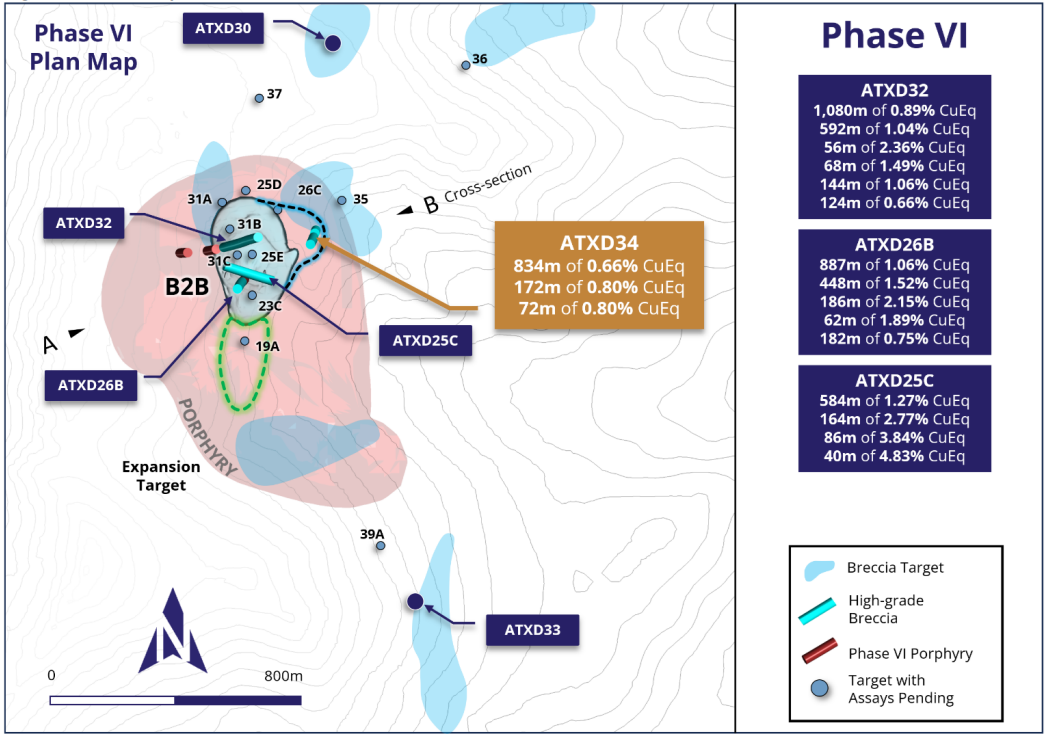
(Source: ATEX Resources' News Release March 16, 2026)
Drilling Strategy: Discovery First, Infill to Follow
ATEX's current drilling philosophy is primarily discovery-oriented, with infill drilling treated as a secondary benefit where drill holes targeting breccia zones also pass through portions of the porphyry system. The B2B breccia currently has dimensions of approximately 400 metres in strike by 400 metres in dip length, with the original resource estimate based on just six holes.
The 2026 programme has been expanding those boundaries significantly, and Beer indicated that future campaigns will focus on in-fill drilling once the geometry is better understood. The porphyry below, at approximately 1.5 billion tonnes inferred and 500 million tonnes indicated, is being extended to the north and south through current step-out holes. Beer noted that while the company is achieving some de facto infill of the porphyry through exploration drilling, a dedicated resource conversion campaign is not the immediate priority.
Comparable Projects and Infrastructure Context
Beer drew comparisons to several established copper-gold systems to contextualise Valeriano's potential. Newmont's Red Chris in Canada and BHP's Carrapateena in Australia both contain approximately 400–500 million tonnes at grades comparable to Valeriano's porphyry resource. On the breccia side, Beer referenced the acquisition of a comparably sized breccia zone for approximately C$3.8 billion, suggesting that ATEX's B2B alone at a targeted 50 million tonnes already represents a material asset relative to comparable transactions.
Beer also outlined the infrastructure context:
"There's a desalination route, there is a power line to within 50 kilometres of our project. You can drive to site within two hours from a city of 50,000 people. So there's a lot of infrastructure available to the party that eventually develops this region."
Processing infrastructure is also developing in the broader district, with the Yanacocha Norte project operated by Newmont and Teck situated approximately 40 kilometres away.
Company Profile: Leadership Transition
Chris Beer, formerly Chair of the Audit Committee, stepped into the role of Interim President and CEO following the departure of Ben Pullinger in late January. Beer joined the ATEX board in spring 2024 and brings a background in finance and capital markets, including experience on Bay Street. The board has used the transition as an opportunity to conduct what Beer describes as a far-reaching executive search.
The candidate profile reflects the project's maturity: the company is seeking an individual with exploration credentials, engineering capability, and experience engaging with major mining companies. The search is ongoing, and Beer has indicated the board is taking its time given the company's strong financial position.
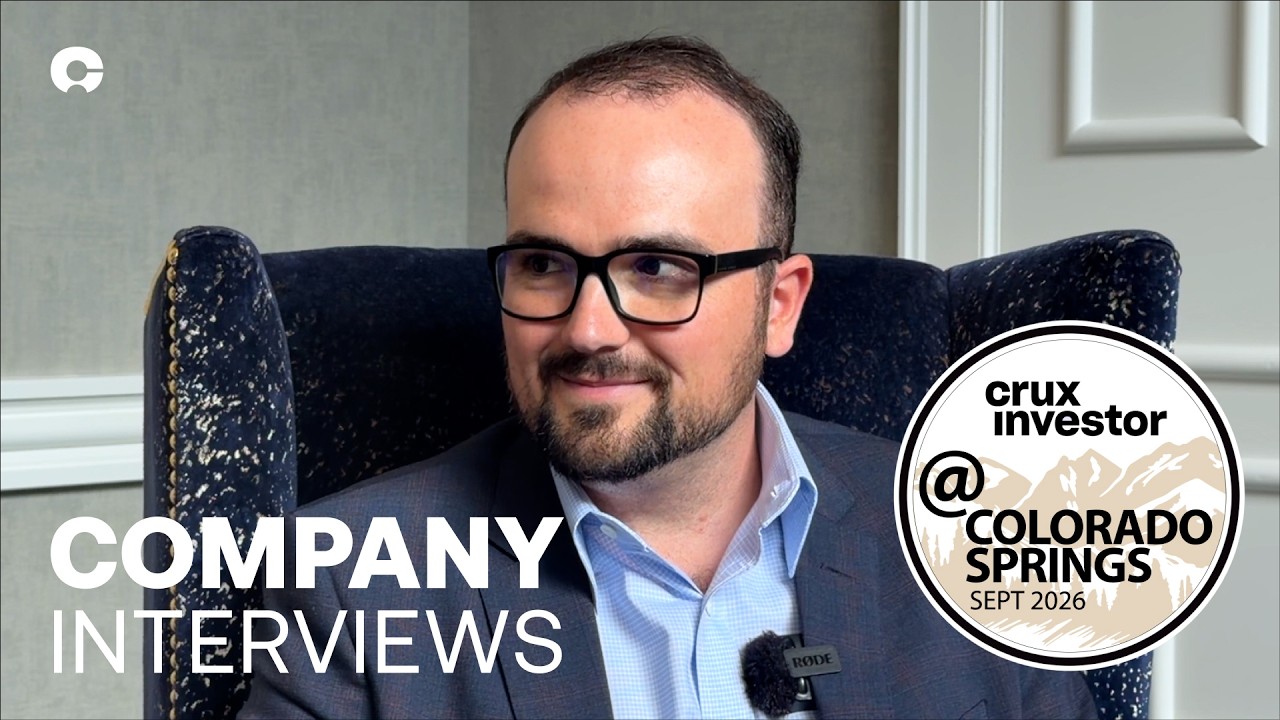
Interview with Chris Beer, Interim President & CEO of ATEX Resources
Shareholder Base and Capital Position
ATEX Resouorces holds approximately $150 million in cash, providing an estimated 2-3 years of operational runway at current drilling pace. The company runs 5-6 rigs and has been achieving efficiency gains through extended drilling seasons and continued refinement of its directional drilling approach, a capability developed in partnership with Recon Technology that has been central to testing the deep porphyry targets at Valeriano.
Strategic shareholders include Agnico Eagle with a stake of over 15%, as well as Pierre Lassonde and the Trinity Capital Group. Beer indicated that a second tranche of warrants exists at prices modestly above current trading levels, providing a potential additional source of funding in receptive hands.
Jurisdiction and Regulatory Environment
Chile's regulatory environment was noted as a supportive factor. Beer referenced meetings with outgoing and incoming Chilean mining ministers during PDAC, and indicated that the new administration appears focused on accelerating permitting and regulatory processes, partly in response to competitive pressure from Argentina's improving investment environment.
The Investment Thesis for ATEX Resources
- Scale of the resource base: Valeriano hosts approximately two billion tonnes of copper-gold mineralisation, placing it among the larger undeveloped porphyry systems globally. Scale is a primary criterion for major mining company interest.
- High-grade breccia as a near-term value driver: The B2B breccia, targeted at 50 million tonnes grading above 1.5% copper equivalent, represents a potentially mineable, high-grade subset of the broader system that could attract a wider range of development partners beyond the largest global miners.
- Discovery upside across the district: ATEX has identified three to four additional porphyry targets within six kilometres of Valeriano, each interpreted as potentially comparable in scale. Successful testing of any of these targets over the next 12 months could represent a material re-rating catalyst.
- Well-funded exploration: With approximately $150 million in cash and no immediate financing requirement, ATEX can sustain two-and-a-half to three years of drilling at current pace without diluting existing shareholders. Investors should monitor whether warrant exercise provides additional non-dilutive capital.
- Attractive metallurgy: Two rounds of testwork have confirmed clean, high-grade concentrate production with no deleterious elements — a commercially significant factor that reduces processing risk and enhances the project's attractiveness to potential partners or acquirers.
- Strategic shareholder alignment: Agnico Eagle's 15%+ stake provides both technical credibility and a signal of institutional conviction. Antofagasta's adjacent land holding adds further context regarding district-level interest from major miners.
- Jurisdiction improving: Chile's regulatory direction appears constructive, with the current government signalling an intent to accelerate permitting. Investors should track policy implementation and permitting timelines as the project matures.
The Emerging Porphyry Frontier in the Central Andes
The copper market's structural supply deficit is now a well-established theme, but the investment community's attention is increasingly shifting from known producing regions to emerging frontier districts capable of delivering the next generation of tier-one copper systems. The Central Andes of Chile and Argentina, a belt extending thousands of kilometres through one of the world's most prolific copper-gold metallogenic provinces, continues to yield new discoveries, and the district in which ATEX Resources operates is representative of this next exploration frontier.
Porphyry copper systems in established Chilean districts such as Maricunga and El Indio have been in production or advanced study for decades. The corridor between them, however, remained underexplored due to the depth of mineralisation. This is now changing as exploration technology with geophysics and directional drilling has made it economically practical to test these deeper targets. ATEX's Valeriano discovery is a direct product of this technological shift.
As Beer summarised the opportunity:
"When you pioneer a new district, it's really interesting when you see the tenor of the grade. And what we're seeing is close to 1% copper equivalent, more than double the global copper equivalent grade, with very attractive metallurgy."
The emerging hypothesis that this corridor may host a district of multiple, clustered, billion-tonne-scale porphyry systems has material implications for copper supply forecasting and for the strategies of major miners seeking to replace reserves at scale. Copper demand growth linked to energy transition infrastructure, grid expansion, and electrification of transport continues to outpace the rate at which new supply is being brought into production. Large, high-quality, developable porphyry systems in stable jurisdictions with established infrastructure corridors are, accordingly, among the most sought-after assets in global mining M&A.
TL;DR
ATEX Resources holds a two-billion-tonne copper-gold porphyry resource at Valeriano in Chile, topped by a high-grade breccia zone that Phase VI drilling has just expanded by an estimated 70% in tonnage terms after intersecting rhyolite for the first time. The company has $150 million in cash, five to six active drill rigs, Agnico Eagle as a 15%+ strategic shareholder, and three to four additional district targets to test in the next 12 months. A new CEO search is underway. The investment case rests on continued discovery and the potential for this corridor to become a recognised tier-one copper district.
Frequently Asked Questions (FAQs) AI-Generated
Valeriano hosts approximately two billion tonnes of copper-gold mineralisation at close to 0.85% copper equivalent. This places it among the larger undeveloped porphyry systems globally. The resource comprises two distinct components: a high-grade B2B breccia zone targeted at 50 million tonnes grading above 1.5% copper equivalent, and a large underlying porphyry with approximately 500 million tonnes of indicated resource at around 1% copper equivalent, with further inferred material extending the system.
Rhyolite is a felsic, permeable rock that is receptive to copper-gold mineralising fluids. The intersection of approximately one kilometre of continuous copper-gold mineralisation in rhyolite — rather than breccia as anticipated — is the first time this host rock style has been observed at Valeriano. It materially expands the exploration target envelope and has increased estimated B2B breccia tonnage by approximately 70%, while leaving over 500 metres of lateral and southern extent still to be tested.
The company holds approximately $150 million in cash and operates five to six drill rigs. At the current pace, management estimates this provides two-and-a-half to three years of operational runway. Efficiency gains from directional drilling and extended drilling seasons have helped reduce costs per metre. A second tranche of warrants at prices modestly above current trading levels also represents a potential additional source of non-dilutive capital.
Agnico Eagle holds a stake exceeding 15%, providing both technical credibility and a signal of institutional conviction in the project. Pier Land and the Trinity Capital Group are also named as significant investors. Antofagasta, which holds adjacent landholdings to the north with a similarly scaled porphyry resource, adds further context regarding district-level interest from major miners, though it is not a direct shareholder in ATEX.
Following Ben Pullinger's departure in late January, Chris Beer stepped in as Interim President and CEO from his prior role as Chair of the Audit Committee. The board has initiated a far-reaching executive search and is not rushing the process given the company's strong financial position. The candidate profile includes exploration credentials, engineering capability, and demonstrated experience working with major mining companies — reflecting both the current exploration focus and the project's longer-term development potential.
Analyst's Notes





Subscribe to Our Channel

Stay Informed


