




Pampa Medina Expansion Supports Marimaca’s Growth Path


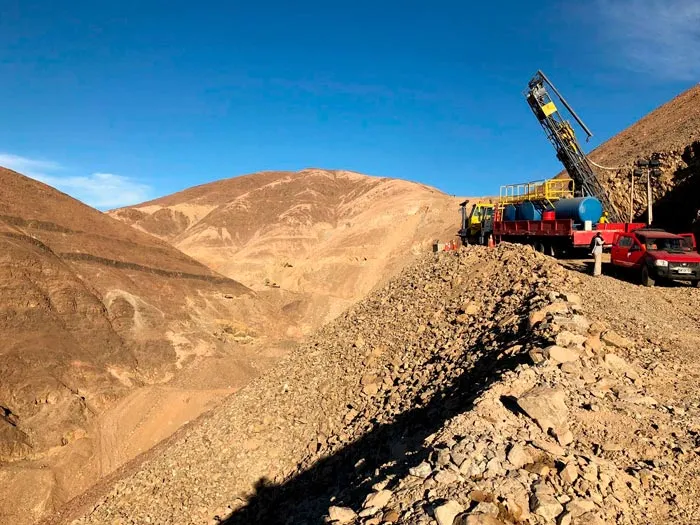
Marimaca advances the MOD oxide project to production while drilling tier-one Pampa Medina discovery. Trading at MOD value, exploration upside appears free.
- Marimaca Copper is advancing the Marimaca Oxide Deposit (MOD) toward final investment decision while simultaneously exploring the potentially tier-one Pampa Medina sulfide discovery in northern Chile
- The company reports consistent mineralisation across drill holes at Pampa Medina, with high-grade zones extending 1.5 kilometers north-south and 600-800 meters east-west, comparing favourably to world-class deposits like Kamoa-Kakula
- MOD oxide project alone carries a pre-tax NPV8 of $1.1 billion at $5/lb copper, while the company trades at $1.2 billion market cap with $160 million cash, effectively valuing Pampa Medina exploration upside at zero
- Management is allocating $30 million to drilling 35,000 meters at Pampa Medina by September to achieve maiden inferred resource by Q2 2027, targeting 150-meter spacing based on mineralisation continuity
- The company has implemented a sulfuric acid cost-hedging strategy through elemental sulfur burning, protecting margins against volatility while progressing debt financing and permitting for MOD construction start in early 2027
Marimaca Copper (TSX: MARI) finds itself at an inflection point where near-term oxide production plans intersect with what management characterises as a potentially transformational sulfide discovery. CEO Hayden Locke outlined the company's dual-track strategy during a recent interview, addressing investor questions about capital allocation, development timelines, and the emerging geological understanding at Pampa Medina. Following a C$409 million capital raise in February and amid Middle East geopolitical tensions, the discussion focused on articulating the investment case across both the advanced MOD and earlier-stage Pampa Medina projects
MOD Project Economics at Current Valuation
The Marimaca Oxide Deposit represents the company's core near-term value proposition. At $5 per pound copper, the asset carries a pre-tax NPV8 valuation of $1.1 billion, according to management. With current market capitalisation around $1.2 billion and $160 million in cash, Locke argues the market is
"Trading at the value of the MOD and you're effectively getting ... the Pampa Medina oxide opportunity - which we know full well can become an additional 25,000 tons a year of production....- you're getting this world-class potentially tier-one exploration opportunity for free."
The MOD project is designed to deliver 50,000 tons of copper cathode annually through conventional oxide leaching. Management sees a clear pathway to expanding this to 75,000 tons per year by incorporating Pampa Medina, which continue to expand with each drill hole. The company is deep into detailed engineering and running debt financing processes, targeting early pre-FID construction work by year-end with full construction decision to follow.
Pampa Medina Discovery: Scale and Geological Continuity
The Pampa Medina discovery has evolved from oxide exploration into what management now characterises as a district-scale sulfide system. Drill results consistently encounter mineralisation across what Locke describes as "a very clear high-grade relatively thick zone of mineralisation that’s extensive over north to south, a bit over 1.5 kilometers east west between 600 and 800 meters."
Critically, management reports that "every single drill hole is hitting a horizon that has those what we perceive to be economic widths and grades," with success rates allowing tonnage to accumulate rapidly. The geological team has identified trends extending three to four kilometers north and at least one kilometer southwest of current drilling, suggesting significant expansion potential beyond the initial discovery footprint.
One standout drill hole encountered five stacked mantos across 400 meters of mineralised package, fundamentally reshaping the geological model. This prompted discussion of whether the deposit might support a large-scale open pit targeting 400 meters at 0.5% copper, or selective underground mining of 20-50 meter horizons at higher grades. Either scenario, according to Locke, would deliver "very competitive" unit costs per ton of ore compared to analogous sediment-hosted deposits.
Path to Maiden Resource by Mid-2027
Marimaca has reduced its Pampa Medina drilling budget from initial estimates to $30 million, primarily because "we don't need as much drilling to get to an inferred resource." The company is targeting 150-meter by 150-meter drill spacing based on mineralisation continuity, compared to the 1.6-kilometer spacing used by comparable projects for inferred resources. The current campaign involves 35,000 meters of drilling to be completed by end-September, followed by six to seven months for maiden resource calculation expected in early Q2 2027.
This resource will represent "a very small snapshot" of the identified mineralisation envelope but should provide sufficient definition for economic assessment. Management acknowledges this will not capture the full district potential but will establish "something that allows people to start looking at it and going okay this is actually a real opportunity."
The board has committed to parallel advancement of both MOD toward production and continued Pampa Medina exploration. Locke explained:
"we see a significant amount of value to be created while pushing ahead on the MOD and moving towards a construction decision and going to FID and turning ourselves into a producer while exploring in parallel."
Interview with Hayden Locke, President & CEO of Marimaca Copper Corp.
Leachable Mineralogy Creates Processing Flexibility
A potentially significant aspect of the Pampa Medina sulfides involves their dominant copper minerals - bornite and chalcocite - both of which are amenable to heap leaching. This creates optionality beyond conventional concentrate production. "There is a world where those become part of a really extended leaching operation and we expand our eventual cathode production significantly," Locke noted.
However, portions of the sulfide resource contain higher proportions of chalcopyrite, which has lower leaching recoveries and would likely require concentration. The ultimate flowsheet remains open, with management committed to "run some scenario analysis, work out what might be the best economic way to develop this project." The preference for leaching operations stems from significantly lower capital intensity compared to concentrate projects at similar scale.
Sulfuric Acid Cost Management Strategy
Recognising sulfuric acid cost volatility as a key business risk for oxide operations, Marimaca is implementing an elemental sulfur burning strategy. The chemistry relationship - one ton of elemental sulfur produces three tons of sulfuric acid - provides natural hedging. Current spot acid prices around $400 per ton compare to estimated self-production costs below $250 per ton, offering payback in 12-14 months at current pricing.
Beyond cost advantages, the strategy addresses supply reliability and inventory management. "Acid is notoriously difficult to ship and store," Locke explained, requiring expensive concrete tankage for 30-40 days of inventory. "Elemental sulfur on the other hand, you can just store on the surface. You don't even need to cover it." The approach also provides access to abundant elemental sulfur from Canadian tar sands operations seeking environmental remediation outlets.
Construction Readiness by Early 2027
The MOD project has substantially advanced permitting, with two to three remaining permits expected by October 2026, ahead of when required for for a full construction descision. The company can commence early works under current permits.
"We're going to be in a position as of the end of this year, early next year to really start construction as quickly as we feel comfortable."
Long-lead item procurement is underway, with some concerns emerging around transformer availability driven ironically by copper supply constraints. Management has identified critical path items and maintains sufficient capital for necessary deposits. The debt financing process is progressing with "virtually no pushback" and strong interest from groups seeking exposure to standalone, bank-financeable copper projects below the multi-billion dollar scale of typical major developments.
The Investment Thesis for Marimaca Copper
- Near-term production catalyst: MOD oxide project advancing toward FID and construction start in early 2027, targeting 50,000 tons copper cathode annually with clear pathway to 75,000 tons through Pampa Medina oxide expansion
- Compelling valuation asymmetry: Trading at enterprise value roughly equivalent to MOD standalone NPV ($750M at 0.75x multiple), providing free exposure to Pampa Medina exploration upside
- Tier-one discovery potential: Consistent high-grade mineralisation across 1.5km+ strike length with district-scale expansion potential extending 3-4km to the north, comparing favorably to world-class sediment-hosted deposits
- De-risked development execution: Fully permitted for early works, debt financing process progressing with strong lender interest, sulfuric acid hedging strategy protecting margins against key input cost volatility
- Capital-efficient resource definition: Reduced drilling requirement to $30M for maiden inferred resource by Q2 2027 due to exceptional mineralisation continuity, targeting 150m drill spacing versus 1.6km used by comparable projects
- Processing optionality: Dominant bornite/chalcocite mineralogy potentially amenable to lower-capex heap leaching versus conventional concentrate operations, with metallurgical testwork ongoing
- Strategic positioning in copper-constrained market: Chilean jurisdiction with established infrastructure, advancing toward production as global copper supply tightens and few new projects reach construction
- Dual-catalyst pathway: Near-term value creation through MOD construction decision and first production, medium-term rerating potential from Pampa Medina resource definition and scale confirmation
Macro Thematic Analysis
Marimaca Copper's development timeline positions it to capture the structural copper supply deficit emerging as electrification accelerates while mine development cycles extend. Chile's production decline from aging assets creates space for new entrants with permitted, financeable projects. The company's scale - mid-tier production versus multi-billion dollar mega-projects - fills a market gap where traditional bank financing remains viable without major mining company involvement. Locke noted: "there is a huge number of groups that would like to be our financing partner" given MOD represents "a standalone project that can be financed by ourselves." The sulfuric acid hedging strategy demonstrates operational sophistication addressing input cost volatility. The best encapsulation of the opportunity:
"we're trading at the value of the MOD and you're effectively getting this world-class potentially tier-one exploration opportunity for free."
TL;DR
Marimaca Copper offers dual exposure to near-term copper cathode production through the advanced MOD project (50,000-75,000 tpa) valued at $1.1B NPV, while current market cap (~$1.2B) provides minimal credit for the potentially tier-one Pampa Medina sulfide discovery showing consistent high-grade mineralisation across 1.5km+ strike. With FID expected in early 2027 and maiden Pampa Medina resource due Q2 2027, the stock offers asymmetric risk-reward as a de-risked developer with significant blue-sky exploration optionality.
FAQ's (AI Generated)
Analyst's Notes





Subscribe to Our Channel





%20(1)%20(1).jpg)
.jpg)
Stay Informed


