ATHA Energy's High-Grade Uranium Discoveries at Angilak Strengthen Canada's Strategic Supply Position


ATHA Energy confirms high-grade uranium discoveries at Angilak's RIB Corridor with 100% drill success rate, positioning Canada as key supplier amid global supply deficits.
- ATHA Energy's confirmation of multiple high-grade uranium discoveries along the Mineralized RIB Corridor at Angilak materially reinforces the project's district-scale exploration thesis in a tightening global uranium market.
- A 100% success rate intersecting uranium mineralization across RIB East, West, North, and South supports the interpretation of a large, continuous mineralizing system rather than isolated occurrences.
- Grades up to 5.55% U₃O₈ reinforce the potential for future low-cost, high-margin development, aligning with investor preference for high-grade jurisdictions amid rising capital intensity.
- The RIB East and West trends are anchored by the RIB North discovery hole, a standout intercept of 0.5m at 8.16% U₃O₈ within a 13.6m continuous mineralized zone grading 0.53% U₃O₈.
- The discoveries arrive as uranium supply security becomes a strategic priority for utilities and governments, elevating the value of scalable projects in Tier-1 jurisdictions like Canada.
- With pending assays expected in the coming weeks, expanded geophysics planned for 2026, and exposure to multiple uranium basins including a 10% carried interest in Athabasca projects, ATHA offers exploration torque leveraged to structural uranium deficits rather than short-term price volatility.
Uranium Markets Enter a Security-Driven Investment Phase
The uranium market has undergone a fundamental shift in how utilities, governments, and institutional investors evaluate supply risk. What was once a cyclical commodity trade has evolved into a strategic assessment of long-term supply security, with implications extending beyond spot price movements.
From Price Cycles to Supply Security
The traditional uranium investment thesis centered on price cycles, with investors positioning for periodic supply squeezes and subsequent contractions. That framework has given way to a more structural view. Utilities are securing supply through longer-term contracts while applying jurisdictional filters that eliminate suppliers in geopolitically uncertain regions.
This behavioral shift reflects lessons from recent supply chain disruptions. Global uranium demand continues to grow, driven by reactor restarts, new builds, and life extensions across established nuclear fleets. Yet primary mine supply remains constrained by years of underinvestment during the post-Fukushima downturn.
For investors, the implication is clear: exploration success in Tier-1 jurisdictions now commands attention that transcends grade or resource size alone.
Why High-Grade Discoveries Matter in the Current Cycle
Capital discipline has become a defining characteristic of the mining sector, and uranium is no exception. Cost inflation across labor, equipment, and permitting has elevated the importance of grade as a determinant of project economics. Higher-grade systems historically correlate with lower all-in sustaining costs, stronger internal rates of return, and faster payback periods once developed.
Troy Boisjoli, Chief Executive Officer of ATHA Energy, contextualizes the company's position:
"We have the opportunity and the ability to be executing on a project that has tremendous scale potential at a time in the uranium sector. The vast majority of the risk is on the supply side and there's supply side uncertainty here."
The Angilak Project as a Case Study in District-Scale Discovery
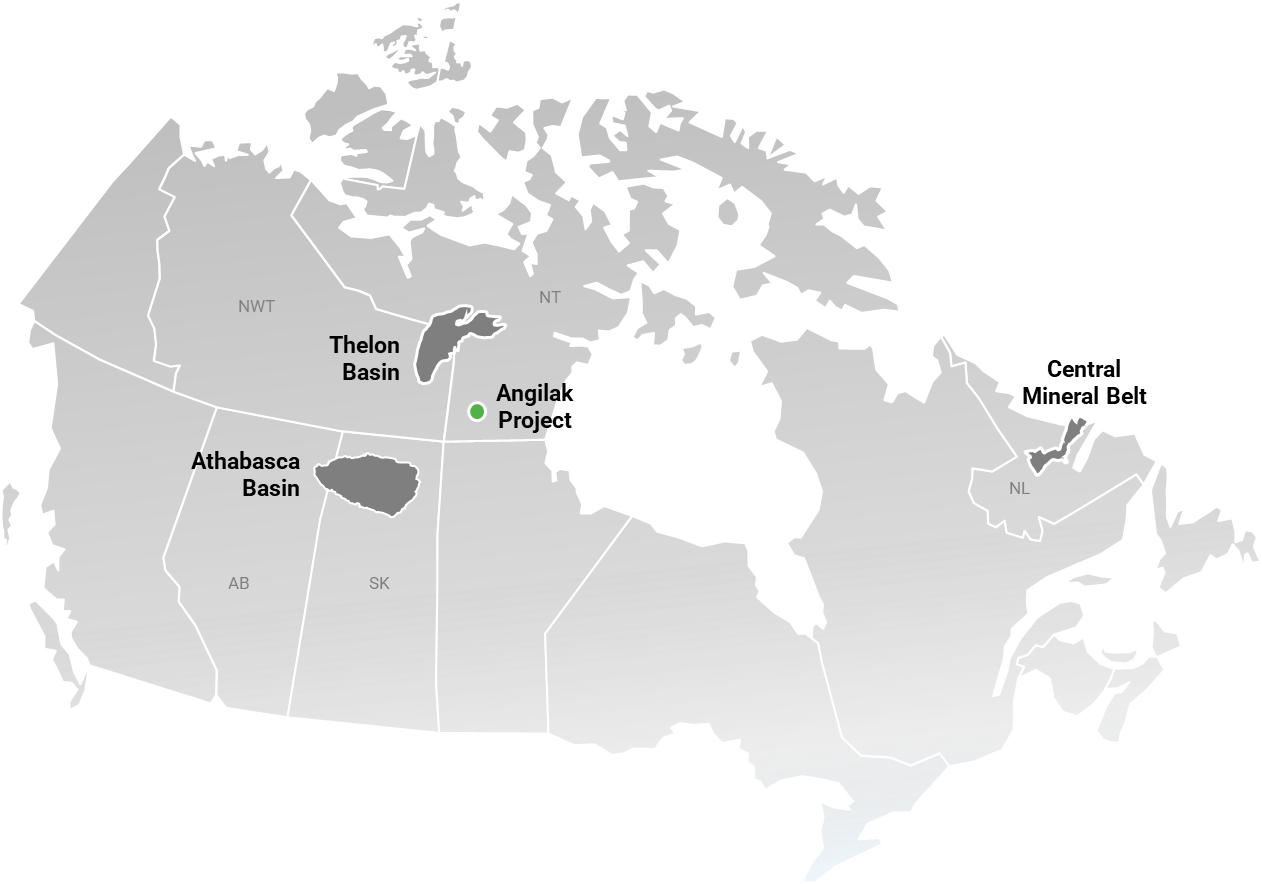
ATHA Energy's Angilak Project in Nunavut, Canada represents one of the more significant uranium exploration programs currently underway outside the Athabasca Basin. The project's scale and geological setting position it as a potential contributor to Western uranium supply chains.
Geological Context: The Angikuni Basin
The Angikuni Basin, situated within the broader Thelon regional setting, occupies an increasingly prominent position within Canada's uranium landscape. While the Athabasca Basin dominates production, the Angikuni/Thelon region has long been recognized by geologists as hosting similar unconformity-related uranium potential.
The geological architecture at Angilak features graphitic shear zones and structural corridors that serve as conduits for uranium-bearing fluids. These features, analogous to structures hosting major deposits in the Athabasca, provide the geological rationale for ATHA's district-scale exploration thesis.
The Mineralized RIB Corridor
The Mineralized RIB Corridor extends over 12 kilometers and is defined by stacked graphitic shear zones confirmed to host uranium mineralization at multiple locations. ATHA's technical team has deployed modern discovery tools including 3D electromagnetic inversion modeling and magnetotelluric surveys to refine targeting before drilling.
This corridor-scale approach fundamentally changes exploration risk profiles. Rather than testing isolated geophysical anomalies, ATHA is systematically evaluating a continuous mineralizing system where success at one location increases confidence in adjacent targets.
Cliff Revering, Vice President of Exploration, emphasizes the significance of these results:
"Uranium mineralization encountered to date, spanning a 12 km structural corridor, speaks for itself."
Interpreting the Drill Results: Why 100% Success Matters
Exploration results merit examination not for individual intercepts alone, but for what they collectively indicate about system scale and continuity. ATHA's RIB Corridor results demonstrate consistent mineralization across the entire tested strike length.
RIB East, West, North & South: Beyond Isolated Intercepts
The 2024-2025 drill campaigns delivered uranium mineralization in all holes tested along the RIB Corridor. Key results include hole RIBE-DD-003 at RIB East returning 5.55% U₃O₈ over 0.5 meters within a mineralized zone now defined over 750 meters of strike length. RIB West produced multiple intervals exceeding 1% U₃O₈ across a 2.2-kilometer strike extent. RIB North and RIB South represent additional discoveries that remain open for expansion, with RIB South currently defined by one diamond drillhole.
The 100% success rate, defined as all holes intersecting uranium mineralization, carries statistical significance beyond promotional value. In uranium exploration, where drill programs routinely encounter barren holes, consistent mineralization across multiple kilometers suggests a robust mineralizing system.
Troy Boisjoli quantifies the district-scale nature of these discoveries:
"This is our fourth discovery in one single drill program within that Angikuni Basin. RIB in particular now has conductive corridors that are mineralized over 12 kilometers. We have not missed yet."
Mineralization Style & Economic Implications
The mineralization styles encountered at Angilak include basement-hosted, sandstone-hosted, and unconformity-related occurrences. Recent drilling returned 34.7 m of total composite uranium mineralization1, including 13.6 m grading 0.53% U₃O₈, 1.1 m grading 4.81% U₃O₈, and grades up to 8.16% U₃O₈ over 0.5 m.
Troy Boisjoli draws the comparison to established uranium districts:
"This is an Athabasca-style intersection both in terms of thickness and grade that we're seeing in the Angikuni Basin... We're seeing grades and thicknesses analogous to the Athabasca Basin style mineralization, which was our thesis the whole time."
Important caveats apply: no mineral resource has been defined, and significant technical work remains before economic parameters can be established. However, geological confidence built through systematic drilling reduces exploration risk and supports continued investment in delineation.
Exploration Strategy & Capital Efficiency
The uranium sector has witnessed a broader shift toward data-driven exploration, with companies deploying geophysical and geochemical tools to improve targeting precision before committing drill capital. ATHA's approach exemplifies this discipline.
Targeted Tools Over Blind Drilling
Integration of electromagnetic surveys, magnetotelluric imaging, and structural interpretation has allowed ATHA to prioritize targets with the highest probability of success. The technical team's expertise underpins this approach. Cliff Revering previously served as chief geologist at Cameco's Cigar Lake operation, one of the world's highest-grade uranium mines.
Troy Boisjoli acknowledges the team's role in de-risking exploration:
"The EM inversion model has given us a high precision geophysical model which has guided our targeting... The correlation between that model and mineralization has been very, very strong within the RIB area."
Funding, Scale & Optionality
ATHA's fully funded 10,000-meter summer 2025 drill program allowed systematic advancement across multiple targets. The company completed 46 holes across the Lac 50 Deposit and RIB-Nine Iron trends during the 2024 and 2025 drill campaigns, with recent assay results covering twelve drillholes from the Mineralized RIB Corridor.
Additionally, ATHA holds a 10% carried interest in key Athabasca Basin exploration projects operated by NexGen Energy Ltd. and IsoEnergy Ltd., located near actively developed areas including Triple R, Arrow, Spitfire, and Centennial deposits. This provides non-dilutive exposure to discoveries in that prolific district.
Jurisdictional Advantage in a Fragmenting Uranium Market
Uranium's transition from commodity to strategic input has elevated jurisdictional considerations from secondary factors to primary valuation drivers.
Canada's Role in Western Uranium Supply Chains
Canada ranks among the world's established uranium producers, with Saskatchewan hosting the Athabasca Basin's high-grade deposits. Nunavut offers similar regulatory frameworks with established permitting pathways for mineral development.
Both regions benefit from inclusion within allied supply frameworks that utilities and governments are constructing to diversify sources. This creates structural demand for Canadian uranium that extends beyond spot market dynamics.
Near-Term Catalysts & What Investors Will Be Watching
Exploration narratives require continuous validation through results. ATHA's near-term catalyst calendar provides multiple opportunities for market reassessment.
Pending Assays & Target Expansion
The company anticipates disclosing all remaining assay results in the coming weeks from the KU Discovery, Mushroom Lake, and Lac 50 Deposit area. Each positive result incrementally reduces geological risk and supports higher valuations.
2026 Programs: Defining the System
Additional MMT surveys paired with 3D EM Inversion modeling is planned for 2026, designed to unlock and define the true scale of the Mineralized RIB Corridor and the Angikuni Basin.
Troy Boisjoli articulates the forward trajectory:
"The objective here is not exploration for the sake of exploration. It's exploration for discovery's sake to move projects forward, to be extremely relevant in this cycle… Moving into delineation, infill, and project advancement is a natural progression based off of where we're at."
The Investment Thesis for Uranium
Uranium's investment case has evolved beyond cyclical price appreciation to encompass structural supply dynamics and geopolitical realignment.
- Structural supply deficits created by long-term underinvestment and extended contracting cycles favor discovery-driven re-ratings as utilities compete for secure supply.
- High-grade deposits historically deliver superior all-in sustaining cost and internal rate of return profiles, providing a cost hedge against inflationary pressures affecting lower-grade operations.
- Canadian jurisdiction offers geopolitical stability and regulatory predictability as uranium transitions from commodity to strategic input within Western energy security frameworks.
- District-scale discoveries provide asymmetric upside potential without the capital intensity and execution risk associated with development-stage projects.
- Early-stage exploration allows exposure to uranium fundamentals through multiple discovery options rather than single-asset dependency.
Why the RIB Corridor Matters for Uranium Investors
ATHA Energy's exploration success at Angilak follows a clear progression: systematic technical work identified prospective targets, disciplined drilling confirmed mineralization, and consistent results across four discoveries established district-scale potential. This sequence reduces geological risk while increasing relevance as the uranium market prioritizes supply security.
The RIB Corridor results do not represent a finished development story. Resource definition and economic studies lie ahead before ultimate value can be established. What the results provide is evidence that the Angikuni Basin hosts a mineralizing system of sufficient scale and grade to warrant serious evaluation.
TL;DR
ATHA Energy's systematic drilling at its Angilak Project in Nunavut has confirmed four uranium discoveries along a 12-kilometer Mineralized RIB Corridor, achieving a 100% success rate with grades up to 5.55% U₃O₈. These results arrive as the uranium market shifts from cyclical price speculation toward structural supply security, with utilities applying jurisdictional filters favoring Tier-1 regions like Canada. The discoveries demonstrate Athabasca-style mineralization in the underexplored Angikuni Basin. ATHA's fully funded 10,000-meter summer 2025 drill program and 10% carried interest in Athabasca Basin projects provide diversified exposure. While no mineral resource has been defined, consistent results across multiple kilometers reduce geological risk and support the district-scale thesis.
FAQs (AI-Generated)
A 100% success rate—meaning all holes intersected uranium mineralization—suggests a robust, continuous mineralizing system rather than isolated occurrences. This statistical consistency across 12 kilometers of strike length reduces exploration risk and supports the interpretation of district-scale potential.
Management describes the mineralization as "Athabasca-style" in terms of thickness and grade, with intercepts up to 8.16% U₃O₈. The geological architecture features similar unconformity-related characteristics, though no mineral resource has been defined and significant technical work remains.
Utilities and governments are applying jurisdictional filters that prioritize geopolitically stable regions. Canada's Tier-1 status provides regulatory predictability and inclusion within Western supply frameworks, creating structural demand beyond spot market dynamics.
Pending assay results from the KU Discovery, Mushroom Lake, and Lac 50 Deposit are expected in coming weeks. Additional MMT surveys and 3D EM Inversion modeling planned for 2026 will help define the true scale of the RIB Corridor system.
ATHA holds a 10% carried interest in key Athabasca Basin exploration projects operated by NexGen Energy and IsoEnergy, located near actively developed deposits including Triple R, Arrow, Spitfire, and Centennial. This provides non-dilutive exposure to that prolific district.
Analyst's Notes





Subscribe to Our Channel




.jpg)

Stay Informed