Before the Results Hit: Why ATHA Energy Deserves a Second Look Now



ATHA Energy holds 7M+ acres across Canada's top uranium basins, a district-scale Angilak discovery, and a 10% carried interest in two leading Basin developers at a C$269M EV.
- ATHA Energy controls Canada's largest uranium exploration land package - over 7 million acres across the Athabasca, Thelon, and Angikuni basins
- Its flagship Angilak Project in Nunavut hosts the Lac 50 Deposit plus a conceptual exploration target of 60.8M to 98.2M lbs U3O8 across a 31 km mineralized trend
- The company's 10% carried interest in key Basin developer lands provides embedded upside at zero exploration cost to ATHA
- As of February 26, 2026, ATHA's enterprise value stands at C$269M - a fraction of its developer peers in the same basin
- Over US$115M has been invested at Angilak to date, with 48 drill holes totalling more than 20,000 metres completed across the 2024–2025 programs
The Macro Backdrop: Why Uranium Is Now a National Security Asset
The uranium market no longer trades purely on industrial fundamentals. According to the U.S. Energy Information Administration (EIA), imports accounted for 99% of the U3O8 used in 2023 to make nuclear fuel in the United States - with just 0.05 million pounds of domestically produced material consumed against 32 million pounds of imported material. That number improved in 2024, but the structural dependency remains acute. Canada was the top foreign source in 2024, supplying 36% of total U.S. uranium deliveries, followed by Kazakhstan at 24% and Australia at 17%.
Globally, the nuclear fleet continues to expand. According to the World Nuclear Association's 2025 Performance Report, there were 440 operable reactors at the end of 2024, with a combined installed capacity of 398 GWe - a record. A further 70 reactors are under construction worldwide. The IAEA projects that global nuclear capacity could reach between 561 GWe (low case) and 992 GWe (high case) by 2050, up from 377 GWe today . Reactors consumed approximately 68,900 metric tonnes of uranium in 2025 .
On the price side, uranium spot prices fluctuated between US$63.17 and US$83.33 per pound throughout 2025 . The long-term price indicator closed 2024 at US$82.00 per pound, up from US$72.00 at the start of that year. Supply constraints remain real: in 2024, worldwide uranium production met only 90% of global demand, with the remaining 10% drawn from stockpiles.
Company Overview: Designed for a Strategic Supply Cycle
ATHA Energy Corp. is a Canadian uranium exploration company listed on the TSX Venture Exchange under the ticker SASK, and cross-listed on the Frankfurt Exchange (X5U) and OTCQB (SASKF). With 346.3 million basic shares outstanding and a share price of C$0.89 as of February 26, 2026, the company's basic market capitalisation stands at C$308M with an enterprise value of C$269M.
The company's management team is its most underappreciated asset. CEO Troy Boisjoli and VP Exploration Cliff Revering carry backgrounds from leading uranium producers and developers - institutions that developed and operate some of the world's highest-grade uranium mines, including McArthur River, Cigar Lake, Eagle Point, and Arrow. Chairman Mike Castanho brings capital markets depth from senior investment banking roles, while SVP Business Development Ryan Gaffney has prior experience across multiple uranium-focused capital markets and research platforms.
Three analyst researchers cover the stock across independent research firms. That coverage breadth is notable for a junior explorer at this stage of development.
"ATHA delivered one of the largest exploration programs in the uranium sector in 2024 over one of the most comprehensive uranium exploration portfolios in Canada."
The Angilak Project: A District in the Making
The Angilak Project sits in the Angikuni and Yathkyed Basins of Nunavut, 100% owned by ATHA - a basin that the company describes as "a geological analogue to the Athabasca Basin in a friendly mining jurisdiction," citing Canadian Science Publishing research. That analogy matters: the Athabasca Basin produces uranium at an average mine grade of 16.36% U3O8 - the highest in the world, compared to 2.64% in Niger, 0.75% in Kazakhstan, and 0.06% in Australia (World Nuclear Association).
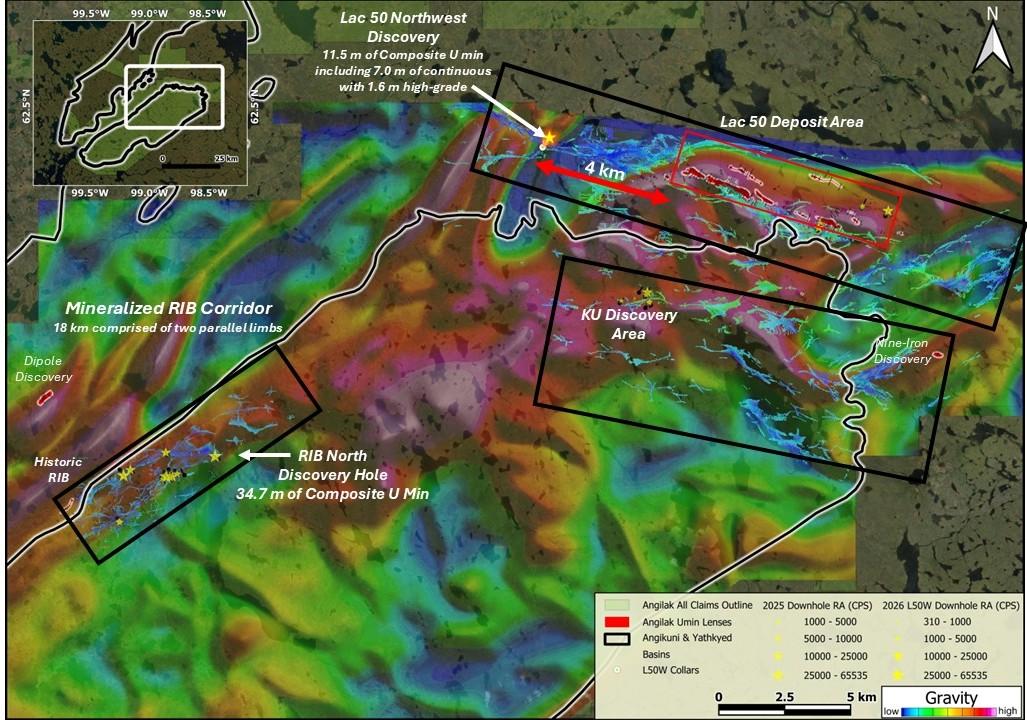
The 2024–2025 exploration programs were transformational. ATHA completed 48 diamond drill holes totalling more than 20,000 metres, achieving a 100% drill hit rate across the Lac 50 Corridor. The 2024 program identified three new parallel trends - Lac 48, 52, and 54 - and delivered grades up to 5.85% U3O8. In 2025, the company discovered the Mineralized RIB Corridor ("MRC") - an 18 km structure with four new discoveries (RIB North, East, West, South) across a 12 km strike, again with a 100% hit rate on every hole drilled. The standout intercept, drill hole RIBN-DD-001, returned a 34.7-metre composite interval including 0.5 metres grading 8.160% U3O8.
The Lac 50 conceptual exploration target currently stands at 60.8M to 98.2M lbs U3O8 at an average grade of 0.37% to 0.48% - with only approximately 24% of the Lac 50 Corridor drill-tested to date. The KU-Nine Iron Corridor extends 14 km from the KU Discovery to the Nine Iron area, with grades up to 1.56% U3O8 already intersected and multiple untested EM-defined targets remaining along trend.
"In addition to the Lac 50 Deposit, ATHA's 2024 program at its 100%-owned Angilak Project outlined a 31 km mineralized trend, with 2025 work confirming multiple new zones and supporting a potential district-scale uranium opportunity."
The Land Bank: 7 Million Acres No One Is Talking About
Beyond Angilak, ATHA holds 3.8 million acres within the Athabasca Basin - the largest individual land package in that jurisdiction, accumulated over more than 10 years by what the company describes as "the most successful uranium staking team in Canada." Add to that 3.1 million acres in Nunavut's Thelon Basin and 267,795 acres in Newfoundland and Labrador's Central Mineral Belt, and the total exploration footprint exceeds 7 million acres.
The Athabasca Basin holdings include four advanced, drill-ready targets. Zenith sits on a 29 km prospective structural corridor trending from established operating uranium mines in the region. Ridge has a 14 km trend of coincident ANT and gravity anomalies on strike from an advanced neighbouring uranium project. Pinnacle/Wares has a 12 km conductive trend with a historical intersection of 0.18% U3O8 at a depth of 202.9 metres at the unconformity. Gemini hosts the post-discovery GMZ mineralized zone. Saskatchewan was ranked 3rd globally for mining investment attractiveness by independent research in 2025, reinforcing the regulatory quality underpinning these land holdings.
In Labrador's Central Mineral Belt, ATHA's position sits adjacent to one of the largest uranium deposits in North America - the Michelin Project. ATHA also holds post-discovery Moran Lake and Anna Lake deposits in the region, providing near-term news flow potential independent of the flagship Angilak program.
"ATHA holds the largest exploration land position and has projects across the exploration risk curve in the Athabasca Basin."
Carried Interest: Free Exposure to the Sector's Best Operators
Perhaps ATHA's most overlooked asset is structural rather than geological. The company holds a 10% carried interest in key exploration lands operated by two of the Athabasca Basin's leading developers (combined enterprise value exceeding C$12.6B as at February 26, 2026). This means ATHA participates in any discovery upside on that ground without funding any of the associated exploration costs.
One partner alone announced 30,000 metres of drilling in the Athabasca region in 2024. ATHA's carried interest position is situated among the Basin's most actively developed areas, near operating mines with significant infrastructure already in place. As both developers advance programs that cost hundreds of millions of dollars annually, ATHA sits as a silent beneficiary of that activity.
Supply Deficit & Canadian Grade Premium
The supply side of the uranium equation remains structurally challenged. Years of underinvestment following the 2011 Fukushima accident led to mine closures and reduced exploration globally. New uranium mines typically require 7 to 15 years from discovery to production - meaning decisions made today determine supply availability well into the next decade. In 2024, global uranium production covered only 90% of reactor demand, with the remaining 10% drawn from existing stockpiles.
Canada's geological advantage is decisive in this environment. The Athabasca Basin's average mine grade of 16.36% U3O8 is more than six times higher than Kazakhstan and over 270 times higher than Australia - a quality differential that translates directly into lower production costs and higher margins. The WNA reports that the Athabasca Basin has produced over 900 million lbs of U3O8 historically and holds known resources of 606,600 tonnes U3O8.
"The Athabasca Basin is the most advantageous production district due to its high grades."
The Investment Thesis for ATHA Energy
- ATHA's C$269M enterprise value trades at a steep discount to developer peers in the same basin, offering substantial re-rating potential as Angilak advances through the discovery curve
- The Lac 50 conceptual exploration target of 60.8M to 98.2M lbs U3O8 - with only 24% of the corridor drill-tested - provides a long runway of organic catalysts through the 2026 drilling season
- Investors in junior uranium explorers should prioritise companies with 2M+ acres of prospective land, active discovery programs, and proven management - ATHA satisfies all three criteria
- The 10% carried interest in two leading Basin developers gives ATHA embedded upside exposure to some of the sector's best-funded operators without any additional exploration cost burden
- Consider building a position ahead of 2026 drill results from the MRC and KU-Nine Iron Corridor, where multiple untested EM-defined targets remain across a combined 32 km of prospective trend
- Diversify uranium portfolio exposure across explorers and developers to capture both discovery-stage upside and near-term production leverage as global reactor demand continues to structurally expand
ATHA Energy occupies a rare position in the junior mining landscape: genuine district-scale discovery momentum, a multi-basin land position unmatched in Canada, institutional-quality technical leadership, and carried interest exposure to the sector's leading developers - all priced at an enterprise value below C$300M. The 2026 exploration season at Angilak is loaded with potential news flow across the MRC, KU-Nine Iron Corridor, and Lac 50 expansion - with only a fraction of the known trend yet drill-tested.
The macro context is equally supportive. Global nuclear capacity stood at 398 GWe at end-2024, with 70 reactors under construction and IAEA projections pointing to capacity potentially reaching 992 GWe by 2050. Uranium produced only 90% of 2024 reactor demand. The U.S. imported 99% of its nuclear fuel concentrate in 2023 and still sourced the vast majority from foreign suppliers in 2024. Canada, with the world's highest-grade uranium mines and a top-tier regulatory environment, is the single most important supplier to address that dependence.
For investors seeking leveraged exposure to the uranium supply thesis, the window to enter ATHA at current valuations may narrow considerably as 2026 drill results begin to flow.
TL;DR
ATHA Energy holds Canada's largest uranium land package, a district-scale Nunavut discovery with a 60.8M–98.2M lb U3O8 exploration target, and a 10% free-carry interest in two leading Basin developers - all at a C$269M enterprise value heading into a catalyst-heavy 2026 drilling program.
FAQs (AI-Generated)
As of February 26, 2026, ATHA's enterprise value is C$269M, with a basic market cap of C$308M at C$0.89 per share.
The conceptual exploration target is 60.8M to 98.2M lbs U3O8 at an average grade of 0.37% to 0.48%, though this has not yet been defined as a formal mineral resource under NI 43-101.
ATHA holds a 10% carried interest in key portions of land operated by two leading Basin developers, meaning it receives 10% of any discovery upside without funding the exploration costs.
Canada's Athabasca Basin mines produce at an average grade of 16.36% U3O8 - the highest in the world - which translates directly into lower production costs and more commercially robust projects.
Drill results from the expanded Angilak program targeting the MRC, KU-Nine Iron Corridor, and Lac 50 system expansion are the primary near-term catalysts for share price re-rating.
Analyst's Notes





Subscribe to Our Channel






Stay Informed