ATHA Energy Continues Exploration Success with C$63 Million Combined Raise for 2026 Drilling Program


ATHA Energy: 14km uranium discovery in Canada's Angikuni basin, 100% drill success, $63M funded, expanding to 3 rigs. Delineation phase amid 20-year best market.
- ATHA Energy has achieved 100% drill success across the Angikuni basin in Canada, with continuous mineralisation over 14km in the RIB corridor and 5km at Lac 50, far exceeding typical uranium deposit strike lengths of under 1km
- Company raised C$63 million including participation from Warren Gilman's QRC, providing multi-year runway to advance from discovery to resource delineation
- Scaling from two to three drill rigs represents largest exploration program to date, focused on proving continuity within discovered mineralised systems rather than greenfield exploration
- Best intercept shows 34m of mineralisation including 13m continuous at over 0.5% uranium with peak grades above 8%, comparable to Athabasca basin-style deposits
- CEO cites most constructive uranium market in 20 years, positioning company at inflection point with discovery risk addressed and capital deployed toward resource growth
ATHA Energy is entering a critical phase in its development as a uranium explorer, having transitioned from early-stage greenfield exploration to systematic resource delineation across Canada's Angikuni basin. In a recent interview, CEO Troy Boisjoli outlined how the company's exploration success has positioned it for accelerated growth in 2026, backed by C$63 million in capital and what he describes as the most favourable uranium market conditions in two decades.
District Scale Control Over the Angikuni Basin
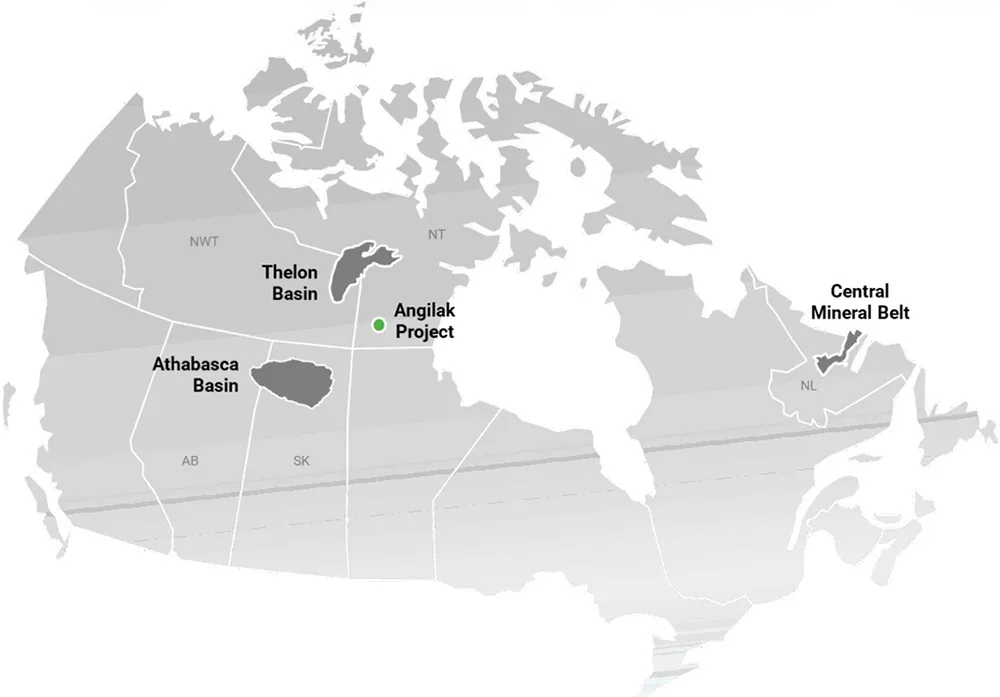
ATHA's position in the Angikuni basin originated with its acquisition of Latitude Uranium, which brought the Angilak project into the company's portfolio. At acquisition, the land package represented approximately one-third of the basin. Through subsequent staking and consolidation, ATHA has expanded its holdings to encompass the entire Angikuni basin, providing district-scale exploration potential comparable to more established uranium jurisdictions.
The strategic importance of this consolidation becomes clear when examining the company's exploration methodology. Rather than testing scattered targets across multiple projects, ATHA has focused its technical and capital resources on a single, coherent geological system. This approach has yielded exceptional drill success rates, with Boisjoli noting that the company has achieved 100% success on geophysical targets tested to date.
Exploration Results Establishing Discovery at Scale
The company's drilling campaigns delivered results that fundamentally altered its investment profile. In 2024, ATHA drilled 25 holes around the Lac 50 deposit, achieving a 25-for-25 success rate in expanding mineralisation in all directions. Simultaneously, the company advanced its basin-wide exploration thesis, leading to multiple discoveries in the KU and RIB areas during 2025.
The RIB corridor results warrant particular attention. Over a 14-kilometer strike length, ATHA drilled 13 holes contiguously, with every hole encountering mineralisation. Boisjoli emphasised the rarity of this outcome with the best intercept returning over 34 meters of mineralisation, including 13 meters of continuous mineralisation at grades exceeding 0.5% uranium and portions above 8% grade.
Evaluating the Metal Endowment Potential
To contextualise the results, Boisjoli drew direct comparisons to established deposits in Saskatchewan's prolific Athabasca basin. Major deposits like Cameco's Cigar Lake and NexGen's Arrow project feature strike lengths of approximately 900 meters to under one kilometer. In contrast, ATHA has identified continuous mineralisation over the RIB area alone, with recent geophysical surveys extending the Lac 50 corridor from the initial 5 kilometers of known mineralisation. Boisjoli explained the significance:
"We have mineralisation continuously in the RIB area over 14 km. When you expand out the geophysics that we've just recently completed, that corridor extends to 21 km."
This scale differential suggests the potential for a metal endowment significantly larger than typical uranium deposits, though the company remains in early-stage delineation with economic studies pending.
Interview with Troy Boisjoli, CEO of ATHA Energy Corp.
Deploying Capital for the Delineation Program
The company's recent financing activities reflect growing institutional confidence in the Angilak project. ATHA raised $25 million in its most recent round, complementing an earlier investment from Queen’s Road Capital Investment Ltd. (QRC), an entity associated with Warren Gilman, a uranium sector veteran with history at NexGen Energy. The combined $63 million financing provides what Boisjoli describes as "multi-year runway" to execute the company's technical program without near-term dilution pressure.
For 2026, ATHA is deploying three drill rigs simultaneously, up from two in previous years. This represents the largest exploration program in the company's history, with objectives focused on proving continuity within already-discovered mineralised systems rather than testing new greenfield targets. The strategy shift from discovery to delineation signals management's confidence that discovery risk has been adequately addressed and that capital deployment should now focus on resource growth and economic optimisation.
Nunavut's Regional Infrastructure Logistics
The Angikuni basin sits in the Nunavut territory, north of more established uranium districts. While the region lacks the infrastructure density of Saskatchewan's Athabasca basin, it is not without precedent for large-scale uranium development. Orano's Kiggavik deposit, located in the Thelon basin north of Angikuni, hosts approximately 133 million pounds of uranium, demonstrating that Nunavut's geology can support world-class deposits and that development pathways exist despite logistical challenges.
ATHA's basin consolidation strategy provides both exploration upside and potential operational advantages. Control of an entire geological system allows for integrated development planning and reduces the risk of competing claims fragmenting a mineral trend. However, infrastructure development costs in remote northern Canada is still substantial and will require careful economic modeling as projects advance toward feasibility.
The Investment Thesis for ATHA Energy
- Discovery risk is behind them. ATHA has achieved 100% drill success across every geophysical target tested in the Angikuni basin: 25 for 25 at Lac 50, 13 for 13 contiguously in the RIB corridor. For a junior uranium explorer, having the discovery question answered while still being pre-resource is an unusually de-risked entry point for investors.
- Scale that dwarfs comparable deposits. While stablished Athabasca basin deposits like Cigar Lake and Arrow have strike lengths of under 1km, ATHA has identified continuous mineralisation over 14km in the RIB corridor alone, with geophysics extending that corridor to 21km suggesting a metal endowment potential that could be a multiple of conventional uranium deposits in the region.
- High-grade intercepts confirm quality, not just scale. The best RIB intercept continuous above 0.5% uranium with peaks above 8% grades. Scale without grade is a common junior mining trap; ATHA is demonstrating both.
- District-scale control is a strategic moat. Having consolidated from one-third of the Angikuni basin at acquisition to 100% of the basin, ATHA holds an irreplaceable land position. No competing explorer can stake into the trend and the consolidation also allows for integrated development planning if projects advance toward feasibility.
- Capital secured, dilution risk reduced. With C$63 million raised including participation from Warren Gilman's QRC, the company has multi-year runway to execute its program. Investors are not buying into a company that needs to return to market imminently.
- The program is scaling at the right moment. Moving from two to three drill rigs in 2026 represents ATHA's largest exploration program to date. Critically, the focus is delineation of known mineralised systems rather than greenfield exploration making acapital-efficient strategy at the stage where discovery has already been validated.
- Near-term catalysts are built in. Active drilling across three rigs generates consistent news flow, with each result carrying the potential to extend mineralised strike or confirm continuity. For investors seeking re-rating events, the drill program is structured to deliver multiple data points throughout 2026.
- Institutional validation from a credible name. Warren Gilman's QRC participation is not a passive institutional tick-the-box investment. Gilman's association with NexGen, .one of the most successful uranium explorer stories of the last cycle lends sector-specific credibility to ATHA's thesis that the Angikuni basin can support a world-class deposit
Uranium Market Timing and Investment Rationale
Nuclear power, long politically marginalised in Western markets, has been rehabilitated as the only large-scale, dispatchable, low-carbon baseload energy source capable of meeting the electricity demands of an AI-driven, data centre-intensive economy. The United States, United Kingdom, France, Japan, and South Korea have all moved to extend reactor lifetimes and, in several cases, commission new builds. The tripling of global nuclear capacity by 2050 endorsed at COP28 by over 20 nations has shifted from aspiration to policy commitment, creating a decades-long demand floor that utilities are now scrambling to contract against.
The supply side tightness was crystallised in 2023 and early 2024 when uranium spot prices surged toward $100/lb for the first time in over a decade. While prices have moderated from peak levels, the medium-term outlook reflects a market where new supply cannot be brought online quickly enough to satisfy contracted demand growth, and where the incentive price required to bring new mines into production sits materially above current spot.
Boisjoli framed the investment opportunity in terms of both project-specific developments and broader market dynamics. On the project side, ATHA Energy sits at what he termed an inflection point: discovery risk addressed, capital secured, and drilling focused on resource growth. On the market side, he stated:
"We're at an inflection point in our business, well funded to be able to grow through critical milestones. We really like the trajectory we're on. This uranium market that we're heading into is the most constructive market I've seen in 20 years in the space."
This confluence of company-specific progress and favourable sector fundamentals creates the classic setup for junior explorer re-rating. With drill results serving as near-term catalysts and a multi-year exploration runway funded, ATHA has positioned itself to deliver news flow that could drive valuation expansion if mineralised trends prove continuous and economically viable.
TL;DR: Executive Summary
ATHA Energy has de-risked discovery across Canada's Anjukuni basin with 100% drill success, identifying continuous mineralisation over 14km in the RIB corridor and 21km geophysical potential at Lac 50 - multiples larger than typical uranium deposits under 1km strike. With $63 million funding and three rigs deployed in 2026, the company transitions from exploration to resource delineation at an inflection point, backed by high-grade intercepts (up to 8% uranium) and what CEO Troy Boisjoli calls the most constructive uranium market in 20 years.
FAQs (AI Generated)
The company has addressed discovery risk through 100% target success and now focuses on proving continuity within multiple mineralised corridors, requiring increased drilling capacity to advance delineation work simultaneously.
Major Athabasca basin deposits like Arrow and Cigar Lake have strike lengths under 1km. ATHA's 14km continuous mineralisation represents a magnitude larger scale, suggesting significantly higher metal endowment potential.
Best result shows 34m total mineralisation including 13m continuous at over 0.5% uranium with peak grades above 8%, comparable to high-grade Athabasca basin deposits in both grade and geological setting.
The region is remote Nunavut territory with limited infrastructure. However, nearby Orano's 127-million-pound Kiggavik deposit demonstrates precedent for developing large-scale projects despite logistical constraints in the region.
ATHA controls an entire basin with validated targeting methodology achieving 100% success, has shifted from discovery to delineation phase, and maintains exceptional scale potential across multiple mineralised corridors simultaneously.
Analyst's Notes





Subscribe to Our Channel






Stay Informed