Cabral Gold Increases Gold Resource to 3.5 Million Ounces, Targets Self-Funded 2027 PEA


Cabral Gold's drill-led update lifts Cuiú Cuiú to about 3.5 million ounces as heap leach cash funds a hard rock study targeted for 2027.
- Cabral Gold's updated Cuiú Cuiú resource totals 998,800 ounces Measured and Indicated and 2,512,900 ounces Inferred across 6 deposits.
- President & CEO Alan Carter said most of the resource growth came from drilling, even though the hard rock was reported at a stricter cut-off than in 2022.
- At a 1.00 grams per tonne cut-off, Cabral Gold's hard rock holds about 1.9 million ounces across the Indicated and Inferred categories, averaging about 2.3 grams per tonne.
- The company's Phase 1 heap leach mine is producing about 3,000 ounces a month, which Chief Executive Officer Alan Carter said removes the need for further dilution.
- Cabral Gold is targeting the end of the third quarter of 2027 for a preliminary economic assessment on its Phase 2 hard rock.
Cabral Gold Inc. (TSXV:CBR) has lifted the resource at its Cuiú Cuiú gold district in Pará State, Brazil, to 998,800 ounces in the Measured and Indicated (M&I) categories and 2,512,900 ounces Inferred. The estimate models 6 deposits, against 3 in the last hard rock estimate in 2022. It follows the company's first gold pour at its Phase 1 heap leach mine in September 2026.
Management attributes most of the increase to new drilling, and the hard rock was reported at a higher cut-off grade than in 2022. Phase 1 is now producing gold, and the company is using that cash to fund drilling and a preliminary economic assessment (PEA) on the hard rock, targeted for the end of the third quarter of 2027.
The oxide mine now operating covers only the weathered upper layer of the 6 deposits. The much larger body of primary rock below it is the subject of the 2027 study work.
Drilling Drove Resource Increase
VMG Consultoria e Soluções prepared the estimate independently under NI 43-101. M&I resources total 42.5 million tonnes (Mt) at 0.73 grams per tonne (g/t) gold, and Inferred resources total 82.1 Mt at 0.95 g/t. Those figures are 49% and 376% above the previous oxide and hard rock estimates combined. The estimate is based on 149,835 meters of drilling, including 604 holes for 46,118 meters completed since the 2022 estimate.
The resource pit shells use a long-term gold price of US$3,500 per ounce, with the hard rock reported at a 0.35 g/t cut-off. President and Chief Executive Officer of Cabral Gold, Alan Carter, said most of the growth came from additional drilling, and that the company tightened the hard rock threshold even as the gold price rose:
"Even though the gold price has risen considerably, even with the pullback, it's double what it was four years ago, but we've been more conservative with our cutoff. So instead of using a 0.26 gram cutoff that we used four years ago, we used a 0.35 gram cutoff."
Cabral's sensitivity table gives the effect of a looser threshold. At a 0.25 g/t cut-off, the hard rock totals 793,800 ounces Indicated and 2,496,300 ounces Inferred, against 733,200 ounces and 2,302,000 ounces at the reported 0.35 g/t. The reported figure leaves those lower-grade ounces out.
Higher-Grade Hard Rock Beneath the Oxide Mine
The primary, or hard rock, resource comprises 20.8 Mt at 1.09 g/t for 733,200 ounces Indicated and 65.4 Mt at 1.09 g/t for 2,302,000 ounces Inferred. Indicated hard rock ounces are up 63% on the 2022 estimate, and Inferred hard rock ounces are up 406%. Carter said about 86% of the roughly 3.5 million ounce district total is primary material. Central is the largest contributor at 43.6% of the hard rock ounces, followed by Jerimum Cima at 22.3% and MG at 15.3%.
Average grade understates the higher-grade core. At a 1.00 g/t cut-off inside the same pit shells, the hard rock holds 463,200 ounces Indicated at 2.32 g/t and 1,452,200 ounces Inferred at 2.37 g/t. At 2.00 g/t, it holds 308,300 ounces Indicated at 3.70 g/t and 922,000 ounces Inferred at 4.08 g/t. Carter described those grades as excellent for an open pit operation.
Interview with Alan Carter, President & CEO of Cabral Gold Inc.
Phase 1 Cash Flow Funds the District Without New Equity
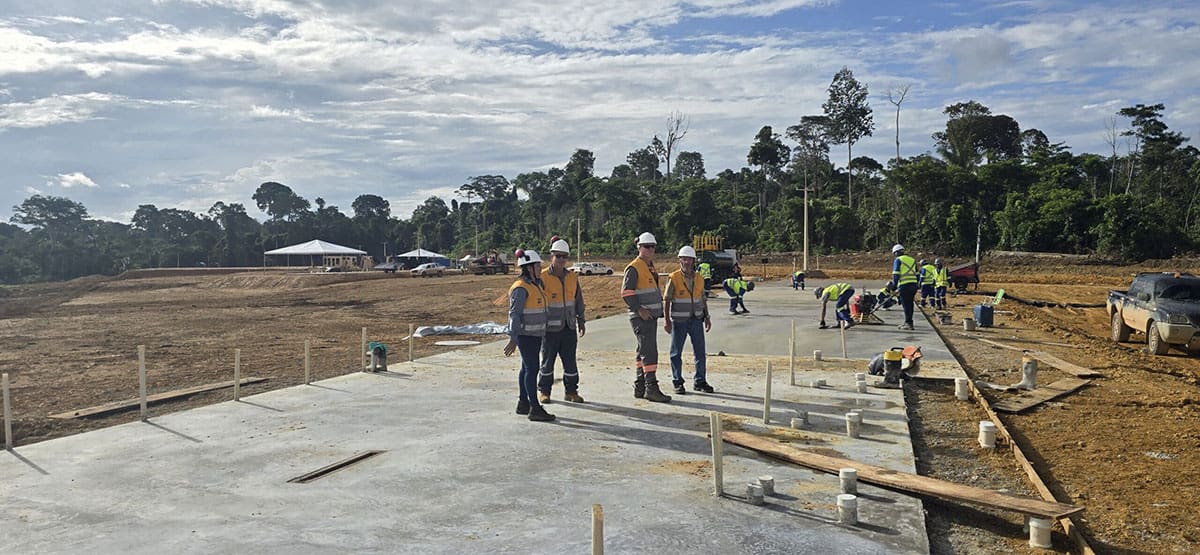
Phase 1 is a 3,000 tonne per day heap leach operation mining oxide saprolite at a rate of about 1 Mt per year. Cabral announced its first gold pour on September 10, 2026, and is targeting commercial production in the fourth quarter of 2026. Carter said the operation is producing about 3,000 ounces a month and that this cash flow makes the company self-funded, without a need to further dilute its capital structure. Cabral reported a cash position of C$68 million as of November 6, 2026.
The ore requires no drilling, blasting, crushing, or grinding. The July 2025 prefeasibility study (PFS) by Ausenco put all-in sustaining cost at US$1,210 per ounce in the first year at a US$2,500 per ounce base case. Carter noted some cost inflation from fuel prices since then. In the same study's sensitivity case at US$3,000 per ounce gold, the after-tax net present value at a 5% discount rate is US$112 million and the after-tax internal rate of return is 114%, on initial capital of US$37.7 million.
The oxide resource has also grown, to 265,600 ounces M&I at 0.38 g/t and 210,900 ounces Inferred at 0.39 g/t, increases of 21% and 190% in 16 months. Carter said the oxide now being fed to the plant is higher grade than the resource average. The company links the oxide growth to plans to expand the Phase 1 heap leach operation.
A Preliminary Economic Assessment by 2027
Phase 2 is the development of the hard rock beneath the oxide layer. Carter said the PEA is the step that will test the economics of that material:
"By the end of the third quarter of 2027, I'd like to have a PEA, and then that will give some visibility on what the viability is of that hard rock resource."
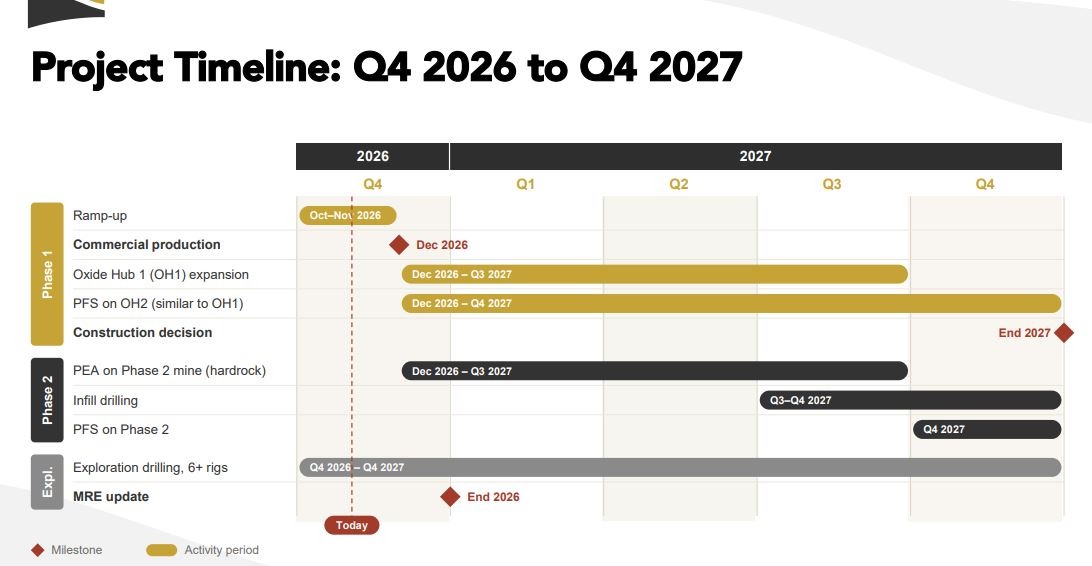
In Cabral's November 2026 project timeline, the PEA on the Phase 2 hard rock mine runs from December 2026 to the third quarter of 2027. Commercial production is scheduled for December 2026, and the first Phase 1 oxide hub expansion runs from December 2026 to the third quarter of 2027. Phase 2 infill drilling follows in the third and fourth quarters of 2027, with a PFS on Phase 2 in the fourth quarter of 2027.
Carter said 2027 will combine infill drilling to upgrade the Inferred ounces with continued exploration at full pace.
Open Deposits & More Than 50 Targets
The estimate covers the MG, Machichie, Central, Pau da Merenda, Jerimum Baixo, and Jerimum Cima deposits. All 6 remain open at depth, and Central, Pau da Merenda, Machichie, and Jerimum Cima remain open along strike. Morro da Lua, Machichie SW, and Central SE have returned economic drill intercepts but lack enough drilling for inclusion.
More than 50 peripheral targets with gold in reconnaissance drill holes, surface trenches, and boulder fields remain untested or partially tested across Cabral's 30,563 hectare land package, which it owns 100%. At the Alonso target, 24 surface samples of quartz vein float averaged 91.7 g/t gold, and the source of the boulders is unknown. The company ranks Cuiú Cuiú as the largest gold project in the Tapajós region and the second-largest undeveloped primary gold deposit in Brazil.
The Investment Thesis for Cabral Gold
- Cabral Gold has grown the Cuiú Cuiú resource to 998,800 ounces Measured and Indicated and 2,512,900 ounces Inferred across 6 deposits, mostly through drilling, according to management.
- The hard rock was reported at a higher cut-off grade than in 2022, even though the gold price has risen since then, which leaves lower-grade ounces out of the headline total.
- At a 1.00 grams per tonne cut-off, the hard rock holds 463,200 ounces Indicated at 2.32 grams per tonne and 1,452,200 ounces Inferred at 2.37 grams per tonne inside open pit shells.
- The Phase 1 heap leach mine is producing about 3,000 ounces a month and management states that this cash flow removes the need for further equity dilution.
- The preliminary economic assessment on the hard rock, targeted for the end of the third quarter of 2027, is the next test of whether Phase 2 can be developed economically.
- Watch the declaration of commercial production, the first gold loan repayment on March 2027, and infill drilling results that convert Inferred ounces into higher-confidence categories.
Cabral now pairs a producing oxide mine with a district resource that Carter puts at about 3.5 million ounces, up from about 1.2 million ounces. The 2027 study work will decide how much of that resource becomes a second mine.
Macro Thematic Analysis
Gold juniors fund exploration by selling shares, and the cost of that funding rises when share prices fall. A weaker gold price lowers share prices, so each dollar raised costs a larger share of the company. Carter described the funding problem facing explorers:
"I think the big worry for a lot of junior companies, particularly on the exploration side, is they've got to raise money. I know that very well. So you've got to keep coming back to the market. Share price is low, you're going to suffer a lot more dilution. We don't have to do that."
Cabral's response was a low-capital starter mine on the oxide layer that overlies all 6 deposits, with initial capital of US$37.7 million in the PFS. The PFS base case assumed US$2,500 per ounce gold, below the US$3,500 per ounce the new resource pits use, and Carter said gold remains about double its level of 4 years ago even after the recent pullback.
The Tapajós setting supports the district argument. According to Brazil's National Mining Agency, the province produced an estimated 30 million to 50 million ounces of placer gold between 1978 and 1995, and Cuiú Cuiú was the largest area of placer workings, at an estimated 2 million ounces. The new estimate defines resources in the same district, which Carter puts at about 3.5 million ounces. For a junior in production, a softer gold price lowers margins on each ounce sold. For an explorer without production, it raises the number of shares issued for each meter drilled.
TL;DR
Cabral Gold's updated Cuiú Cuiú estimate totals 998,800 ounces Measured and Indicated and 2,512,900 ounces Inferred across 6 deposits, and management attributes most of the growth to drilling. The hard rock was reported at a 0.35 grams per tonne (g/t) cut-off, which CEO Alan Carter said is stricter than the 2022 threshold. At a 1.00 g/t cut-off, the hard rock holds 463,200 ounces Indicated at 2.32 g/t. The Phase 1 heap leach mine is producing about 3,000 ounces a month, which Carter said removes the need for further dilution. A preliminary economic assessment on the hard rock is targeted for the end of the third quarter of 2027.
FAQs (AI-Generated)
Analyst's Notes





Subscribe to Our Channel






Stay Informed