




Scotia Metals Drills Ahead of Schedule at Acadia & Eyes Low-Cost Lithium Option in Brazil


Scotia Metals has started scout drilling at Green Wolf in Nova Scotia and optioned Brazil's Nordestina lithium project for US$10,000 a month.
- Scotia Metals started a 6-hole, roughly 1,000-meter scout drill programme at Green Wolf in November 2026, about 2 months ahead of its plan.
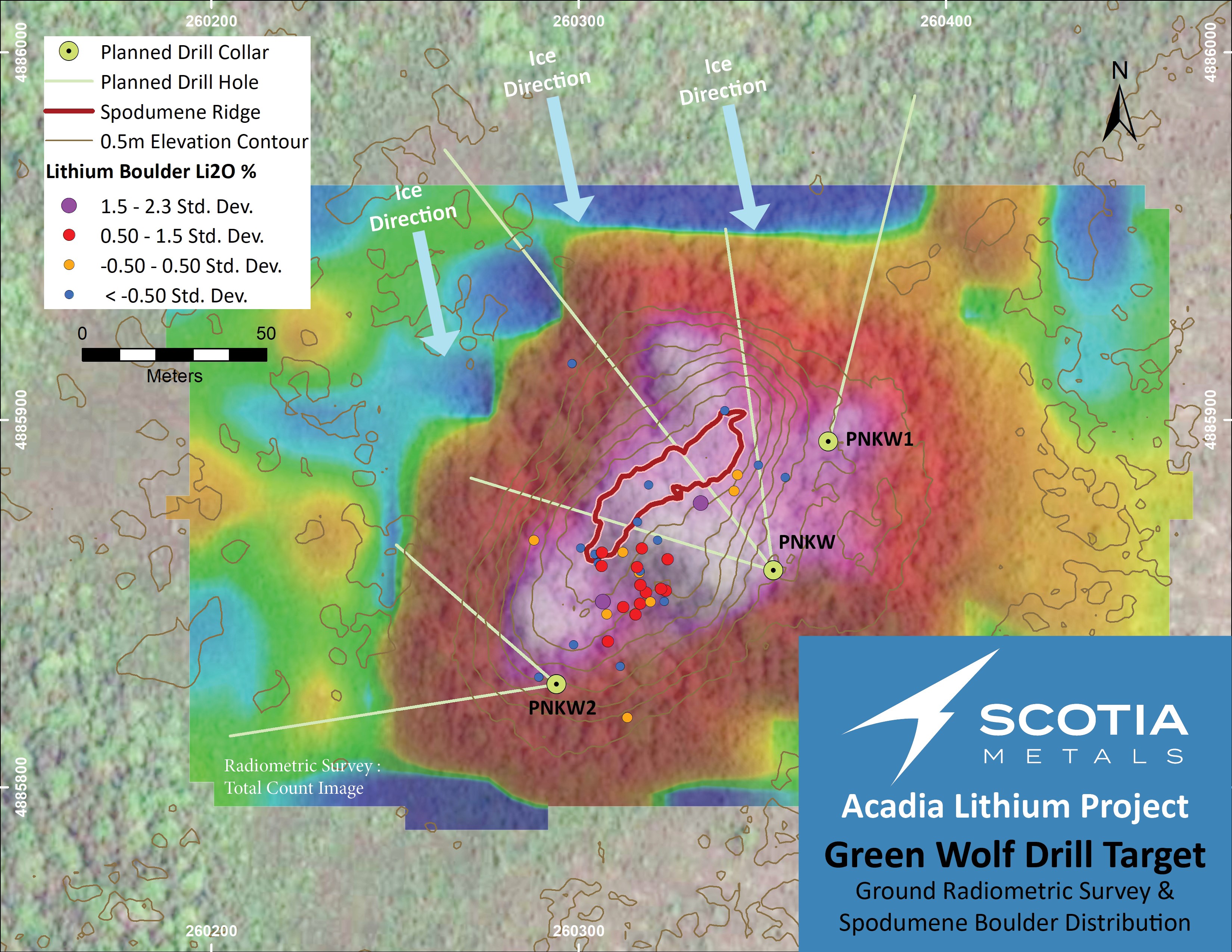
- The drilling tests whether a high-grade spodumene boulder cluster, with channel samples up to 2.72% lithium oxide, comes from a bedrock pegmatite beneath a nearby ridge.
- The company is targeting a December core update, with assays to follow and a full-property programme toward the end of the first quarter of 2027.
- Scotia optioned the Nordestina lithium project in Brazil for US$10,000 per month, with a US$2.0 million exercise price due by May 2028, subject to approvals.
- Management plans to fund near-term work from cash and warrants and to defer a raise to around mid-2027, once results are in hand.
Scotia Metals (CSE:SMET) has moved its Acadia Lithium Project in Nova Scotia from surface work to drilling. In early November 2026, the company started a maiden scout programme of about 1,000 meters (m) across 6 holes at the Green Wolf target, where spodumene boulders have returned historical grades of up to 3.40% lithium oxide. A week later, it announced an option over the Nordestina Lithium Project in Bahia State, Brazil, adding a second hard-rock lithium target for US$10,000 per month.
Both moves come as spodumene prices recover from the 2023 to 2024 collapse and critical-mineral policy pushes lithium supply chains onshore in North America. For a company with no resource yet, the Green Wolf drill results will set the direction for 2027.
Maiden Drilling at Green Wolf Ahead of Schedule
Green Wolf lies in the southern part of the Acadia property. Scotia spent the summer field season on till sampling, geophysics and ground preparation there, then began drilling about 2 months ahead of the early-2027 start in its original plan.
Chief Executive Officer (CEO) of Scotia Metals, Rodrigo Roso, said the programme has a narrow objective:
"Success for us is finding one or more pegmatites within our 6 holes that we're programming, and if we start hitting, maybe we expand a little bit further [...] We will be between 1,000 and 1,500 meters and then set back and organize a full-fledged programme"
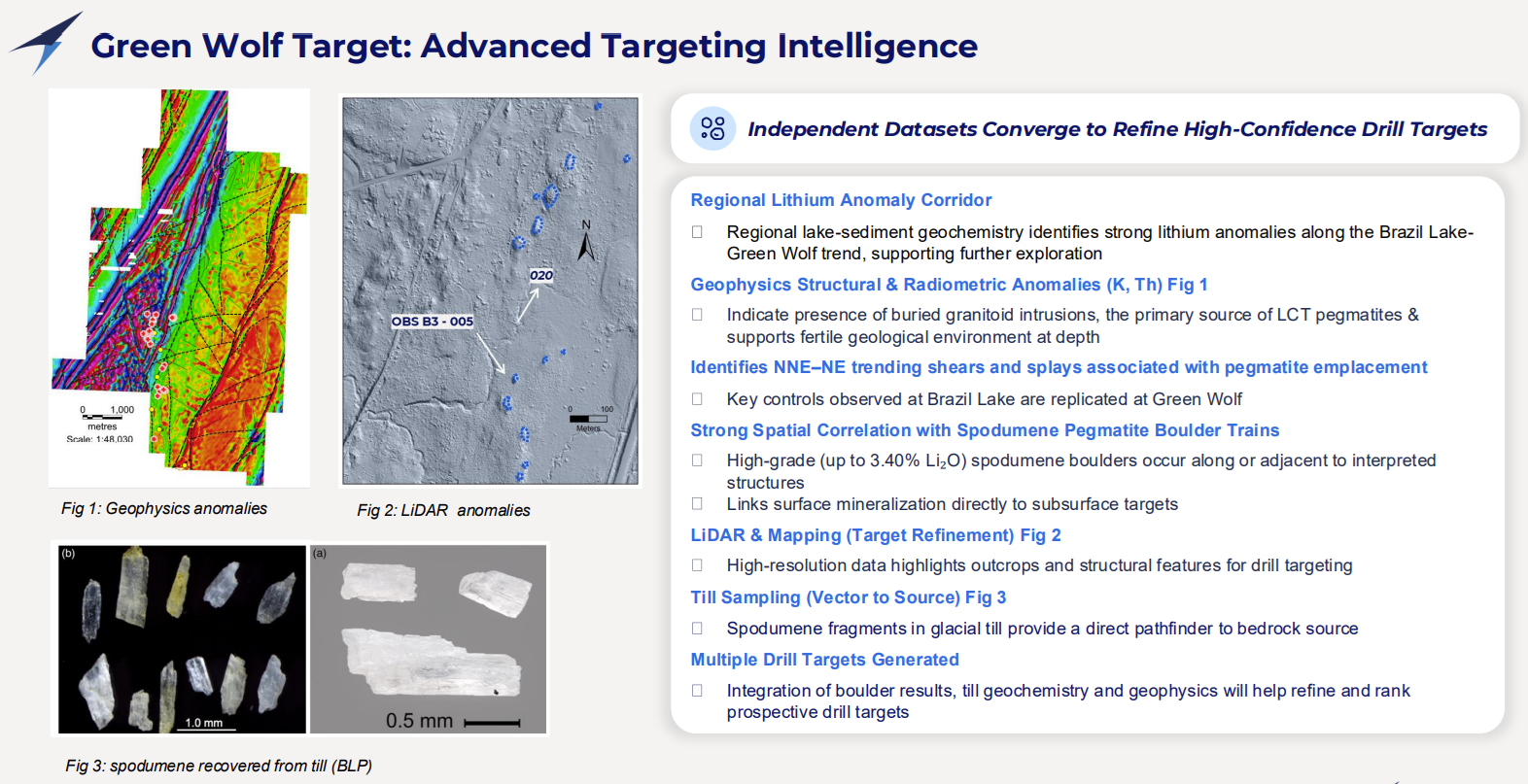
The holes target a ridge at the up-ice end of a dense boulder cluster. The boulder train stops at the ridge, glacial flow points toward it, and some large boulders on the ridge may be outcrop. Roso said a radiometric anomaly and a fault run along the same feature, which he compared with the setting at the neighbouring Brazil Lake deposit. Holes are planned on both sides of the ridge to reach the bedrock source.
Channel sampling of 38 boulders in the cluster returned 20 samples above 1.0% lithium oxide, with a high of 2.72%. Roso said total drilling will land between 1,000 m and 1,500 m, with a visual update from the core targeted for December and assays to follow. A hit would feed a full-property drill programme that the company is targeting to start toward the end of the first quarter of 2027.
Scale & Infrastructure Shape the Acadia Case
Scotia holds 43 exploration licenses covering 37,268 hectares (ha), the largest lithium land position in Nova Scotia, along more than 80 kilometers (km) of prospective strike. Roso said summer work found anomalies at many locations across the package. The Brazil Lake deposit, owned by Champlain Mineral Ventures, lies directly south of Green Wolf and hosts 10.0 million tonnes at 1.20% lithium oxide under JORC.
Roso named infrastructure as the main difference between Acadia and other North American lithium projects. A deep-water port at Shelburne is a 1-hour drive from the project, paved roads reach the drill areas, and power lines and water are available. He said the team's mine-building experience across several jurisdictions supports its view that a deposit found here would be cost-competitive because of that access.
Interview with Rodrigo Roso, Director & CEO of Scotia Metals
Nordestina Adds a Low-Cost Brazilian Option
Scotia signed an option to acquire 100% of Nordestina, 9 mineral permits covering 16,566 ha in northeastern Bahia. Mapping identified suspected spodumene at 100 locations along a corridor of about 3.3 km by 1.4 km, alongside lepidolite and pollucite, a cesium mineral. A historic artisanal pit exposes all 3 minerals. Roso said the geological setting resembles the one that hosts the Bikita and Tanco pegmatites. The identifications are visual and preliminary, pending laboratory confirmation.
The option costs US$10,000 per month, which is not credited toward the price. Scotia can exercise it for US$2.0 million in cash at its discretion up to May 31, 2028, with no work commitment. The agreement is not yet complete: it remains subject to Brazilian permit transfer approval and Canadian Securities Exchange acceptance. Assays from 1,355 soil and rock samples are expected from late November 2026, subject to laboratory capacity.
Roso said the first test is whether the outcrops form a single pegmatite system, and that the project should be drill-ready early in 2027. He called the option an opportunistic, low-cost bet that would pay off heavily if it works. Nordestina will be funded separately from the flow-through money committed to Acadia, he said.
Funding Plan & Share Register
Roso said Scotia has cash in the bank and enough to start drill programmes at both projects at the same time, with drilling in Brazil cheaper than in North America. He said outstanding warrants would bring in about $1.5 million before any raise, and the company is working to accelerate their exercise.
Roso states general and administrative costs are low, so most spending goes into the ground. He said a raise could come around mid-2027, possibly earlier if markets and results allow, and the company does not plan to go to market before it has results. The board and its associated backers hold a little under 50% of the shares, rising to close to 90% when groups that typically back the same team are included.
A Team With Lithium Build Experience
Roso said investors are buying the team first, citing its record of building lithium mines in Australia, Brazil, Canada and Argentina. Chairman Brian Talbot was Head of Operations and CEO at Galaxy Resources and Allkem Lithium, and led implementation of Sigma Lithium's Grota do Cirilo and Lithium Ionic's Bandeira projects. Director Nick Rowley was Director of Corporate Development at Galaxy Resources and had a role in the US$6 billion Galaxy-Orocobre merger that formed Allkem.
Vice President Exploration James Abson has worked on large lithium systems including Bikita. On the capital markets side, Director Darryl Cardey co-founded K92 Mining, Northern Empire and Underworld Resources, and Director Shawn Khunkhun is a former CEO of Dolly Varden Silver. The presentation credits the group with more than C$9 billion in shareholder value creation.
The Investment Thesis for Scotia Metals
- The 6-hole scout drilling at Green Wolf, started in November 2026, is the first test of whether the spodumene boulder field has a bedrock pegmatite source.
- Monitor the December core update and the assays that follow, because a pegmatite intersection would support the full-property drill programme targeted for the end of the first quarter of 2027.
- The 37,268-hectare Acadia package lies along strike from the third-party Brazil Lake deposit, which hosts 10.0 million tonnes at 1.20% lithium oxide.
- A deep-water port 1 hour away, paved roads, power lines and water give Acadia the infrastructure that Roso cited as its main difference from other North American lithium projects.
- Nordestina gives shareholders a Brazilian spodumene target for US$10,000 per month, with first assays expected from late November 2026 and an exercise decision due by May 31, 2028.
- Warrant proceeds of about $1.5 million and a tightly held register support management's plan to defer a raise until results are in hand.
The thesis is a drill-test story. Scotia has funded 2 early-stage lithium projects with modest cash commitments, and the first meaningful data from each are due within weeks.
Macro Thematic Analysis
Roso argued that lithium price swings are narrowing as the market matures. He described lithium as a young market next to copper, and said spodumene concentrate prices of about US$1,200 per tonne still support attractive economics for North American projects. He said demand has grown at a compound annual rate of 13% to 15% for 15 years, and that he is bullish on the market through the end of 2027 and into 2028. The Fastmarkets forecast cited in Scotia's presentation points to a near-term surplus through 2027 to 2028 of less than 1% of demand, with deficits returning from 2029 and reaching about 100,000 tonnes of lithium carbonate equivalent by 2030. Energy storage for grid and data-center use is growing alongside electric vehicles. The presentation also notes that new hard-rock supply takes years to bring online.
Scotia is running 2 strategies. Roso said Nova Scotia's government has been supportive of Acadia, and he sees a downstream partner as its route to market:
"It's a beautiful project for this North America supply chain construction. My view of the future is that we'll partner up this project with some downstreamer in the North America space to build a true North America supply chain for lithium."
Brazil is the cost lever. Roso said Brazil is a proven lithium jurisdiction with lower production costs and faster permitting than North America, and that the team knows those costs from its earlier work on Brazilian projects. The company's OTCQB listing release cites a Benchmark Mineral Intelligence projection that North America's share of global mined lithium supply will rise from 1.7% to 13% by 2050. Scotia holds a project tied to each route.
TL;DR
Scotia Metals has started a 6-hole, roughly 1,000-meter scout drill programme at the Green Wolf target on its Acadia Lithium Project in Nova Scotia. The programme tests whether spodumene boulders grading up to 3.40% lithium oxide come from a nearby bedrock pegmatite. The company is targeting a visual core update in December, with assays to follow and a full-property programme toward the end of the first quarter of 2027. Separately, Scotia optioned the Nordestina project in Brazil for US$10,000 per month, with a US$2.0 million exercise price due by May 31, 2028. Management plans to defer any equity raise until results are in hand.
FAQs (AI-Generated)
Analyst's Notes





Subscribe to Our Channel



Stay Informed


