




Cabral Gold's Construction Progress at Cuiú Cuiú Shifts Valuation From Exploration Risk to Cash-Flow Optionality



Cabral Gold's Cuiú Cuiú construction signals shift from explorer to producer with US$1,210/oz AISC, non-dilutive financing, and Q4 2026 production target.
- Cabral Gold's construction progress at Cuiú Cuiú marks a transition from speculative explorer to near-term producer, reducing execution and financing risk for investors evaluating late-cycle gold equities.
- On-schedule delivery of the Phase 1 oxide heap leach project anchors valuation to cash flow rather than exploration optionality, a critical distinction in a tightening capital market where developers face heightened scrutiny.
- The project's US$1,210/oz all-in sustaining cost and 78% after-tax internal rate of return strengthen leverage to gold prices while insulating downside risk through rapid payback economics.
- Ongoing hard-rock drilling funded by anticipated oxide cash flow creates a self-financing growth model, a structural rarity among junior developers that typically rely on repeated equity dilution.
- For investors, Cuiú Cuiú represents a case study in how execution discipline combined with staged development can unlock district-scale upside without compressing per-share value through capital structure expansion.
Execution Credibility as a Valuation Driver in Gold Equities
Late-cycle gold markets have increasingly rewarded execution certainty over resource expansion. Capital scarcity across the junior development sector has raised the cost of delays, construction overruns, and financing missteps. Developers demonstrating tangible infrastructure progress now command lower risk discounts in net asset value models compared to peers still navigating permitting or financing uncertainty.
The Disconnect Between Bullion Prices & Equity Performance
Despite elevated gold prices, a meaningful disconnect persists between bullion performance and junior equity valuations. Institutional investors have rotated toward companies with near-term cash flow visibility, treating construction milestones as signals of management credibility and balance sheet control. In this environment, schedule adherence communicates more than additional resource ounces about a company's ability to deliver shareholder value.
Alan Carter, President and Chief Executive Officer of Cabral Gold, addressed the company's development timeline:
"We're anticipating commissioning in Q3 of 2026 and commercial production in Q4… We recently raised $45 million US through a gold loan… We should be producing gold in the fourth quarter of 2026. "
Cuiú Cuiú's Phased Development Approach
The Phase 1 oxide project at Cuiú Cuiú exemplifies the capital-efficient starter pit model that has gained traction among developers seeking to de-risk larger systems. Heap leach processing of near-surface oxide material provides a lower-risk entry point to production, generating early cash flows while minimizing upfront capital intensity. The Updated Pre-Feasibility Study, with an effective date of July 29, 2025, outlines an after-tax NPV of US$73.9 million at a US$2,500/oz gold price assumption, rising to US$138 million at spot prices of US$3,340/oz.
Oxide Material Characteristics & Operational Implications
Free-digging oxide deposits offer distinct advantages for project economics and schedule certainty. Material that requires no drilling or blasting reduces both operating costs and execution complexity during the critical construction-to-commissioning transition. At Cuiú Cuiú, deep weathering profiles create a substantial oxide inventory that supports the initial production phase.
Alan Carter outlined the geological foundation underpinning the staged strategy:
"Gold deposits that we have found at Cuiú Cuiú are very deeply weathered and they're weathered down to about 60 meters on average. That means there's a lot of material there which is free digging."
Construction Progress & Infrastructure Development
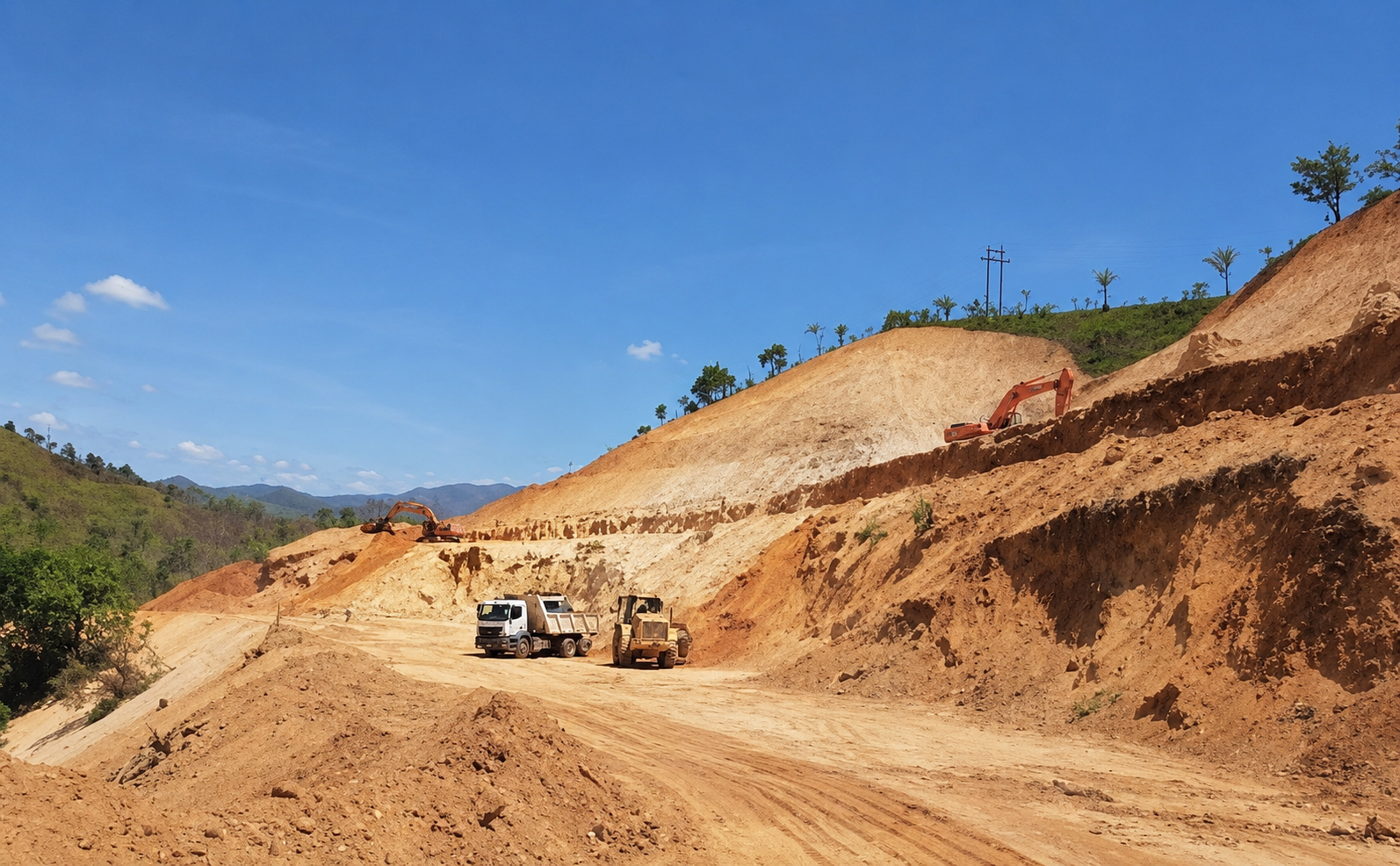
As of December 2025, tangible construction activity provides investors with observable signals of schedule confidence. Engineering completion stands at 26%, while procurement has reached 65% by value. Critical infrastructure milestones have been achieved, including completion of all access road upgrades, installation of 10 new bridges, and commissioning of the concrete batch plant.
Alan Carter provided specifics on construction momentum:
"We have 143 people now working on the construction, currently building this thing. We have probably closer to 80 people on the exploration front… We have 50 pieces of heavy equipment moving around. There are buildings andifferent parts of the plant going up."
Project Economics & Margin Structure
Evaluating internal rate of return and net present value requires context regarding execution risk. The 78% after-tax IRR becomes meaningful when construction and operational risks are demonstrably controlled through milestone achievement. The project's pre-production capital expenditure of US$37.70 million, fully covered by the gold loan facility, positions Cuiú Cuiú for commissioning without additional financing requirements.
Cost Positioning Relative to Global Benchmarks
The US$1,210/oz life-of-mine all-in sustaining cost positions Cuiú Cuiú competitively on the global cost curve. Operations in the lower quartile maintain margin durability even during price corrections, while higher-cost producers face compression that can eliminate profitability entirely. The oxide heap leach approach generates lower operating costs than conventional milling of sulphide material, creating a cost structure differential that affects how investors should model longer-term district development.
Schedule risk represents a primary concern for any development-stage project. Management reports the project remains on track and on budget since the positive construction decision in mid-October 2025.
Alan Carter acknowledged the execution challenge directly:
"The main risk here is keeping to schedule... It is an aggressive schedule. As I said, currently we're on track."
Non-Dilutive Financing & Capital Structure Preservation
The financing model employed to fund construction carries significant implications for per-share value creation. Repeated equity raises during development compress enterprise value per ounce and reduce upside participation for existing shareholders. Markets increasingly penalize the "drill now, finance later" model that characterized earlier cycles.
Gold Loan Structure & Implications
The US$45 million gold loan, which closed on November 26, 2025, represents a departure from conventional equity financing. Provided by the Precious Metals Yield Fund, an affiliate of Phoenix Gold Fund (Cabral's largest institutional shareholder), the facility carries a 39-month term with a 10% interest rate paid quarterly. Principal payments of 39 kilograms of gold per quarter commence on March 31, 2027, aligning repayment with anticipated production cash flows.
Alan Carter emphasized the strategic rationale:
"It was a gold loan. We borrowed $45 million US in gold and we'll have to repay that with interest, there was no equity raise as part of that, which I think surprised a lot of people... The best way to fund all that work that needs to be done is not by continually diluting the capital structure and doing private placement after private placement and ending up with a massive number of shares issued and outstanding."
The Self-Funding Exploration Model
Generating operating cash flow from oxide production to fund ongoing exploration represents structural optionality that most junior developers cannot replicate. Internal funding for drilling programs eliminates the equity financing cycle that typically accompanies resource expansion, allowing per-share net asset value to grow without offsetting dilution.
Alan Carter articulated the integrated strategy:
"Start with a relatively modest stage one operation to mine the oxides and use that cash to fund the drilling of the much larger hard rock resources. That's the strategy, that's the plan... Unlike a lot of other developers, we are going to keep exploring aggressively during the build here."
District-Scale Potential & Hard-Rock Systems
The oxide starter operation represents the initial phase of a larger district opportunity. Underlying primary mineralization, not subject to the Phase 1 mine plan, constitutes the longer-term resource target.
The Central-PDM Structural Corridor
Recent geological work has identified structural continuity between established deposits, expanding the prospective footprint. Fault-controlled mineralization along identified corridors suggests repeatability across a multi-kilometer trend.
Alan Carter described the emerging district-scale picture:
"The bigger prize at Cuiú Cuiú is the definition of this very large gold district that clearly contains multiple deposits... Hard rock resources aren't subject to this Phase 1 mine that we're building right now. That's the material that we're targeting... The PDM discovery is about 2 kilometers to the north of the Central gold deposit. We've always suspected these two were connected... It opens up that whole 2 kilometer intervening trend between Central and PDM. That's tremendously exciting."
Permitting Framework & Regulatory Pathway
Pará State represents an established mining jurisdiction, evidenced by its hosting of GMining's Tocantinzinho, Brazil's third-largest gold mine, which was commissioned in September 2024. The broader Tapajós region produced an estimated 30 to 50 million ounces of placer gold historically, establishing operational precedent and regulatory familiarity.
Licensing Status & Expansion Pathway
The project is advancing under trial mining licenses permitting production at 1,500 tonnes per day. The Updated PFS contemplates expansion to 3,000 tonnes per day, requiring transition to a full mining license. Public consultations completed in late 2025 recorded no formal opposition.
Alan Carter provided clarity on the regulatory timeline:
"We're developing this project under what's called trial mining licenses which will allow us to mine 1,500 tons a day. The PFS study that we released in July contemplates going to 3,000 tons a day. In order to make that jump, we need the full mining license in place… We had the public audience a few months ago. There's no opposition, we expect to get our full mining license in January."
The Investment Thesis for Cabral Gold
- Execution visibility reduces the discount rates applied to net asset value and future cash flow projections, as demonstrated by Cuiú Cuiú's 26% engineering completion and 65% procurement advancement.
- Low-cost oxide production at US$1,210/oz AISC provides downside protection through margin resilience and enables rapid capital payback.
- Self-funded exploration preserves per-share upside by eliminating the dilution cycle that accompanies equity-financed resource expansion.
- Phased development strategies improve capital efficiency by generating cash flow before committing to larger processing infrastructure.
- Jurisdictional positioning adjacent to operating mines supports regulatory pathway confidence and operational continuity.
- Non-dilutive financing through structured gold loans maintains capital structure integrity during the development phase.
How Cuiú Cuiú’s Construction Adds Value to the Conversation
Construction progress at Cuiú Cuiú represents more than a routine project update. For Cabral Gold, it signals a valuation inflection point as the company transitions from exploration-stage risk metrics toward production-stage fundamentals. The combination of non-dilutive financing from the Precious Metals Yield Fund, on-schedule construction, and a self-funding growth model positions the project distinctly within the junior development peer group.
For investors evaluating gold equities in an environment where capital remains selective, companies that convert development plans into physical infrastructure command differentiated consideration. The significance for Cuiú Cuiú lies not in resource ounces alone, but in the framework for how and when that value reaches shareholders.
TL;DR
Cabral Gold's Cuiú Cuiú project in Brazil is transitioning from exploration to near-term production, with commissioning expected in Q3 2026 and commercial production in Q4 2026. The Phase 1 oxide heap leach operation features competitive economics at US$1,210/oz all-in sustaining cost and 78% after-tax IRR. A US$45 million gold loan provides non-dilutive financing, preserving shareholder value. Construction stands at 26% engineering completion and 65% procurement by value, with 143 workers on site. The self-funding model allows oxide cash flow to finance hard-rock exploration without equity dilution, while district-scale potential along the Central-PDM corridor offers additional upside.
FAQs (AI-Generated)
Management anticipates commissioning in Q3 2026 and commercial production in Q4 2026. The project remains on track and on budget since the positive construction decision in mid-October 2025.
The Updated Pre-Feasibility Study outlines a life-of-mine all-in sustaining cost of US$1,210/oz, positioning the project competitively in the lower quartile of the global cost curve.
Cabral secured a US$45 million gold loan from the Precious Metals Yield Fund, an affiliate of Phoenix Gold Fund. The 39-month facility carries 10% interest with principal repayments aligned to production cash flows, avoiding share dilution.
Cash flow from oxide production will fund ongoing hard-rock drilling programs, eliminating the need for repeated equity raises that typically dilute shareholders during resource expansion.
Recent geological work identified structural continuity along a 2-kilometer trend between the Central deposit and PDM discovery, with underlying hard-rock mineralization representing a larger long-term resource target.
Analyst's Notes





Subscribe to Our Channel





Stay Informed






















