




China's Gold Appetite Fuels Case for Serabi Gold Investment



China added 1.24 tonnes of gold in Jan 2026, lifting reserves $50B. Serabi Gold, Brazil producer targeting 60koz by 2026, trades at discount with 22% FCF yield.
- China's central bank purchased gold for the 15th consecutive month, lifting reserves to 74.19 million fine troy ounces and their value to $369.58 billion, signaling sustained official-sector demand amid macro uncertainty.
- Gold prices surged near $5,600 per ounce before retreating to around $4,960, yet remain historically elevated, underpinning robust margins for producers with low all-in sustaining costs.
- Serabi Gold operates two high-grade underground mines in Brazil's Tapajós region, targeting 44,000 to 47,000 ounces in 2025 and a production ramp to more than 60,000 ounces per annum by 2026.
- The company's de-risked Coringa project, backed by a 2024 preliminary economic assessment showing post-tax net present value of $184 million at $2,100 gold, offers organic growth without dilutive equity raises.
- With an enterprise value near $153 million, Serabi trades at a discount to peers on price-to-net-asset-value and free-cash-flow metrics, presenting re-rating upside as Coringa ramps and exploration adds ounces.
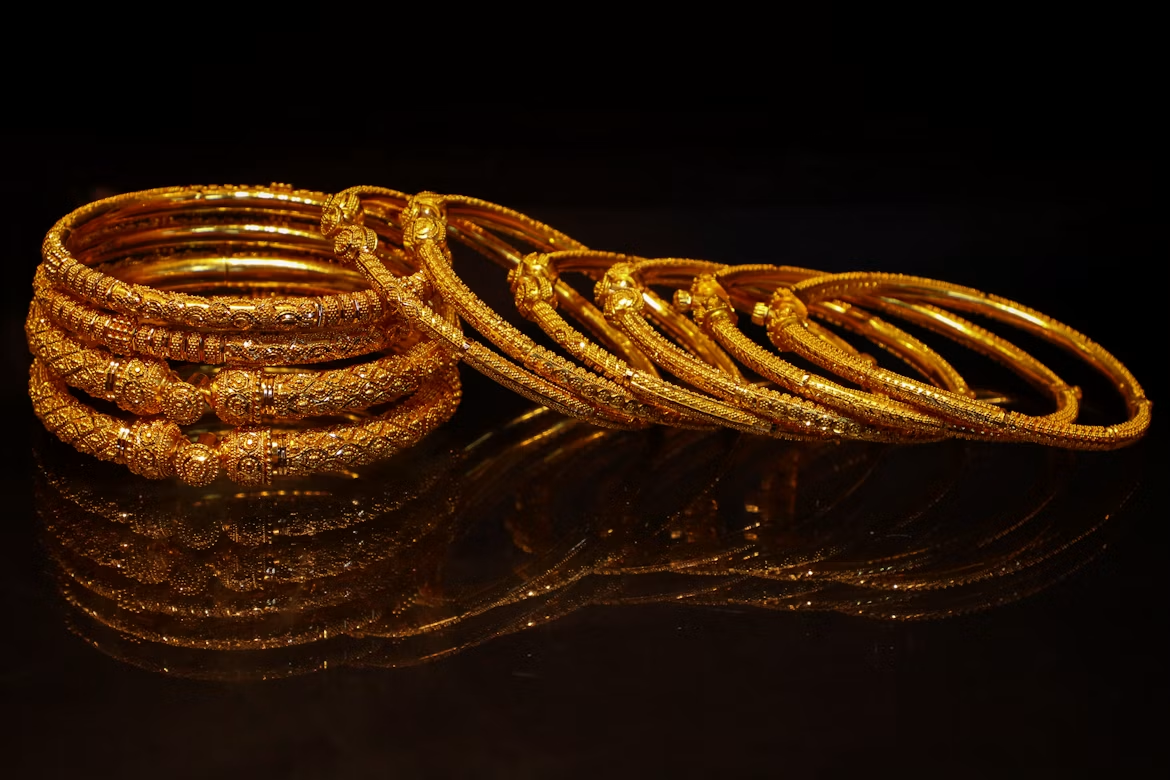
Gold's role as a monetary anchor and portfolio hedge has rarely been more visible than in the first quarter of 2026. On February 7, Reuters reported that the People's Bank of China expanded its bullion reserves for the 15th straight month, bringing holdings to 74.19 million fine troy ounces and their dollar value to $369.58 billion from $319.45 billion the prior month. That accumulation, which resumed after a pause in 2024, unfolds against a backdrop of elevated bullion prices. Spot gold briefly touched $5,600 per ounce before settling near $4,960, reflecting central banks' broader shift toward non-dollar assets. For equity investors, the headline is clear: official-sector buying and safe-haven demand are structural tailwinds that favor producers with low costs, high grades, and visible growth pipelines. Serabi Gold, a United Kingdom-listed miner with operations concentrated in Brazil's Para State, fits that profile. The company's Palito Complex has delivered steady 30,000 to 40,000-ounce annual output for two decades, and its Coringa acquisition positions Serabi to exceed 60,000 ounces per year by 2026 while maintaining all-in sustaining costs below $1,250 per ounce.
The Serabi Story: Two Decades of Brazilian Gold Production
Serabi Gold operates in the Tapajós mineral province, a 90,000-square-kilometer belt in northern Brazil that has yielded an estimated 30 million ounces of artisanal gold yet hosts only 7 million ounces of defined hard-rock resources. The company's flagship Palito Complex comprises the Palito and São Chico underground mines, a 650-tonne-per-day carbon-in-pulp plant, and an ore-sorting system commissioned in 2020. Over the past decade Serabi has replaced depletion through brownfield drilling, lifting Palito's measured-and-indicated resource to 378,000 ounces at 10.1 grams per tonne and its inferred inventory to 154,000 ounces at 7.0 grams per tonne as of October 2023. In November 2023 management acquired the Coringa project, located 340 kilometers south along a newly paved federal highway, for $22 million. Coringa's measured-and-indicated resource stands at 179,000 ounces at 7.0 grams per tonne, with a further 271,000 ounces inferred at 5.8 grams per tonne, according to an April 2024 technical report.
Management's strategy unfolds in three phases. Phase one, already underway, targets 60,000 ounces per year by 2026 through incremental underground development at Palito and the ramp-up of Coringa trucking. Phase two envisions a consolidated 1.5-million to 2.0-million-ounce resource base by late 2026, supported by a $9 million exploration program that includes 30,000 meters of diamond drilling across brownfield and greenfield targets. Phase three contemplates a capacity expansion beyond 100,000 ounces annually, either via a Palito plant debottleneck or a dedicated Coringa mill, with a preliminary economic assessment slated for 2027. As of March 31, 2025, Serabi held $26.5 million in cash against $5.4 million of debt, providing a financial cushion to self-fund near-term growth without equity dilution.
Growth Engine: How Coringa Unlocks 60,000 Ounces by 2026
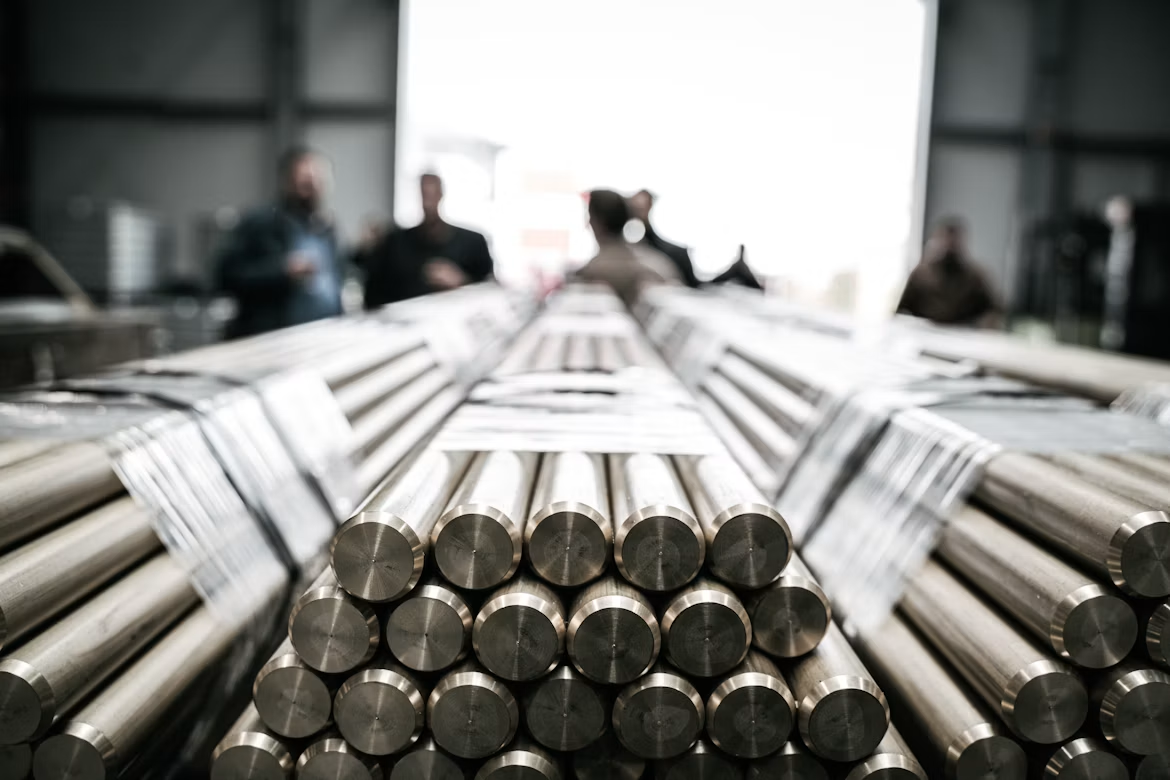
Coringa's transition from exploration to production is the primary catalyst for Serabi's ounce growth. In December 2024 the company commissioned a Comex color-and-density ore sorter at Coringa, replicating the success of a similar unit at Palito that since 2020 has processed 87,442 tonnes of development ore, rejecting 75,939 tonnes of waste and yielding 11,503 tonnes of concentrate grading 9.9 grams per tonne. The ore sorter exploits Coringa's stark visual contrast between barren host rock and quartz-sulfide mineralization, achieving a mass-rejection rate near 60 percent and an upgrade factor of 1.59 times. By removing waste on site, Serabi lowers trucking costs, extends Palito's mill capacity, and reduces tailings volume.
Mike Hodgson, CEO and Director, Serabi Gold mentioned:
"Coringa's ore-sorting technology is a game-changer for us. By upgrading material at site before trucking 340 kilometers, we're able to leverage our existing Palito infrastructure and avoid the capital intensity and permitting timeline of building a new mill. This approach maximizes shareholder value while de-risking our growth profile."
The 2024 preliminary economic assessment assumes an 11-year mine life producing 363,108 ounces at an all-in sustaining cost of $1,241 per ounce, generating a post-tax net present value at 5 percent of $184 million and an internal rate of return above 40 percent at a $2,100 gold price. Sensitivity analysis shows robust economics across a range of assumptions: even at $1,800 gold the project delivers positive free cash flow, while at current spot prices near $4,960 the economics are transformational. Underground development at Coringa employs shrinkage stoping, a low-cost method suited to narrow, high-grade veins. Initial production in July 2022 validated geological models and metallurgical assumptions, and subsequent drilling has extended mineralization below the 250-meter depth tested in the pre-acquisition program. Management expects Coringa to contribute approximately 18,000 ounces in 2025, rising to more than 30,000 ounces in 2026 as additional stopes are commissioned and trucking logistics mature.
Why Central Bank Buying Matters for Your Gold Stock Portfolio
China's 15-month gold-buying streak, reported by Reuters on February 7, underscores a structural shift in reserve management that extends beyond Beijing. Central banks worldwide added 1,136 tonnes in 2022, 1,037 tonnes in 2023, and 1,045 tonnes in 2024, reversing decades of net selling and signaling a preference for tangible assets amid concerns over currency debasement, geopolitical fragmentation, and sovereign-debt sustainability. The People's Bank of China lifted its reported reserves by 40,000 fine troy ounces, approximately 1.24 tonnes, in January 2026, a modest monthly increment that nonetheless contributed to a $50.13 billion jump in the dollar value of holdings as gold prices rallied from $319.45 billion in December 2025 to $369.58 billion in January 2026. That dynamic of rising tonnage and rising prices compounds the strategic value of reserves and incentivizes further accumulation.
The backdrop for central-bank buying is twofold. First, geopolitical uncertainty, including trade tensions, regional conflicts, and contested elections, has elevated risk premia across asset classes, driving investors toward gold as a portfolio stabilizer. Second, monetary policy remains in flux: while some central banks have paused rate hikes or initiated cuts, real interest rates remain below long-term historical averages, reducing the opportunity cost of holding non-yielding bullion. Gold's surge toward $5,600 per ounce reflected speculative momentum following major U.S. central bank news, though the subsequent retreat to $4,960 suggests profit-taking rather than a fundamental shift. Physical demand in China showed mixed signals: consumption declined for the second consecutive year in 2025, yet safe-haven demand for bars and coins rose sharply, offsetting some jewelry demand declines.
For gold producers, elevated and stable prices translate directly into operating leverage. Serabi's 2024 all-in sustaining cost of $1,700 per ounce implies a cash margin near $3,260 at current spot, compared with $400 per ounce when gold traded at $2,100 during the preliminary economic assessment. That margin expansion flows through to free cash flow, which in turn funds exploration, debt reduction, and shareholder returns. In the first quarter of 2025 the company reported earnings before interest, tax, depreciation, and amortization of $12.4 million on production of approximately 11,000 ounces, an annualized run rate consistent with guidance and supportive of a $50 million EBITDA target for the full year at prevailing metal prices.
The Numbers That Matter: Valuation Gap & Re-Rating Triggers
Serabi's market capitalization of approximately $174 million and enterprise value near $153 million position the stock at a meaningful discount to peers on multiple metrics. The company trades at 0.6 times consensus net asset value, below the 0.7-times group median for sub-100,000-ounce producers, and at 2.2 times estimated 2025 enterprise value to EBITDA, compared with a peer average of 3.2 times. Free-cash-flow yield, projected at 22 percent for 2025 based on broker models, ranks among the highest in the small-cap gold cohort, yet the shares have lagged the sector's rally.
At $4,960 gold and $1,250 all-in sustaining costs, Serabi generates roughly $3,700 of cash margin per ounce. On 45,000 ounces of 2025 production, the midpoint of guidance, that translates to $166 million of pre-tax operating cash flow, or about $140 million after corporate costs, taxes, and sustaining capital. Subtracting $9.5 million of underground development and $9 million of exploration leaves $120 million of discretionary cash, equivalent to 69 percent of enterprise value. Even conservative assumptions of $4,000 gold, 40,000 ounces, and $1,400 costs yield free cash flow exceeding $80 million, or more than half the company's equity value.
Catalysts for a valuation re-rating are both near-term and medium-term. In the near term, quarterly production reports and cost updates will confirm the Coringa ramp is on track and that group output is trending toward 60,000 ounces. Approval of Coringa's installation license would remove a key permitting overhang and de-risk the growth narrative. Exploration results from São Domingos, Matilda, and the Mato Velho target have the potential to add high-grade ounces outside the current resource base, extending mine life and supporting phase-three expansion studies.
The Investment Thesis for Gold Producers in a High-Price Environment
- Allocate 5 to 10 percent of a diversified mining portfolio to sub-100,000-ounce producers with near-term growth, targeting 50 percent upside if gold holds above $4,500.
- Prioritize companies with all-in sustaining costs below $1,300 per ounce, ensuring positive free cash flow even if prices retreat to $3,000.
- Favor jurisdictions with stable mining codes and favorable tax regimes; Brazil's 15.25 percent effective rate reduces political and operational risk.
- Seek operators that self-fund expansion through retained earnings, avoiding equity dilution that erodes per-share value in a rising gold environment.
- Monitor central-bank gold purchases as a leading indicator of sustained physical demand; the World Gold Council reported 1,045 tonnes of official-sector buying in 2024.
- Consider ore-sorting technology as a differentiator; companies that can upgrade feed grade and extend mill capacity without major capital gain competitive advantage.
China's unbroken 15-month streak of gold buying, adding 40,000 fine troy ounces or 1.24 tonnes in January 2026 alone and lifting the dollar value of reserves by $50.13 billion, is more than a headline. Combined with 1,136 tonnes of central-bank purchases in 2022, 1,037 tonnes in 2023, and 1,045 tonnes in 2024, the resulting price environment, with spot near $5,000 per ounce and central-bank demand providing support, offers a rare window for gold producers to generate transformational free cash flow. Serabi Gold, a Brazil-focused miner with a 20-year operating history and a de-risked expansion project, embodies the investment case. With an enterprise value below $160 million, Serabi trades at a discount to peers despite offering comparable margins and faster growth. As Coringa ramps and exploration adds high-grade discoveries, the company is positioned to re-rate toward sector multiples, delivering equity returns that compound the leverage inherent in a rising gold price.
TL;DR
China's central bank bought gold for the 15th consecutive month, adding 1.24 tonnes in January 2026 and lifting reserve values by $50.13 billion. Serabi Gold, a Brazil-based producer targeting 60,000 ounces per year by 2026, trades at a discount to peers despite low costs, high grades, and a de-risked growth project at Coringa. With gold near $5,000 per ounce and all-in sustaining costs below $1,250, the company generates robust free cash flow and offers re-rating upside.
FAQs (AI-Generated)
Sustained central-bank purchases of 40,000 ounces or 1.24 tonnes added in January 2026 signal structural demand and provide a price floor, supporting margins for low-cost producers like Serabi.
Management guides 44,000 to 47,000 ounces for the full year, rising to more than 60,000 ounces in 2026 as Coringa ramps.
An on-site ore sorter pre-concentrates run-of-mine material at a 1.59x upgrade factor, which is then trucked 340 kilometers to the Palito processing plant.
The company reported $1,700 per ounce for 2024, with Coringa's steady-state AISC projected at $1,241 per ounce in the 2024 preliminary economic assessment.
At 0.6 times price-to-net-asset-value and 2.2 times EV/EBITDA, Serabi trades below the sub-100,000-ounce producer median of 0.7 times and 3.2 times, respectively.
Analyst's Notes





Subscribe to Our Channel

.png)
Stay Informed






















