Energy Fuels: America's Critical Minerals Leader


.webp)
Energy Fuels emerges as leading US producer of uranium and rare earths, backed by $700M raise and diversified critical mineral portfolio across three continents.
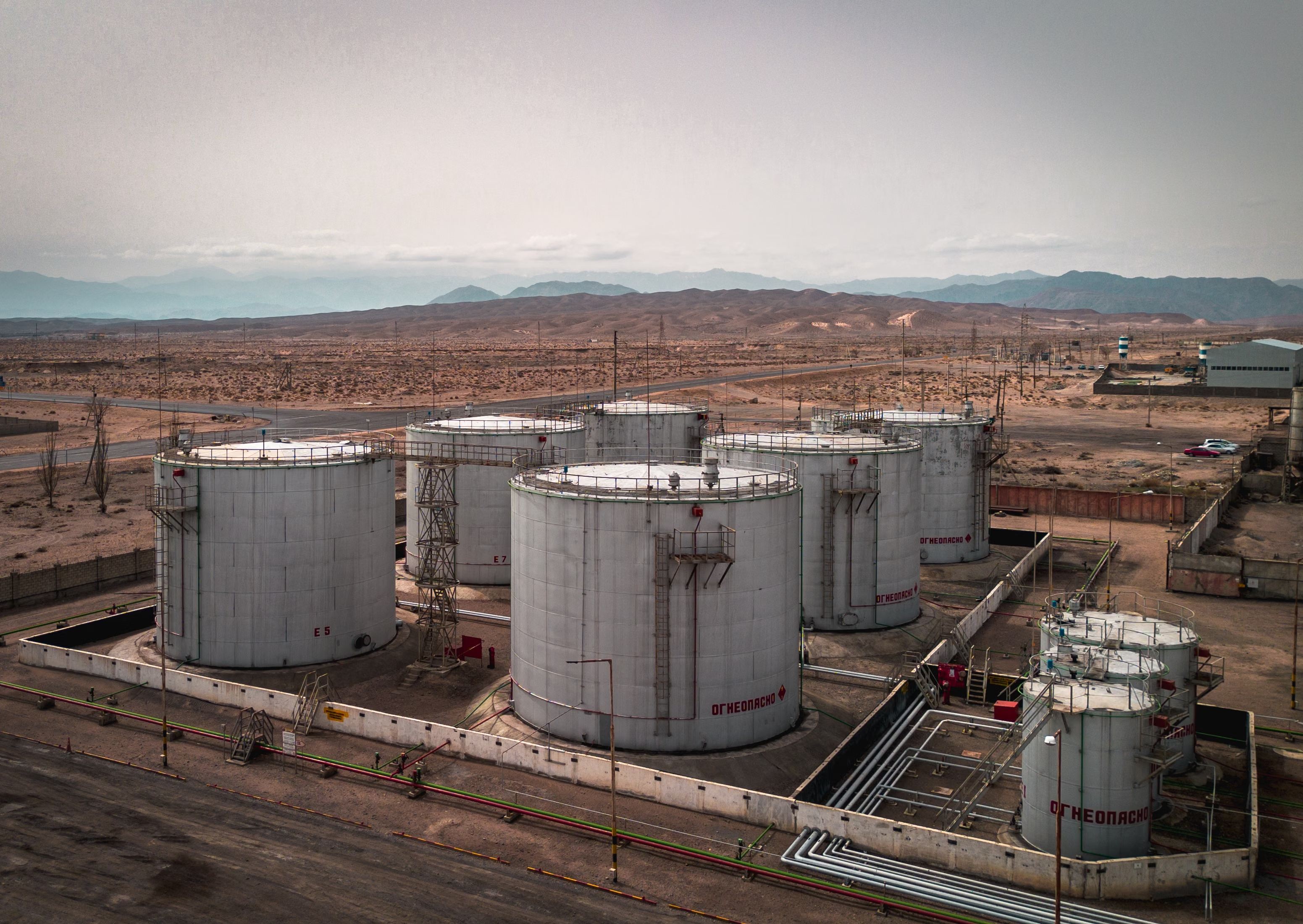
- Energy Fuels operates the White Mesa Mill in Utah, the only conventional uranium processing facility in the United States with licensed capacity exceeding 8 million pounds of U3O8 annually, and the sole US facility capable of processing monazite for rare earth oxide production.
- The company secured $700 million through a convertible senior notes offering in October 2025, oversubscribed by more than 7x, providing capital for White Mesa Mill Phase 2 expansion and Donald Project development with an effective pre-tax yield of just 2.1%.
- Energy Fuels is actively producing separated neodymium-praseodymium (NdPr) oxide, with commercial validation by major manufacturers including POSCO, and plans to commence commercial production of critical heavy rare earth oxides (dysprosium and terbium) by Q4 2026.
- The company's asset base spans uranium mines in the US, heavy mineral sands projects in Australia, Madagascar, and Brazil, creating multiple pathways to production across complementary critical mineral commodities.
- As of September 30, 2025, Energy Fuels maintained $298.5 million in working capital, with uranium production trending toward 2+ million pounds annually and substantial finished inventory across uranium, vanadium, and rare earth products.
Why Energy Fuels Merits Investor Attention
In an era defined by energy transition, national security concerns, and supply chain resilience, Energy Fuels Inc. (NYSE American: UUUU, TSX: EFR) has positioned itself at the intersection of multiple strategic commodity themes. The Denver-based company represents one of the few vertically integrated critical minerals producers in North America, with operating assets spanning uranium production, rare earth element processing, and heavy mineral sands development.
The company's transformation goes beyond uranium production to become what management describes as "a globally significant critical mineral company based in the US." This evolution comes as Western governments actively seek to reduce dependence on Chinese rare earth supply chains and rebuild domestic uranium production capacity. What distinguishes Energy Fuels from exploration-stage competitors is its operational status, with the White Mesa Mill processing uranium-bearing materials for over four decades and recently adding commercial rare earth oxide separation capabilities.
Company Overview: A Diversified Critical Minerals Platform
Energy Fuels operates a portfolio spanning three primary commodity groups: uranium and vanadium, rare earth elements, and heavy mineral sands containing titanium and zirconium minerals. The operational foundation rests on the White Mesa Mill, which management characterizes as the only operating conventional uranium mill in the USA and the only US facility able to process monazite for rare earth oxide production.
Current uranium operations include two producing mines: the Pinyon Plain Mine in Arizona, potentially the highest-grade uranium mine in US history, and the La Sal Complex in Utah, comprising several mines along an 11-mile trend. These operations generated sales of 240,000 pounds of U3O8 at a realized price of $72.38 per pound during the third quarter of 2025.
The development pipeline includes three large-scale uranium projects with combined resources approaching 70 million pounds: Sheep Mountain in Wyoming (fully permitted), Roca Honda in New Mexico (designated as a "Fast-41 Covered Project" by the Trump Administration), and Bullfrog in Utah (pre-permitting stage). The company also maintains the Nichols Ranch in-situ recovery operation in Wyoming on standby.
Strategic Rare Earth Initiative: Capturing Value in Critical Magnets
Energy Fuels' most transformative initiative involves rare earth elements, particularly magnetic rare earths essential for electric vehicle motors, wind turbines, and defense applications. The company's approach centers on processing monazite, a mineral concentrate containing 50-60% total rare earth oxides with higher concentrations of valuable neodymium, praseodymium, and heavy rare earths compared to other feedstocks.
The White Mesa Mill currently operates Phase 1A rare earth processing with capacity to handle up to 10,000 tonnes per annum of monazite, producing up to 1,000 tonnes annually of separated NdPr oxide. The company has achieved commercial validation, with the corporate presentation confirming qualification by POSCO and production of commercial-scale rare earth permanent magnets.
"Energy Fuels' White Mesa Mill is the only U.S. facility with the commercial capacity to process monazite for production of high-purity 'light' and 'heavy' REE oxides."
The company is actively piloting separation of heavy rare earth oxides, having produced approximately 29 kilograms of dysprosium oxide at 99.9% purity through September 2025, with 1 kilogram of terbium oxide expected in December 2025. Management plans commercial US production of heavy REE oxides as early as Q4 2026 for dysprosium, terbium, and potentially samarium oxides. At October 31, 2025 pricing, NdPr oxide trades at $87,500 per tonne, dysprosium oxide at $850,000 per tonne in Europe, and terbium oxide at $3.6 million per tonne in Europe.
Phase 2 Expansion: Scaling Production Capacity
Energy Fuels' most significant near-term catalyst is the planned Phase 2 expansion of rare earth processing capacity at the White Mesa Mill. The company expects to release a feasibility study for this expansion before year-end 2025, detailing plans for dedicated monazite crack and leach circuits for simultaneous production of REE oxides plus U3O8.
The Phase 2 configuration targets annual production capacity of up to 6,000 tonnes of NdPr oxide, 275 tonnes of dysprosium oxide, 80 tonnes of terbium oxide, and potentially other rare earth oxides based on customer requirements. At current market prices, this production profile would generate approximately $986 million in annual revenue from rare earth oxides alone. The company has initiated permitting for Phase 2 with planned commissioning in 2028.
Financing for this expansion received a significant boost in October 2025 when Energy Fuels successfully closed a $700 million convertible senior notes offering, oversubscribed by more than 7x with favorable terms including a 0.75% annual coupon rate, 32.5% conversion premium ($20.34 per share), and capped call features effectively increasing the conversion price to $30.70 per share. The net proceeds of approximately $625 million are earmarked for White Mesa Mill Phase 2 expansion and Donald Project development.
Securing Monazite Feedstock: The Heavy Mineral Sands Strategy
Energy Fuels' rare earth production strategy relies on securing reliable supplies of monazite concentrate sourced as a byproduct from heavy mineral sands mining operations. The company emphasizes that importing high-grade monazite sand byproduct from HMS mines globally is a lower-cost way to produce separated REE oxides versus primary REE production.
The most advanced HMS-sourced monazite supply comes from the Donald Project in Australia, where Energy Fuels is earning up to a 49% joint venture interest with Astron Corporation while securing 100% of the monazite produced. The Donald Project has received conditional support of A$80 million in development financing from Export Finance Australia, with total project funding estimated at A$520 million. Management expects a final investment decision as early as Q1 2026 with potential monazite deliveries to White Mesa Mill by late 2027. The Donald Project is particularly valuable for its exceptional levels of heavy REE oxides, including dysprosium, terbium, and samarium.
Energy Fuels also controls the Toliara Project in Madagascar, considered one of the best HMS development opportunities globally with additional valuable REE monazite byproduct. The project features a 38-year mine life with significant expansion potential, though recent political unrest requires monitoring. An updated feasibility study is expected before year-end 2025.
The company's third HMS project, Bahia in Brazil, is 100%-owned with sonic drilling underway and a resource estimate expected in 2025. Bahia could potentially supply 3,000-5,000 tonnes per annum of monazite to White Mesa Mill for decades, translating to roughly 300-500 tonnes annually of NdPr oxide plus dysprosium and terbium. Energy Fuels also maintains a current offtake agreement with Chemours Company, expected to deliver 500-2,000+ tonnes per annum of monazite.
Uranium Business: Foundation of Cash Generation
While rare earth elements represent Energy Fuels' highest-growth opportunity, the uranium business provides near-term cash generation supporting company operations. The September 30, 2025 financial update shows uranium sales of 240,000 pounds at an average realized price of $72.38 per pound during Q3 2025, with contract deliveries of 300,000 pounds planned for full-year 2025, increasing to 620,000-880,000 pounds in 2026.
The Pinyon Plain Mine in Arizona represents Energy Fuels' highest-grade uranium asset, with management expecting to mine over 2 million pounds of U3O8 in 2026 at costs of approximately $23-30 per pound. The presentation notes substantial potential growth in resources, suggesting multi-year production potential. The La Sal Complex in Utah is actively mining and shipping ore to the mill for processing and sale in 2025 and beyond.
Energy Fuels has secured four long-term uranium sales contracts featuring fixed and market price components, floors and ceilings, and inflation escalation, with deliveries scheduled from 2025 through 2030. The company emphasizes its status as a trusted partner for US nuclear utilities. Cost-of-goods sold on U3O8 sales should trend lower starting in Q1 2026 as low-cost Pinyon Plain ore is processed, suggesting improving margins ahead.
Financial Position & Operational Metrics
Energy Fuels entered the fourth quarter of 2025 from a position of financial strength, reporting $298.5 million in working capital as of September 30, 2025, before adding the approximately $625 million in net proceeds from the October convertible notes offering. Total assets reached $758.3 million as of quarter-end.
Inventory positions as of September 30 included 485,000 pounds of finished U3O8, 1.62 million pounds of uranium in stockpile and work-in-progress, 905,000 pounds of finished vanadium pentoxide, 37,000 kilograms of finished separated NdPr oxide, and 9,000 kilograms of finished high-purity, partially separated mixed rare earth elements. The company calculated its finished product inventory worth approximately $45.3 million at current commodity prices.
Operational guidance indicates uranium production trending toward 2+ million pounds U3O8 per year currently, with potential to scale to 4-6 million pounds annually as development projects advance. For Q4 2025, management expected contract sales of 160,000 pounds of U3O8 with potential for additional spot market sales.
Investment Thesis for Energy Fuels
- Phase 2 expansion could deliver $986 million annual REE revenue by 2029 at current prices, with capital funding secured through October 2025 convertible notes offering.
- Low-cost Pinyon Plain ore ($23-30/lb production cost) entering mill feed starting Q1 2026 should drive improving COGS against long-term contract prices with floors, ceilings, and inflation escalation through 2030.
- Donald FID expected Q1 2026 and Toliara feasibility before year-end 2025 provide multiple pathways to secure 40,000+ tonnes annual monazite feedstock by late 2020s.
- US-based rare earth separation and uranium production directly address Department of Defense supply chain priorities, creating potential for government offtake agreements or production incentives.
- Combined $900+ million liquidity provides financial runway through multiple development phases without near-term dilution risk given capped call structure.
- Exposure to uranium, magnetic rare earths, heavy rare earths, titanium, and zirconium reduces single-commodity price risk while capturing thematic premium across energy transition and defense manufacturing.
Energy Fuels presents a multifaceted investment case centered on domestic critical mineral production at a time of heightened policy support and structural supply chain reconfiguration. The company has successfully transitioned from uranium-only producer to diversified critical minerals platform while maintaining the financial resources to execute its development pipeline through the secured $700 million convertible debt financing.
The investment thesis rests on three pillars: near-term uranium cash generation at improving margins as low-cost Pinyon Plain ore flows through the mill; commercial rare earth oxide production scaling from 1,000 tonnes NdPr annually today to 6,000+ tonnes by 2028-2029, supplemented by high-value heavy rare earth production; and optionality on heavy mineral sands projects that could secure decades of monazite feedstock while generating additional revenue from titanium and zirconium products.
Investors should monitor several key catalysts in coming quarters: Phase 2 feasibility study release before year-end 2025, Donald FID and financing announcement in Q1 2026, Toliara feasibility study and FID timing, heavy rare earth commercial production commencement in Q4 2026, and uranium production trends as Pinyon Plain ramps toward 2+ million pounds annually. The stock's performance will likely track progress on these milestones alongside broader uranium and rare earth price trends, with particular sensitivity to any US government policy initiatives supporting domestic critical mineral supply chains.
TL;DR
Energy Fuels operates the only US facility producing both uranium and separated rare earth oxides, with $900+ million in liquidity to fund White Mesa Mill Phase 2 expansion (6,000 tpa NdPr capacity by 2028) and Donald HMS project development. Uranium production approaches 2 million pounds annually at improving margins, while rare earth business scales from current 1,000 tpa NdPr to add heavy rare earths (Dy/Tb) by Q4 2026. Three HMS projects (Donald, Toliara, Bahia) provide pathway to 40,000+ tpa monazite feedstock securing long-term rare earth production. Strong policy alignment with US government critical mineral supply chain priorities. Key near-term catalysts include Phase 2 feasibility (before YE 2025), Donald FID (Q1 2026), and heavy REE commercialization (Q4 2026).
FAQs (AI-Generated)
Energy Fuels operates the White Mesa Mill, the only conventional uranium processing facility in the US, capable of processing multiple feed types including alternative feed materials, enabling rare earth co-production unavailable to in-situ recovery competitors.
The company adapted existing White Mesa Mill uranium processing circuits to handle monazite cracking and leaching, then installed solvent extraction capacity producing commercially validated NdPr oxide at 1,000 tonne annual capacity, with POSCO confirmation enabling rare earth permanent magnet production.
Phase 2 feasibility study releases before year-end 2025, permitting is underway, commissioning targets 2028, reaching 6,000 tpa NdPr and 355 tpa combined Dy/Tb capacity, dependent on monazite feedstock availability from Donald (2027+) and Toliara.
The October 2025 offering features 32.5% conversion premium ($20.34/share) and capped call options effectively raising conversion price to $30.70/share, with 0.75% coupon and 2.1% all-in yield minimizing cash interest burden during development phase.
Uranium production scaling toward 4-6 million pounds annually from expanded mine base; rare earth oxide sales approaching $986 million annually at current prices from 6,000+ tpa NdPr plus heavy REE production; and potential titanium/zirconium/radium revenue streams from HMS operations and medical isotope development.
Analyst's Notes





Subscribe to Our Channel







.jpg)

Stay Informed