




Federal Permitting Sequence Shapes P2 Gold's Path to 2029 Gabbs Production


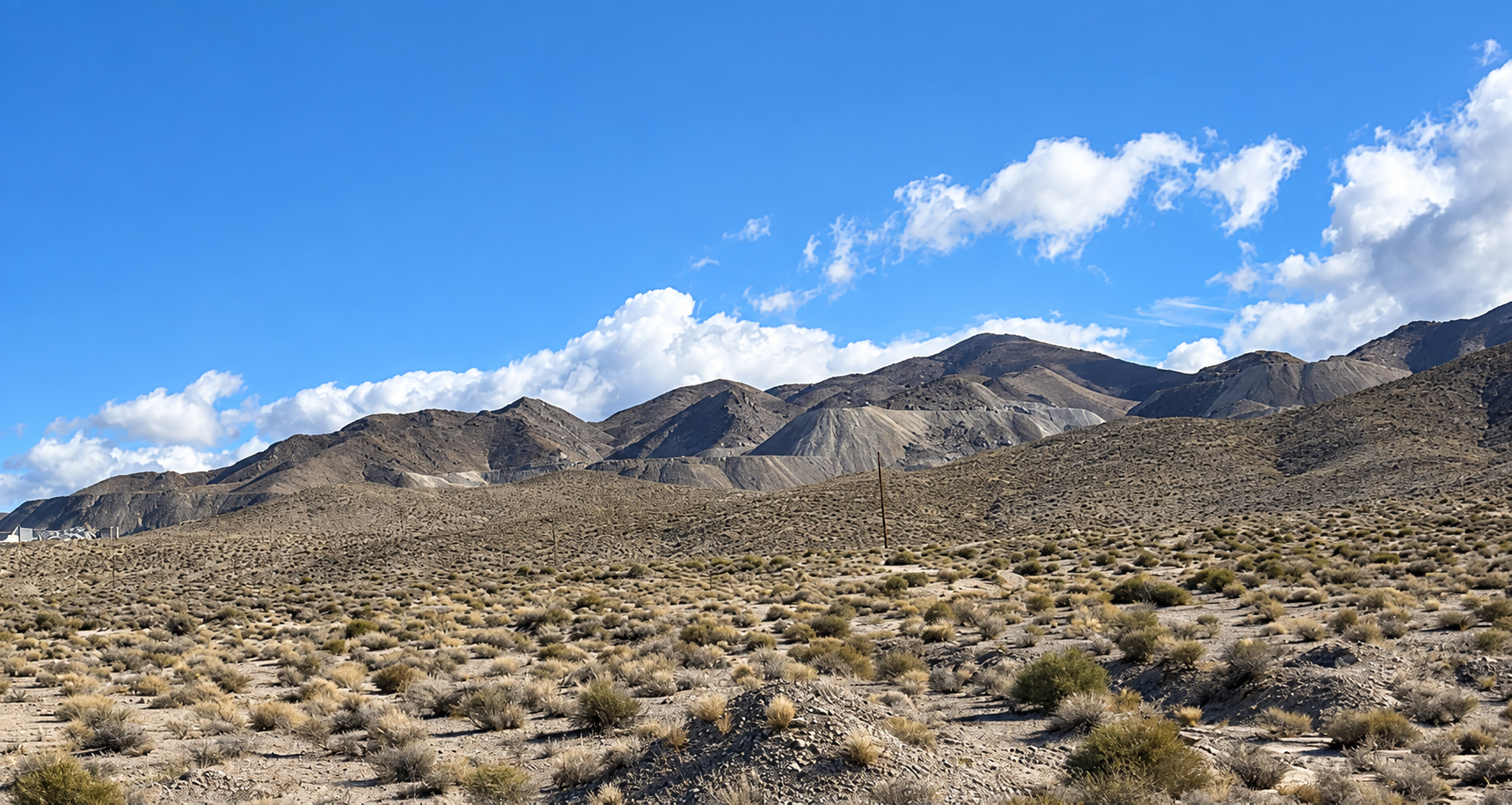
P2 Gold's Gabbs project enters a federal permitting sequence, with 3 first-quarter 2027 milestones shaping the path to 2029 gold-copper production.
- P2 Gold has submitted a draft Mining Plan of Operations (MPO) for its Gabbs gold-copper project in Nevada, retained a National Environmental Policy Act (NEPA) document contractor, and has baseline needs assessment work in progress.
- 4 federal steps remain outstanding: formal submission of the MPO; a Bureau of Land Management determination of whether an EA or an EIS is required; submission of that document; and a Record of Decision.
- The company is targeting 3 milestones in the first quarter of 2027: MPO submission, a filing for acceptance under Alternative Arrangements for NEPA, and the feasibility study.
- The company's development schedule makes the construction start contingent on permitting, with production targeted for 2029.
- Arimetco prepared a pre-feasibility study and an MPO at Gabbs in 1995, and the site has paved highway access with power and water on site.
The Permitting Sequence Now Sets the Pace
P2 Gold (TSXV: PGLD | OTCQB: PGLDF) has drilled 92 reverse circulation holes at its Gabbs project in Nye County, Nevada, since October 2025, and is targeting an updated Mineral Resource estimate (MRE) in the fourth quarter of 2026 followed by a feasibility study (FS) in the first quarter of 2027. The company states that Gabbs is on track for production in less than 3 years and is targeting first gold and copper output in 2029. P2 Gold attaches one condition to that date in its development schedule: construction start is contingent on permitting.
With construction contingent on permitting, the federal regulatory sequence has become a deciding factor in the path toward P2 Gold's 2029 Gabbs production target. The project lies on 827 Bureau of Land Management (BLM) lode mining claims and 1 patented claim, covering approximately 68.9 square kilometers. P2 Gold reports permitting progress on 2 parallel tracks: the Mining Plan of Operations (MPO) and the review required under the National Environmental Policy Act (NEPA).
Where Gabbs Stands in the Federal Permitting Process
On the MPO track, P2 Gold has submitted a draft plan, and 2 baseline workstreams are in progress: the baseline needs assessment reports and the baseline needs assessment resources. Formal submission of the MPO is the one item on this track that the company lists as outstanding.
On the NEPA track, the company has retained a NEPA document contractor. 3 steps remain open: a BLM determination on whether an EA or an EIS is required, submission of the EA or EIS, and a BLM Record of Decision (ROD).
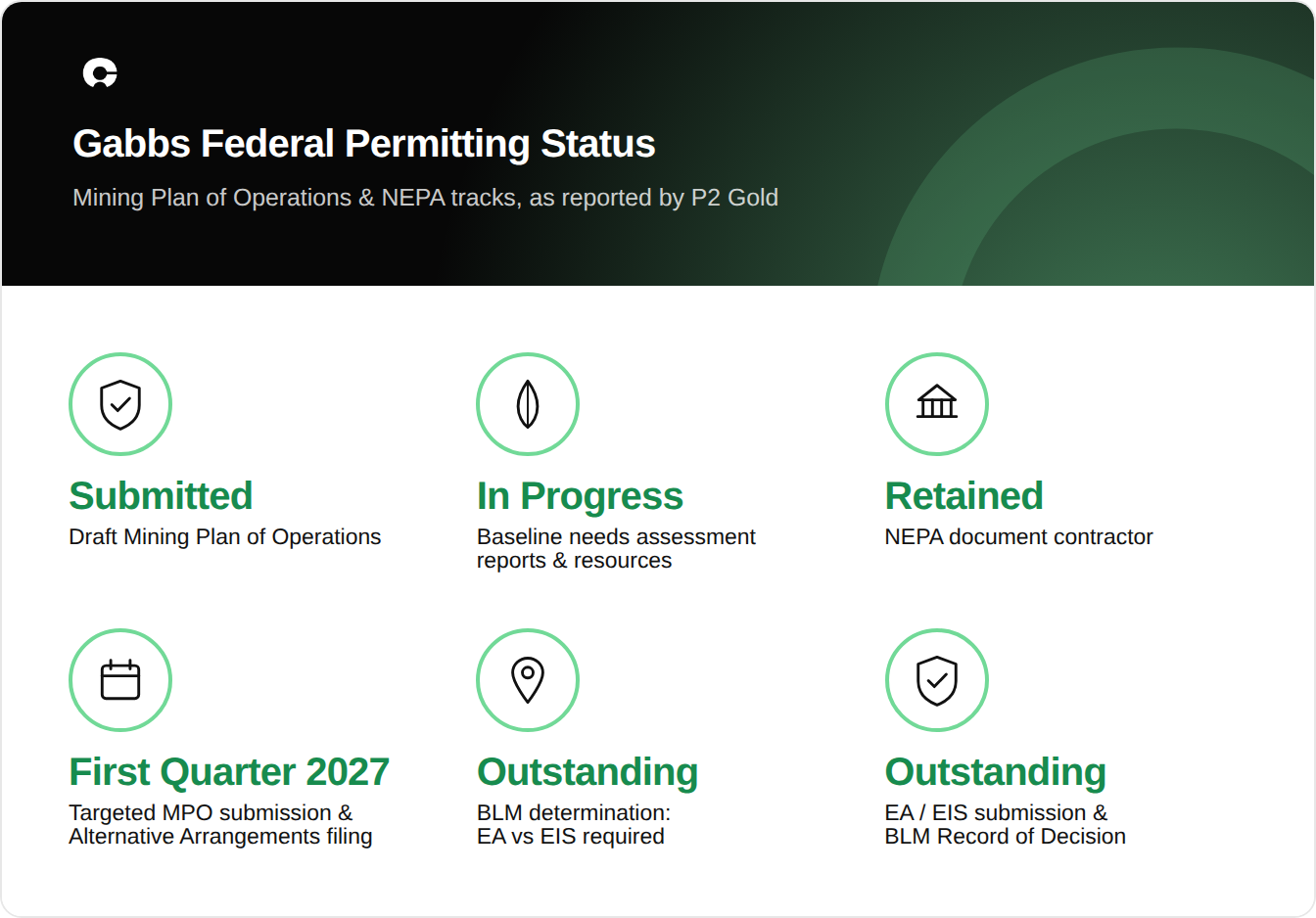
The outstanding items divide into 2 groups. MPO submission and EA or EIS submission are company actions. The EA-versus-EIS determination and the ROD are BLM decisions. Every item marked as done or underway is preparatory work within P2 Gold's control, while both agency decisions still lie ahead.
First Quarter 2027: 3 Milestones in 1 Quarter
P2 Gold lists 3 catalysts for the first quarter of 2027: submission of the MPO, a filing for acceptance under Alternative Arrangements for NEPA, and the FS. On the company's schedule, the MPO and FS bars both end in early 2027, as does the water rights transfer. P2 Gold lists the Alternative Arrangements filing as a catalyst but provides no further detail on that pathway.
The first quarter of 2027 follows a fourth quarter of 2026 in which the company is targeting Lucky Strike and Sullivan drill results, metallurgical test results, and the updated MRE. That estimate will form the basis of the FS, so the resource model, the technical study, and the 2 regulatory filings all land within 2 consecutive quarters on the company's timeline.
For the permitting sequence, the MPO submission and the NEPA filing are the 2 company-controlled permitting actions P2 Gold is targeting for that quarter, alongside the FS.
What Still Sits Between the Filings & Construction
Beyond the first-quarter 2027 filings, P2 Gold's permitting checklist lists 3 further open steps: the BLM's EA-versus-EIS determination, submission of the EA or EIS, and the BLM ROD. No dates are attached to these items. The company's development schedule shows environmental studies and permitting extending through 2027, with a hatched extension into the first half of 2028.
Construction appears on that same schedule. The bar is hatched through the first half of 2028, solid through the second half, and hatched again through the first half of 2029. Production is expected to ramp up from the fourth quarter of 2028 through the first quarter of 2029 and be solid from the second quarter of 2029. The company also describes permitting activities as ongoing until construction. The BLM's EA-versus-EIS determination is the first NEPA decision listed and the ROD the last, with construction contingent on permitting.
Permitting also paces expansion drilling. Additional drilling to extend Lucky Strike to the southwest is subject to permitting additional drill pads, and the Gold Ledge and Southwest exploration areas require a plan of operations before drill access.
The FS Is a Parallel Track, Not the Finish Line
The updated MRE will form the basis of the FS, which is advancing on a nominal production rate of 12 million tonnes per year and targeting average annual production of 150,000 ounces of gold and 45 to 50 million pounds of copper. The infill and expansion drilling, 32 holes at Sullivan and 60 at Lucky Strike since October 2025, feeds that estimate.
The 2025 preliminary economic assessment (PEA) is the baseline against which the FS will be measured. At US$2,350 per ounce of gold, US$29 per ounce of silver, and US$4.50 per pound of copper, the PEA outlined an after-tax net present value at a 5% discount rate (NPV5%) of US$942.9 million and an after-tax internal rate of return of 33.8%, on preproduction capital of US$382.7 million. It modeled average annual production of 109,000 ounces of gold and 33 million pounds of copper over a 14.2-year mine life.
According to the company's schedule, detailed engineering begins in late 2026 and continues through 2027, overlapping with the environmental studies and permitting bar. A completed FS defines the project and its economics, but P2 Gold ties the construction start to permitting rather than to the study.
A Previously Studied Site With Existing Infrastructure
Gabbs has been through mine-development studies before. Glamis Gold completed a heap leach bulk sample in 1989, and P2 Gold records a pre-feasibility study and an MPO by Arimetco in 1995. P2 Gold acquired the project in 2021, and the current MPO is its own new submission.
The physical site is already served. The property is accessed via paved Highway 361, approximately 150 miles from Reno, and the company reports that power and water are on site. An engineering study for a grid connection is in progress. In P2 Gold's initial conceptual general arrangement, the process plants, heap leach facility, and dry stack tailings facility lie alongside Highway 361 and Pole Line Road, with the County Line and Paradise Peak mines south of the property boundary.
The Investment Thesis for P2 Gold
- P2 Gold has submitted a draft Mining Plan of Operations for Gabbs, retained a National Environmental Policy Act document contractor, and has baseline needs assessment reports and resources in progress.
- The company is targeting formal submission of the Mining Plan of Operations, a filing for acceptance under Alternative Arrangements for the National Environmental Policy Act, and a feasibility study in the first quarter of 2027.
- The Bureau of Land Management's determination of whether an EA or an EIS is required is the first agency decision in the company's listed sequence, followed by submission of that document and a Record of Decision.
- The company's development schedule makes the construction start contingent on permitting, with production targeted for 2029.
- An updated Mineral Resource estimate, targeted for the fourth quarter of 2026, will form the basis of the feasibility study, which targets 150,000 ounces of gold and 45 to 50 million pounds of copper per year.
- The 2025 preliminary economic assessment outlined an after-tax net present value of US$942.9 million at a 5% discount rate and an after-tax internal rate of return of 33.8% at base-case metal prices.
Gabbs now has a technical study path and a regulatory path advancing in parallel. The technical path reaches its next checkpoint, the feasibility study, in the first quarter of 2027. The regulatory path reaches its filing stage in that same quarter, and the Bureau of Land Management decisions that follow determine when construction can begin, relative to the 2029 production target.
TL;DR
P2 Gold has submitted a draft MPO for Gabbs, retained a NEPA contractor, and has baseline work in progress. In the first quarter of 2027, the company is targeting formal MPO submission, a filing under Alternative Arrangements for NEPA, and the FS. The BLM's EA-versus-EIS determination, the EA or EIS submission, and the ROD follow. The construction start is contingent on permitting, with production targeted for 2029.
FAQs (AI-Generated)
Analyst's Notes





Subscribe to Our Channel








Stay Informed






















