Why P2 Gold's Latest Step-Out Matters More for the Resource Model Than for Any Single Interval



P2 Gold's Lucky Strike step-out extends gold-copper continuity southwest, strengthens resource geometry and underpins the fourth-quarter 2026 resource estimate.
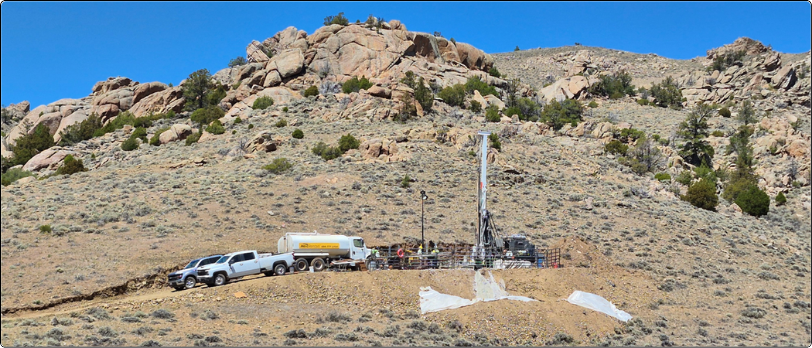
- P2 Gold reported results from eight reverse circulation (RC) drill holes testing the southwest extension of the established Lucky Strike gold-copper corridor.
- One hole intersected 118.87 meters at 0.62 grams per tonne gold and 0.22% copper, including 44.20 meters at 1.12 grams per tonne gold and 0.33% copper.
- A second hole returned 129.54 meters at 0.69 grams per tonne gold and 0.22% copper and ended in mineralization.
- The quartz monzonite host unit appears to thicken toward the southwest, improving the geological constraints needed to model grade and thickness between drill holes.
- P2 Gold has completed 92 RC drill holes since October 2025, supporting a mineral resource estimate (MRE) targeted for the fourth quarter of 2026 and the subsequent feasibility study (FS).
A Continuity Result, Not a Discovery Result
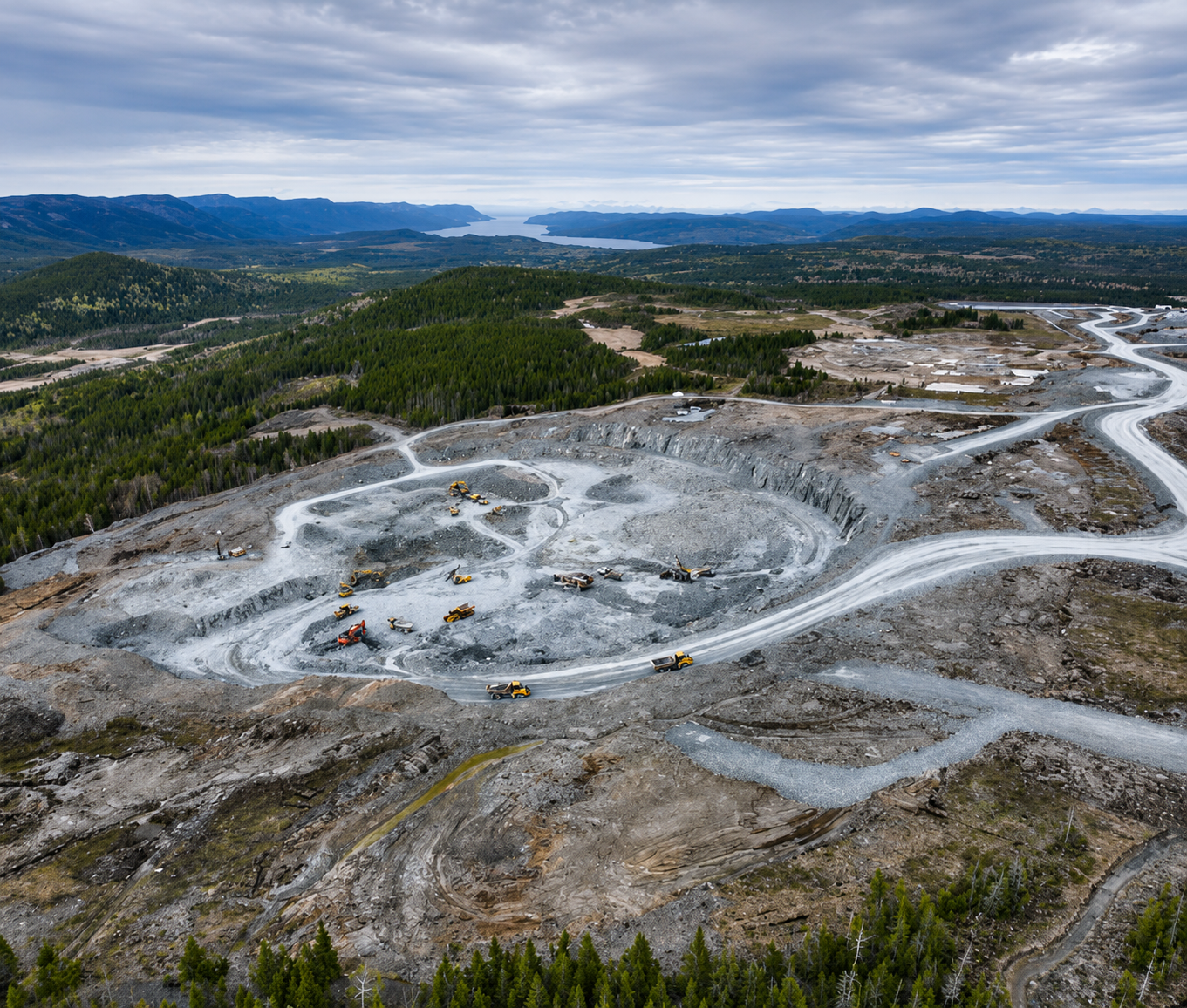
P2 Gold Inc. (TSXV: PGLD | OTCQB: PGLDF) is not reporting a new zone at its Gabbs Project in Nevada. The eight reverse circulation (RC) drill holes at the Lucky Strike Zone tested the southwest extension of a gold-copper corridor the company had already defined. One hole intersected 118.87 meters grading 0.62 grams per tonne gold and 0.22% copper, including a higher-grade core of 44.20 meters at 1.12 grams per tonne gold and 0.33% copper. A second hole intersected 129.54 meters at 0.69 grams per tonne gold and 0.22% copper, including 24.38 meters at 1.12 grams per tonne gold and 0.38% copper, and ended in mineralization, as the release notes explicitly.
A discovery result expands what a company knows exists. A continuity result tests whether a known system holds its grade and thickness as it steps out, which is the input a mineral resource estimate (MRE) depends on.
The Geometry Behind the Number
At Lucky Strike, gold-copper mineralization occurs within and below a tabular quartz monzonite unit, underlain by a pyroxenite footwall; mineralization within the monzonite is gold-dominant, transitioning to copper-gold mineralization in the footwall. The monzonite exceeds 150 meters in thickness at Lucky Strike, and the footwall zone adds a further 20 meters to 60 meters, producing a combined mineralized package greater than 200 meters thick. This step-out shows the monzonite thickening toward the southwest, with the higher-grade corridor turning in the same direction.
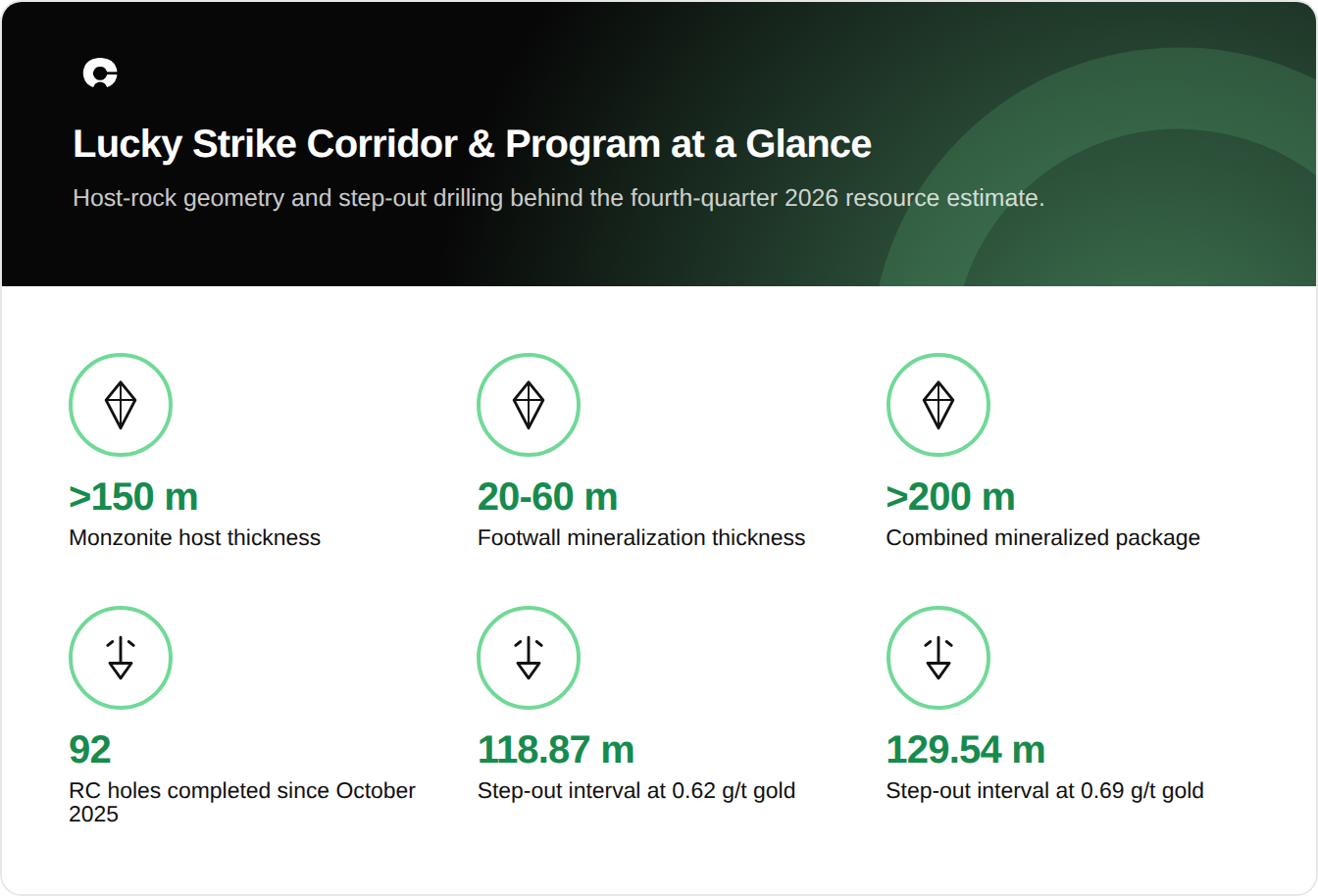
Geometry places the 118.87-meter interval within a single, thickening system whose orientation is becoming better constrained with each pad, rather than treating it as an isolated intercept. A thickening, consistently oriented host unit is the kind of geological setting that typically supports more confidence in projecting grade and thickness between drill holes, though the release does not draw this connection to resource modeling.
The Fourth Quarter 2026 Catalyst Is the Real Deadline
Since starting the program in October 2025, P2 Gold has completed 92 RC drill holes, split 32 at the Sullivan Zone and 60 at Lucky Strike. That drill count is the input, not the output. The company is targeting an updated MRE for Gabbs in the fourth quarter of 2026, which will form the basis of a feasibility study (FS) on placing the project into production. Against that timeline, this release represents one increment of drill density added ahead of a defined catalyst date, rather than a standalone news event.
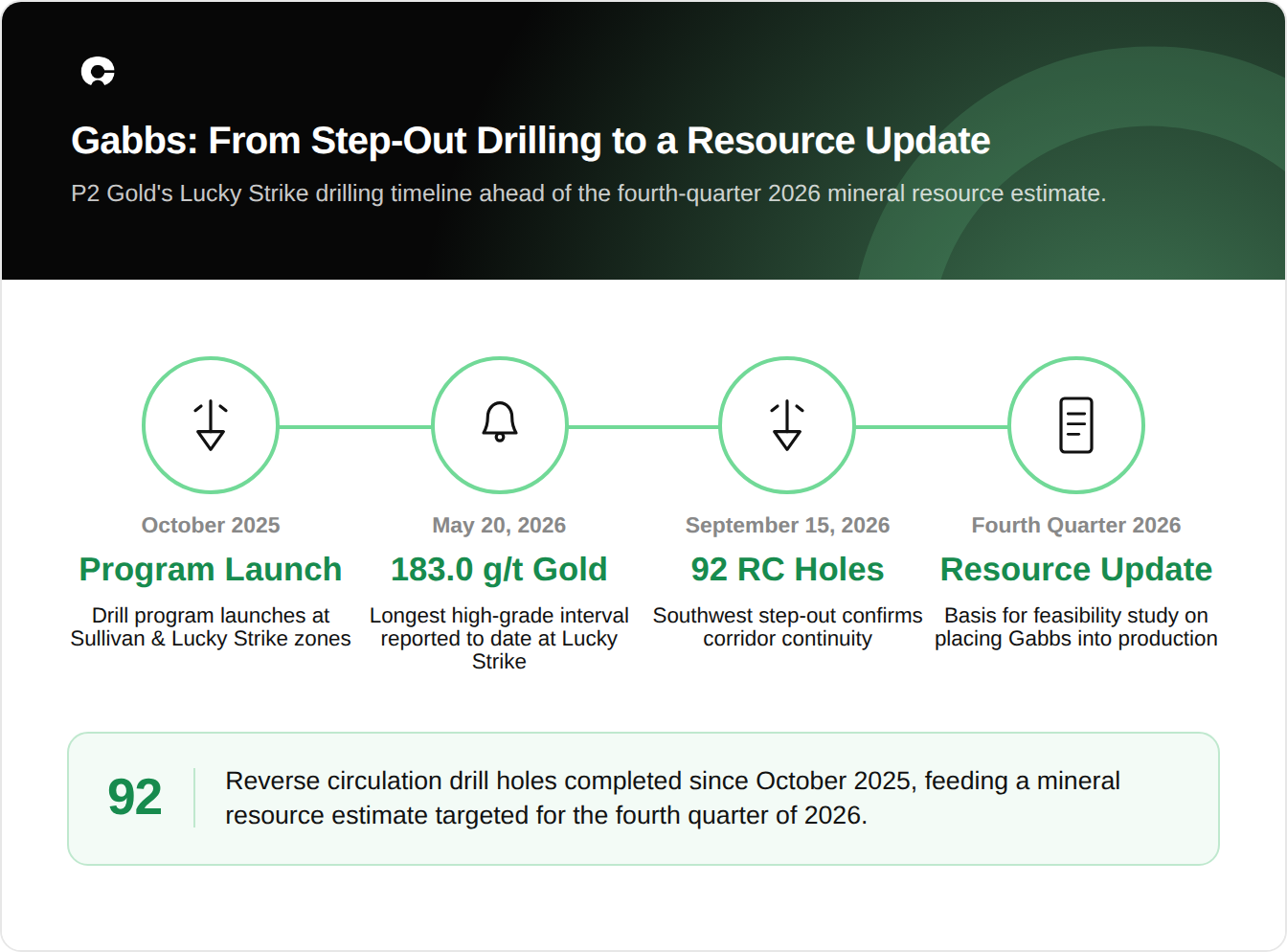
The company's stated sequencing reinforces this: additional drilling in the southwest is planned, focusing on the shallower mineralization in the western half of Lucky Strike, after which drilling will shift to expanding the zone to the northeast and southeast, both of which remain open. The figure that matters most to investors is not any single grade result in this release, but whether the 92 completed holes are building toward a MRE to be delivered on schedule in the fourth quarter of 2026.
Residual Risks Worth Watching
The corridor, described as open to the southwest, northeast, and southeast, cuts both ways: it is the basis for expansion, but it also means the system is not yet fully bounded, and the company itself has stated that additional drilling in those directions has not yet been completed. The release's own forward-looking information disclosure cautions that actual results and the timing of exploration and development activities may differ materially from current expectations, which applies directly to the fourth-quarter 2026 MRE and the FS it is intended to support. Neither the pace of the resource estimate nor its eventual scale is guaranteed by the drill results in this release alone.
Key Takeaway for Investors
This step-out reads as supporting data for P2 Gold's MRE, targeted for the fourth quarter of 2026, rather than as a standalone catalyst. The company has disclosed a thickening, consistently oriented host unit at Lucky Strike, the kind of geometry that would typically support a resource estimate ahead of the FS it is meant to underpin, though the release itself does not characterize the geology in these terms. With 92 RC drill holes completed since October 2025 and the corridor still open on three sides, the near-term question for investors is whether that resource estimate lands on schedule and at a scale consistent with the company's stated production targets, not whether any individual hole in this release set a new grade benchmark. P2 Gold reported on May 20, 2026, that it is one of the longest intervals of high-grade gold and copper encountered to date at Lucky Strike.
FAQs (AI-Generated)
Analyst's Notes





Subscribe to Our Channel





Stay Informed